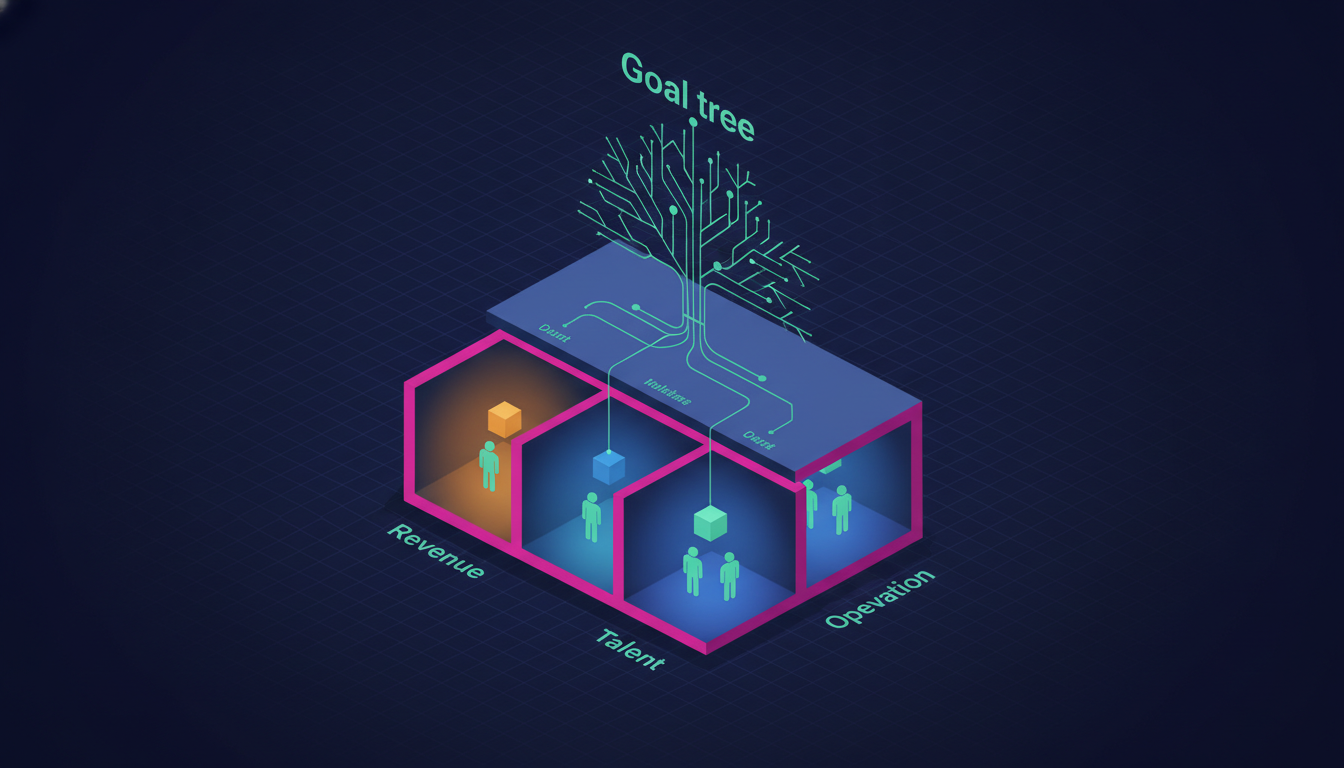
Six days. Five gaps, each with a name.
A strategy that lives in the CEO's head and does not travel. Data in forty places. Pilots that demo well and then die. Prompts that pull everyone toward the same average answer. And the question nobody in the room will answer out loud: what should AI do here, and what should our people keep doing?
If you have followed the first week of the 8 Edges season, you probably nodded at every one of those. Then, somewhere around Day 6, a different feeling sets in. Fine, Dave. I see the gaps. Where do I actually start?
I have sat across the table from enough founders to know what they are bracing for when they ask that. They expect the answer to be a re-org. A new reporting line. A box on the chart with AI in the title. A transformation program with its own logo and a consultant attached. Half of them have been sold exactly that before, and it cost them a year.
So here is the answer, and I want you to feel the relief in it. You do not start with a re-org. You start with what your company is already trying to achieve.
Start with the outcome, not the org chart
Not with a re-org. Start with what the company is trying to achieve, and that comes down to four outcomes: greater revenue, higher performing talent, streamlined operations, and a culture that innovates.
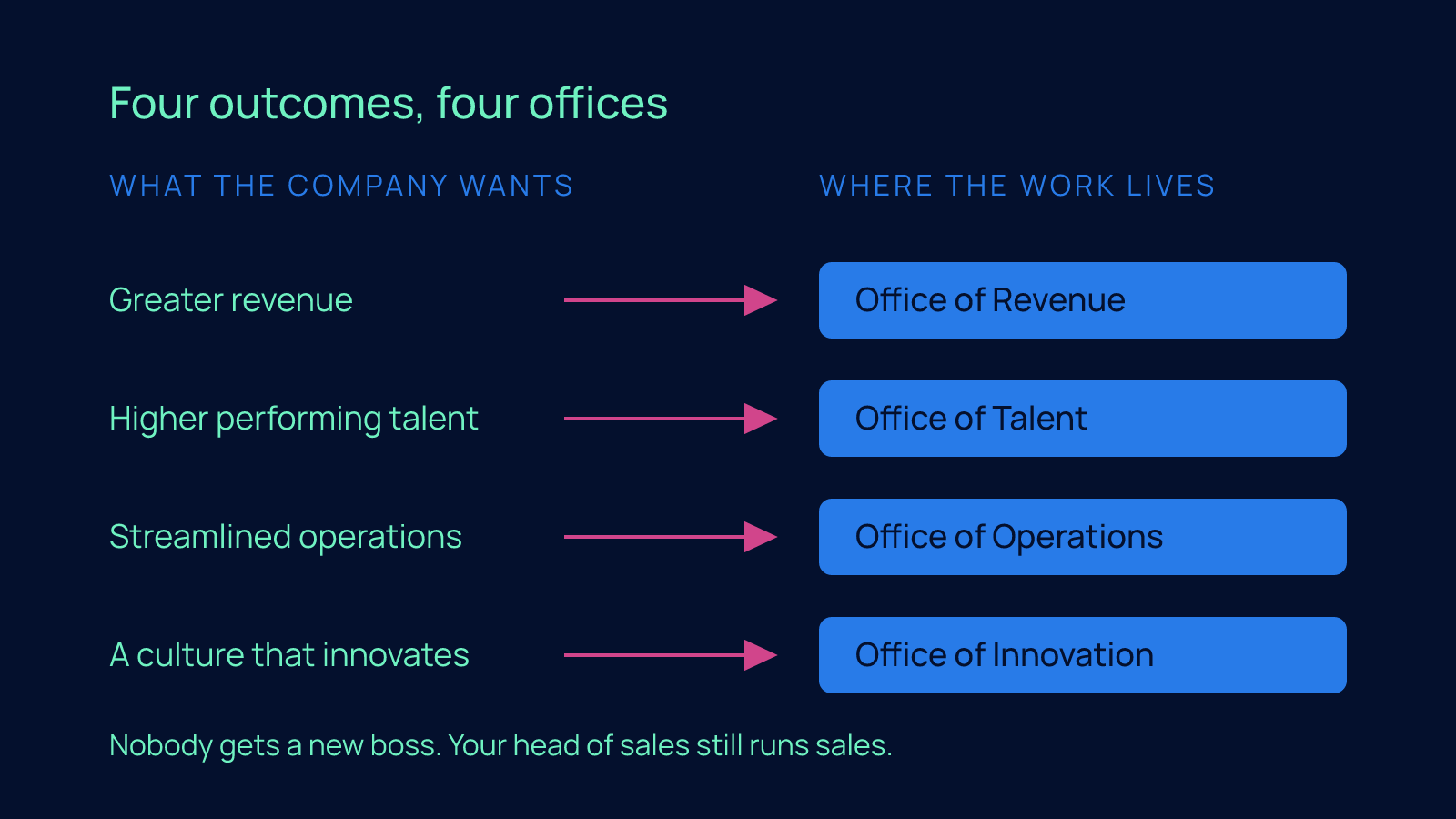
Strip any company down to what it wants and you get four things.
Greater revenue. Higher performing talent. Streamlined operations. A culture that innovates.
That is the whole list. Every initiative you have launched, every person you have brought on, every tool you have bought was a bet on one of those four. If you can name a fifth, I would genuinely like to hear it, because in twenty years of building companies I have not found one that did not fold back into these.
Each outcome resolves into a place where the work for it lives:
- Greater revenue becomes the Office of Revenue.
- Higher performing talent becomes the Office of Talent.
- Streamlined operations becomes the Office of Operations.
- A culture that innovates becomes the Office of Innovation.
At Edge8 we call these the Four Offices of the Future.
Let me be precise about the word office, because it is doing a lot of work. An office here is not a department and it is not a floor. Nobody gets a new boss. Your head of sales still runs sales. Your ops lead still owns ops. An office is a way of organizing the work so that AI can help with it, without reorganizing the business that does it. It sits over the top of your existing company as a map of the work: the kind of map a human can steer and a machine can read.
That distinction is the whole point. AI does not care about your reporting lines. It cares about workflows: this input, this step, this output, this decision. When work is organized by outcome, you can ask a precise question of any workflow in the building: which of the four does this serve, and what would better look like? When work is organized only by department, you get the Day 3 problem. Forty tools, each owned by a team, each holding a slice of the truth, none of them talking.
Why you cannot skip to the build
ADKAR, from Hiatt at Prosci, says people move through awareness, desire, knowledge, ability and reinforcement, and the season follows that order: the first week built awareness, the next three weeks build knowledge and ability, one office at a time.
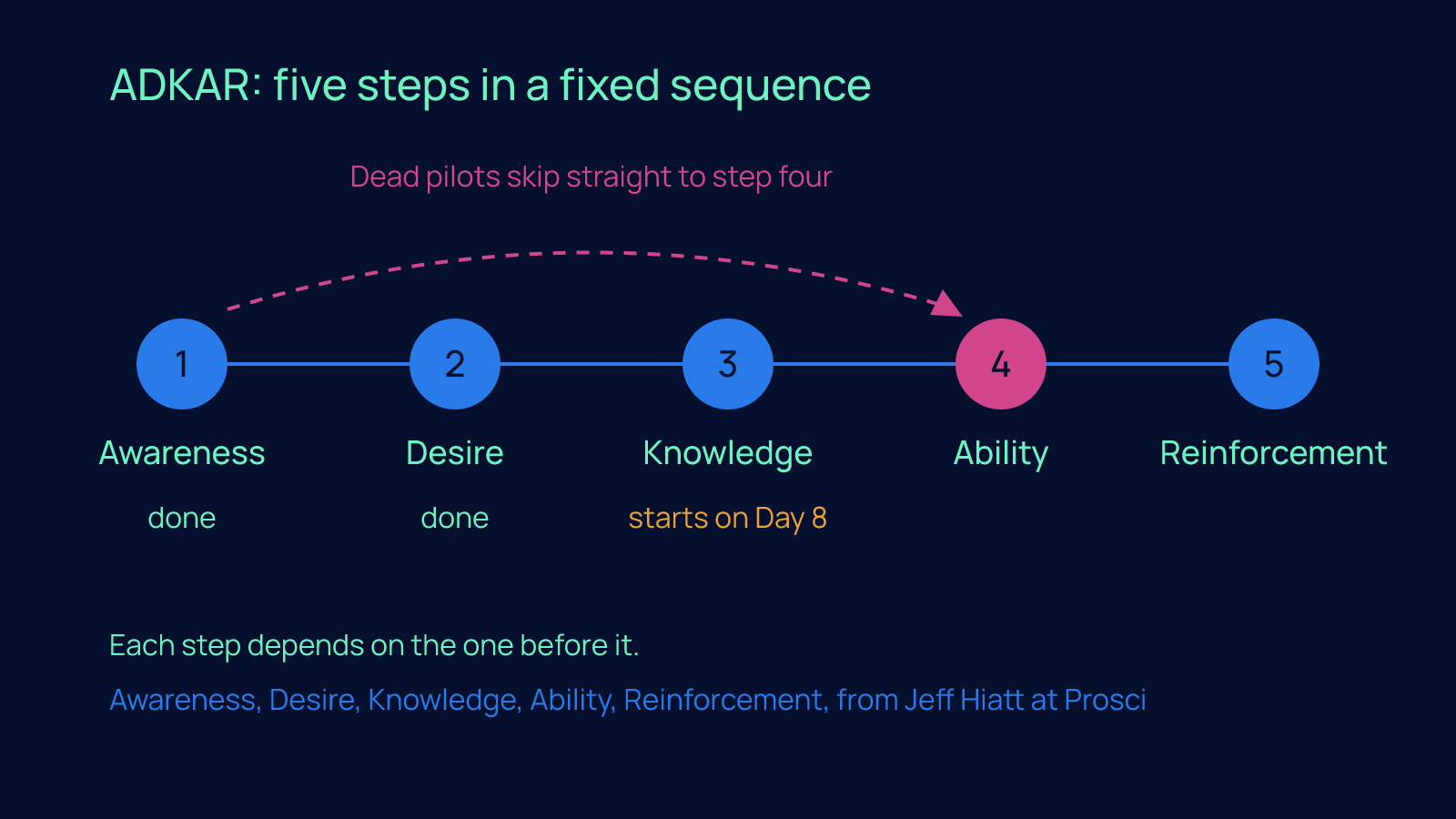
There is a second framework behind this season, and it explains why the order of the next three weeks is not an accident.
It is called ADKAR, and it comes from Jeff Hiatt at Prosci. It describes how a person actually moves through a change, and it goes in a fixed sequence:
- Awareness that something needs to change.
- Desire to be part of changing it.
- Knowledge of how to change.
- Ability to actually do it, on a real day, with real work.
- Reinforcement so the change sticks instead of sliding back.
Each step depends on the one before it. You cannot give someone ability before they have knowledge, and knowledge does not land on someone who has no desire to use it.
Nearly every dead pilot I have looked at skipped straight to step four. Someone bought a tool, built a demo, and handed it to a team that had no awareness of why and no desire to change how they worked. The tool won the demo and lost the Tuesday. That is the Day 4 story, and ADKAR tells you exactly why it keeps happening.
So the season follows the sequence on purpose. The first week was awareness: naming the gaps plainly enough that you could see them in your own company. The itch you felt at the question at the top of this post, where do I start, is desire. The next three weeks build knowledge and ability, one office at a time, on real screens with real data. Reinforcement is the job of the thing I am about to show you.
Which puts you here. Awareness: done. Desire: if you have read this far, done. Knowledge starts on Day 8.
Walking the map
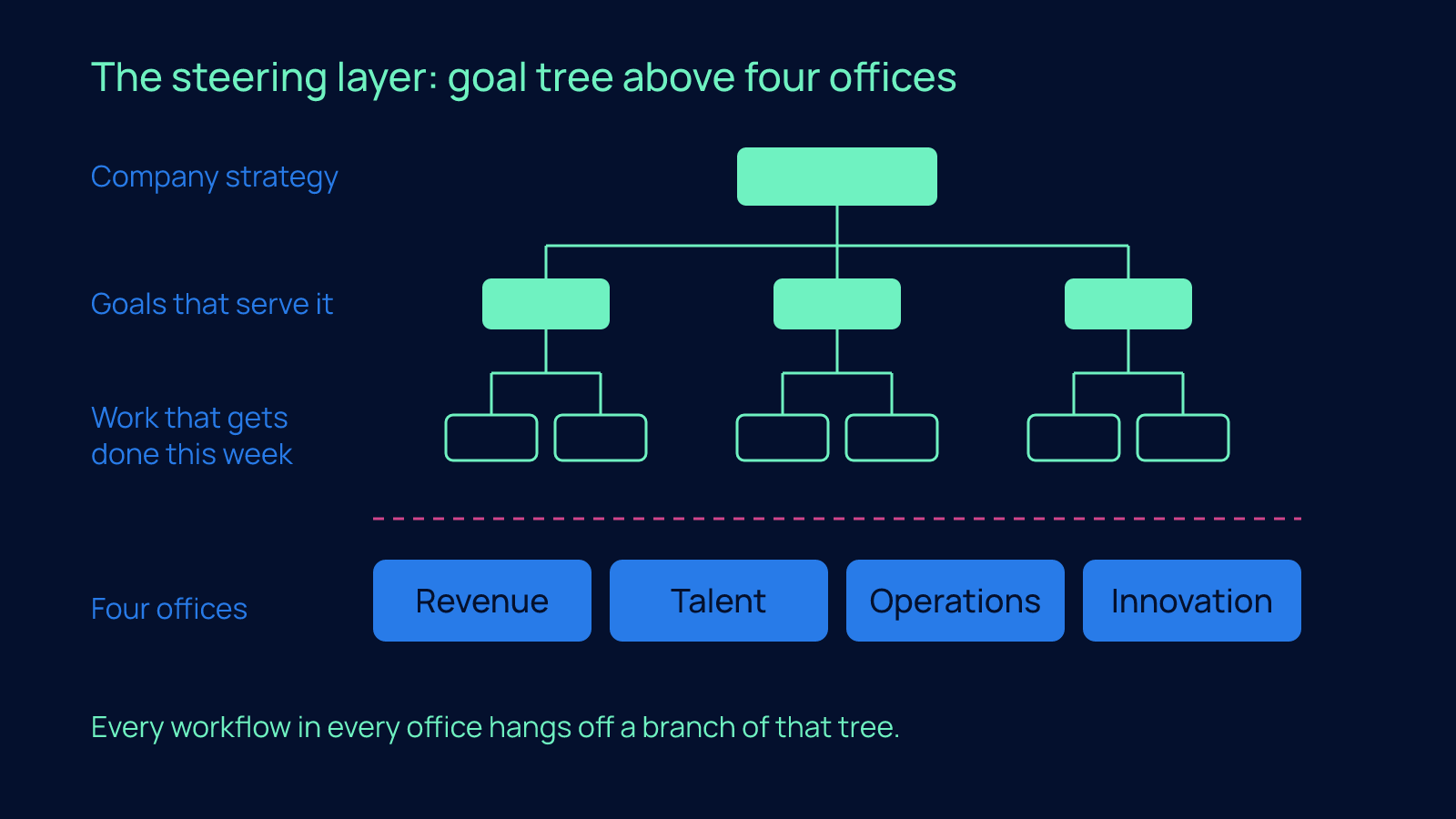
Edge8 runs on its own Company OS. The map I am about to describe is live in it today. It is not a slide, and it is not a mockup for the film.
Open it and the first thing you see is the dashboard. Down the left side is a sidebar with four entries: Revenue, Talent, Operations, Innovation. Click any one and you are inside that office, looking at the workflows that belong to it. One system, four offices, each holding its own work.
That alone is useful. It is not the most important thing on the screen.
Above the offices sits the goal tree. If you read the Day 2 post on building one, you know the shape: the company strategy at the top, branching into the goals that serve it, branching again into the work that gets done this week. Every workflow in every office hangs off a branch of that tree. Which means every person in the company, and soon every agent, can trace what they are doing on a Wednesday afternoon straight back up to the strategy the leaders set.
A quick definition, since I promised no jargon without one. An agent, in plain language, is a piece of AI software that has been given a specific job, a boundary it cannot cross, and permission to run that job repeatedly without a human typing a prompt each time. We will build several this season. You will see each one on screen before it touches anything real.
That is the steering layer. The offices tell you where the work lives. The goal tree tells you why it exists and whether it is still pointed at the right thing. Strip either one away and the other breaks. Offices without a tree become four silos with nicer names. A tree without offices becomes a strategy document nobody can act on, which is the Day 1 gap all over again.
Now the two questions I ask of every AI claim, including my own. What did the AI just do? And what does the person still decide?
On Day 7 the honest answer to the first question is: nothing. No AI acts in this episode. The map shows where agents and people will work. The goal tree is what will keep both pointed at the strategy. And the decision about what sits in that tree, which goals matter and in what order, belongs to the leadership team. It stays there for the entire season. That is not a limitation of the software. It is the design.
What belongs in each office
You do not need a consultant to sort your work into the four. Ask what outcome each piece of work serves.
The Office of Revenue holds the work of finding, winning and keeping customers: everything from the first conversation to the renewal.
The Office of Talent holds the work of finding, growing and keeping the people who do all of the above.
The Office of Operations holds the processes that make the business run every day without anyone being a hero.
The Office of Innovation holds the work of trying new things on purpose, with a budget and a decision at the end, rather than as a side project that dies in a Slack channel.
Most companies already do all four. Almost none of them can see all four in one place, connected to one strategy, in a form a machine can work inside. That gap is the whole opportunity.
Why the build starts in the Office of Revenue
The build starts in the Office of Revenue, one workflow per day, on real screens with real data.
You start where the outcome is least argued about. Nobody in your company disputes that more revenue is good. So the build starts in the Office of Revenue, one workflow per day, on real screens, with real data, and you watch each one get made.
And before any workflow, one database. Day 8 begins there, because you cannot build a revenue workflow on data that lives in forty places. You put it in one place first. That is not glamorous. It is the step every dead pilot skipped.
Notice what did not happen in any of this. Nobody's title changed. Nobody moved desks. No new department appeared on the chart. The company kept running exactly as it did on Monday, and on top of it a map appeared that AI could finally read.
The other one hundred ninety nine
This season opened with a premise. Picture a two hundred person company. The CEO knows the strategy. The other one hundred ninety nine need to.
By the end of these thirty days, they will. Every one of them will be able to open the same system, find their office, see their work, and trace it to the goal it serves.
And half of them will not be human.
That is the promise of Act 2. It starts on Day 8 with one database, and it gets built in front of you.
Your next step: watch the Day 7 film, then reply to this post with one line telling me which of the four outcomes you would start with and why. I will show you the map in our Company OS and we can talk through what that office would hold for your company.
FAQ
How do I decide where my company should start with AI without reorganizing the whole business first?
Start with the outcome, not the org chart. Strip any company down to what it wants and you get four things: greater revenue, higher performing talent, streamlined operations, and a culture that innovates, and in twenty years of building companies Dave Hajdu has not found a fifth that did not fold back into these. Each outcome becomes an office, a map of the work laid over your existing company, so your head of sales still runs sales and nobody gets a new boss. AI reads workflows, not reporting lines, so organizing work by those four outcomes is what lets AI help without you moving a single desk.
Do I need a new org chart or a new department before my company can use AI properly?
No. An office in this sense is not a department and not a floor; it is a way of organizing the work so AI can help with it. In the live Company OS described in the post, the dashboard shows one system with four entries in the sidebar (Revenue, Talent, Operations, Innovation), each holding its own workflows, and nobody's title changed to make that map appear. The alternative, organizing only by department, is how you end up with forty tools, each owned by a team, each holding a slice of the truth, none of them talking.
What order should my company follow when rolling out AI so the change actually sticks with my team?
Follow ADKAR, the change model from Jeff Hiatt at Prosci: awareness, desire, knowledge, ability, reinforcement, five steps in a fixed sequence where each depends on the one before it. Nearly every dead pilot Dave Hajdu has looked at skipped straight to step four: someone bought a tool, built a demo, and handed it to a team with no awareness of why and no desire to change how they worked. Spend the first week naming the gaps plainly so people see them in their own company, then build knowledge and ability one office at a time over the next three weeks.
What should be the first AI project in my company, and what has to happen before I build it?
Start where the outcome is least argued about: nobody disputes that more revenue is good, so the first build belongs in the Office of Revenue, one workflow per day, on real screens with real data. Before any workflow comes one database, because you cannot build a revenue workflow on data that lives in forty places. Putting the data in one place first is not glamorous, but it is the step every dead pilot skipped.
How do I make sure every employee, and every AI agent, in my company is working toward the same strategy?
Put a goal tree above the four offices: company strategy at the top, branching into the goals that serve it, branching again into the work that gets done this week, with every workflow hanging off a branch. That is what lets anyone trace a Wednesday afternoon task straight back to the strategy the leaders set, and the decision about which goals sit in that tree stays with the leadership team. The season's premise is a two hundred person company where the CEO knows the strategy and the other one hundred ninety nine need to; by the end of thirty days each of them can open the same system, find their office and see their work, and half of them will not be human.