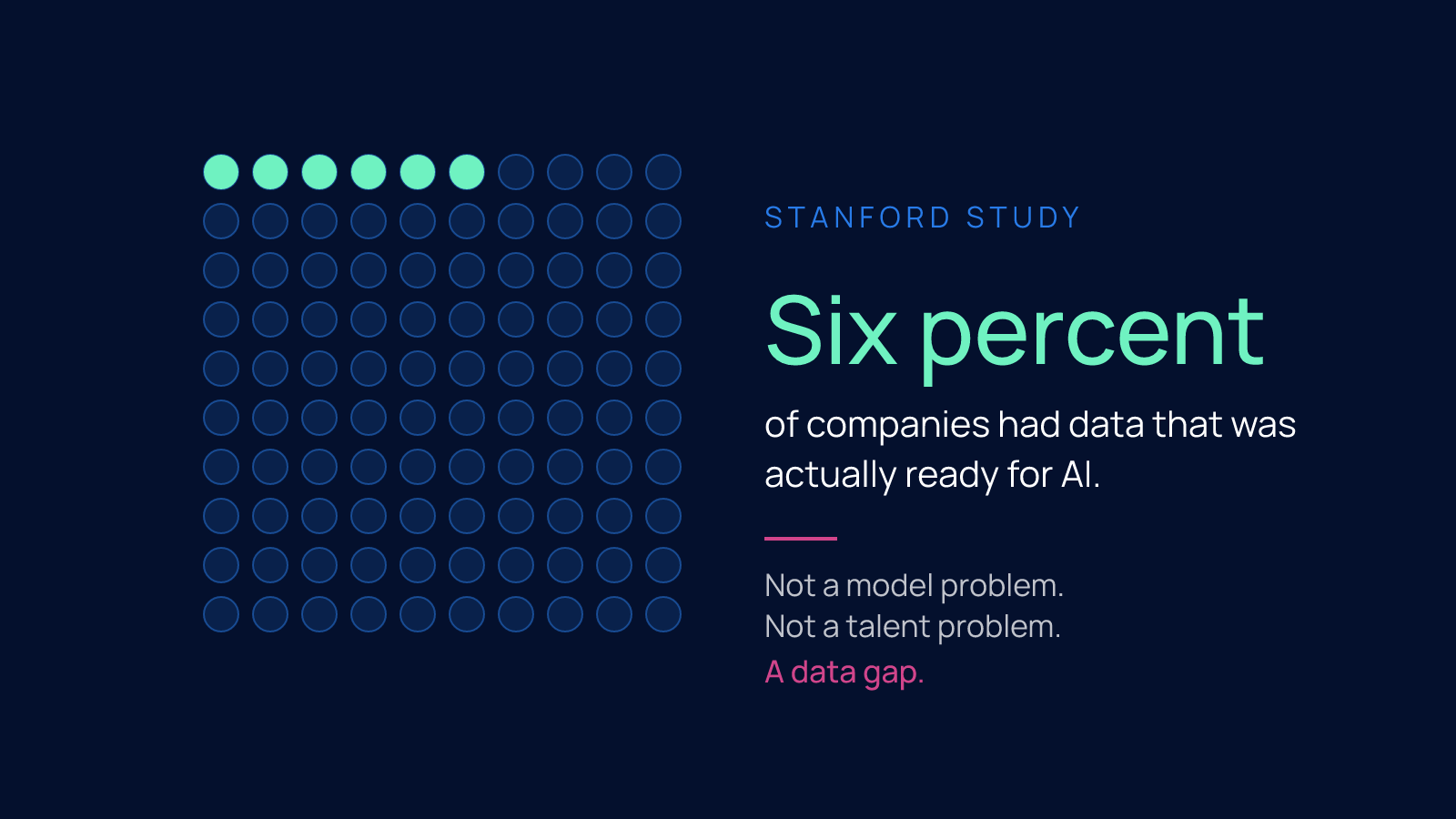
Stanford studied enterprise AI deployments and found that only 6 percent of companies had data that was actually ready for AI.
Six percent.
Sit with that number, because it rewrites the story most founders tell about why AI has not paid off for them yet. That story takes one of two shapes. Either the models are not good enough yet, so we wait for the next release. Or we do not have the right people, so we go find them. Both versions are comfortable because both put the problem outside the building. The Stanford figure puts it back inside. The reason AI has not helped most companies is not a model problem and not a talent problem. It is a data gap. The vast majority of companies asked AI to help and had nothing coherent to show it.
I say this as someone who places AI engineers and AI officers for a living, so you would expect me to tell you the answer is talent. It is not, or at least not first. The best engineer you can bring in will spend her first stretch discovering that your company does not know where its own facts are.
Where does your business actually live?
Here is the quick check, and you can do it right now.
Ask one question: where does your business actually live?
Not where it is supposed to live. Where it actually lives, today, as the work gets done.
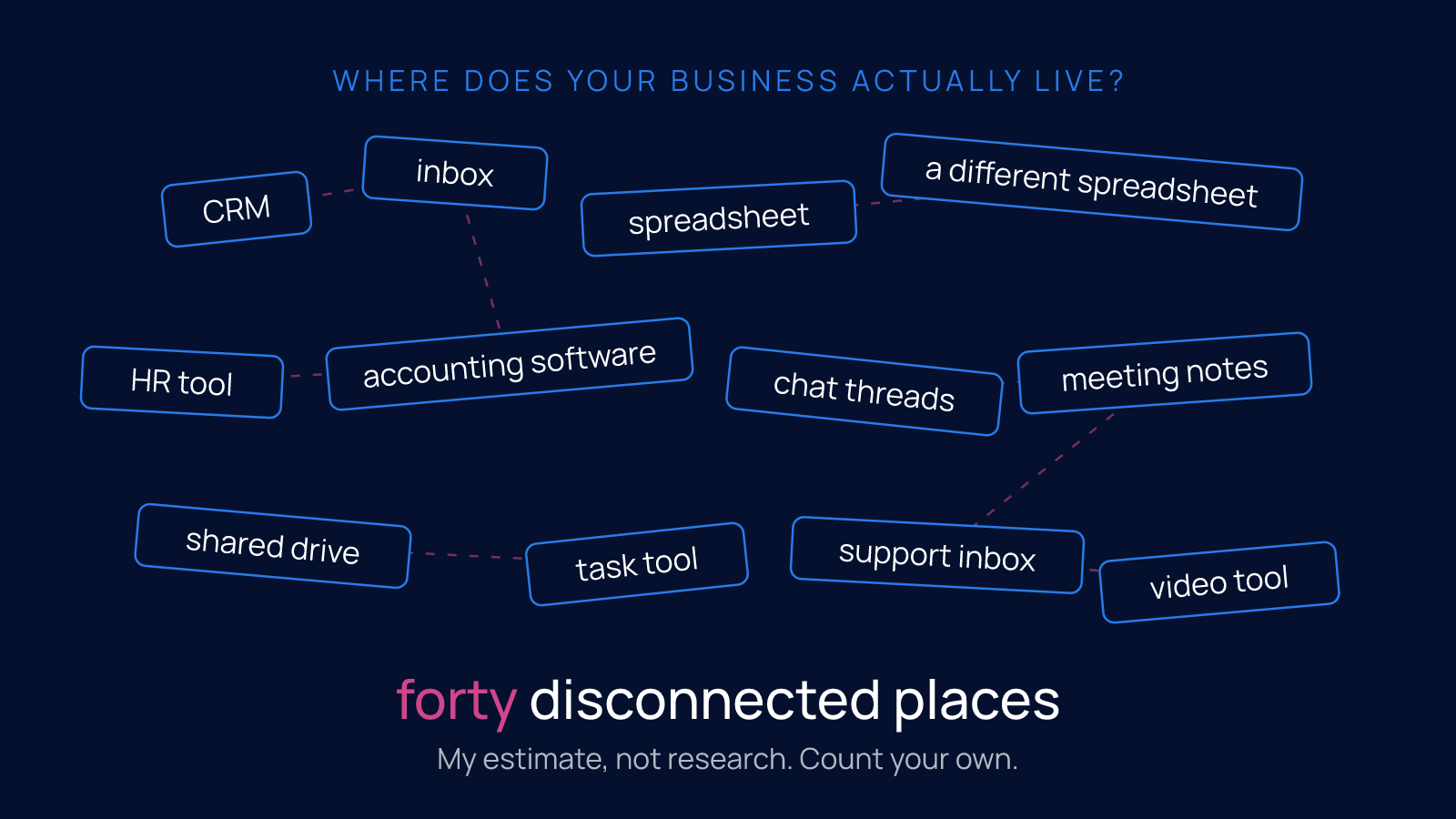
For most companies I sit down with, the honest answer is something like 40 disconnected places. That number is my estimate, not research, but count your own and see how far off I am. Here is what the count usually looks like.
Customers live in the CRM, the sales tool that is supposed to hold every customer. Except the newest ones, who live in a salesperson's inbox because nobody has entered them yet. Pricing lives in a spreadsheet. The real pricing, the discounts people actually give, lives in a different spreadsheet that one person owns. People data lives in an HR tool. The books live in accounting software. The decisions, the ones that explain why the company does what it does, live in chat threads and meeting notes that nobody can search and nobody will read again.
Keep going. Contracts in a shared drive. Project status in a task tool. Customer complaints in a support inbox. Meeting recordings in a video tool. Each tool was a reasonable choice when you bought it. Together they are not a company. They are a scatter.
Now count your own. If you ran out of fingers before you ran out of places, you have the same problem Stanford found in almost everybody.
Then you ask AI to help. With what?
AI can only create value where it can see the data.
This is where the data gap stops being an abstraction and becomes the reason your AI pilot went nowhere.
You bring in a tool, or an engineer, or a consultant, and you ask AI to help the business. Help us sell more. Help us spot the clients who are drifting. Help us stop losing deals. And the only honest answer back is a question: with what?
AI can only create value where it can see the data. That is the whole principle, and it is simpler than the vendors want it to be. A model does not know your clients. It does not know which ones have open deals, which ones you have not spoken to in a month, which ones are late on an invoice. It can only know those things if the facts exist in a place it can read, in a shape it can connect. If your clients live in one tool, your deals in a second, your meetings in a third and your invoices in a fourth, the AI sees four strangers and no company.
So it does what it can with what it can see. It summarizes an email. It drafts a paragraph. It answers a question about a single document. Useful, but a toy. Nobody builds a company on a toy, so the founder concludes, wrongly, that AI is overhyped. The AI was never given the one thing it needed.
The six percent is not a talent club or a budget club
Here is the part I most want you to take away, because it runs against what almost everyone assumes.
When founders hear "only six percent of companies had data ready for AI," they picture the companies with the biggest budgets, the deepest engineering benches, the Silicon Valley zip codes. They assume membership is bought with money or hired with talent.
I do not believe that. The six percent is a data club. Its members are the companies that made their facts visible in one place. Some are large. Plenty are small, because a small company has fewer facts and fewer tools, and can get to one home faster than a conglomerate ever will. Budget does not get you in. Talent does not get you in. You can bring in a brilliant machine learning engineer (someone who builds systems that learn patterns from data) and she will still be stuck if the data is in forty places. You will have paid a premium for a very expensive person to do plumbing.
What gets you into the club is one decision. It is free to make and expensive to avoid.
The entry fee is one decision
The six percent is the club that wins, and the entry fee is one decision: one home for every fact, and a rule the whole company lives by, if it is not in the system, it did not happen.
One home for every fact.
That is the decision. Every customer, every deal, every meeting, every invoice, every person, every price, in one database, as one connected set of records. Not forty tools wired to each other through connections that break on a Tuesday. One place.
And the decision comes with a rule the whole company has to live by: if it is not in the system, it did not happen.
The software is the easy part. The rule is the hard part. It means the salesperson does not get credit for the deal that lives in his inbox. It means the discount agreed in a hallway does not exist until it is on the record. It means the decision made in a chat thread is not a decision until somebody writes it where the company can see it. The rule is uncomfortable for exactly as long as it takes people to notice that everything suddenly works, and then nobody wants to go back.
Companies that skip the rule and only buy the database end up with a forty-first tool. Companies that adopt the rule end up with a company that can see itself. That is what "data ready for AI" means in plain words: the facts about your business are in one place, connected to each other, and kept current because the people who work there treat that place as reality.
What one home looks like
"One database" sounds like a slide. I want you to see a screen.
At Edge8 we run our own company on a system we call the Company OS. It is live, not a mock-up. Open it and the first thing you see is every company we work with, on one screen. Click into one of them and the people at that company, the deals we have open with them, the meetings we have had and the invoices we have sent are all already there, as one record. Not five tools stitched together with a dashboard on top. One record, because it is one database.
That single fact is what changes the relationship with AI. Because every table lives in the same place and is already connected, a plain English question can be answered across all of it at once.
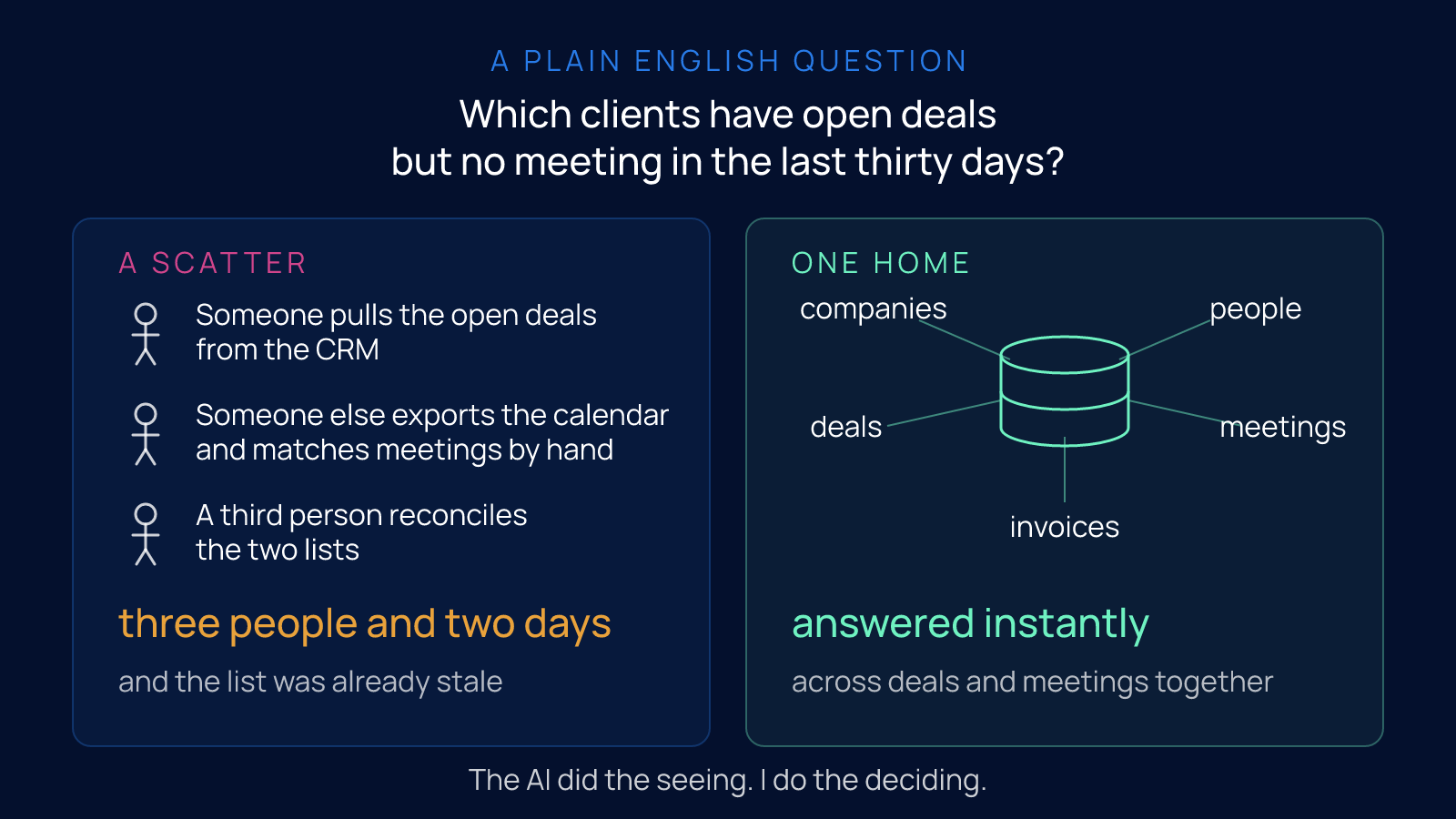
Here is the question I asked it: which clients have open deals but no meeting in the last thirty days?
Think about what that question used to cost. Someone pulls the open deals from the CRM. Someone else exports the calendar and matches meetings to companies by hand. A third person reconciles the two lists and argues about which contacts count. In the example I use, that was 3 people and 2 days, and by the time the list arrived it was already stale.
In one home the AI answers it instantly, across deals and meetings together, because it can see both.
Now the two questions I insist every AI claim answer. What did the AI just do? It answered a question across the whole database and handed me a list. What does the person still decide? Which of those clients to call, in what order, and what to say. The AI did the seeing. I do the deciding. That is the right division of labor, and it is only possible because the AI could see the data in the first place.
Your AI is only as smart as what it can see
Your AI is only as smart as what it can see. Give it one home for every fact and it stops being a toy and starts being a colleague.
Come back to the six percent.
Everything above is the explanation for that figure. Most companies have not given AI anything to look at. They have asked a very capable colleague to help and then locked the filing cabinets in forty different rooms. Then they blame the colleague.
Your AI is only as smart as what it can see. Give it one home for every fact and it stops being a toy and starts being a colleague: one that answers the cross-cutting questions nobody on your team had time to answer, so your team spends its time on the decisions those answers point to.
What to do this week
Three steps, in order.
First, count the places. Ask where your business actually lives and write down every one. Do not clean up the list. The length of the raw list is the point.
Second, make the decision. Pick the one home. Then say the rule out loud to the whole company and mean it: if it is not in the system, it did not happen.
Third, give it an owner. This is where talent finally matters. The person you need first is not a prompt engineer (someone who writes instructions for AI tools). It is someone who owns the data layer, meaning the one home and the rules that keep it true, and who redesigns the workflows so facts land in the system as part of doing the work rather than as homework afterward. That is a specific kind of engineer, and it is the one to find first.
This is Day 3 of the 30-day 8 Edges season. Day 1 named the two gaps that stall AI in a company: scattered data and undesigned workflows. Day 2 took the execution gap and showed the goal tree. Today is the data gap, and the Day 3 film shows the one-database screen described above, live, with the plain English question answered on camera. Watch it. Tomorrow, Day 4 takes on why AI pilots fail, and after today you can already guess part of the answer.
Then reply and tell me where your business actually lives. Send me the number you counted. That is the first fact worth putting in one place.
FAQ
What does it take to get my company's data ready for AI when it is scattered across forty different tools?
Less than most founders fear. Stanford studied enterprise AI deployments and found only six percent of companies had data that was actually ready for AI, and the thing those companies share is not budget or headcount but one decision: one home for every fact, meaning every customer, deal, meeting, invoice, person and price in a single database as one connected set of records. The decision comes with a rule the whole company lives by, that if it is not in the system it did not happen. Buy the database without the rule and you simply end up with a forty-first tool.
Why has AI not paid off for my company yet even though we tried it?
Because the AI was never shown the business. Stanford found only six percent of companies had data ready for AI, which means the vast majority asked AI to help and had nothing coherent to show it. When your clients live in one tool, your deals in a second, your meetings in a third and your invoices in a fourth, the AI sees four strangers and no company, so it does small jobs like summarizing an email and the founder wrongly concludes AI is overhyped. It is a data gap, not a model gap or a people gap.
How do I find out where my company's data actually lives?
Ask one question: where does the business actually live today, as the work gets done, not where it is supposed to live. Write down every place, including the CRM, the salesperson's inbox holding the newest customers, the pricing spreadsheet, the second spreadsheet with the real discounts, the HR tool, the accounting software, the chat threads and the meeting notes. Do not clean up the list, because its length is the point. For most companies Edge8 sits down with the honest answer is something like forty disconnected places, which is an estimate rather than research, so count your own and see how far off it is.
How do I get my team to actually put everything in one system instead of inboxes and spreadsheets?
Adopt one rule and say it out loud to the whole company: if it is not in the system, it did not happen. That means the salesperson gets no credit for the deal sitting in his inbox, the discount agreed in a hallway does not exist until it is on the record, and a decision made in a chat thread is not a decision until it is written where the company can see it. The software is the easy part and the rule is the hard part, and companies that skip the rule and only buy the database end up with a forty-first tool. The discomfort lasts exactly as long as it takes people to notice that everything suddenly works.
What can AI actually do for my business once all our data is in one database?
It can answer the cross-cutting questions nobody on your team had time for. In Edge8's own Company OS, a plain English question like which clients have open deals but no meeting in the last thirty days is answered instantly across deals and meetings together, because both live in the same connected database. Pulling that same list by hand used to take three people and two days, and it was stale by the time it arrived. The AI does the seeing and hands over the list; the person still decides which clients to call, in what order, and what to say.