
Picture the day you presented the strategy. You had the deck. Three priorities, maybe four. The room nodded. Someone said it was the clearest the company had ever been about where it was going, and they meant it.
Now open your calendar six months later.
Every team is busy. Nobody is slacking. Sales is chasing the deals that are easiest to close this quarter. Operations is hitting a number that somebody chose at some point, though nobody can tell you when or why. Marketing is running the campaign that was already half built when the strategy landed. Pull any meeting off the calendar and ask which of the three priorities it serves, and you will get a pause, then a reasonable-sounding answer invented on the spot.
That is the execution gap. Strategy rarely fails in the conference room. It dies between the conference room and the calendar.
The gap is the default, not a failure of character
Rumelt showed most companies have a translation problem rather than a strategy problem: direction is clear at the top and loses specificity at every layer below.
The tempting story is that people did not care enough, or that the strategy was not good enough. Neither is true. The people in that room believed in the plan. The plan was fine.
The gap is the default because clarity does not travel on its own. A priority that is perfectly clear to the founder who wrote it gets a little fuzzier when a VP restates it to their directors, fuzzier again when a director turns it into team targets, and by the time it reaches the person doing the work on a Tuesday afternoon it has become "do more of the thing we already do."
Richard Rumelt made this point better than anyone. Most companies do not have a strategy problem. They have a translation problem: direction is clear at the top and loses specificity at every layer below. Nobody rewrote the strategy. It simply arrived at the bottom of the company with none of its edges left.
So if you are about to spend another offsite sharpening the strategy document, stop. The document is not the bottleneck.
The fix is frequency, not a better document
MIT Sloan Management Review named the fix, FAST goals: frequently discussed, ambitious, specific, transparent, with the weight on frequently, because goals that live on paper do not live in anyone's attention.
MIT Sloan Management Review, in a piece by Sull and Sull, named the thing that actually works. They call them FAST goals: frequently discussed, ambitious, specific, transparent.
Read that list again and notice where the weight sits. Ambitious, specific, and transparent describe the goal itself. Frequently discussed describes what people do with it. That is the one that matters most, because a goal that lives on paper does not live in anyone's attention.
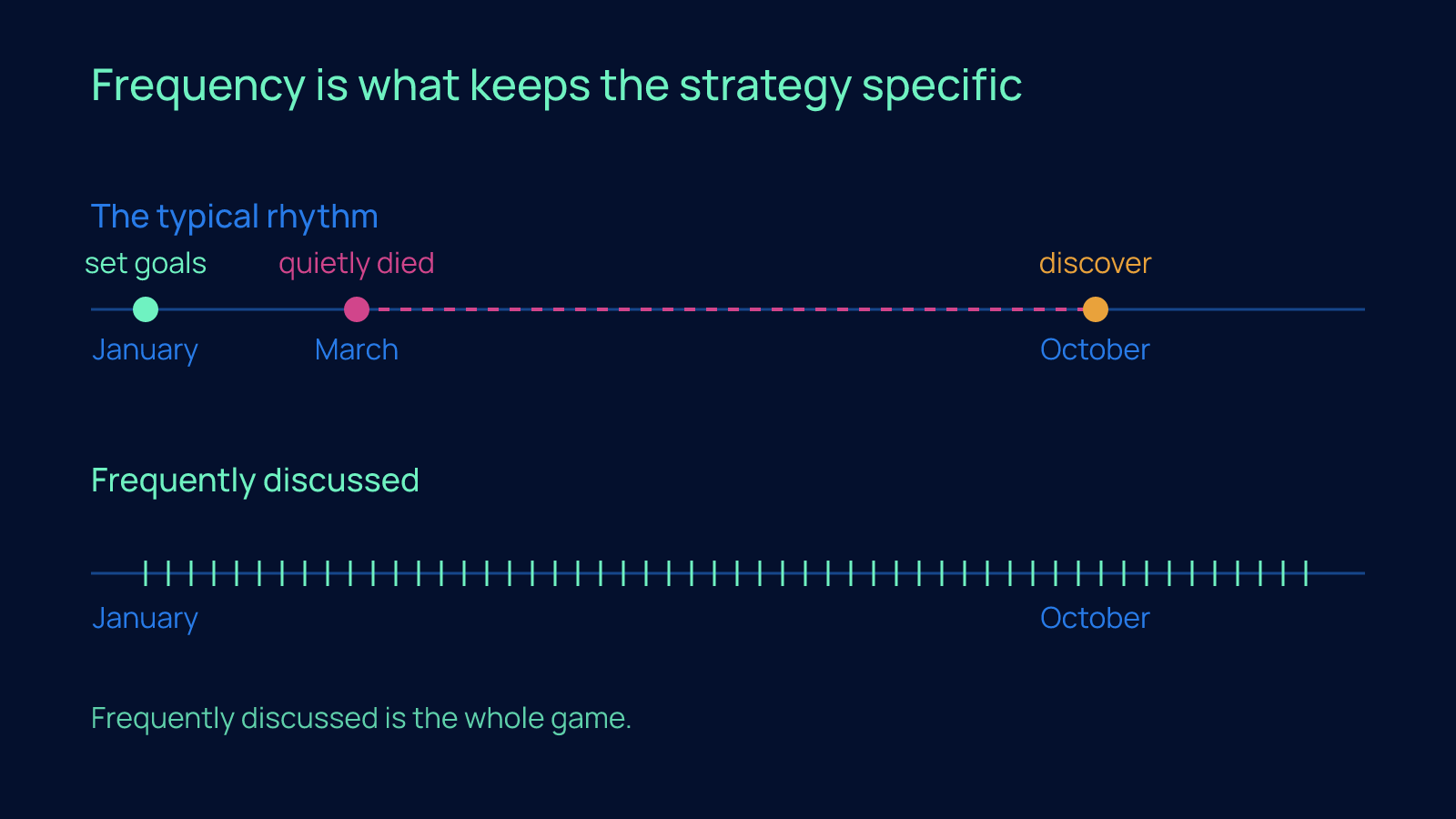
This runs against how most companies operate. The typical rhythm: set goals in January, review them in a quarterly business review, discover in October that half of them quietly died in March. The goals were specific. They were even ambitious. They were just never talked about, so they never competed with the hundred urgent things that showed up every week and won.
Frequency is what keeps the strategy specific as it travels down the layers. Every time a goal is discussed, someone gets to ask "what does this mean for what I do this week," and the translation happens out loud instead of silently degrading.
The problem is that frequency is hard to sustain. You cannot keep fifty goals in fifty heads through willpower and calendar reminders. You need a shape that makes frequent discussion the easy path instead of the heroic one.
The goal tree: the shape that makes frequency possible
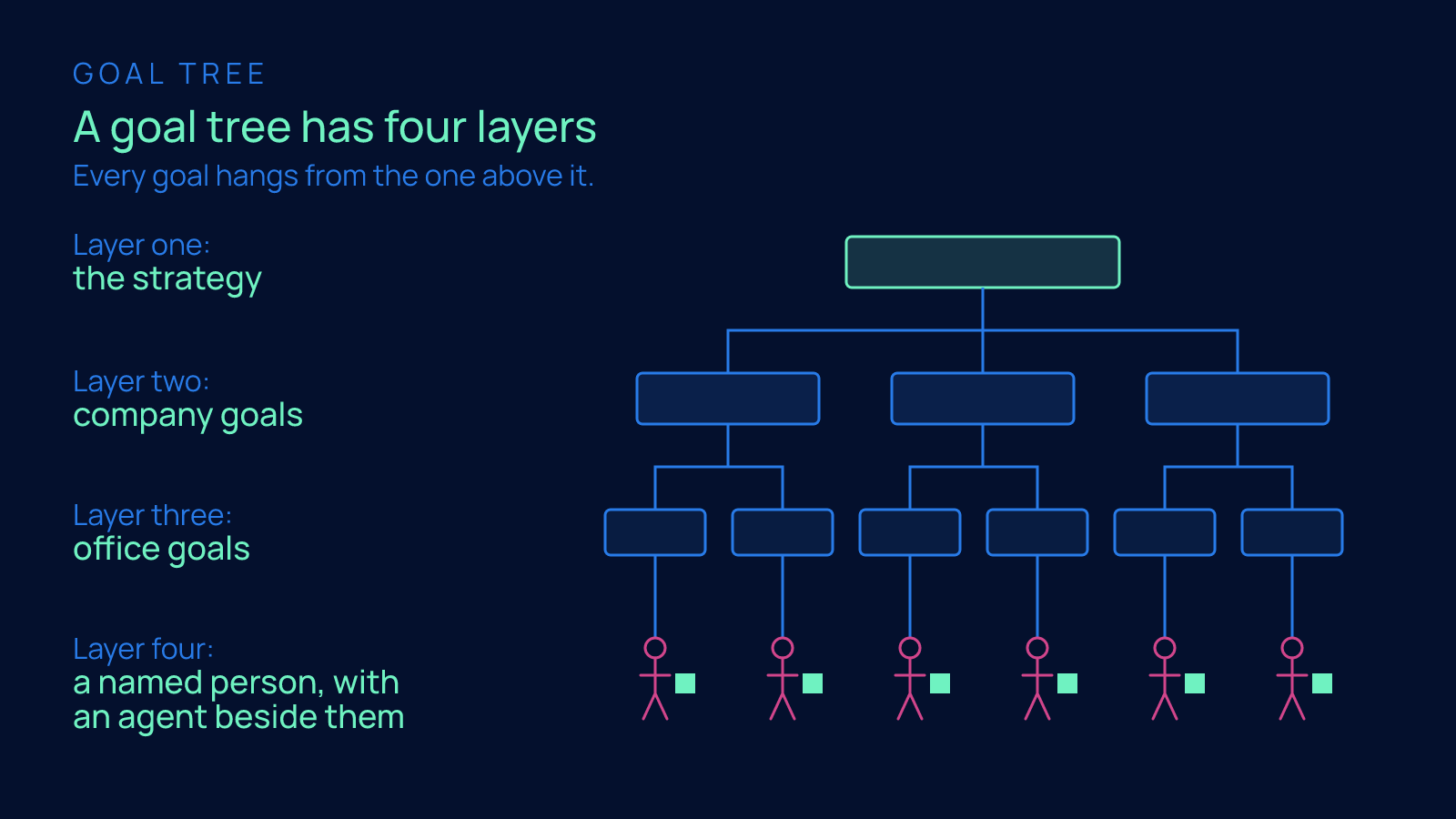
The shape is simple enough to sketch on a napkin, and that is on purpose. A goal tree has four layers, and the one rule is that every goal hangs from the one above it.
Layer one: the strategy. One sentence, or a few. This is the top of the tree, the thing you said in the conference room. It does not change often.
Layer two: company goals. The handful of outcomes that, if you hit them this year, mean the strategy is working. Each one connects explicitly to the strategy. If you cannot say which line of the strategy a company goal serves, it is not a company goal. It is a wish.
Layer three: office goals. Every team, department, or office has its own goals, and each one hangs from a company goal. Sales does not get a sales goal because sales always has a sales goal. Sales gets a goal because a company goal needs it.
Layer four: a named person, with an agent beside them. At the bottom of every branch is one human being whose name is on it, and the AI agent that works alongside them on it. Not a team. A person. This is the layer where the strategy finally becomes somebody's Tuesday.
Drawn out, the whole company can see the line from what the founder said to what a specific person is working on this week. That visibility is what makes "frequently discussed" possible. You do not have to remember to bring the strategy into a one-on-one. It is already there, hanging above the goal you are talking about.
The two rules that make it more than a slide
People get alignment through conversation, AI gets it through context, from the same tree.
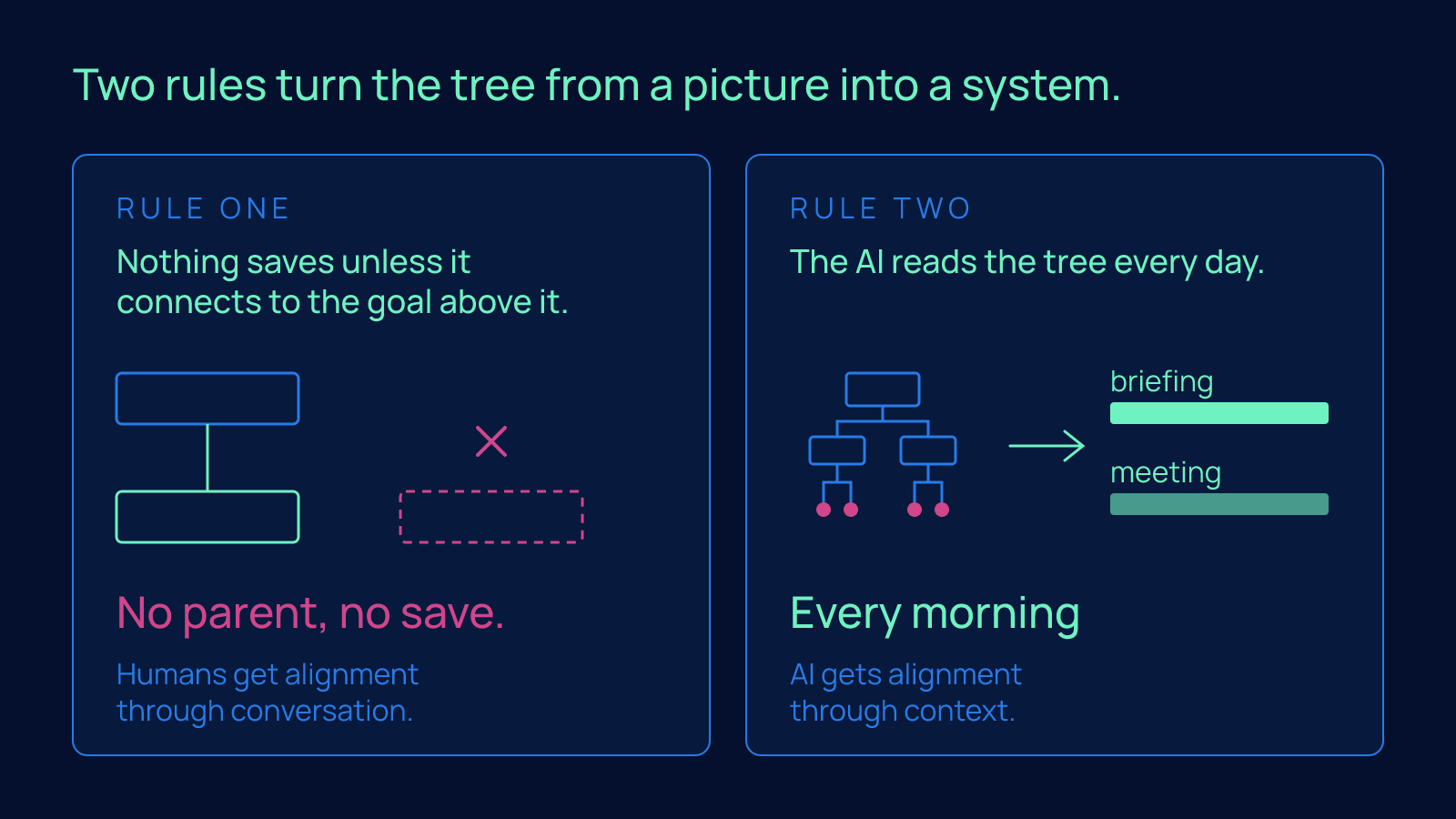
Plenty of companies have drawn something like this on a slide. The slide gets presented, admired, and archived, and six months later we are back at the calendar. Two rules turn the tree from a picture into a system. We run both in Edge8's own Company OS, so the tree I am describing is not a proposal. It is the one my team works from every day.
Rule one: nothing saves unless it connects to the goal above it.
This is the enforcement mechanism, and it is the part most companies skip because it feels rigid. In our system you cannot create a goal that floats free. To add an office goal, you pick the company goal it serves. To add a personal goal, you pick the office goal it serves. No parent, no save.
That forces the translation conversation at the moment of creation. The person adding the goal has to ask, right then, "which part of the strategy is this for," and if the honest answer is "none of it," the goal does not get made. Over a year, that single constraint quietly deletes the entire category of busy work that was never connected to anything.
It also keeps the tree true. There is no drift between the official picture and what people actually have on their plates, because the plates are the picture.
Rule two: the AI reads the tree every day.
This is where AI does something useful rather than decorative, so let me be precise about what it does and what it does not.
What did the AI just do? Every morning, before anyone opens a laptop, it read the goal tree. When it prepared a briefing for someone, it started from that person's goals and the branch above them. When it prepared a meeting, it pulled the goals the people in that room share and put them at the top of the prep. Every briefing and every prepared meeting starts from the same goals, because they all come from the same tree.
What does the person still decide? Everything that matters. Whether the goal is still the right one. Whether the number should move. What to do this week about the distance between where the goal is and where it should be. Whether to have the hard conversation the briefing makes obvious. The AI surfaces the strategy every single day. The person acts on it.
That is the whole point of putting AI on this problem. Humans get alignment through conversation. AI gets alignment through context. Give both of them the same tree and the strategy stops depending on anyone's memory. It shows up on its own, every morning, at every layer.
How to build a goal tree this month
Here is the order I would work in.
1. Write the strategy at the top in plain words. If your strategy needs a deck to explain, it will not survive the trip down the tree. Get it to a few sentences someone in their first week could repeat back to you.
2. Pick the company goals that prove the strategy is working. Keep the number small. For each one, write the specific line of strategy it serves next to it. If you cannot, cut it.
3. Have every office build its layer from the company goals down, not from their current work up. This is the step that hurts. Teams will want to start with what they are already doing and find a parent for it. Make them start with the company goal and ask what their office owes it. Some current work will not fit. That is information, not a problem to smooth over.
4. Put a name on every leaf. One person per bottom-level goal. If two people share it, nobody owns it. If an agent is going to work alongside them, write down what the agent does on that goal and what the person still decides.
5. Enforce the connection rule from day one. Whatever tool you use, make it impossible to add a goal without a parent. If your tool cannot do that, enforce it in the review meeting by deleting anything that floats.
6. Wire the tree into the daily rhythm. Whether it is an AI reading it each morning or a human pulling it into every one-on-one, the tree has to show up far more often than the quarterly review. Frequently discussed is the whole game.
Strategy that travels
Six months from now you will have a busy calendar either way. The question is whether that busyness traces back to what you said in the conference room, or whether it drifted there on its own.
A goal tree does not make people care more. They already care. It gives clarity a vehicle so it can travel from the top of the company to a named person at the bottom without losing its edges on the way. People discuss the same goals. The AI reads the same goals. The strategy travels.
This is Day 2 of the 8 Edges season. Day 1 named the two gaps that keep companies stuck. Today's film walks through the goal tree live in our Company OS, from the strategy at the top to a named person with an agent beside them at the bottom. Watch the Day 2 film, then reply and tell me where your strategy stopped traveling. Day 3 takes on the second gap: where your data actually lives.
FAQ
How do I build a goal tree that connects my strategy to what every person on my team actually works on each week?
Build it in four layers, with the one rule that every goal hangs from the goal above it: the strategy at the top in one sentence or a few, a small set of company goals under it, each office's goals under those, and at the bottom of every branch one named person with the AI agent that works beside them. Work from the company goals down, not from current work up, and put one person on every bottom-level goal, because if two people share it nobody owns it. Then enforce the connection rule from day one: no parent, no save. Finally, wire the tree into the daily rhythm so it shows up far more often than the quarterly review.
Why does my strategy stop reaching my team a few months after I present it?
Because clarity does not travel on its own. Richard Rumelt called this a translation problem rather than a strategy problem: direction is clear at the top and loses specificity at every layer below, so three priorities, maybe four, arrive at the person doing the work as 'do more of what we already do.' Open your calendar six months after the presentation and every team is busy, yet pull any meeting off it and ask which priority it serves and you get a pause and an answer invented on the spot. The document is not the bottleneck, so another offsite spent sharpening it will not help.
What are FAST goals and which part of the framework matters most?
FAST goals, named by Sull and Sull in MIT Sloan Management Review, are frequently discussed, ambitious, specific, and transparent. Three of those describe the goal itself; frequently discussed describes what people do with it, and that is the one that matters most, because a goal that lives on paper does not live in anyone's attention. Most companies set goals in January, review them in a quarterly business review, and discover in October that half of them quietly died in March because they never competed with the hundred urgent things that showed up every week. Frequency is what keeps a goal specific as it travels down the layers.
How can AI help keep my team's daily work aligned with company strategy?
Give the AI the same goal tree your people see and have it read the tree every day. In that setup, every morning before anyone opens a laptop the AI reads all four layers, starts each person's briefing from their goals and the branch above them, and starts each meeting prep from the goals the people in the room share. The person still decides everything that matters: whether the goal is still right, whether the number should move, what to do this week about the gap, and whether to have the hard conversation the briefing makes obvious. Humans get alignment through conversation, AI gets alignment through context, and both work from one tree.
How do I stop my team from spending time on work that does not connect to any company goal?
Adopt the rule that nothing saves unless it connects to the goal above it: to add an office goal you must pick the company goal it serves, and to add a personal goal you must pick the office goal it serves. That forces the translation conversation at the moment of creation, and over a year it quietly deletes the entire category of busy work that was never connected to anything. It also keeps the picture true, because you cannot keep fifty goals in fifty heads through willpower and calendar reminders. If your tool cannot enforce it, enforce it in the review meeting by deleting anything that floats.