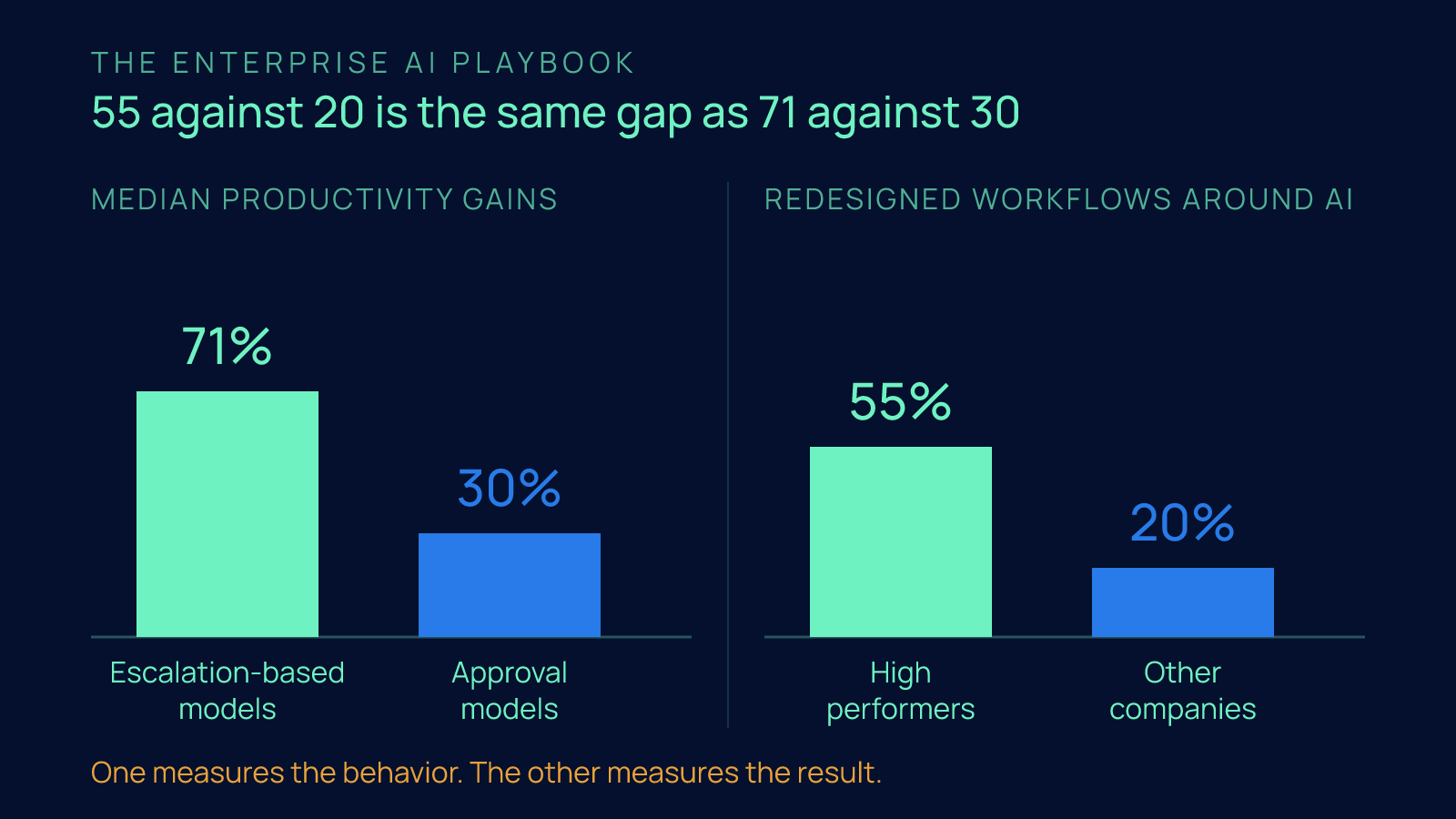
Stanford's Digital Economy Lab put a number on something I have been telling founders. In "The Enterprise AI Playbook" (Pereira, Graylin and Brynjolfsson, March 2026), the authors compared how companies place humans inside AI workflows. Their line: "Escalation-based models (AI handles 80%+ autonomously, humans review exceptions) delivered 71% median productivity gains versus 30% for approval models."
71 against 30. Same models. Same vendors. Often the same use case. The difference is one design decision: where the human sits.
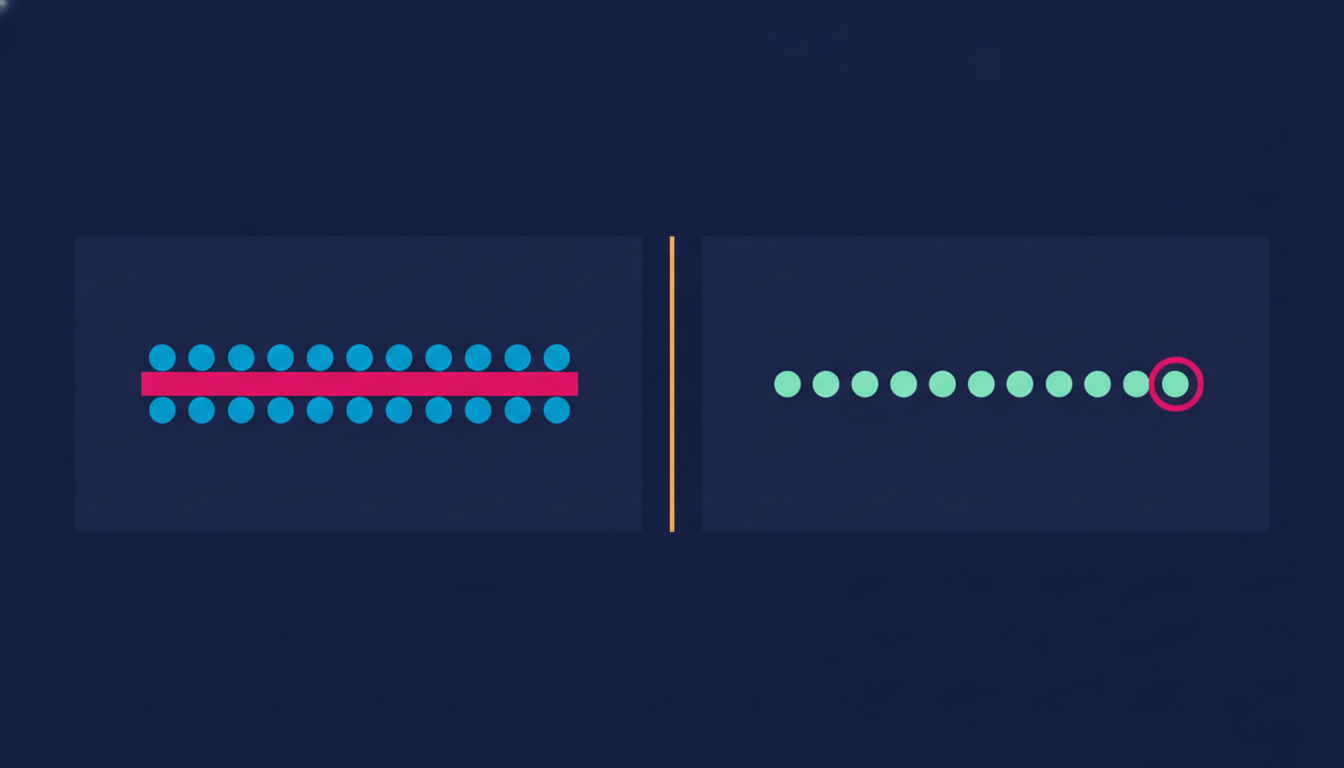
In an approval model, the human sits at the gate. Every output waits for a person to look at it and click yes. In an escalation model, the human sits at the exception. The machine handles the routine, checks its own work against rules someone wrote down, and only raises its hand when something breaks a rule. The person shows up for the 20%, or the 5%, or the one case that matters.
If you have an "AI approval" step in a process right now and the gain was disappointing, that is why. You bought a tool and kept the workflow. You put a faster engine in a car that still stops at every intersection.
Here is the part most people skip: you cannot move the human from the gate to the exception unless you can say, precisely, what an exception is. And you cannot say that unless the workflow is written down end to end. The redesign is the work. The documentation is how the redesign becomes real. Everything else in this post is evidence for that claim, starting with the page you are reading.
This post got here without anyone pressing Publish
I run Edge8's blog as an escalation model, and I want to walk through it plainly, because it is the smallest complete example I have.
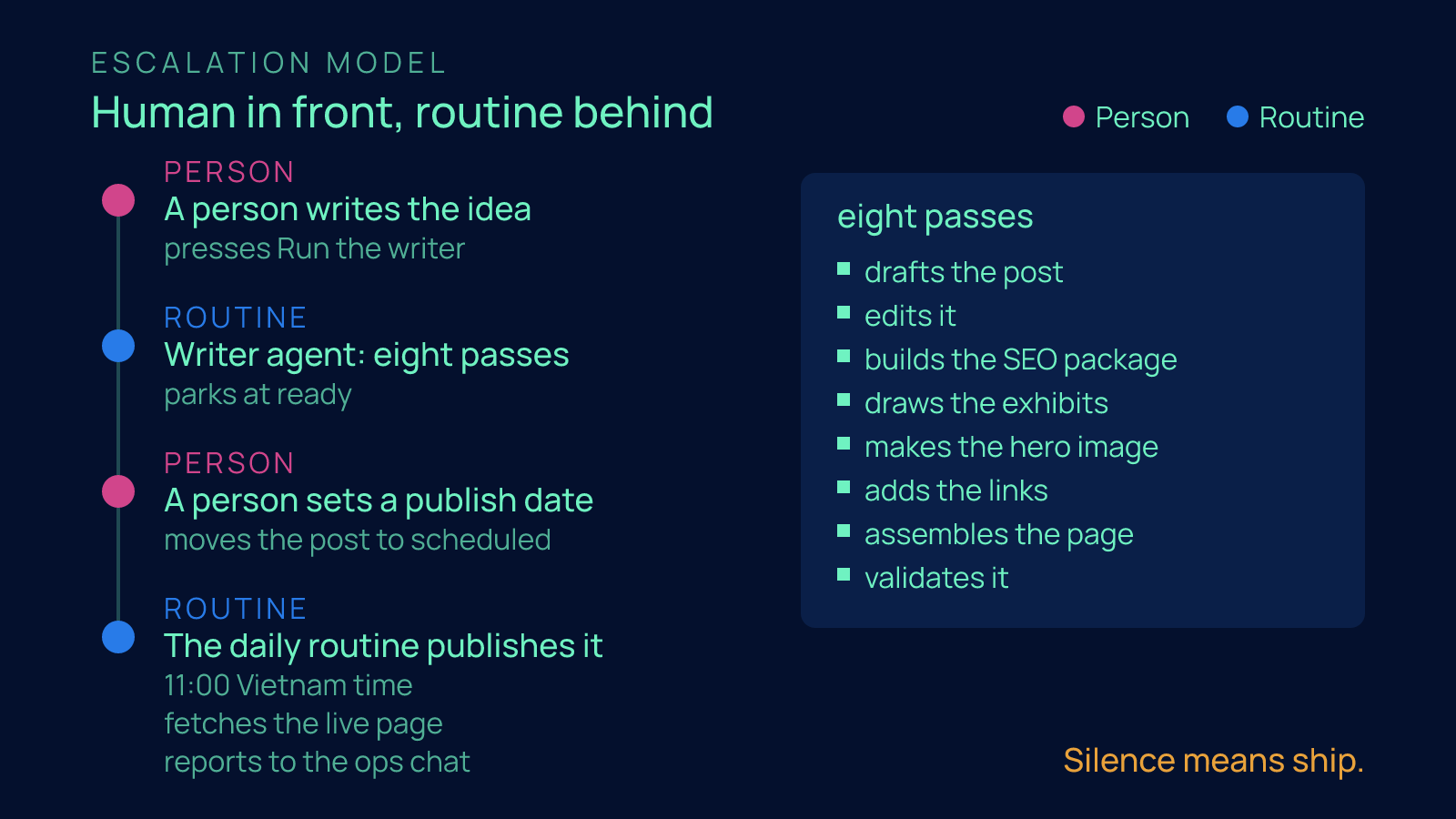
A person, in this case me, writes the idea and presses Run the writer. The writer agent drafts the post, edits it, builds the SEO package, draws the exhibits, makes the hero image, adds the links, assembles the page and validates it. Our own description of the writer agent: "A good post is not one model call; it is eight passes, each with its own lens and its own check."
When the run finishes, it parks at ready. A person sets a publish date and moves the post to scheduled. The days between scheduling and that date are the review window. If nobody pulls the post back, the daily routine publishes it at 11:00 Vietnam time, fetches the live page to prove it is really up, and reports to the ops chat. Silence means ship.
That is what happened here. This post was drafted by the writer agent, checked in eight passes, scheduled by a person, and published by the routine. Nobody pressed Publish on the day.
Notice what I did not say. I did not say the blog is automatic. A person still writes the idea. A person still sets the date. What changed is that the person no longer stands at the gate reading every line before it goes out. The person stands at the exception.
What the machine checks so the human does not have to
A post that fails validation stays scheduled, is retried on the next run, and is named in the report. A bad post never silently disappears.
An escalation model only works if the machine can tell you when it has failed. Otherwise "review the exceptions" means "review everything and hope."
So the writer agent names 14 failure conditions and checks itself against every one before a post ships. A few of them:
- An em dash anywhere in the copy (our brand rule forbids them).
- A slug that is already taken.
- An exhibit that shows a number the body never states.
- A pull quote that cannot be verified verbatim against the sources.
Each of those is a rule a human used to enforce by reading. Now each one is a line the agent enforces by checking, and when a check fails, the failure names the rule it broke in the ops chat. From our publishing workflow: "A post that fails validation stays scheduled, is retried on the next run, and is named in the report. A bad post never silently disappears."
That last sentence is the whole design in miniature. The human is not asked to catch problems. The human is told about them. The principle at the top of that page is "Human in front, routine behind." The operating rule that follows from it: "Writers write. Nobody hand-edits pages or deploys anything."
None of those 14 checks existed until someone sat down and wrote the workflow out, step by step, and asked at each step: what does wrong look like here, and how would a machine know? That is documentation. It is unglamorous. It is also the only reason a person can safely walk away from the gate.
The escalation ratio is a setting
Each brand on our platform has an auto-publish switch. Turn it on and the scheduling step disappears entirely.
For Edge8 the switch is off. The brand rules are still being tuned, and while they are, I want a person setting the date and holding the review window. But the switch exists, and the day the rules are tight enough, the ratio moves without anyone rebuilding anything.
That is the difference between a redesigned workflow and a tool with an approval button. In a redesigned workflow, how much the human does is a dial, and the documented rules tell you when it is safe to turn it.
Eleven systems, workflows on paper, nothing that could run
The blog is the small example. Here is a larger one from a current engagement, described by industry only.
A footwear retailer with eleven systems brought us in. Unusually, they already had workflows documented when we arrived. Someone had done the writing-down. And they still could not execute a single one of them, because every workflow needed data from systems that were not connected to each other. The documented process stayed manual, a person carrying numbers between screens, and it ended, every time, in a spreadsheet.
So the engagement began with two months of recorded conversations and workflow documents, built alongside the data foundation, at the same time and in the same room. On the planning call our position was blunt: the bulk of the real work is defining the workflows. Once the workflow is clear and the data is connected, the building is straightforward.
Thirty-five workflows are documented so far, most of them ending in a spreadsheet that gets retired as the manual process goes away. The work is still in progress. But the shape is clear, and it is the same shape as the blog: write the process down, connect the data it needs, decide what an exception looks like, and move the human there.
The two halves are one job
The retailer taught me something the blog could not, because the blog's data lives in one place. The retailer's did not.
A documented workflow without connected data cannot escalate anything. It can describe an exception, but it cannot detect one, because the numbers it would check live in systems that do not talk. The human stays at the gate by necessity.
Connected data without a documented workflow has nothing to run. You can pipe eleven systems into one warehouse and you have a very expensive place for a person to open a spreadsheet.
Founders tend to buy one half. The technical ones buy the data project. The operational ones buy the process project. Both then buy an AI tool, bolt an approval step onto it, and get 30% instead of 71%. The two halves are one job, and it needs one owner.
The report says the same thing with bigger samples
High performers redesign workflows, not just deploy tools.
Two numbers from the Stanford playbook back this up from the outside.
First: "Four factors consistently slow projects down." The report puts learning curve and iteration at 25%, data quality and preparation at 21%, regulatory and compliance at 21%, and process documentation gaps at 21%. Read those together. Data quality and process documentation, the two halves I just described, each slow roughly one project in five. And the report quotes an executive at a software company: "Majority of customers don't do a good job maintaining their knowledge bases." The written-down version of how the company works is usually out of date or missing.
Second: the report cites McKinsey finding that top performers are nearly three times more likely to fundamentally redesign workflows as part of their AI efforts. 55% of high performers redesigned workflows around AI. 20% of other companies did. The playbook's own summary: "High performers redesign workflows, not just deploy tools."
That 55 against 20 is the same gap as 71 against 30, seen from the other side. One measures the behavior. The other measures the result.
The report also notes that "Similar use cases took weeks at one company and years at another." Same use case. Same technology. The variable is the organization, and specifically whether it knew how its own work worked before it tried to hand that work to a machine.
Where most companies start, and what the 20% is for
The playbook describes a financial services company that chose an 80/20 model for marketing content: AI generates, humans refine. Time to market went from seven weeks to six hours. The report calls the human 20% transitional and expects it to shrink as the AI improves.
That is the honest starting point for most companies, and I would not talk anyone out of it. 80/20 with humans refining is roughly where Edge8's blog sits today, with the auto-publish switch off and a person setting dates. The point is not to reach zero human involvement on day one. The point is to design the workflow so the 20% is a documented, measurable slice that can shrink on purpose, rather than an approval step that stays at 100% forever because nobody can say what would make it safe to remove.
That is what the auto-publish switch is for. At Edge8 the 20% is a scheduling step and a review window, and when the rules are tight enough, the step goes away and nothing gets rebuilt.
Agentic AI is a role change, and only one in five has made it
Agentic AI isn't a new UI; it's a redefinition of the role of humans and machines in the workflow.
The finding from the playbook I keep coming back to: "Agentic AI isn't a new UI; it's a redefinition of the role of humans and machines in the workflow."
And the number attached to it: "Agentic implementations showed 71% median productivity gains versus 40% for high-automation but represented only 20% of cases."
Only 20%. The outcome is documented. The gain is large. And four out of five companies have not done it, not because the models are unavailable, but because the redesign is the work, and the redesign requires someone to write the workflow down, connect the data underneath it, define the exceptions, build the checks, and then hold the dial.
That is not a tool purchase. It is not a consultant deck either. It is an operating role inside the company.
This is the job the AI officer actually does
When founders ask me what an AI officer does, this post is my answer. Not a strategy presentation. Not "AI transformation." The AI officer owns the data layer and the workflow redesign, and owns them together, because as the retailer showed, they are one job.
Concretely, the person who owns this does what I described above, at your scale: sits with the people who run the process, records how the work is actually done, writes it down end to end, connects the data the workflow needs, defines what an exception looks like in a form a machine can check, builds the checks, and moves the human from the gate to the exception. Then they hold the switch, and turn it when the rules are tight enough.
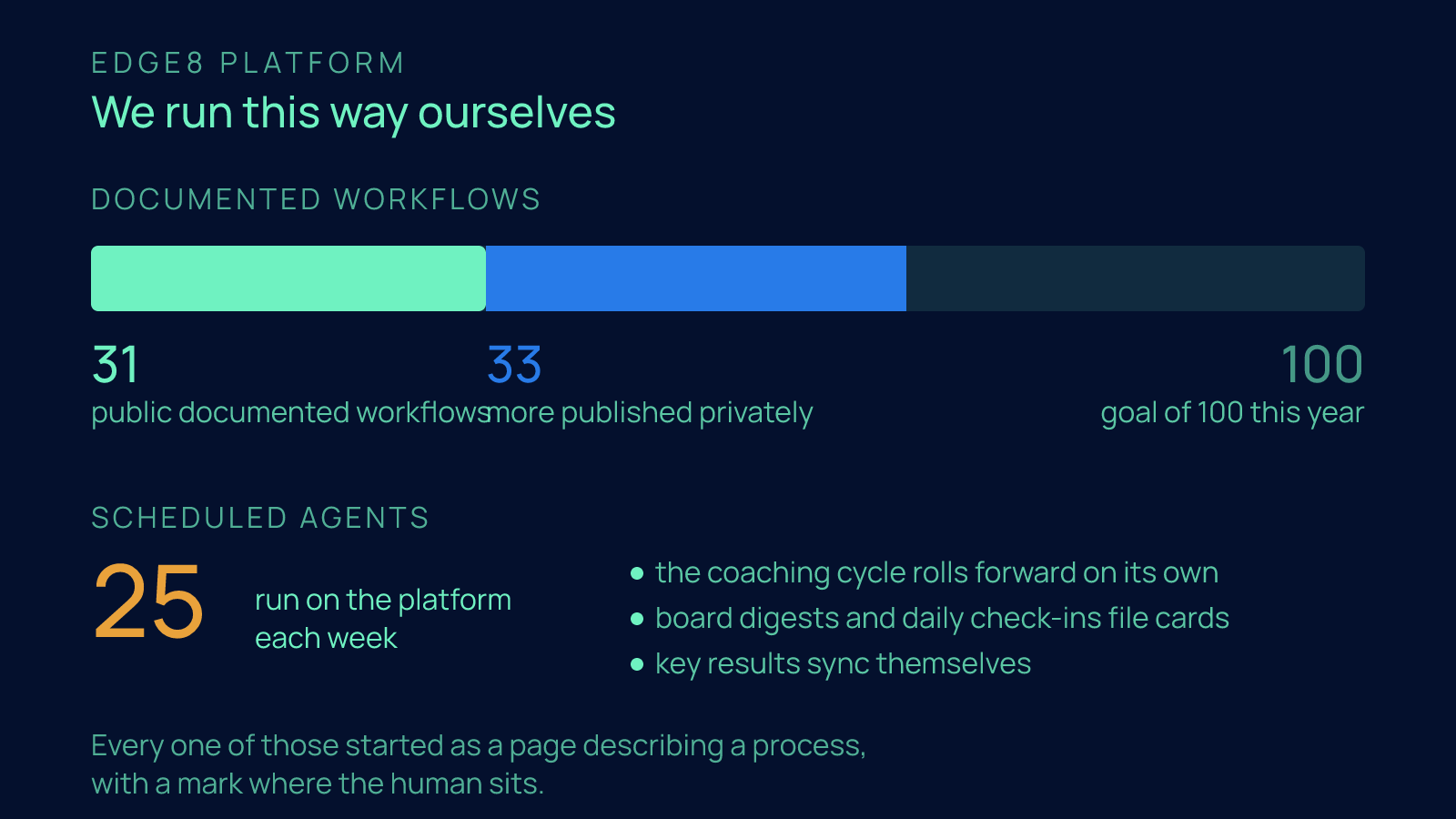
We run this way ourselves before we tell anyone else to. Edge8 has 31 public documented workflows and 33 more published privately, against a goal of 100 this year. Every public page draws its decisions, failure paths and human gates. 25 scheduled agents run on the platform each week: the coaching cycle rolls forward on its own, board digests and daily check-ins file cards, key results sync themselves. The Monday leadership packet is on the table before the meeting starts. Every one of those started as a page describing a process, with a mark where the human sits.
Do this one thing this week
Pick one process in your company that has an approval step in front of AI output. Just one.
Write it down end to end on one page. Where the work starts, every hand-off, what data each step needs and where that data lives, and where it ends. Then mark two things: where the human currently sits, and where the exceptions actually happen. In most companies those two marks are far apart. The human reads everything, and the real problems show up in three or four specific places.
That page is the beginning of the redesign. It is also the beginning of the job description for the person who should own it.
Reply to Edge8 with that page. Send it as it is, rough is fine. I will read it and we can talk about who should own the redesign in your company, and whether that is someone you already have or someone you still need.
FAQ
What is AI workflow redesign and why does Stanford's Enterprise AI Playbook say escalation beats approval?
AI workflow redesign means rewriting how a process runs so the machine handles the routine and a person only steps in on defined exceptions, instead of approving every output. The Enterprise AI Playbook by Pereira, Graylin and Brynjolfsson at Stanford's Digital Economy Lab (March 2026) reports that escalation-based models, where AI handles 80% or more autonomously and humans review exceptions, delivered 71% median productivity gains versus 30% for approval models. Same models and vendors, often the same use case. The variable is whether the workflow was redesigned so the human sits at the exception rather than at the gate.
What does the Enterprise AI Playbook say separates high performers from everyone else in enterprise AI?
The playbook cites McKinsey finding that top performers are nearly three times more likely to fundamentally redesign workflows as part of their AI efforts, with 55% of high performers redesigning workflows around AI against 20% of other companies. Its summary line is that high performers redesign workflows, not just deploy tools. The report also names four factors that consistently slow projects down: learning curve and iteration at 25%, data quality and preparation at 21%, regulatory and compliance at 21%, and process documentation gaps at 21%. Agentic implementations showed 71% median gains but represented only 20% of cases.
How does Edge8 publish blog posts without a person pressing Publish?
A person writes the idea and runs the writer agent, which drafts, edits, builds the SEO package, draws exhibits, makes the hero image, adds links, assembles the page and validates it across eight passes. The run parks at ready, a person sets a publish date, and the days before that date are the review window. If nobody pulls the post back, the daily routine publishes it at 11:00 Vietnam time, fetches the live page to prove it is up, and reports to the ops chat. The agent checks itself against 14 named failure conditions, such as an em dash or a slug already taken, and a post that fails validation stays scheduled and is named in the report rather than silently disappearing.
Why do documented workflows still fail if the data behind them is not connected?
A documented workflow without connected data can describe an exception but cannot detect one, because the numbers it would check live in systems that do not talk to each other, so the human stays at the gate by necessity. Edge8 saw this with a footwear retailer running eleven systems that already had workflows written down and still could not execute any of them; every process stayed manual and ended in a spreadsheet. Connected data without a documented workflow has the opposite problem: nothing to run. The two halves are one job and need one owner, which is the work an AI officer does inside a company.
How do you start an AI workflow redesign this week?
Pick one process that has an approval step in front of AI output and write it down end to end on a single page: where the work starts, every hand-off, what data each step needs and where it lives, and where it ends. Then mark two things, where the human currently sits and where the exceptions actually happen. In most companies those marks are far apart, with a person reading everything while the real problems show up in three or four specific places. That page is the beginning of the redesign and the beginning of the description of the role that should own it.