Last year you bought the tools.
A copilot seat for everyone who asked for one. A handful of subscriptions nobody tracks anymore. A pilot project with a sharp deck and a demo that got nods around the leadership table.
Now ask the honest question. What changed?
Not the headcount. Not the days between a sales call and a proposal in the customer's inbox. Not the margin. Not one weekly meeting runs differently than it did before the deck. The pilot demoed well, then died quietly, and nobody wrote the obituary because nobody wanted to be the one to say it.
So the company reaches for the comfortable conclusion. AI is not ready yet. We will look again next year.
That conclusion is wrong, and it is expensive. AI is ready. Your company is not. And there is hard data on exactly why.
The study that looked at winners, not failures
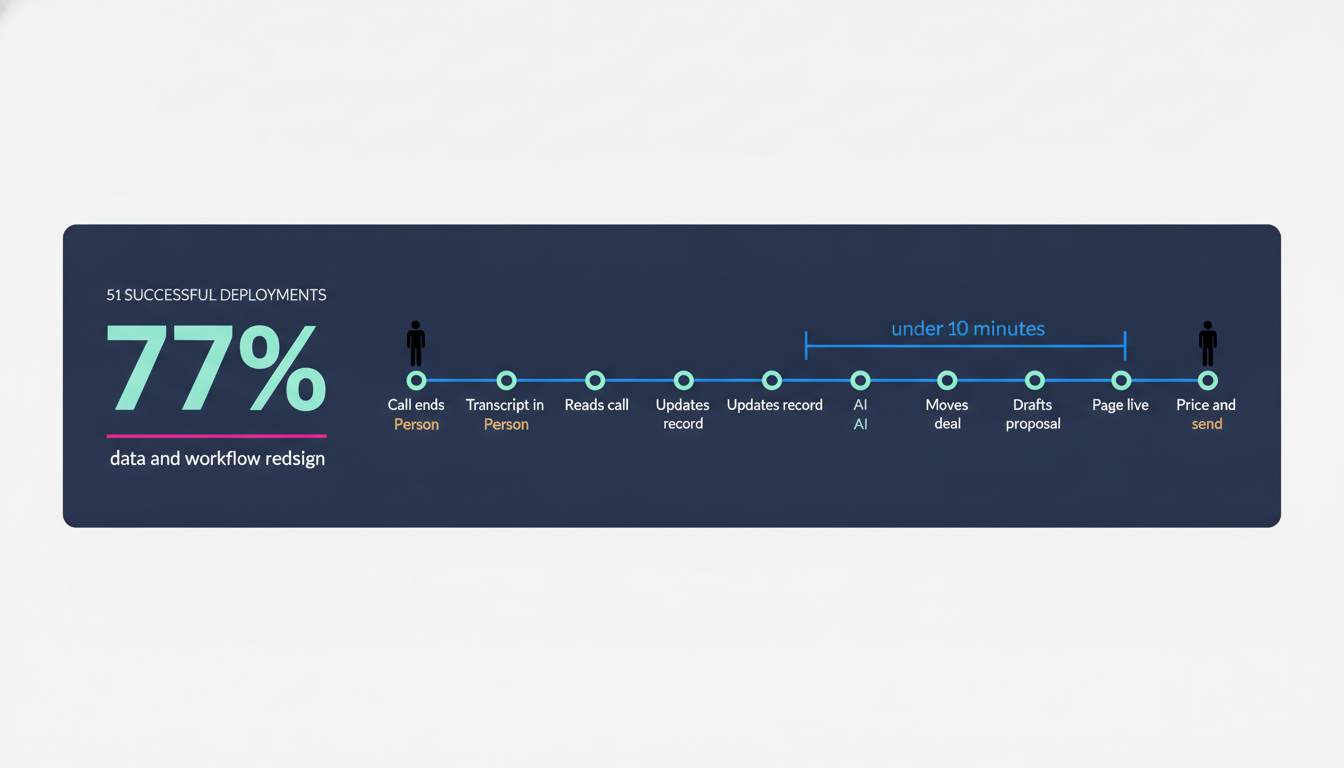
Stanford studied fifty-one successful AI deployments, the winners rather than the failures, and in seventy-seven percent of them the hard work was not the AI technology. It was the data, and redesigning the workflows.
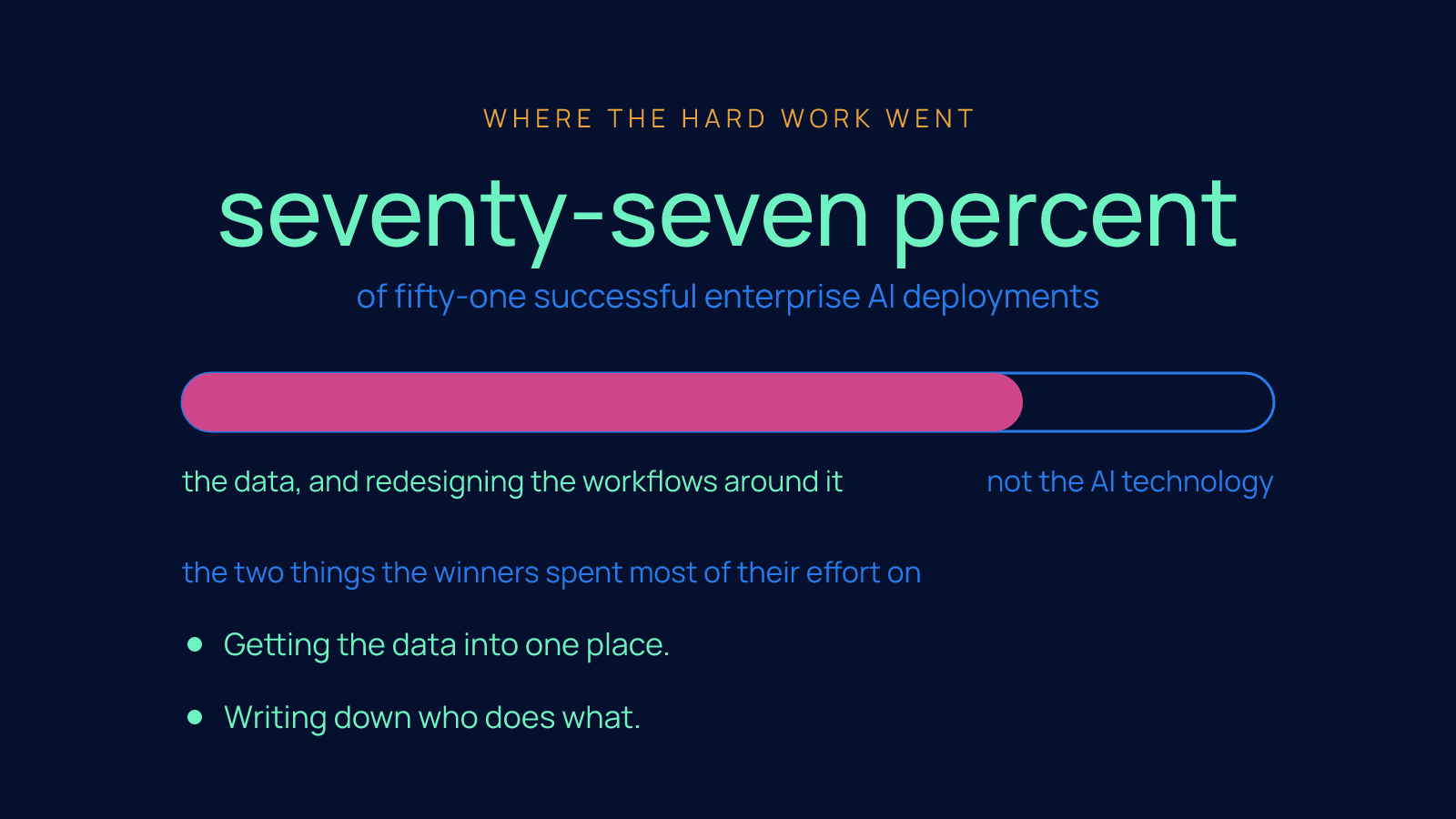
Most of what gets written about AI failure studies the failures. Stanford did the opposite. Researchers looked at fifty-one successful enterprise AI deployments, the ones that actually worked, and asked where the hard work went.
In seventy-seven percent of them, the hard work was not the AI technology. It was the data, and redesigning the workflows around it.
That one finding inverts how most companies spent last year. The budget went to tools. The meetings went to picking vendors. The pilot went to proving the model could do something clever on a clean example. Almost nothing went to the two things the winners spent most of their effort on:
- Getting the data into one place.
- Writing down who does what.
Neither is glamorous. Neither makes a keynote. But that is where more than three quarters of the companies that won put their effort.
Why a pilot demos well and still dies
Think about what a pilot usually is. Someone picks a tool. Someone finds a clean example. The tool does something impressive on that example in front of a room, and everyone agrees it looks promising.
Then it meets the actual company.
The customer data is in three systems and a spreadsheet. The proposal template lives in one person's drafts folder. Nobody has written down what happens after a sales call ends, because every rep does it a little differently and half of them do it on Friday afternoon from memory.
The AI did exactly what it was asked to do. The problem is that nobody could tell it what the next step was or where the real data lived. So it answered questions in a chat window, the humans went back to typing, and a few months later the seat licenses got quietly cut in the budget review.
That is not an AI failure. That is a missing design. The distinction matters because it decides what you fix. Swapping tools fixes nothing. Designing the workflow fixes the whole thing.
What a designed workflow actually is
A workflow is designed when every step names its owner, a person or an AI.
Here is the whole definition in one sentence: a workflow is designed when every step names its owner, a person or an AI.
Not "the team handles it." Not "AI helps with follow-up." Every step. One owner. A named person or a named AI step.
If you cannot list the steps between the call ending and the proposal sending, and put a person or an AI next to each one, you do not have a workflow. You have habits. And AI cannot run habits, because habits live in people's heads and change with their mood.
Day 1 of the 8 Edges season named two gaps: scattered data and undesigned workflows. Day 3 took the first one apart. Today is the second. Together they are the two things the Stanford winners fixed, and the two things your pilot never touched.
One designed workflow, end to end
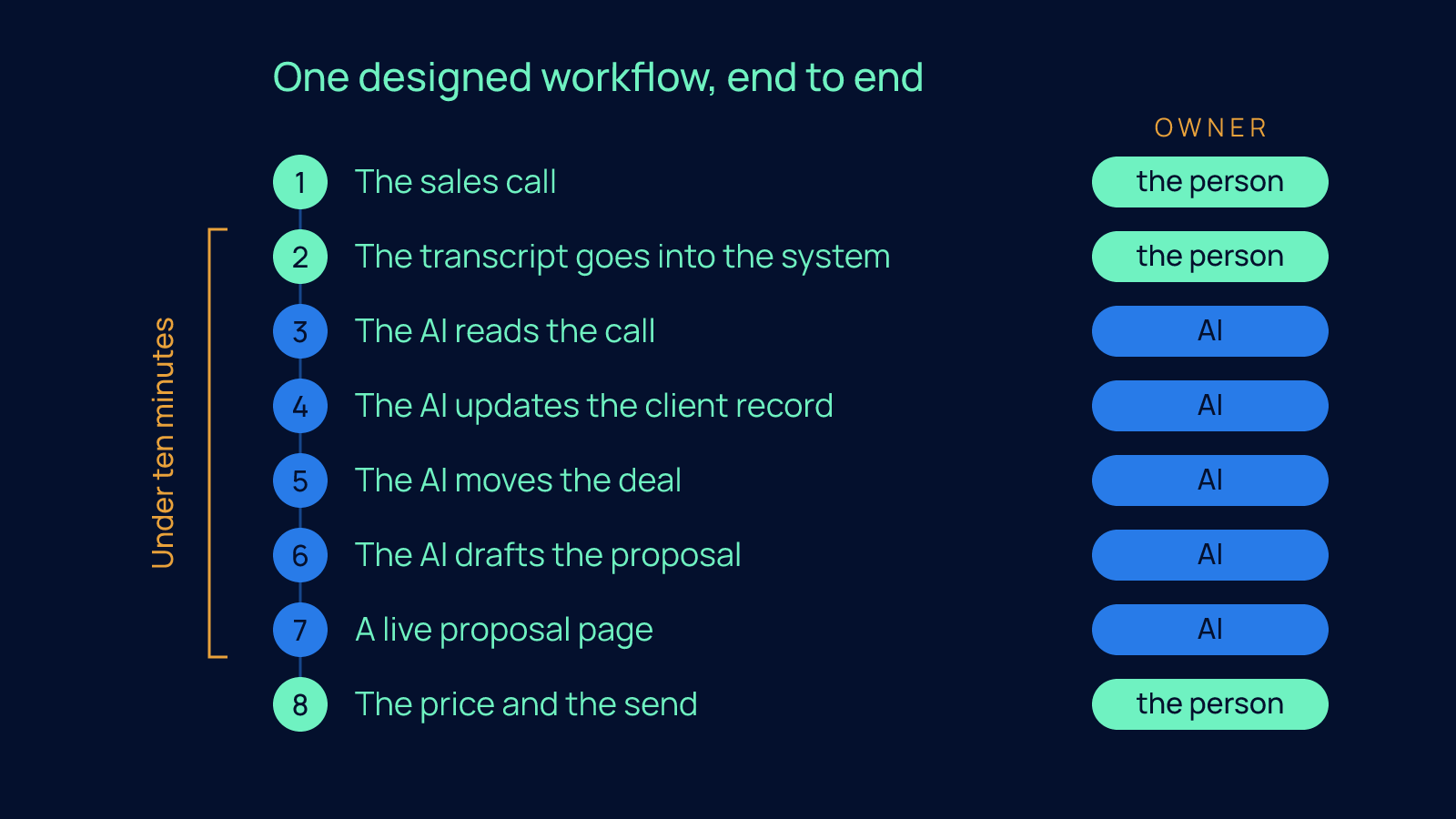
Rather than argue in the abstract, here is one workflow that runs live in Edge8's own Company OS today. (Company OS is simply what we call the system our company runs on: one set of data, with the workflows designed on top of it.) Every step has its owner marked.
Step 1. The sales call. Owner: the person. A human runs the conversation. Listens, asks, reads the room. Nothing here is automated and nothing here should be.
Step 2. The transcript goes into the system. Owner: the person. The call ends and the transcript lands in the system. That is the last thing a human types in this workflow. Everything after this point happens on its own.
Step 3. The AI reads the call. Owner: AI. It reads the full transcript, not a summary of a summary. What was asked for, what was promised, what the objection was, what the next step should be.
Step 4. The AI updates the client record. Owner: AI. The record reflects the conversation that just happened, in the one place the company keeps its data. Nobody retypes notes into a CRM on Friday.
Step 5. The AI moves the deal. Owner: AI. The deal advances to the stage the conversation earned. The pipeline is true because it was updated by the thing that read the call, not by whoever remembered to drag a card.
Step 6. The AI drafts the proposal. Owner: AI. The draft is built from the call and the record, so it reflects what the customer actually said rather than the last proposal someone copied.
Step 7. A live proposal page sits on our own domain, ready to send. Owner: AI. Not an attachment in a drafts folder. A page, on our domain, ready to go.
Step 8. The price and the send. Owner: the person. A human sets the price and decides whether it goes. That decision is never delegated.
Under ten minutes from hanging up the phone to a live proposal page. That is our own measure of our own workflow, not a research figure, and I want to be precise about the difference.
Run it through the two questions I ask about every claim involving AI. What did the AI just do? It read the call, updated the record, moved the deal and drafted the proposal. What does the person still decide? The call itself, the price, and whether to send.
Why this is not the pilot you already ran
Here is the part that should bother you. The AI in that workflow is not exotic. It is the same category of model that sat in your pilot and answered questions in a chat window.
The difference is not the technology. The difference is that it was handed one set of data and a written owner for every step. Nobody had to prompt it because the workflow told it what to do. Nobody had to check whether it updated the right record because there is only one record. Nobody had to chase the rep because the rep's only jobs are the call and the price.
Your pilot had none of that. It had a clever tool pointed at a company that had never written down how its own work moves. Of course it died.
The two unglamorous things, and who owns them
For a founder this is not an abstract lesson. It is a question of ownership, and it has to be answered with a name.
Someone inside your company has to own the data layer: get the customer records, the deals, the transcripts and the proposals into one place and keep them there. Someone has to own the workflow redesign: sit with the sales team, write down every step from call to proposal, and put a name or an AI next to each one.
That person is not a prompt wizard, and it is not the vendor who sold you the seats. It is someone who will spend weeks on consolidation and process mapping before anything looks impressive, and who understands enough of the business to know which steps a human must keep. If your last pilot had nobody in that seat, you now know why it stalled. Nobody gave the AI a workflow because nobody owned writing one.
Where Day 4 sits in the season
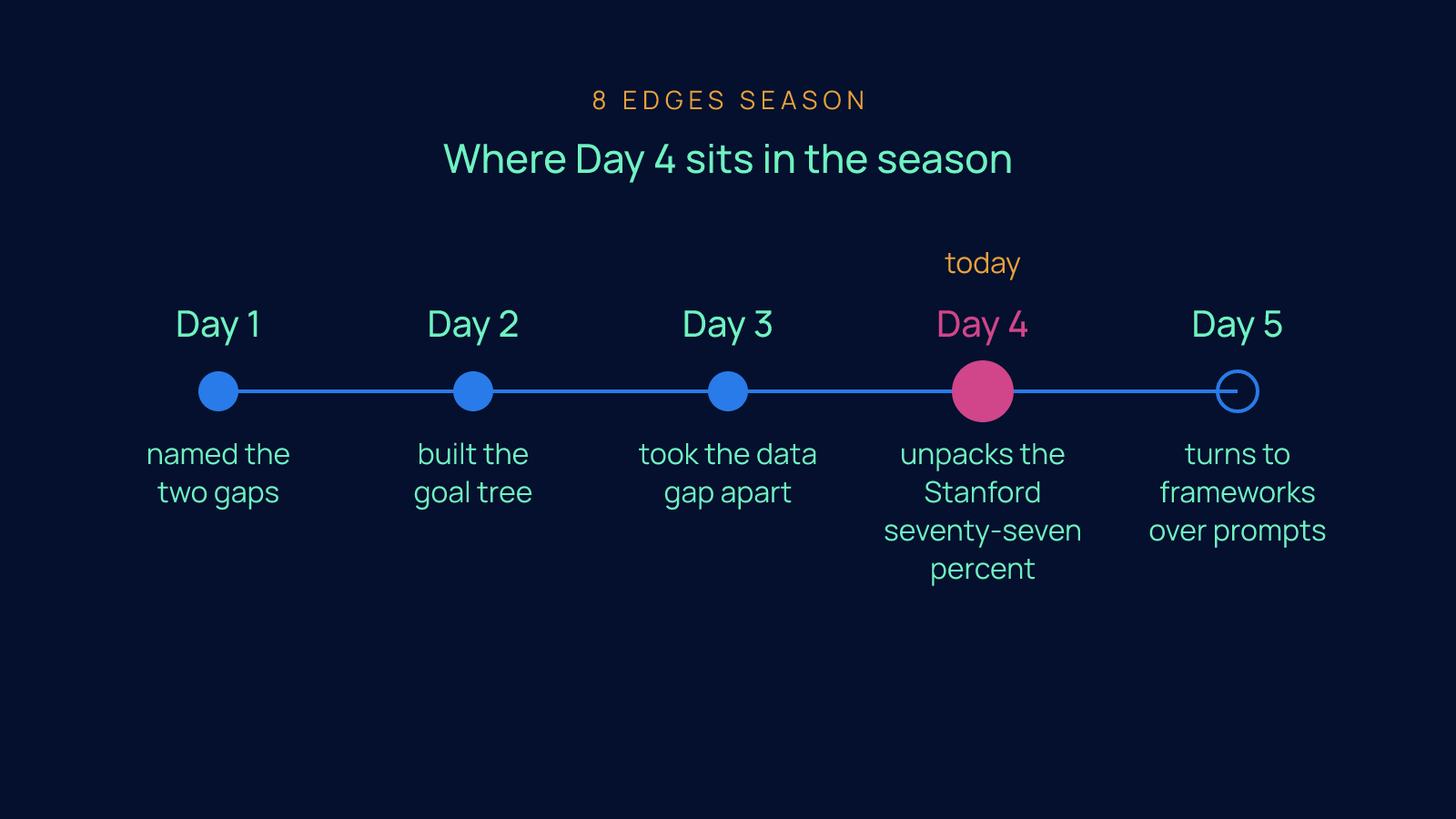
For anyone joining the 8 Edges season partway through:
- Day 1 named the two gaps, scattered data and undesigned workflows.
- Day 2 built the goal tree for the execution gap.
- Day 3 took the data gap apart, with the Stanford six percent.
- Day 4, today, unpacks the Stanford seventy-seven percent, names the second gap and shows the call-to-proposal workflow running end to end.
- Day 5 turns to frameworks over prompts.
The next step
Pilots did not fail because the AI was weak. They failed because nobody gave it a designed workflow on real data.
The pilots did not fail because the AI was weak. They failed because nobody gave it a designed workflow on real data. Fix those two things and the same AI you already paid for becomes a machine.
Watch the Day 4 film. It shows the workflow above actually running, call to live proposal page, with the owner marked at every step.
Then reply with two things: where your customer data lives today (every place, including the spreadsheet), and the one workflow you would most like to see run end to end. If you want to see the call-to-proposal workflow run inside Edge8's Company OS, ask in the same reply. We will tell you straight whether your data and your workflow are ready for it.
Tomorrow, Day 5, turns to frameworks over prompts.
FAQ
What is the real reason AI pilots fail after they demo well, and where should my team put the effort instead?
The pilot did not fail because the model was weak. Stanford looked at fifty-one successful enterprise AI deployments, the ones that actually worked, and in seventy-seven percent of them the hard work was not the AI technology but the data and redesigning the workflows around it. Most companies spent last year on tools and vendor meetings, which is the inverse of where more than three quarters of the winners put their effort. Put the effort into getting the data into one place and writing down who does what at every step.
How do I tell whether my sales process is something AI can actually run, or just a set of habits?
Use one test: a workflow is ready for AI when every step from the sales call ending to the proposal sending names a single owner, either a person or an AI. If you cannot list those steps and put one owner next to each, you have habits, and habits live in people's heads and change with mood. In most companies the customer data sits in three systems and a spreadsheet and the proposal template lives in one person's drafts folder, which is exactly why the tool answered questions in a chat window and nothing else changed.
How fast can AI turn a finished sales call into a proposal that is ready to send?
In a live workflow running inside Edge8's own system, it takes under ten minutes from hanging up the phone to a live proposal page on the company's own domain. That is a measure of one company's own workflow, not a research figure. The transcript going into the system is the last thing a human types; after that the AI reads the full call, updates the client record, moves the deal and drafts the proposal on its own.
Which parts of the sales-to-proposal process should a person keep and which should I hand to AI?
In the eight-step workflow described in the post, the person owns three steps: running the call, putting the transcript into the system, and setting the price and deciding whether the proposal sends. The AI owns the five steps in between: reading the call, updating the record, moving the deal, drafting the proposal and building a live proposal page. The whole run takes under ten minutes, and the price decision is never delegated.
Who in my company should own making AI change how work actually gets done, instead of just adding another tool?
Someone with a name has to own two unglamorous jobs: the data layer, meaning getting customer records, deals, transcripts and proposals into one place, and the workflow redesign, meaning sitting with the team and putting a person or an AI next to every step. That person is not a prompt wizard and not the vendor who sold the seats, and they will spend weeks on consolidation and process mapping before anything looks impressive. Stanford found that in seventy-seven percent of fifty-one successful deployments this is where the hard work went, so if your last pilot had nobody in that seat, that is why it stalled.