"A founder flies in and ships real AI programs alongside our team in a handful of days." That is how we describe an Infinite Leverage Retreat, and it is the wrong place to look for the return. The leverage is in the 90 days after the week, and in eight ordinary things the founders who get the most from a retreat do (four before they arrive, four once they are home), most of it plain discipline, which is exactly why most people skip it.
Before the retreat
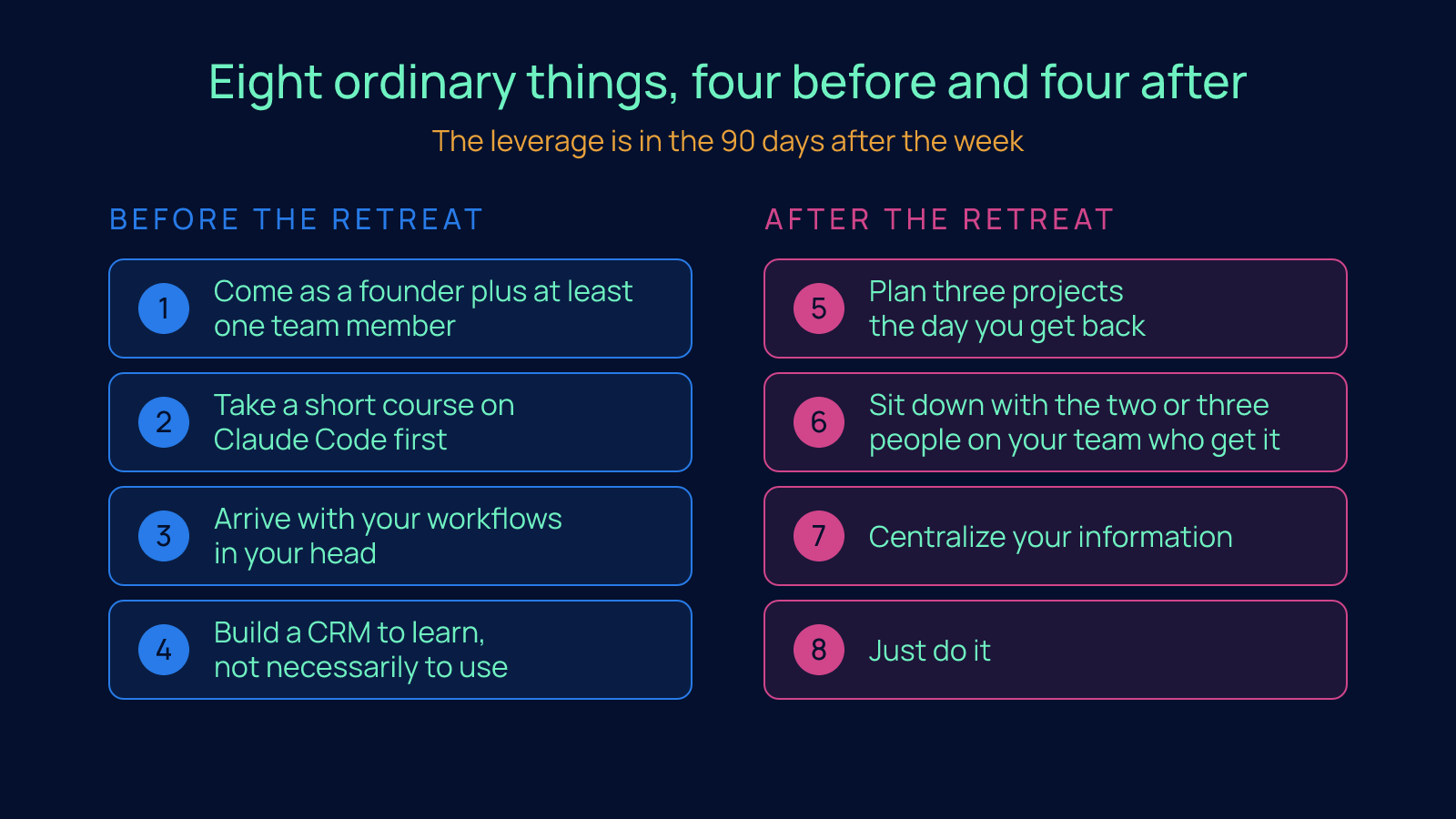
1. Come as a founder plus at least one team member
The most common way retreat work stalls is not technical. It is a founder flying home alone with a working program and a head full of new ideas, then spending the next three weeks explaining both to a team that was not in the room. Every question becomes a meeting. Every meeting waits on the founder's calendar. By the time the team understands the approach, the momentum from the week is gone.
Bring at least one person with you. Ideally the operator who actually runs the workflow you plan to rebuild, or the person who will own the data layer when you get back. When two of you sit through the same week, you leave aligned on the approach, not just the output. You can argue productively on the flight home. You can split the follow-up work. And when the rest of the team asks how it works, someone other than you can answer.
The cost of a second seat is small next to the cost of a founder who becomes the bottleneck for everything the retreat produced.
2. Take a short course on Claude Code first
The retreat is built around shipping, and shipping means the tool has to feel familiar before you sit down. Claude Code is Anthropic's tool for building software from the command line: you describe what you want in plain language and an AI agent writes and edits the code while you direct it. Anthropic publishes a short course, Claude Code in Action, that walks through the basics. Take it before you fly.
The founders who fumble on day one spend the retreat learning an interface instead of learning how their business maps to a workflow. You do not need to be an engineer. You need to have opened the tool, run a few commands, watched it create a file and then change it, and formed a rough sense of what it can and cannot do. That is an evening, not a semester.
Arrive with that, and the retreat starts on the real question: what should we build, and why that first.
3. Arrive with your workflows in your head
Our team can help you build almost anything. It cannot tell you which of your workflows is worth the most to fix. Only you know that, so walk the business in your head before you arrive. Where does information get retyped from one system into another? Where does a customer wait because a person is the queue? Which report do you assemble by hand every Monday? Which handoff between sales and delivery breaks the same way every quarter?
Write them down. Rank them by what they cost you: hours, errors, lost deals, founder attention. Pick the one at the top and have a rough idea of the inputs it uses, the decisions inside it and what a good output looks like. You do not need a specification. You need a point of view.
Founders who arrive without one spend the first day of a short week debating what to work on. Founders who arrive with one spend the first day building. The retreat is a compressed window, and the most expensive thing you can spend it on is deciding.
4. Know going in that you will build a CRM to learn, not necessarily to use
You will build a CRM at the retreat: a customer relationship management system, the database of contacts, companies, conversations and deal stages that a sales team lives in. Some founders hear that and push back. We already have one. We do not sell that way. Both may be true, and neither matters.
The point is not the CRM. The point is what building one teaches. A CRM is the simplest complete example of how data, workflow and AI fit together. There is structured data: contacts, deals, stages. There is a workflow: a lead moves from one stage to the next based on what happens. And there is an obvious place for AI to act: drafting the follow-up, summarizing the call, flagging the deal that has gone quiet. Build that yourself, in a few days, with an agent writing the code, and you understand something no vendor demo can teach: what is hard, what is easy, and where the data has to live for any of it to work.
You might keep it. Plenty do. But treat it as the lab exercise, not the product. Go in with that framing and you will pay attention to the right things: the shape of the data and the logic of the workflow, not the color of the buttons.
After the retreat
5. Plan three projects the day you get back
Over the next 90 days after the retreat, you got to build something.
Not the week after. The day. You leave the retreat with a working program, a method and more energy than you will have again for months. Spend that energy on a plan before it dissipates. Write down three projects you will build over the next 90 days.
What they are matters far less than that they exist. A language tutor for your team. A nurture campaign added to the CRM you just built. A system to track recruits. A tool to store recipes. That list is deliberately mixed, because at this stage you are building the muscle, not the business case. As I put it to founders: "Over the next 90 days after the retreat, you got to build something."
Three is the right number. One is too easy to abandon. Five is a backlog. Three keeps you shipping. Sequence them: the easiest first, so you finish something in the first two weeks, and the one closest to the workflow you ranked in point three last, when your skill has caught up to its value. Put dates on them. Tell someone.
6. Sit down with the two or three people on your team who get it
Not everybody's going to get it.
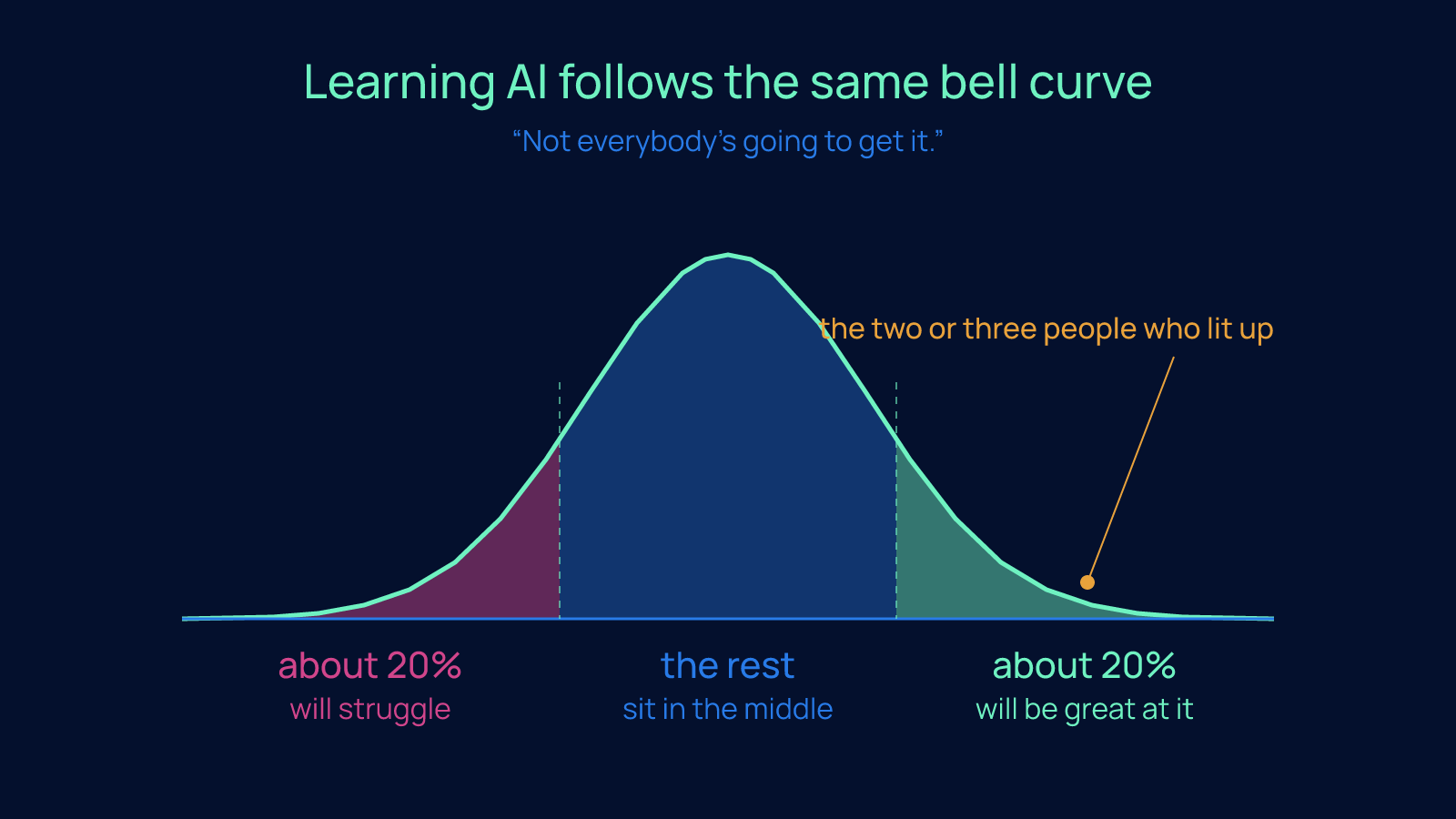
"Not everybody's going to get it." That is not a judgment on your team. It is how learning anything hard works, and AI is no exception. Think of calculus: some people take to it fast, some never quite do, most land in the middle. Learning AI follows the same bell curve. About 20% of your team will be great at it, about 20% will struggle, and the rest sit in the middle waiting to see which way it goes.
So do not run a company-wide rollout in week one. Find the two or three people who lit up when you described what you built, the ones asking what else it could do rather than why it will not work. Sit down with them. Show them the CRM. Give each one a piece of the three projects. Those two or three become the people who pull the middle along, because the middle learns from peers, not from mandates. The 20% who struggle are not lost. They come along later, once the tools are embedded in work they already do.
Fighting the curve wastes the 90 days. Working with it means your first cohort is small, motivated and shipping.
7. Centralize your information
You have to have a good idea of where your data is.
Every project on your list will hit the same wall: it needs data you have not gathered in one place. "You have to have a good idea of where your data is." So make the list. Every place the business stores information: the shared drive full of documents, the spreadsheet that is secretly your pricing model, the Trello board where projects live, the CRM, the inbox holding half the customer history, the accounting system, the notes app one salesperson swears by.
You do not have to move it all on day one. You have to know where it is, who owns it, what shape it is in (structured rows and columns, or prose no system can query) and which of your three projects depends on which source. Then start pulling the pieces those projects need into one place an AI agent can reach.
This is the step founders most want to skip because it is unglamorous, and it is the step that decides whether the projects ship. A tool built on scattered data gives confident answers from partial information. We went deeper on this in how to centralize business data before buying another tool, and it applies with extra force in the 90 days after a retreat.
8. Just do it
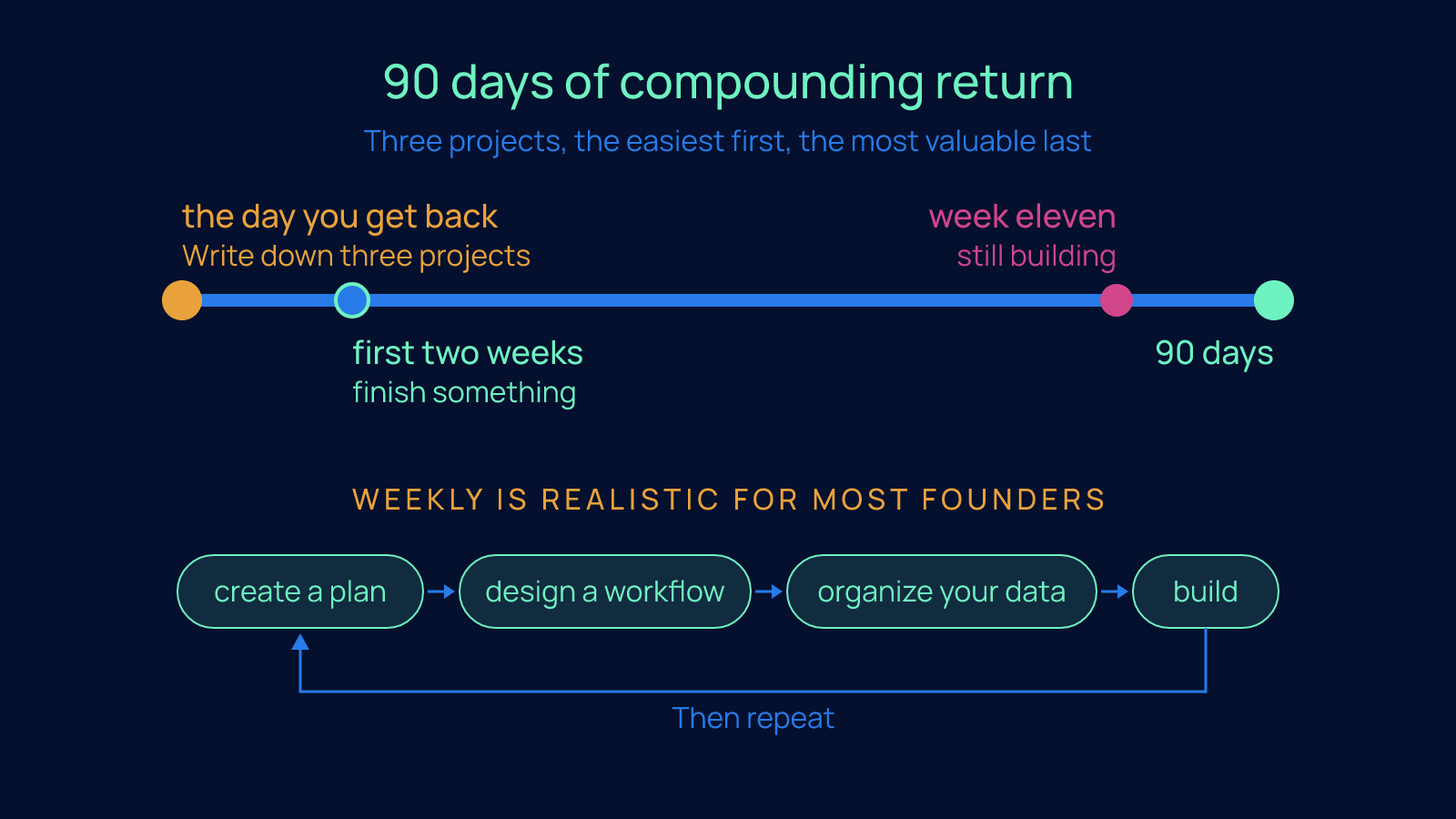
The last of the eight is the least clever and the most important. For 90 days, keep a consistent rhythm: create a plan, design a workflow, organize your data, build. Then repeat. Weekly is realistic for most founders. The exact cadence matters less than the fact that it does not break.
Each cycle you get faster. The prompts get sharper. You stop fighting the tool and start asking it for the thing you actually want. Then something shifts: as you get better, you see where the true return on investment sits in your business. Not where a vendor said it was, not where a conference speaker said it was, but in the specific workflow where a senior person's hours turn into minutes, or where a lead that used to wait days waits seconds. You only see that by building, because building forces you to look at how the work actually flows.
The founders who get the most out of a retreat are not the smartest people in the room. They are the ones still building in week eleven.
"Every retreat runs the same five stages, and each one leaves the P&L a little more complete." The eight things above are what turn that week into 90 days of compounding return. Book an Infinite Leverage Retreat, and bring the team member who will build it with you.
FAQ
How do I get the most out of an AI retreat?
Do four things before you arrive and four once you are home. Before: bring at least one team member, take a short Claude Code course, arrive with your workflows in mind, and know you will build a CRM to learn. After: plan three projects, work with the two or three people who get it, centralize your information and keep a steady rhythm for 90 days. The return is in those 90 days, not in the week itself.
What should I do before an AI retreat to prepare?
Bring at least one team member so two people leave aligned, take a short course such as Anthropic's Claude Code in Action so you are not learning the tool in the room, arrive knowing which workflow is worth the most to improve, and expect to build a CRM to learn rather than to use. That preparation is what lets you start building the day you land and make the 90 days after the retreat count.
What should I build first after an AI retreat?
Write down three projects the day you get back and build them over the next 90 days. What they are matters less than finishing them: a language tutor, a nurture campaign added to a CRM, a tracker for recruits or a recipe store all train the same skill.
How many people on my team will actually pick up AI?
About 20% of your team will be great at it, about 20% will struggle, and the rest sit in the middle waiting to see which way it goes, the same bell curve as learning calculus. Start with the two or three people who get it and let the middle follow what they ship.
How do I keep momentum after an AI workshop?
Keep a consistent rhythm for 90 days: create a plan, design a workflow, organize your data, build, then start the next project. Know where your data lives before you build, because every project after the retreat runs into that question.