
Every founder I sit across from reaches for one of two moves first.
Move one is the AI pilot. Pick a team, buy a tool, give it a quarter, see what happens. Move two is the re-org. Redraw the boxes, rename a few titles, add a layer, and hope the strategy finally lands with the people who have to execute it.
Both moves are wrong, and they are wrong for exactly the same reason. They change the tools or the org chart while the two things that actually decide whether work gets done stay exactly as they were. The data stays scattered. The workflows stay undesigned.
You do not have two gaps. You have one gap, seen twice
Here is the first gap. You know the strategy. You could write it on a napkin. The other 199 people in the company have to execute it every day, and by the time your intent has passed through three managers, five meetings and a dozen tools, it is not your strategy any more. It is a hundred small guesses about what you probably meant. That is the execution gap, and every founder I know feels it in their stomach on a Tuesday afternoon.
Here is the second gap. Leaders want AI to run the business: read every deal, track every candidate, prepare every meeting, flag every risk. Then they switch it on and it does very little, because nobody has told it what the work is. There is no designed workflow for it to run. The data it would need lives in a CRM (the sales database), a spreadsheet, a ticketing system, a shared drive, a Slack thread and someone's head. That is the AI gap.
Look at those two again. The strategy cannot reach the team because the work is undesigned and the information is scattered. The AI cannot help the team because the work is undesigned and the information is scattered. Same cause. Same gap. AI did not create it. AI just makes it impossible to ignore, because a model cannot read a strategy that lives in your head, and it cannot join twelve databases you do not own.
Why the AI pilot fails
Stanford's study of 51 successful AI programs found 77% of the work was data and workflow redesign, not the technology.
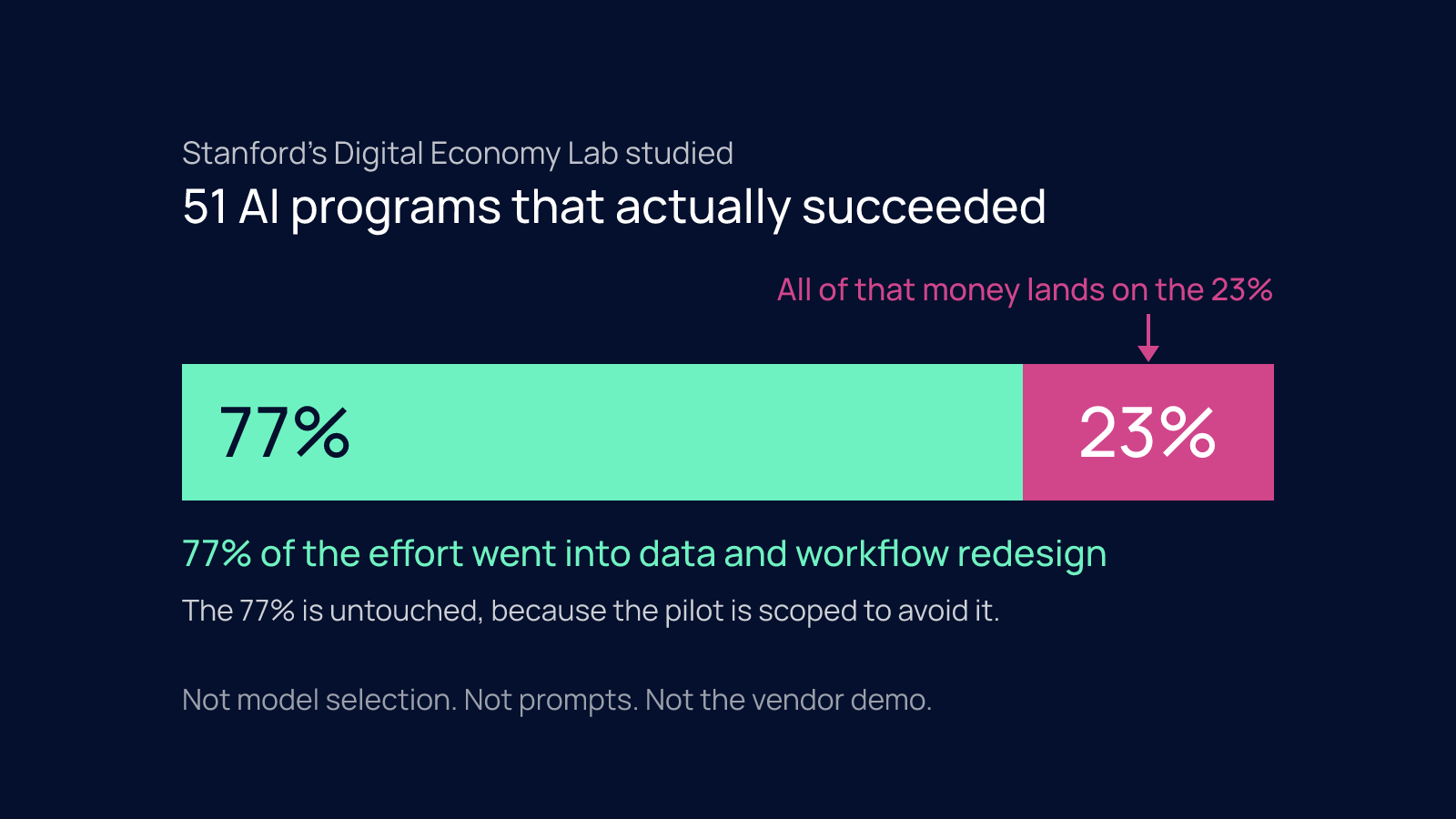
Stanford's Digital Economy Lab studied 51 AI programs that actually succeeded. Not the ones that stalled at the pilot, the ones that worked. Across those 51, 77% of the effort went into data and workflow redesign. Not model selection. Not prompts. Not the vendor demo. Getting the data into one place and deciding, step by step, what the work is and who does what.
Now look at what a typical pilot buys. A tool, a license, a champion on one team, and a quarter to prove value. All of that money lands on the 23%. The 77% is untouched, because the pilot is scoped to avoid it. Nobody wants to start a data cleanup to test a chatbot. So the pilot produces a nice demo and no change, and the company concludes that AI is not ready. AI was ready. The company was not.
Why the re-org fails
The re-org is the same mistake in a different suit. You move people into new boxes and give the boxes new names. What you do not move is the data, and what you do not redesign is the work. The same handoffs happen in the same order with the same gaps, except now people are reporting to someone new and spending the first three months learning who to ask.
A re-org changes who is accountable for an outcome. It does not change whether anyone can see the outcome, or whether the steps to reach it are written down anywhere. If the information is still in twelve places, the new leader inherits the same blind spots the old one had, with less context.
Flip the order
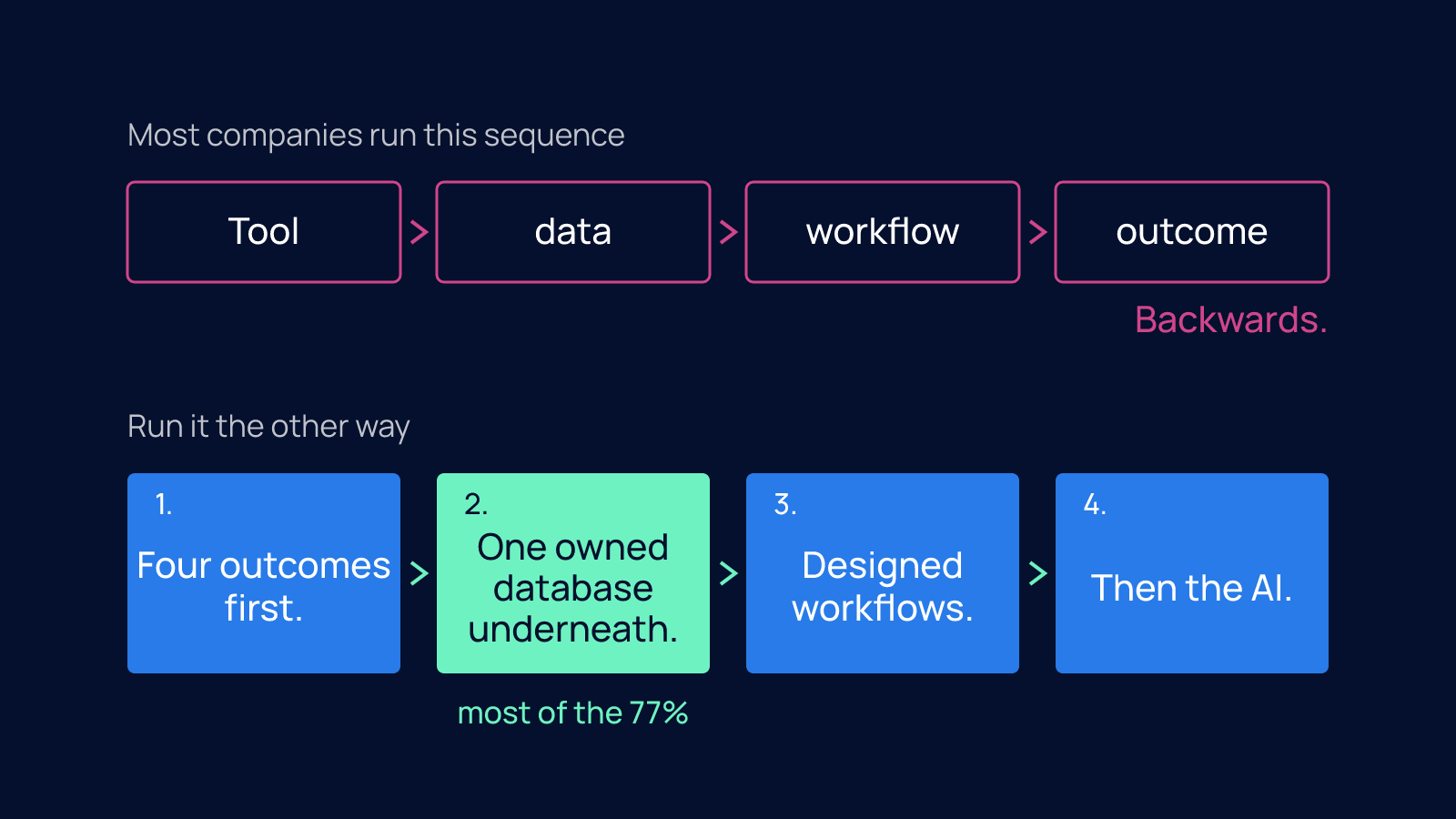
Most companies run this sequence: pick the AI, then hunt for the data it needs, then notice the workflow is a mess, then, sometimes, ask what outcome all this was for. Tool, data, workflow, outcome. Backwards.
Run it the other way.
1. Four outcomes first. Decide what the company is actually trying to move, in words a new hire could repeat on day one. Not a 40-page strategy deck. Four outcomes, one sentence each.
2. One owned database underneath. Owned means you control it, it lives in one place, and you can query it without asking a vendor. Every deal, every person, every project, every idea, in one structure. This is the single hardest step and the one everybody skips. It is also most of the 77%.
3. Designed workflows. A workflow is just the steps a piece of work goes through, who owns each step, what done looks like at the end of it, and what happens next. Most companies have never written theirs down. Writing them down is the redesign. You will find half of them do not need to exist.
4. Then the AI. With the outcomes named, the data in one place and the steps defined, AI has something to do. It can read the database, track the work against the outcomes, and prepare what a person needs before they need it. This is the easy part, which is why it should come last. Put a model in before the data and you have bought something expensive with nothing to read.
Notice that steps one to three fix the execution gap on their own. Even if you never turned on a single model, your 199 people would now know what the company is trying to do, where the information is, and what their part of the work looks like. The AI gap closes as a side effect.
The Four Offices: organize the work without reorganizing the business
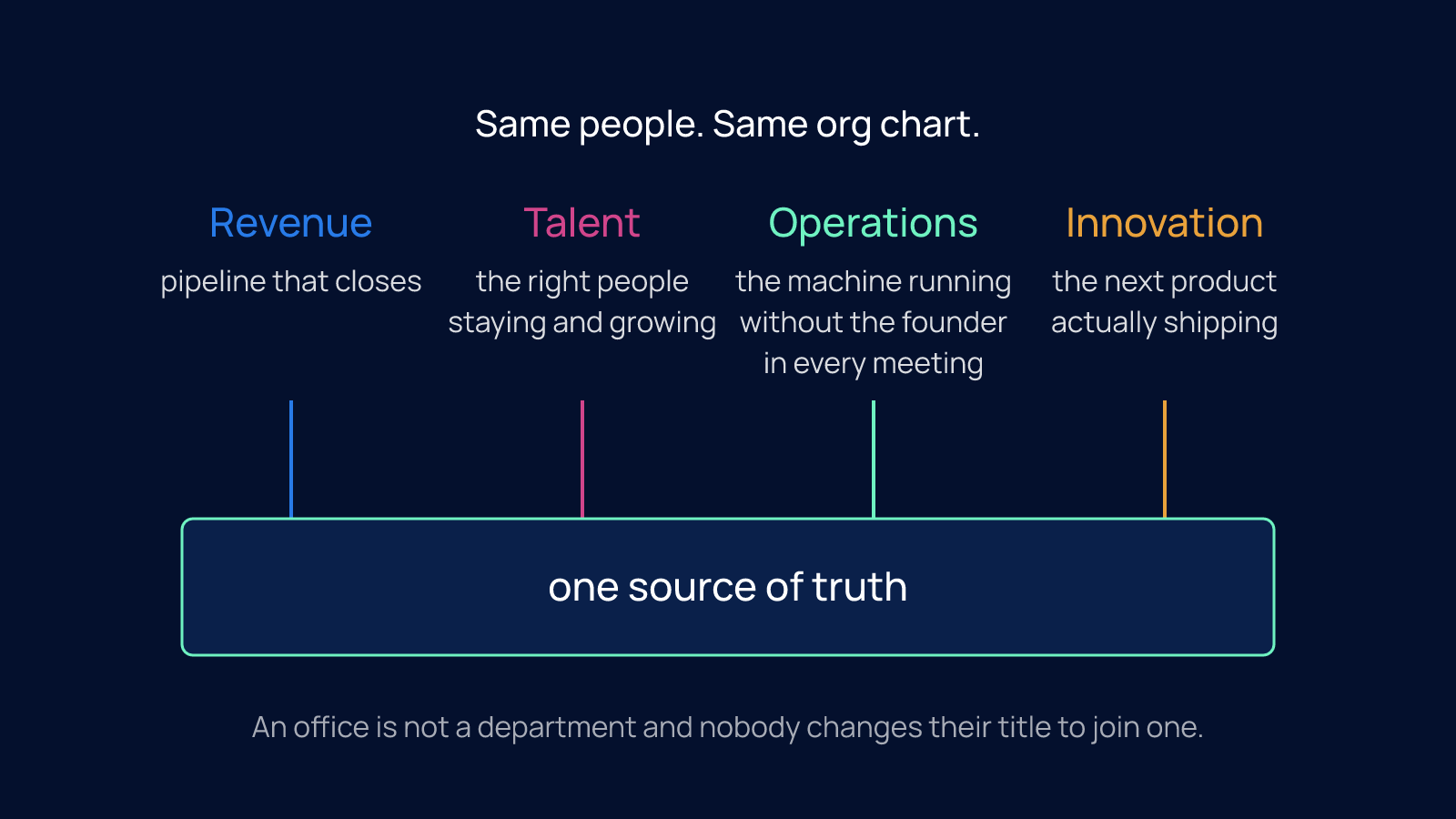
So how do you get four outcomes without another re-org? You stop organizing by department and start organizing by outcome.
We call it the Four Offices. Revenue. Talent. Operations. Innovation. Every company, whatever it sells, is trying to do those four things: bring money in, get and keep the right people, run the machine, and build what is next. Each office is aimed at an outcome the whole company can name.
An office is not a department and nobody changes their title to join one. It is a lens over the same single database. The Revenue office looks at every deal, every account, every conversation, and the outcome is pipeline that closes. The Talent office looks at every candidate, every one-on-one, every review, and the outcome is the right people staying and growing. The Operations office looks at every project, every ticket, every process, and the outcome is the machine running without the founder in every meeting. The Innovation office looks at every experiment and every idea, and the outcome is the next product actually shipping.
Same people. Same org chart. Four clear outcomes, one source of truth, and the work designed so that anyone can see where a piece of it sits and who owns the next step. That is how you close the execution gap without a single announcement about reporting lines.
What the AI does, and what the person still decides
The AI does the reading, the tracking and the preparing. The people do the deciding.
Every claim about AI in this system has to answer two questions. What did the AI just do? What does the person still decide?
The answer is the same in every office. The AI does the reading, the tracking and the preparing. It reads the database so a human does not have to open six tabs. It tracks every piece of work against the outcome its office is aimed at. It prepares the brief, the summary, the draft, the list of what changed since yesterday.
The people do the deciding. Which deal to chase. Who to bring on. Which project to kill. Which idea gets funded. The AI does not make one of those calls, and it should not, because the accountability for the outcome belongs to a person with a name.
This is also why the order matters. An AI that reads scattered data prepares a bad brief. An AI that tracks work with no designed workflow tracks nothing. Put the database and the workflows in first and the reading, tracking and preparing become useful. Put the AI in first and you get the pilot that goes nowhere.
Here is the dare
The season itself is the proof: numbers carry from one episode to the next.
It is easy to write a post like this. Anyone can draw four boxes and a database. So starting Monday 21 September, Edge8 is going to rebuild its own company on this exact system, in the open, for 30 days.
Real screens. Real data. Our own Company OS, which is our name for the single database and the Four Offices running on top of it. Day 1 shows the whole system once, end to end, so that every later episode has a place to sit. From there, one episode a day, and the numbers carry from one episode to the next. If a deal shows up in the Revenue office on Day 4, you will see what happened to it on Day 19. The season itself is the proof. If the system does not hold up on our own business, you will watch it not hold up.
You do not have an AI problem and an execution problem. You have one problem, and it is fixable in the right order.
Your next step: watch the Day 1 film on Monday 21 September. If you want to see the Four Offices running on your own data instead of ours, reply and ask for a demo. Tell me which of the four outcomes you would start with.
FAQ
How do I close the execution gap between my strategy and what my team does every day?
Run the work in this order: name four outcomes in one sentence each, put every deal, person, project and idea into one database you own, write down the steps and owner for each workflow, and only then add AI to read, track and prepare. The gap exists because your intent reaches the other 199 people only after passing through three managers, five meetings and a dozen tools, so it arrives as a hundred guesses about what you meant. Stanford's Digital Economy Lab found that across 51 AI programs that succeeded, 77% of the effort went into data and workflow redesign, and that same 77% is what closes the execution gap even if you never switch on a model.
Why do AI pilots produce a nice demo and then no real change in the business?
Because a pilot is scoped to avoid the hard part. Stanford's Digital Economy Lab studied 51 AI programs that actually worked and found 77% of the effort went into getting the data into one place and redesigning the workflow, not model selection or prompts. A typical pilot spends its whole budget on the other 23%, a tool, a license and a champion on one team, so the scattered data and undesigned work stay exactly as they were and the company wrongly concludes AI is not ready.
Should I start with an AI pilot or a re-org to get my strategy executed?
Neither, because both change the tools or the org chart while the two things that decide whether work gets done, where the data lives and how the work is designed, stay untouched. A re-org moves people into new boxes and they spend the first three months learning who to ask, while the same handoffs happen in the same order with the same blind spots. Start instead with the 77% that Stanford's Digital Economy Lab found in 51 successful AI programs: one owned database and written workflows, which is also what lets the other 199 people see what the company is trying to do.
How do I organize my company around outcomes without doing another re-org?
Stop organizing by department and start organizing by outcome: every company is trying to bring money in, get and keep the right people, run the machine, and build what is next, so aim one lens at each of those four outcomes over the same single database. Nobody changes their title and the org chart stays the same; each lens just shows every deal, every candidate, every project or every experiment tracked against the outcome the whole company can name. Keep the outcomes to four sentences a new hire could repeat on day one, not a 40-page strategy deck, and the 199 people who execute finally know where the information is and what their part of the work looks like.
What should AI actually do in my business, and what should people still decide?
The AI does the reading, the tracking and the preparing: it reads the single database, tracks every piece of work against the outcome it belongs to, and prepares the brief, the summary and the list of what changed since yesterday. People make every decision with a name attached to it: which deal to chase, who to bring on, which project to kill, which idea gets funded. This only works in the right order, because an AI reading scattered data prepares a bad brief, which is why Stanford's Digital Economy Lab found 77% of the effort in 51 successful AI programs went into data and workflow redesign before the model did anything useful.