I spent years at TINYpulse working with more than 1,000 businesses: Fortune 100 companies such as Fidelity, Alaska Airlines and the Boston Red Sox, and hundreds you have never heard of. Different industries, sizes and cultures. Their one-on-one coaching programs failed the same way almost everywhere.
Three reasons. Every time.
One: preparation takes time, so it does not happen. The manager walks in with whatever is in their head from the last two hours, not the last two months.
Two: memories are short and nobody sets accountability. Without a written commitment with an owner and a date, the next meeting cannot open with "you said you would," so it opens with "how are things going," and the hour becomes a casual catch-up.
Three: the documentation is never clear enough to use. You cannot spot a trend across six meetings from a few bullets in a notebook, and you cannot coach a manager on how they coach when there is no record of how they coached.
Those are my observations from the table, not research findings. But I saw the pattern often enough to stop treating it as three problems. It is one problem with three symptoms: nobody owns the record.
Why the record is worth owning
managers account for at least 70% of the variance in employee engagement scores across business units
The research on managers and feedback is blunt about the stakes.
Gallup found that "managers account for at least 70% of the variance in employee engagement scores across business units." Not pay, not perks, not the mission statement on the wall. The manager.
Gallup's later work on feedback puts a clock on it. Among employees who say they received meaningful feedback in the past week, 80% are fully engaged. People who get daily feedback from their manager are 3.6 times as likely to feel motivated to do outstanding work as people who get it once a year. Feedback is a weekly discipline or it is barely working.
Now the part most managers never hear. Kluger and DeNisi reviewed 607 effect sizes from feedback studies. On average, feedback helps: an effect size of 0.41, a moderate lift. But in more than a third of cases, feedback made performance worse. Generic, late, or aimed at the person instead of the work, and it does damage.
So the job is not "give more feedback." The job is feedback that is specific to the person, tied to what they actually committed to, and reviewed by a human before it lands. Those three requirements map onto the three failures. No prep means generic. No accountability means untethered. No documentation means nobody can see whether it helped.
An agent removes all three at once
Every fix I saw at TINYpulse attacked one failure. A meeting template for prep. A shared doc for commitments. A quarterly review to find trends. Each added work for the manager, and the added work is why none of them stuck.
An AI agent is the first tool I have seen that removes all three without adding work, because it will do the three things a manager will not do at 7:45 on a Tuesday: read the whole record, remember every commitment, and write documentation clear enough to show a trend.
So we built our biweekly cycle against the three failures directly. The mechanics are on the workflow page, and I made the case in an earlier post on running better one-on-ones with AI, so I will not repeat either here. The short version: a daily 7:45 routine rolls each person's next 1-1 forward by cadence. Before the meeting, an agent writes the coach a prep from the record: FAST goals (goals that are discussed frequently, ambitious, specific and transparent), priorities, KPIs (the numbers they are measured on), open commitments, the person's OCEAN profile (a five-factor personality profile), check-ins, prior recaps and the shared talking points. The coach holds the meeting. The transcript comes back. An hourly routine drafts a two-tier recap, one tier the coach sees and one the person sees, and the shared tier reaches the person only after the coach reviews and publishes it. Commitments are logged, closed or carried. A mid-cycle check-in loops into the next prep. A monthly trend report per person sets the coaching focus.
The map is simple. Failure one, preparation, is done by the agent from the record. Failure two, memory and accountability, lives in the commitments log, the recap and the roll-forward. Failure three, documentation and trends, is the two-tier recap, the trend report, and a mode split that shows the coach how they coached.
We are six weeks in. The scoreboard is below, including the numbers I would rather not print. First the path, because the path is what you can use.
The eight weeks, one move each
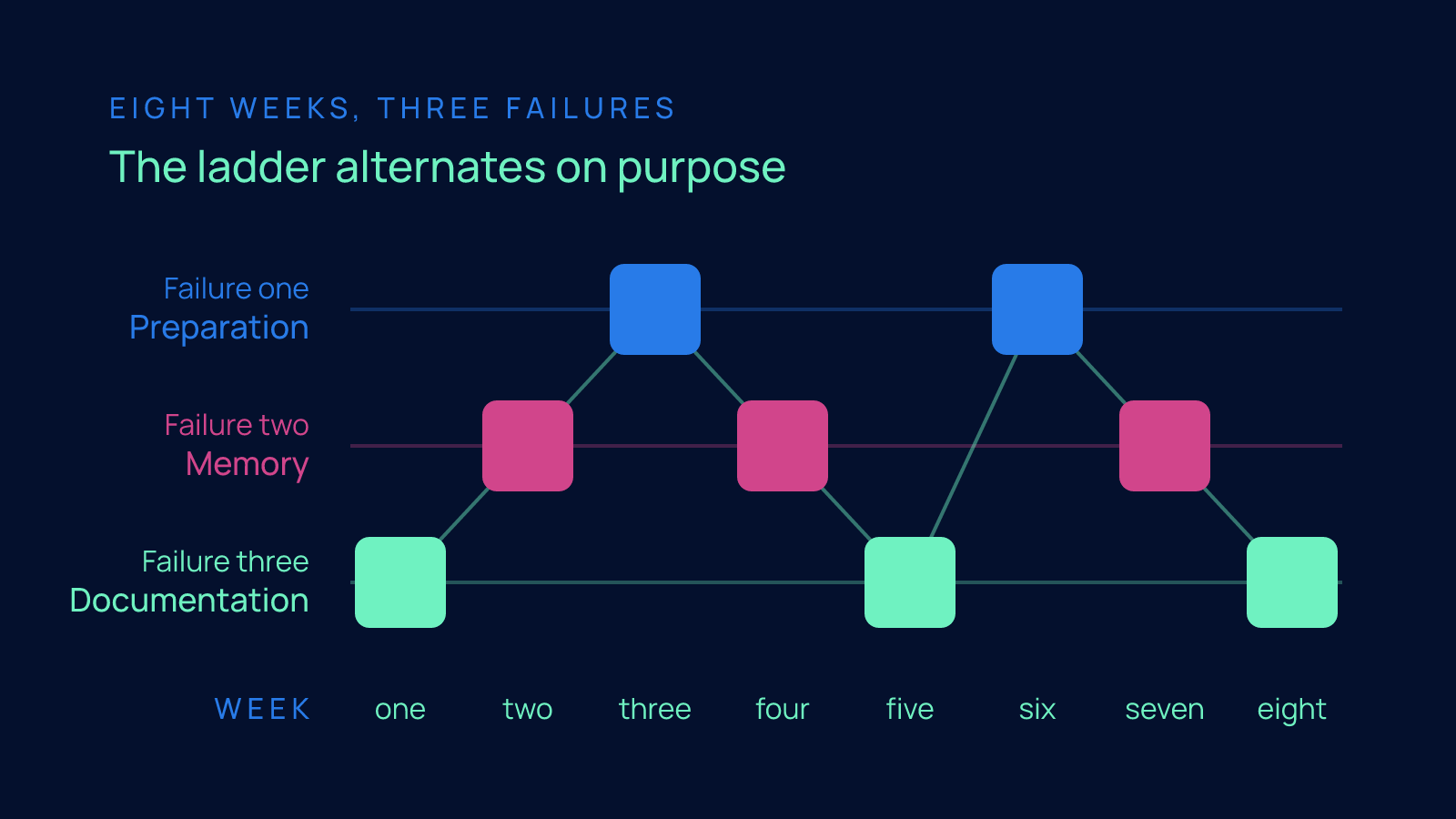
Each week names the failure it removes, what we did, and what we got wrong. Do them in order. Each week's output is the next week's input, and every gap we have in week six traces back to a shortcut in week one.
The ladder alternates on purpose. Weeks one, five and eight remove the documentation failure. Weeks two, four and seven remove the memory failure. Weeks three and six remove the preparation failure. You never fix one failure for long without the other two.
Week one: one row per person
Removes failure three. Put each person's goals, priorities and the last three meetings on a single record. Not a folder, not a chat thread. One row you can point an agent at.
We did this for the people already on the cycle. What we got wrong: we did not get everyone on it on day one, and the roll-forward did not cover every profile. Every person missing from the record in week one became a meeting with no prep in week three. The record is the foundation. Do not pour half of it.
Week two: write down the commitments
Removes failure two. Every promise from every 1-1 gets a line: what, who owns it, by when. Both directions, the coach's promises too.
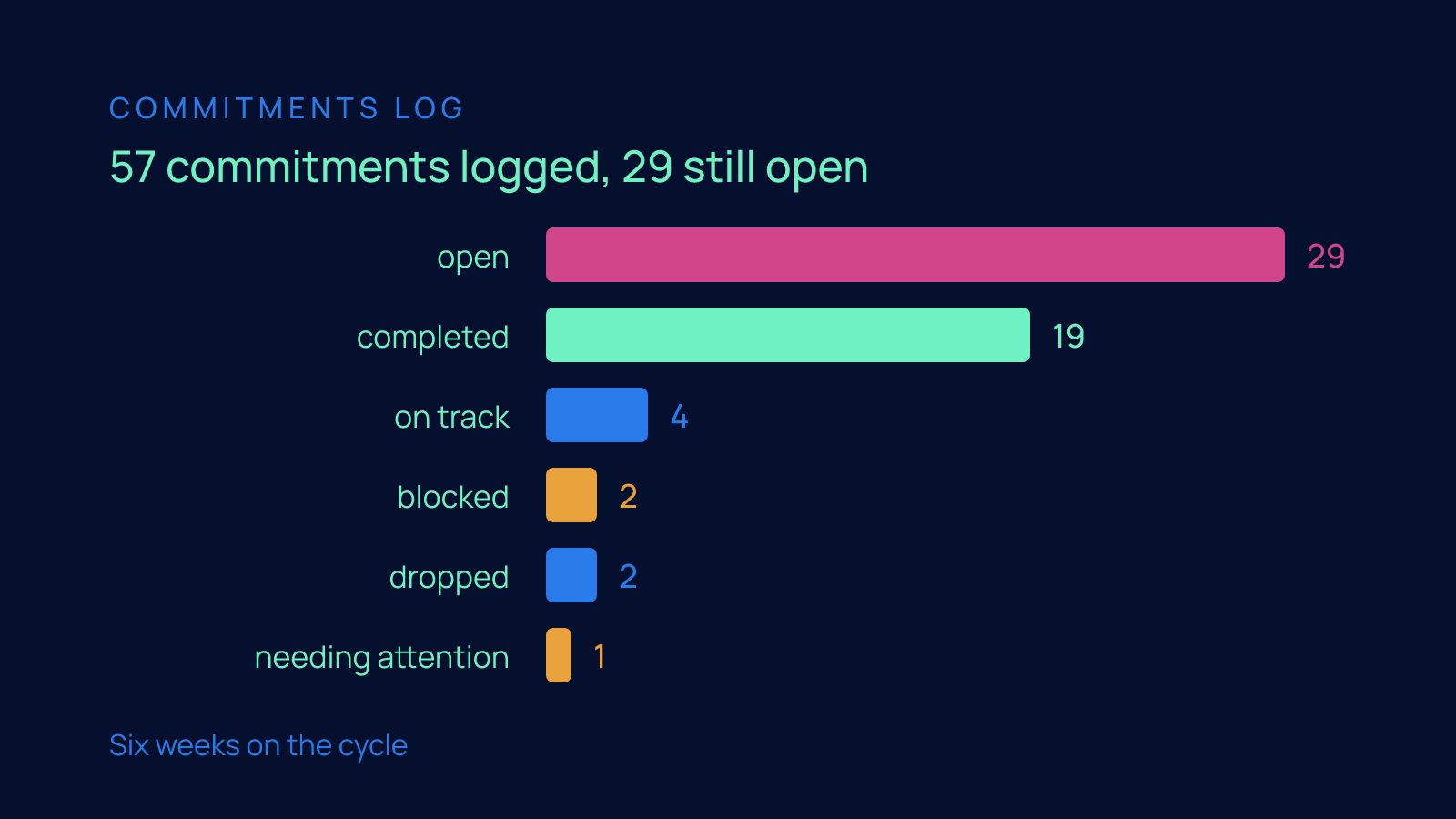
We have logged 57. What we got wrong is what the log now shows us: 29 are still open. A commitments log does not make people follow through. It makes not following through a visible fact instead of a vague feeling, and that is uncomfortable for a reason.
Week three: let the agent write the prep
Removes failure one. Before each 1-1, the agent writes the coach a prep from the record only, nothing invented, and the coach reads it in two minutes. When we had the prep, the first ten minutes stopped being "how are things going" and started on the open commitments and the goal that had slipped.
What we got wrong: only 10 of 30 meetings had one. The transcript pipeline broke for a month, so the record the prep reads from went stale, and the roll-forward missed people who had no profile. A prep is only as good as weeks one and two.
Week four: share the agenda
Removes failure two. Both sides add talking points before the meeting. This changed who the meeting was for. When the person adds two items and the coach adds two, it is their meeting, not a status report to a boss.
What we got wrong: 4 shared talking points across 30 meetings. We built the feature and did not build the habit. A reminder inside the check-in would have done more than the feature did.
Week five: capture the transcript and draft the recap
Removes failure three. Record the meeting, get the transcript back, and let the agent draft a two-tier recap: a coach-only tier with the candid read, and a shared tier for the person. The coach reviews before anything publishes. This is not optional, and I will come back to why.
What we got wrong, and this is the warning I most want you to hear: the transcript pipeline broke for a month. 12 transcripts from 30 meetings. When the transcript does not arrive, no recap is drafted, no commitments are captured, the record goes stale, and the next prep is written from old information. Build the paste fallback first. If the coach can paste a transcript by hand into the record, the pipeline breaking is an inconvenience. If they cannot, it is a month of coaching that never existed.
Week six: profile the person
Removes failure one. Publish an OCEAN profile for each person so the prep can adapt tone. A direct, detail-first person and a relationship-first person should not get the same prep or the same recap.
What we got wrong: we have 4 profiles for 14 people, and it shows. Most preps cannot adapt tone because there is nothing to adapt to. The third of feedback that Kluger and DeNisi found does harm is exactly the feedback that ignores who is receiving it. This is the week we are furthest behind on, and it is the one that most directly protects against doing damage.
Week seven: check in mid-cycle
Removes failure two. Between meetings, a short prompt the person answers in a minute: what moved, what is stuck, what they want to talk about. It feeds the next prep so the meeting starts where the person actually is.
What we got wrong: this is our rarest step. 10 check-ins across 30 meetings. We treated it as a nice-to-have and the preps suffered for it, because a prep built from a two-week-old recap is a prep about two weeks ago.
Week eight: read the trends and coach the coach
Removes failure three. Now the record can teach. A trend report per person. The commitment follow-through rate. And a mode split per meeting: coach (asking), mentor (advising) or direct (telling), against a deliberate 80/15/5 target. The mode split is the first honest picture most managers get of how they coach, and it is the thing I could never give a manager at TINYpulse from a notebook.
What we got wrong: 5 trend reports for 14 people. Trends need consistent inputs, and weeks five through seven were not consistent. The ladder holds you to the rungs you skipped.
The six-week scoreboard, gaps included
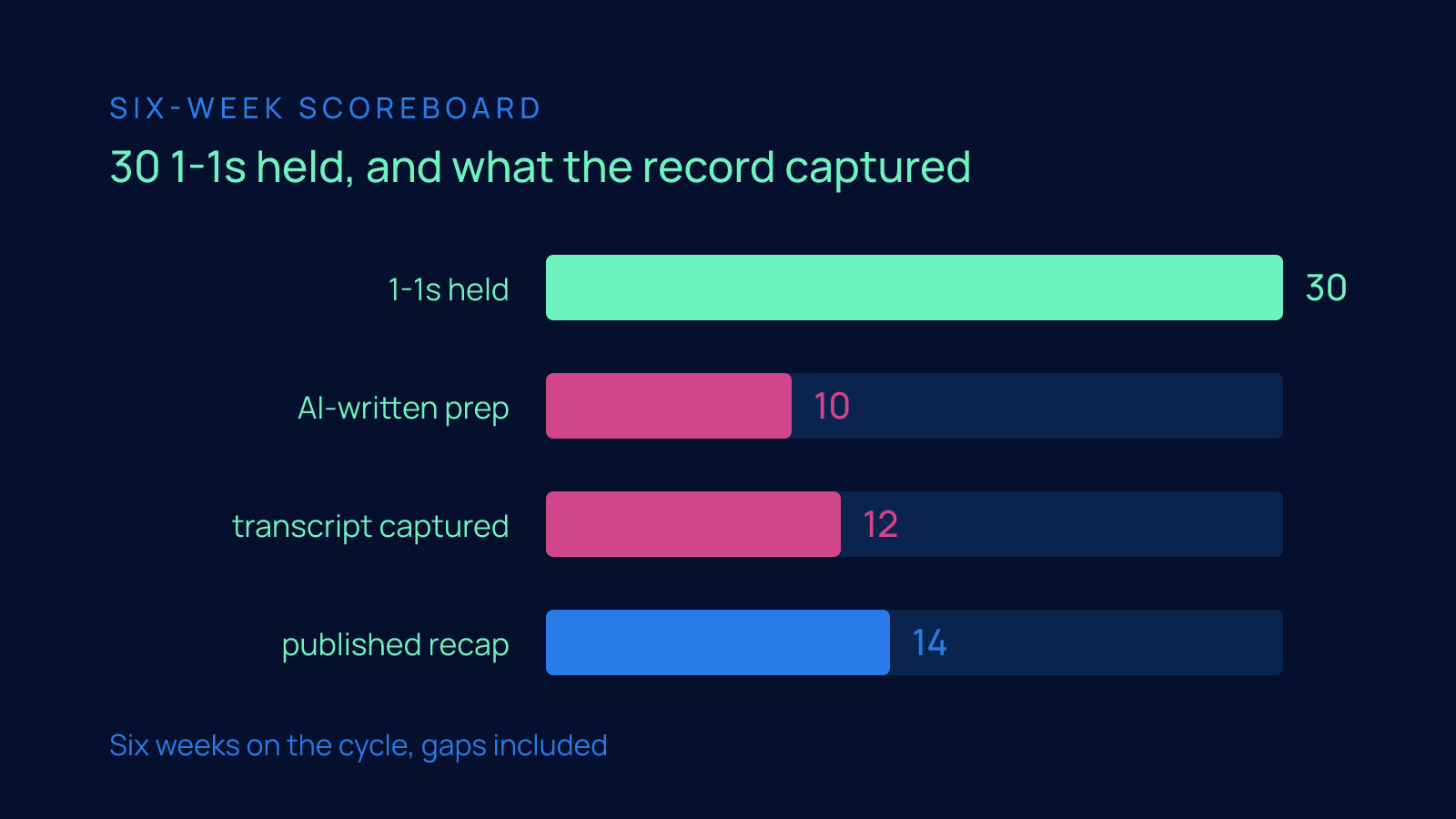
Six weeks on the cycle: 30 1-1s held. 10 with an AI-written prep. 12 with a transcript captured. 14 with a published recap. 57 commitments logged: 19 completed, 4 on track, 29 open, 2 blocked, 2 dropped, 1 needing attention.
Behind those: 14 people coached, 4 published OCEAN profiles, 5 trend reports, 10 check-ins, 4 shared talking points, and nine surveys with 332 responses feeding the same records.
What worked. When the prep existed, the meeting started on substance. The shared agenda changed who the meeting belonged to. The commitments log turned follow-up from a memory into a fact.
What did not. Two thirds of meetings ran without a prep. The OCEAN profile exists for fewer than a third of the team. Check-ins are rare. And the model's first recaps praised more than they reported, which is not a small bug.
I am not claiming engagement or performance improved. We have not measured that yet. I am claiming the three failures I watched for years are now visible on a screen with a number next to each, and a thing you can see is a thing you can fix.
The coach's review is the guardrail, not the bottleneck
Every founder who sees this cycle asks the same question: can the recap go straight to the person? No.
Kluger and DeNisi found feedback harms more than a third of the time. Our model's first recaps were the kind that would land in that third: warm, generous, and light on what actually happened. A person reads a recap that praises a project they know slipped, and the next recap means nothing. A recap that names a slipped deadline the coach never raised in the room does damage of a different kind.
The review takes the coach a few minutes. It is where the coach decides what the person needs to hear, in what words, and what stays in the coach-only tier. That is the coaching. The agent removes the preparation, the remembering and the writing. It does not remove the judgment, and the review gate is where the judgment lives. Take it out and you have automated the third of feedback that hurts.
Someone has to own the record
Here is where this stops being a coaching post. Every rung on the ladder assumes someone owns the record and the cycle: the schema, the roll-forward, the pipeline, the fallback when the pipeline breaks, the review gate, and the question of which manager is telling when the target says they should be asking.
At TINYpulse, that person did not exist, and that is why the three failures kept coming back. Managers do not own records. HR owns forms. IT owns tools. Nobody owns the thing in the middle.
That is the AI officer's job: the person who owns the data layer and the workflow redesign, who treats a broken transcript pipeline as their problem on the day it breaks, and who reads the trend reports for the company the way a coach reads them for a person. It is why I founded the AI Officer Institute. Not someone who hands you a deck about coaching culture. Someone inside your company who owns week one through week eight and every week after.
Do week one this week
Pick week one and do it in the next five working days: one row per person, with their goals, their priorities and the last three meetings. No agent required yet. Just the record.
Then reply and tell me how many of your people have that row today. If the answer is "none," you are where most of the thousand companies I worked with were, and the fix starts with deciding who owns it. Let's talk about who that should be.
FAQ
How do I build a one-on-one coaching program that my managers actually prepare for and follow through on?
Start with one record per person that holds their goals, priorities and the last three meetings, then log every commitment from every meeting with an owner and a date, and only then let an AI agent write the manager a prep from that record. The order matters: in our own six-week log, only 10 of 30 meetings had an AI-written prep, because people missing from the record in week one became meetings with no prep in week three. The stakes justify the discipline, since Gallup found that managers account for at least 70% of the variance in employee engagement scores across business units.
Why do my one-on-one meetings keep turning into casual catch-ups instead of coaching?
Because nobody wrote down what was promised last time, so the next meeting cannot open with what you said you would do and opens with how are things going instead. A commitments log fixes the memory problem but exposes the follow-through problem: six weeks into ours, 57 commitments were logged and 29 were still open. That visibility is the point, and it pays off in engagement, since Gallup reports that 80% of employees who received meaningful feedback in the past week are fully engaged.
Should AI-written feedback go straight to the employee, or should a manager review it first?
A manager should review it first, every time, and the research is the reason. Kluger and DeNisi reviewed 607 effect sizes from feedback studies and found that feedback helps on average, with an effect size of 0.41, but makes performance worse in more than a third of cases. Our model's first recaps praised more than they reported, which is exactly the kind of feedback that lands in that harmful third, so the manager's review takes a few minutes and is where the coaching judgment lives.
How often should managers give feedback for it to actually improve engagement?
Weekly at minimum, and daily where you can. Gallup found that among employees who received meaningful feedback in the past week, 80% are fully engaged, and people who get daily feedback from their manager are 3.6 times as likely to feel motivated to do outstanding work as people who get it once a year. A biweekly one-on-one cycle only sustains that rhythm if a short mid-cycle check-in feeds the next meeting; in our log that was the rarest step, with 10 check-ins across 30 meetings.
How can I see how well my managers actually coach in their one-on-ones?
You need a record clear enough to show a trend, then two measures from it: the commitment follow-through rate per person and a mode split per meeting that tags how much the manager coached by asking, mentored by advising or directed by telling, against a deliberate 80/15/5 target. That split is the first honest picture most managers get of how they coach, and it cannot come from a notebook. It depends on consistent inputs: we captured 12 transcripts from 30 meetings and produced 5 trend reports for 14 people, and every gap in the reports traced back to a missing transcript or check-in.