It is 2 minutes before your 1-1. Take stock of what you actually know about the person about to join the call.
Most founders I talk to know roughly what was discussed last time, mostly as a feeling rather than a record. There is a notes doc somewhere with a few bullets in it, some of them from three meetings ago. There is a general sense that this person is doing fine, or is not, the way you know the weather without looking out the window. And there is a nagging memory that they committed to something, though whether it was due last week or next is anyone's guess.
So the call opens with "how are things going?" and the first ten minutes are spent rebuilding context that should have been there before anyone said hello. That is not coaching. That is catching up, and both people in the room can tell the difference.
Here is what the coach at Edge8 walks in with instead, every other week, for every person on the team.
What the coach walks in with
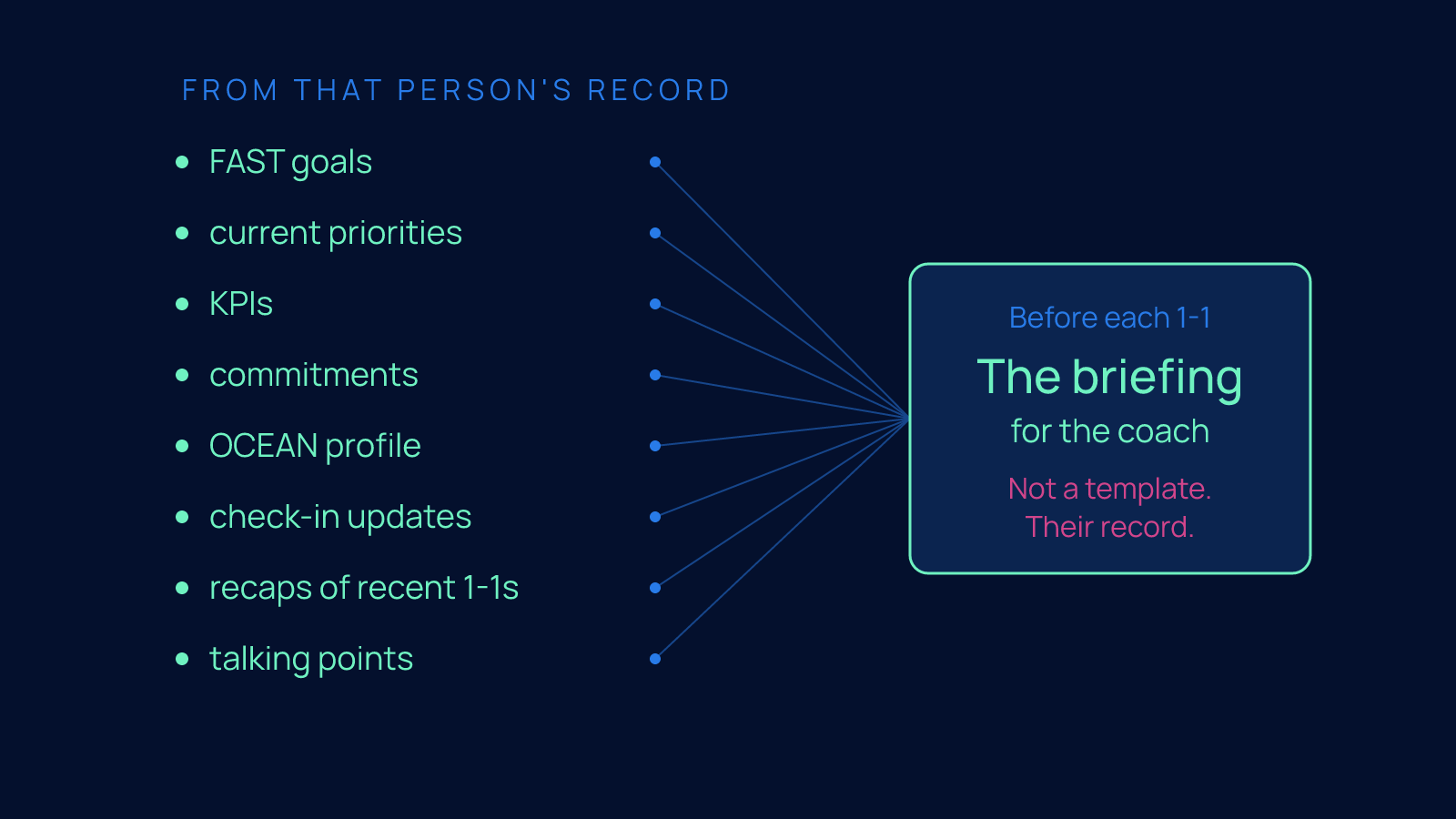
Before each 1-1, the AI prepares a briefing for the coach from that person's record. Not a template. Their record. It pulls from their FAST goals, their current priorities, the KPIs they are measured on, the commitments they made in previous meetings that are still open, their OCEAN profile, the updates they submitted in check-ins since the last meeting, the recaps of recent 1-1s, and any talking points that either the coach or the team member added to the agenda.
Two of those need a plain-language definition. OCEAN is the five-factor model of personality: openness, conscientiousness, extraversion, agreeableness and neuroticism. Each person on the team has a published profile, so the coach knows whether this is someone who wants to talk through options out loud or someone who wants the decision and the reason in one sentence. FAST goals are goals that are frequently discussed, ambitious, specific and transparent. In practice that means they are written down where the rest of the company can see them, and they get revisited every cycle rather than once a year at review time.
The result is a coach who opens the call already knowing which commitment slipped, which priority changed since last time, what the person flagged in their check-in on Tuesday, and how that person tends to receive hard feedback. The first ten minutes are not spent catching up. They are spent on the thing that matters.
That is the whole difference. Same meeting length. Same two people. Radically different starting point, because one side did the remembering in a system instead of in a head.
The cycle, step by step
This is not magic and it is not expensive. It is a loop.
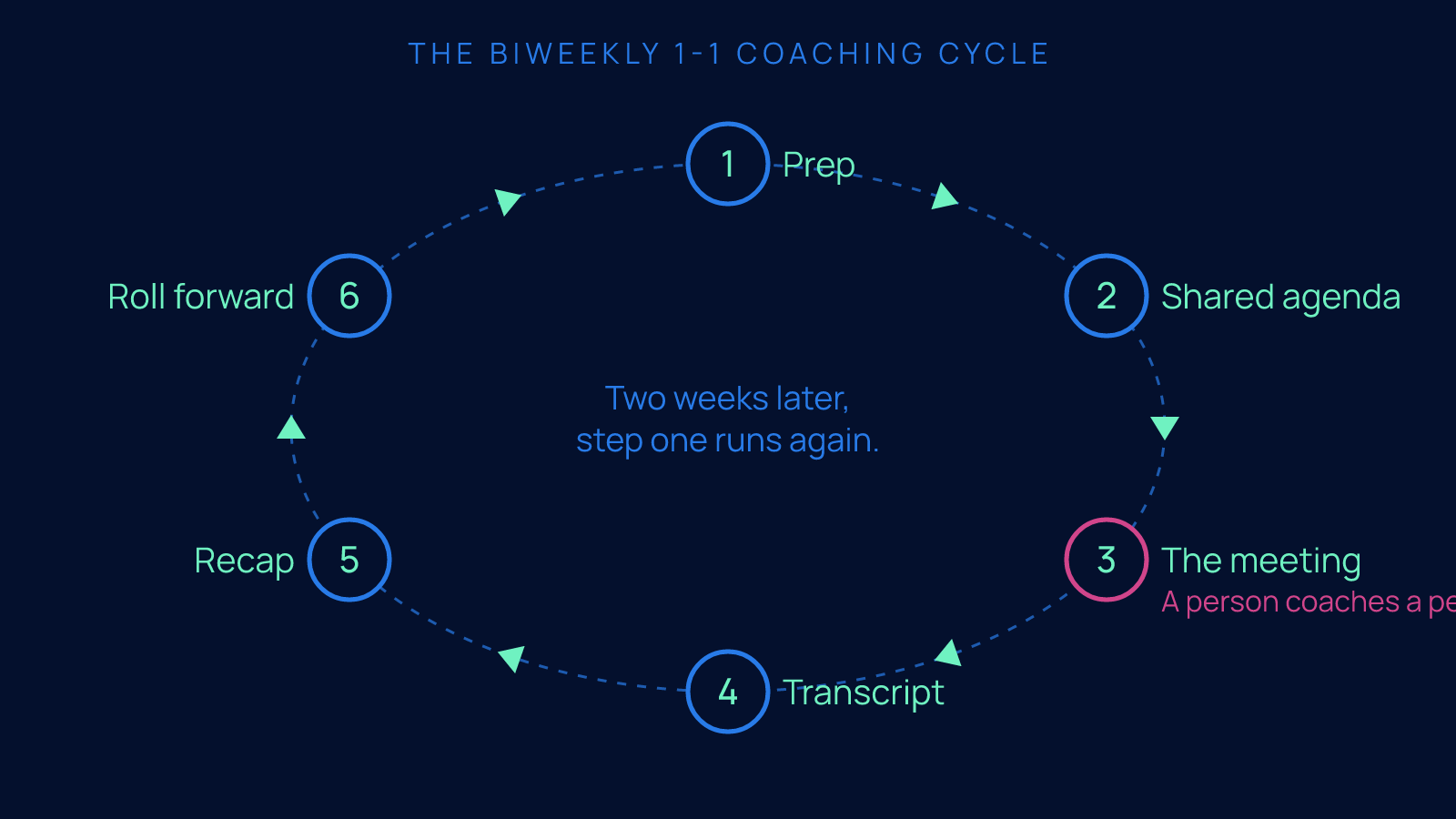
The biweekly 1-1 coaching cycle rolls forward on its own. Nobody schedules the next round. It is already on the calendar, and the preparation for it starts before anyone thinks about it.
- Prep. Before the meeting, the AI writes the coach's briefing from the record described above.
- Shared agenda. Both the coach and the team member add and remove talking points ahead of time. The agenda belongs to both of them. This matters more than it sounds. A 1-1 where only the manager sets the agenda is a status meeting with a friendlier name.
- The meeting. The coach runs the conversation with the briefing in hand. Nothing here is automated. A person coaches a person.
- Transcript. After the call, the transcript comes back from the meeting tool.
- Recap. A recap is written from the transcript and folded into the person's record. New commitments get logged. Old ones get closed or carried forward.
- Roll forward. Two weeks later, step one runs again, and this time it has one more recap, one more set of check-in updates and one more round of talking points to draw from.
Survey answers feed the same place. When someone answers a survey, the answer attaches to their record, alongside the OCEAN profile and everything else. So if a survey surfaces that someone is stretched thin, the coach does not have to remember to ask about it. It is in the briefing.
The coaching gets more specific every cycle because the record gets deeper every cycle. Nobody prepares for an hour. Nobody prepares from memory. The preparation is a by-product of the last meeting having been captured properly.
This is hyper-personalization, pointed inward
"Personalization" has been worn down to a marketing word. It usually means a first name in a subject line and a segment code that decides which of four emails you receive. Hyper-personalization, as I use the term, is different: a message, a briefing or a conversation written for one specific person from what you actually know about that person, not from which bucket they fell into.
By that definition, the biweekly 1-1 is the most personalized thing Edge8 runs. Every cycle, the coach and the AI know the person a little better. The briefing for one team member looks nothing like the briefing for another, because their goals, their commitments, their profiles and their histories are different. The same coach, running the same cycle, has a different conversation with each person, and a different conversation with that person than two weeks ago, because the record moved.
Founders tend to hear "personalization" and think about customers. I would push back on the order. Your team is the group of people you already know the most about, whose outcomes you already care most about, and who will tell you immediately if the personalization is off. If you cannot make a 1-1 specific to the person sitting across from you, you have no business telling a prospect that you understand their situation.
Personalize for your own people first. It is the cheapest proving ground you will ever get, and the feedback loop is two weeks long.
The record is the strategy
Data foundations are a major line item.
Here is the part most companies miss, and it is the part that makes everything else possible.
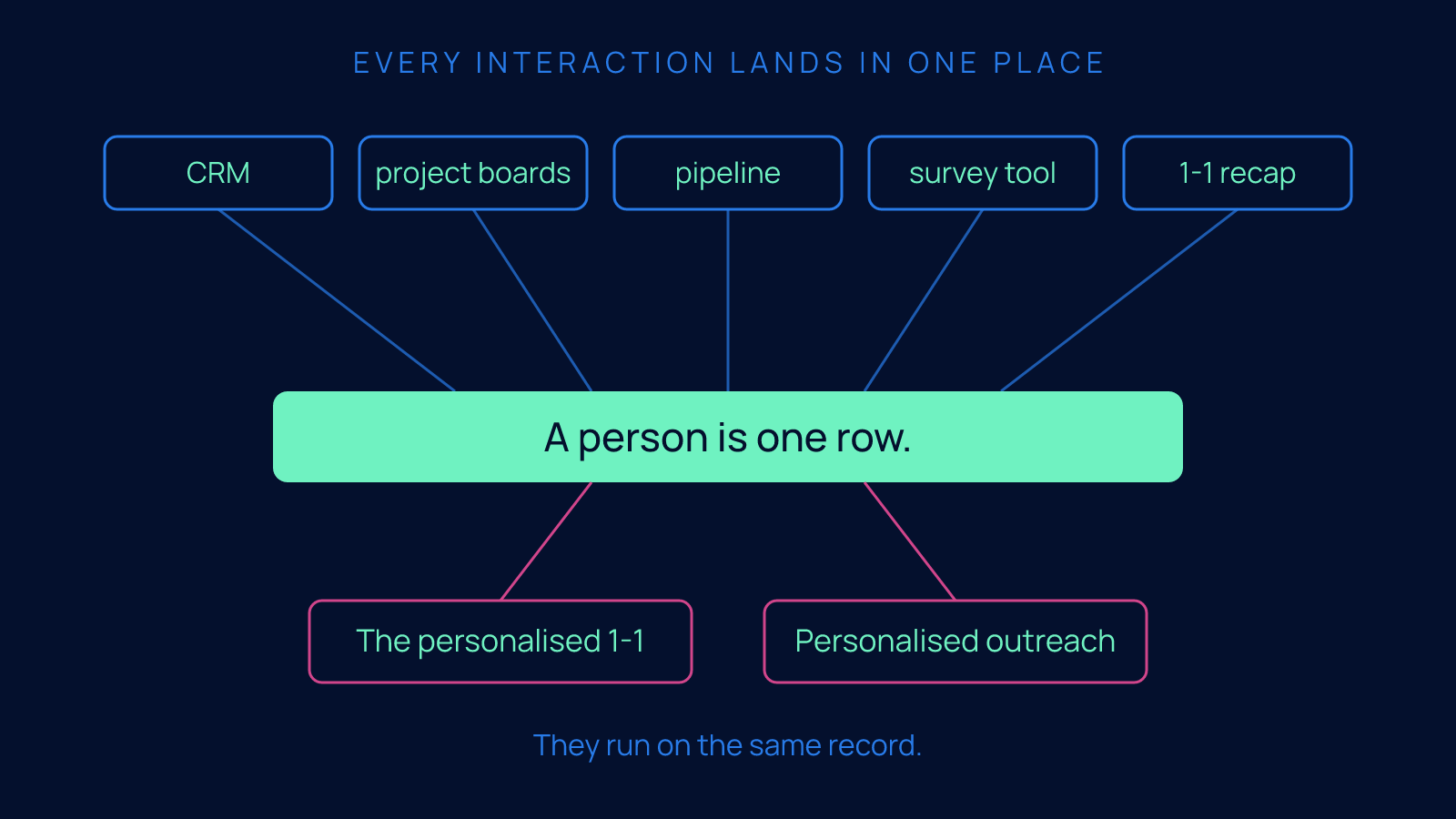
At Edge8, a person is one row. Whether they are a team member, a candidate in the pipeline, a lead or a contact on an open deal, they exist once, in one place, and everything that happens to them attaches to that row. The CRM writes to it. The project boards write to it. The pipeline writes to it. The survey tool writes to it. The 1-1 recap writes to it.
This sounds like a plumbing detail. It is the entire strategy.
Personalization is only as good as the record. If the coach's briefing draws on a record that is missing half of what happened, the briefing is half as useful, and the coach ends up back at "how are things going?" If the record is complete, the briefing is complete. There is no clever prompt that compensates for missing data.
And the record only grows if every interaction lands in one place. The moment the 1-1 notes live in one doc, the survey results in a spreadsheet, the commitments in someone's inbox and the goals in a slide from the January offsite, you do not have a record. You have five partial records that nobody is going to reconcile at 9:58 on a Tuesday.
The Stanford Digital Economy Lab put it bluntly in The Enterprise AI Playbook: "Data foundations are a major line item." Founders read that and think about warehouses and pipelines for the product. It applies just as much to the data about your own people. Where the goals live, where the commitments live, where the transcripts land. That is a data foundation, and it is a line item, and if you skip it the AI has nothing to personalize from. The same report finds the companies that scale AI are far more likely to hold a large, accurate data set: 61% versus 38% for everyone else.
Pointing the same method outward
Personalization that converts, speed that wins deals, and internal tools repackaged as products.
Once the internal version works, the outward version stops being a leap of faith.
The same Stanford report names the three places enterprise AI is creating value right now: "Personalization that converts, speed that wins deals, and internal tools repackaged as products." Read that line again with the 1-1 cycle in mind. We built an internal tool that personalizes a conversation from a record. The revenue department at Edge8 is now doing for leads and open deals what coaching already does for the team: one message per person, written from what the record knows about that person, not from a template with a name field.
That work has just begun. I am not going to claim results for it, because there are none to claim yet. What I can tell you is why we believe it will work, and the answer is not a vendor deck. It is that we have watched the same mechanism operate on ourselves, every two weeks, and we know what it takes to make the record good enough for the output to be specific.
That is the real transfer. Not the model, not the prompt. The discipline of getting every interaction into one row, and the habit of trusting a briefing written from that row. If your team cannot keep its own commitments and check-ins in one place, your sales team will not keep its call notes and objections there either, and your personalized outreach will be as generic as everyone else's.
What has to be true before any of this works
Executive sponsorship is about actions, not approval.
Two more lines from the Stanford report explain why most companies never get to a personalized 1-1, let alone personalized outreach.
The first: "Executive sponsorship is about actions, not approval." Approving an AI budget is not sponsorship. Sponsorship is the CEO running their own 1-1s from the briefing, adding their own talking points, and letting their own commitments get logged and carried forward like everyone else's. If the founder is the one person whose meetings do not land in the record, the record has a hole in it exactly where the most important decisions happen, and the team notices.
The second: "Most critically, they create a culture that gives permission to fail." The first briefings will be clumsy. The first recaps will miss things. Someone will look at a commitment logged against their name and say that is not what they agreed to. That friction is the system working. It is how the record gets corrected and how people learn to trust it. A company that treats the first imperfect recap as proof the whole idea is broken will go back to the notes doc and stay there.
Both of those are management decisions, not technical ones. Which is why they belong to a specific person.
This is the AI officer's job
Somebody inside your company has to own the record. Not the CRM vendor. Not the meeting tool. Not a consultant who leaves in six months. A person on your payroll whose job it is to decide where every interaction lands, to make sure the surveys, the boards, the pipeline and the coaching all write to the same row, and to design the workflows that turn that row into something a manager can use two minutes before a call.
At Edge8 we call that role the AI officer. Not a data scientist building models, not a prompt engineer tuning wording, but the person who owns the data layer (the single place where the company's information about people lives) and redesigns the workflows that run on it. The personalized 1-1 is a workflow. Personalized outreach is a workflow. They run on the same record, and the same person should own both.
The most expensive AI mistake I see founders make is starting with the wrong role. Someone builds a customer-facing chatbot before anyone owns the record behind it, and the chatbot personalizes from nothing. The 1-1 cycle is the inverse: start with the record, start with your own people, prove the method where the people giving you feedback sit next to you. Then point it outward.
We did not arrive at that order by theory. We arrived at it by running the loop on ourselves first, and finding out exactly where the record had holes.
Before your next 1-1
Here is the next step, and it takes five minutes.
Before your next 1-1, write down the five things you would most want to know about the person walking into the call. Their current top priority. The last commitment they made to you. What they flagged in their most recent check-in. How they prefer to receive difficult feedback. Whatever your five are.
Then check how many of those five live in a system that could hand them to you, and how many live only in your head or in a doc you would have to hunt for.
Reply to Edge8 with your count. If it is zero or one, we should talk about who in your company should own that record, because until someone does, every personalization conversation you have, internal or external, is a conversation about a first-name field.
FAQ
How do I run better one-on-one meetings with AI?
Give the AI the person's record before each meeting, not a blank prompt. Before each biweekly 1-1, have it write the manager a briefing from that person's goals, current priorities, KPIs, open commitments, personality profile, check-in updates, recent recaps and any talking points either side added to a shared agenda. Run the conversation yourself; nothing in the meeting is automated. Afterwards the transcript becomes a recap on the record, so two weeks later the next briefing has one more recap to draw from.
Where is AI creating business value right now?
The Enterprise AI Playbook, written by Pereira, Graylin and Brynjolfsson at the Stanford Digital Economy Lab in March 2026, names three places enterprise AI is creating value now: personalization that converts, speed that wins deals, and internal tools repackaged as products. It also states plainly that data foundations are a major line item. That applies to the data about your own people just as much as product data, because a briefing is only as good as the record it is written from.
How do I use personality profiles in one-on-one meetings?
Use a five-factor profile (openness, conscientiousness, extraversion, agreeableness and neuroticism) as context the manager reads before the call, not a label. It tells the manager whether this person wants to talk through options out loud or wants the decision and the reason in one sentence, so difficult feedback lands the way that person actually receives it. Keep the profile on the person's record so it feeds every briefing.
What are FAST goals?
FAST goals are goals that are frequently discussed, ambitious, specific and transparent. In practice that means they are written down where the rest of the company can see them and revisited every cycle rather than once a year at review time. Because they live on the person's record, an AI can pull them into every 1-1 briefing, so the manager opens the call already knowing which goal moved and which one slipped.
What does an AI officer do?
The AI officer is the person inside the company who owns the record: the single place where information about people lives, and where the CRM, project boards, pipeline, surveys and 1-1 recaps all write to the same row. They are not a data scientist building models or a prompt engineer tuning wording. They decide where every interaction lands and redesign the workflows that turn that row into something a manager can use two minutes before a call.