You can buy a tool this afternoon. Put in a card, get a login, add it to the stack. By Friday your team has one more place to paste things into.
That is how most companies are trying to reach Level 3 of AI, and it is why almost none of them get there.
My position: Level 3 is a commitment, not a tool. It cannot be bought off a shelf, it cannot be reached by stacking subscriptions, and the cost of getting there is exactly what makes it worth having. If you want the payoff, you have to want the cost too.
Where the three levels come from
Level 3: seamless learning via AI, learners do not realise they are interacting with AI
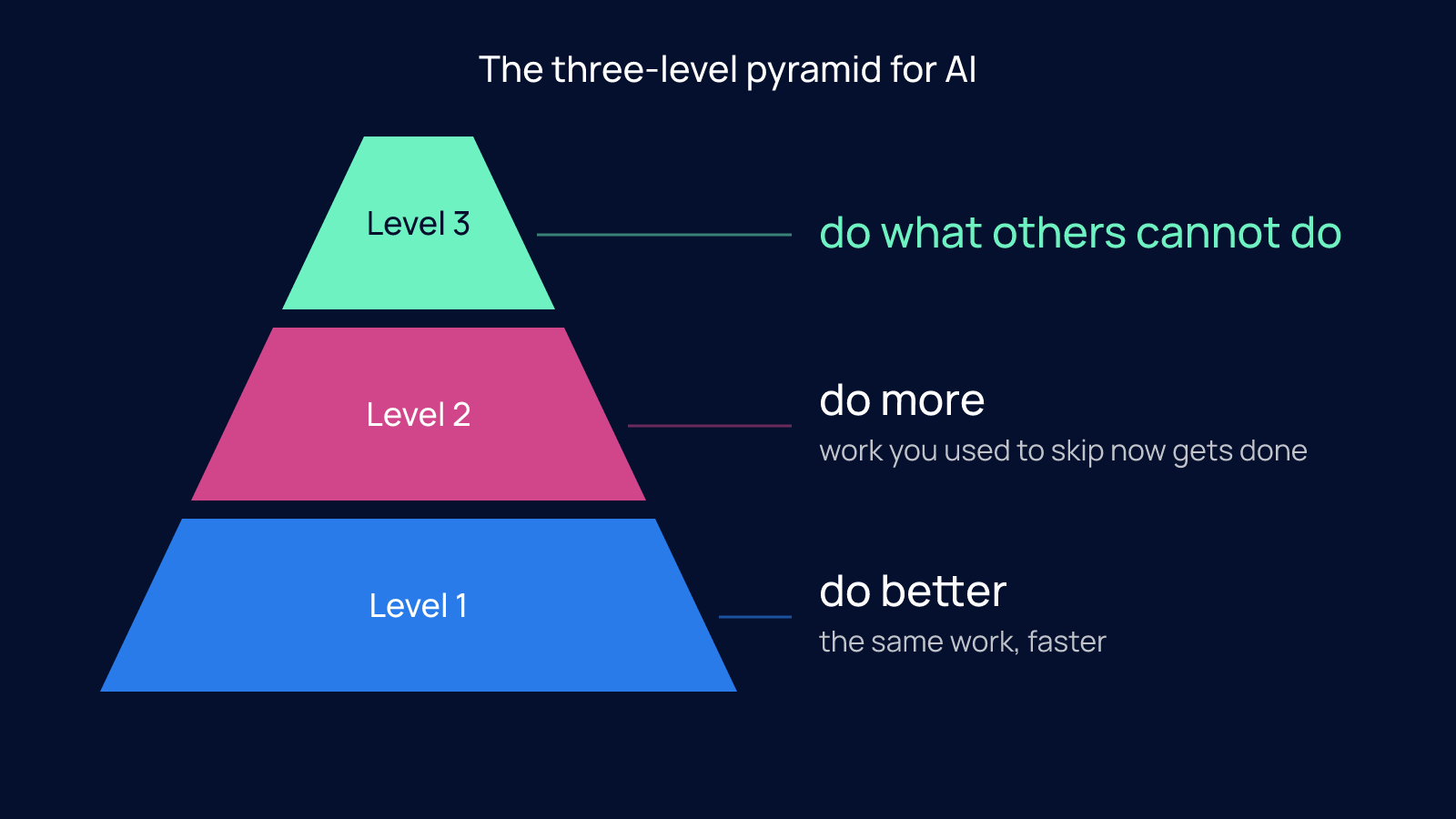
Beyond the Sky Custom Learning published a three-level pyramid for AI in learning. At the top, Level 3, they describe seamless learning via AI: the learner does not notice they are interacting with AI at all. I borrowed that frame for business and laid out all three levels in the anchor piece of this series. Short version: Level 1 is do better (the same work, faster). Level 2 is do more (work you used to skip now gets done). Level 3 is do what others cannot do.
This piece stays at the top of the pyramid, because that is where the money and the confusion both live.
What Level 3 looks like on a Tuesday
Strip the language away and Level 3 is a company running on one set of data. Not one dashboard bolted on top of eleven systems. One place where the people, the priorities, the customers, the money and the work delivered live together and agree with each other.
Once that exists, the AI stops being a thing you open and becomes a thing that is simply there. And here is the test I apply to every claim about AI, including my own: what did the AI just do, and what does the person still decide?
At Level 3 the answers are consistent.
A customer emails about a renewal. The agent (the AI working inside your systems, not a chat window someone opens) files the email against the account, notes the tone, checks the last three touches and the open invoice, and drafts a reply with the right numbers in it. The account manager decides whether to hold the price or offer a concession.
A manager has a one-on-one tomorrow. The agent pulls the goals set last quarter, the work shipped since, the two commitments that slipped, and prepares a one-page brief. The manager decides what to say about the slip.
The month closes. The agent reconciles what was invoiced against what was delivered and flags the three accounts where they disagree. The owner decides which conversations to have.
Filing, tracking, preparing: the AI. Deciding: the person. Nobody on the team says "let me ask the AI." They walk into meetings ready, and the meetings are about the decision.
That is what seamless means in a business. It does not mean magic. It means the plumbing is finished.
Why you cannot accumulate your way there
The instinct is understandable. Buy the AI notetaker. Buy the AI add-on for the CRM. Buy the AI assistant inside the finance tool. Each one is good. Each one is Level 1 or Level 2 for the team using it. And each one holds its own copy of the truth.
The notetaker knows what was said. The CRM knows what was sold. The finance tool knows what was paid. The project tool knows what was shipped. None of them agree on who the customer is, what was promised, or whether the promise was kept. So a person spends the week carrying facts from one box to another, and the AI in each box can only be as smart as the box it lives in.
That is the ceiling. You can have twelve AI features and still not have a company that runs on one set of data. Adding a thirteenth does not change the shape of the problem. Subscriptions accumulate. They do not integrate.
Level 3 is not the sum of Level 2 tools. It is a different structure.
The cost, named honestly
This is not a weekend project. Three things have to be true, and each one costs something.
One database. All five sources in one place, with one definition of a customer, one definition of a project, one definition of a person. That means migrating data: moving the records out of the separate boxes into the one place, and deciding, wherever two records conflict, which one is right. Nobody enjoys it. It has to happen.
Designed workflows. Not "we use AI." Designed means someone sat down and wrote out, for each recurring piece of work, what the agent files, what it tracks, what it prepares, and what the human decides. The one-on-one brief exists because someone designed it. The renewal draft has the right numbers because someone decided which fields feed it.
Attention and investment. The founder or a real leader has to care about this for weeks, not hand it to whoever is free. And it costs money, either in your team's time or in a partner's fee.
I name the cost because founders who have been burned by consultants were usually burned by someone who hid it. The pitch was "just plug it in." The invoice arrived anyway, and the plumbing never got finished.
Why the cost is the point
That cost is the point: what it builds is a company others cannot copy, because the advantage lives in its data and its workflows, not in a subscription anyone can sign up for.
Here is what turns the cost from a burden into the reason to pay it.
Anything you can buy off a shelf, your competitor can buy off the same shelf tomorrow. A subscription is not an advantage. It is table stakes with a monthly fee. If your edge lives inside a tool anyone can sign up for, you do not have an edge.
At Level 3 the advantage lives in two places nobody can copy: your data and your workflows. Your data is the record of every customer, every promise and every delivery your company has ever made, organized so an agent can act on it. Your workflows are the decisions you made about how work should flow and who decides what. A competitor can buy every tool you own and still have neither. They would have to do what you did: commit.
That is why Level 3 is do what others cannot do. Not because the technology is secret. Because the commitment is rare.
The path: five sources in a fixed order
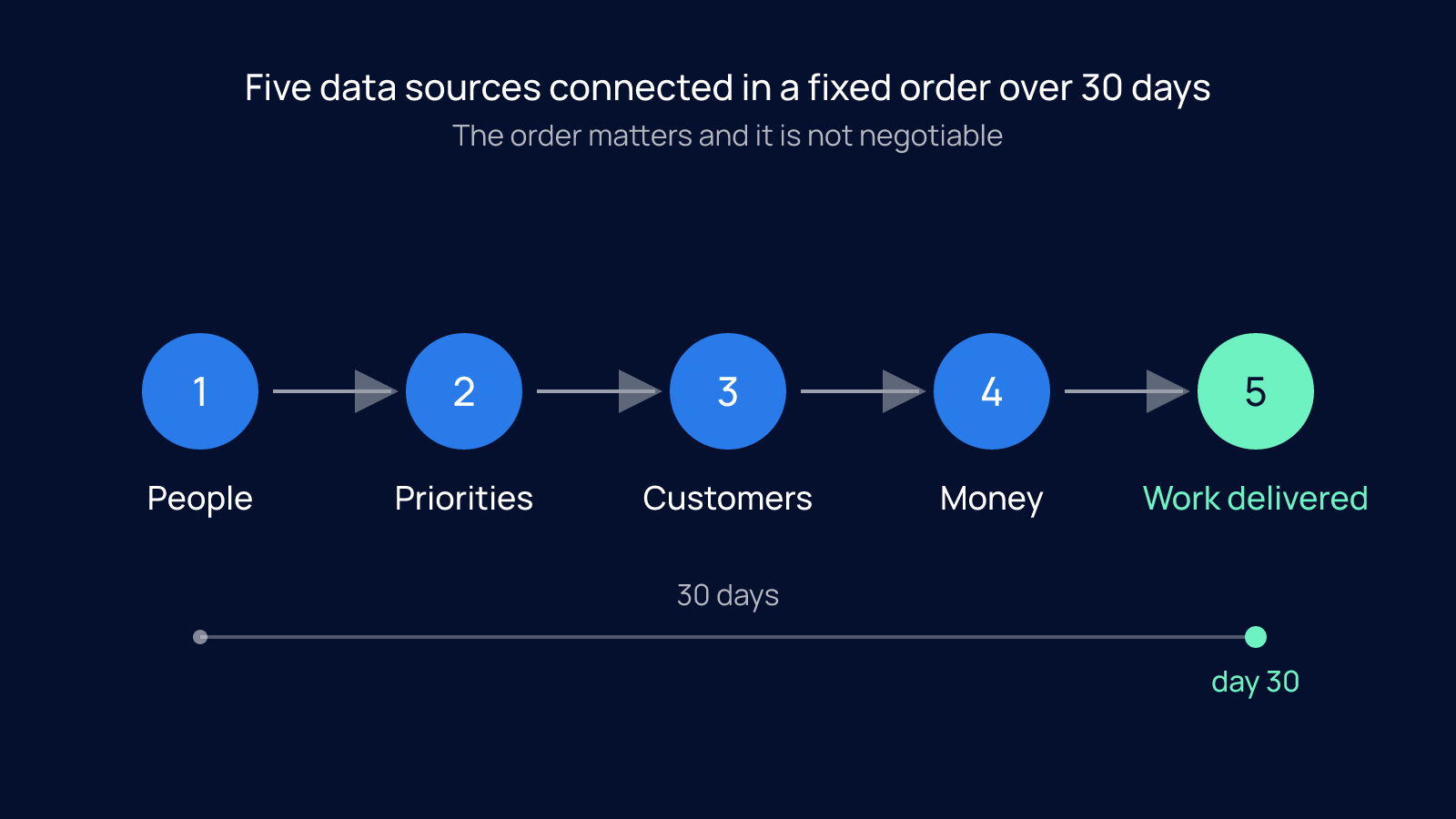
Commitment is easier when it has a shape. The 8 Edges 30-Day Launch is the shape we use: five data sources connected in a fixed order over 30 days.
- People. Who is on the team, who reports to whom, what each person owns.
- Priorities. The goals, so every piece of work can point at a reason.
- Customers. Who they are, what was promised, where each relationship stands.
- Money. What was invoiced, what was paid, what is outstanding.
- Work delivered. What actually shipped, by whom, for whom.
The order matters and it is not negotiable. People come first because every other record needs an owner. Priorities come second because work without a goal cannot be tracked against anything. Customers come before money because a payment has to attach to a relationship. Work delivered comes last because it closes the loop: this person, for this priority, for this customer, got paid this much, and delivered this.
Connect them in a different order and you spend the back half of the month re-attaching records to owners that did not exist yet. Connect them in this order and by day 30 the agents have a coherent world to file, track and prepare in.
Three ways to take it on
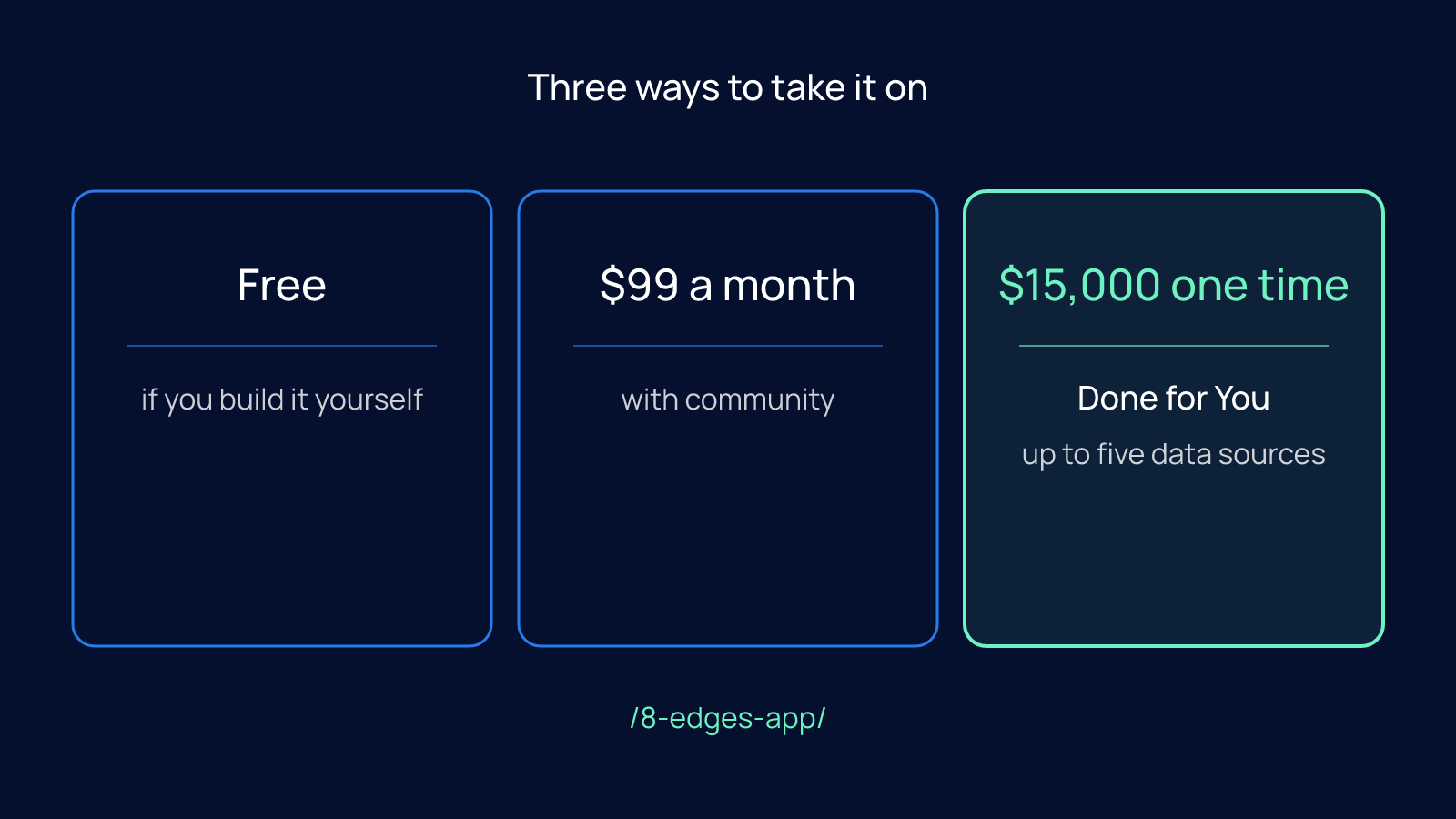
The 8 Edges install has three doors, and I want the price in front of you so the commitment is concrete.
Free if you build it yourself. The structure is there. You do the migration and the workflow design with your own team.
$99 a month with community. The same structure, plus the people doing the same work alongside you.
$15,000 one time for Done for You. We connect up to five data sources and migrate the data in. This is the door for founders who want the commitment made with a partner who has done it before and is accountable for finishing the plumbing.
All three are at /8-edges-app/. None of them is a tool you paste things into. Each is a way to end up running on one set of data.
I will be direct about the third door, because it is the one we do ourselves. Done for You is not a consultant leaving a deck. It is the database built, the five sources connected in order and the data migrated, so that on the first Monday afterward someone on your team walks into a meeting with a brief they did not have to write. The plumbing exists, and the meeting is about the decision.
The Monday question
Before Monday, sit with one question: what would it take for your company to run on one set of data?
Not "which AI tool should we try next." That question has a Level 1 answer and you already know it. The real question is which of the five sources is the messiest today, who would own the migration, and whether you are willing to pay the cost that makes the result impossible to copy.
If the answer is yes, start at /8-edges-app/ and pick your door. If you want to talk it through first, reply to this and tell me which of the five sources you least want to look at. That is where the work usually begins.
Dave Hajdu, founder of Edge8
FAQ
What does it actually take to get my company running on one set of data so AI does the filing and tracking while my team decides?
Three things have to be true, and each one costs something: one database holding all five sources (people, priorities, customers, money, work delivered) with one definition of a customer, a project and a person; designed workflows that spell out what the agent files, tracks and prepares and what the human decides; and real attention and investment from the founder or a senior leader for weeks, not a handoff to whoever is free. The path Edge8 uses is the 8 Edges 30-Day Launch, which connects the five data sources in a fixed order over 30 days so that by day 30 the agents have a coherent world to work in. It cannot be bought off a shelf or stacked from subscriptions; it is a commitment, and the cost is what makes the result impossible for a competitor to copy.
Why can't I get AI running in the background of my whole business just by buying more AI tools?
Because each tool holds its own copy of the truth: the notetaker knows what was said, the CRM knows what was sold, the finance tool knows what was paid, the project tool knows what shipped, and none of them agree on who the customer is or whether a promise was kept. You can have twelve AI features and still not have a company that runs on one set of data, and adding a thirteenth does not change the shape of the problem. Each tool is a Level 1 or Level 2 gain for the team using it, but Level 3 is not the sum of Level 2 tools; it is a different structure built on one database.
Which business data should I connect first when I'm trying to get everything into one database?
Connect five sources in a fixed order: people first, then priorities, then customers, then money, then work delivered. People come first because every other record needs an owner, priorities come second so work can be tracked against a goal, customers come before money because a payment has to attach to a relationship, and work delivered comes last because it closes the loop. Connect them in a different order and you spend the back half of the month re-attaching records to owners that did not exist yet; in the right order, by day 30 of the 8 Edges 30-Day Launch the agents have a coherent world to file, track and prepare in.
How much does it cost to get all my company data into one place with AI working inside it?
The 8 Edges install has three doors so the commitment is concrete. It is free if you build it yourself with your own team doing the migration and workflow design, $99 a month with a community of people doing the same work alongside you, or $15,000 one time for Done for You, where up to five data sources are connected in order and the data is migrated in. Whichever door you pick, the cost is either your team's time or a partner's fee; the plumbing has to be finished either way.
What should AI handle automatically in my business and what should my team still decide?
The AI files, tracks and prepares; the person decides. When a customer emails about a renewal, the agent files it against the account, checks the last three touches and the open invoice, and drafts a reply with the right numbers, while the account manager decides whether to hold the price. Before a one-on-one, the agent pulls last quarter's goals, the work shipped since and the two commitments that slipped into a one-page brief, and the manager decides what to say about the slip. At month close, the agent reconciles invoiced against delivered and flags the three accounts where they disagree, and the owner decides which conversations to have.