Ask a founder what the company is doing with AI and you will hear a list like this. Sales drafts follow-up emails in a fraction of the time. Marketing turns a 40-minute call into a one-page summary before the next meeting starts. Someone in HR gets a first draft of the onboarding deck done before lunch. The trainer writes 20 quiz questions instead of 5.
Every one of those is a real win. I am not going to pretend otherwise, and neither should you.
Now notice what the list has in common. Every item on it is something the company was already doing. Emails, decks, summaries, quiz questions, scripts. The AI did not add a single thing to the business that did not exist last year. It made the existing things arrive faster.
That is Level 1. It is where almost every company I talk to is standing, and the mistake most of them are making is quietly calling it an AI strategy.
Where Level 1 comes from
The Three Levels framing comes from a pyramid Beyond the Sky Custom Learning built for AI in learning and development. Their Level 1 is instructional design efficiency: the L&D team interacts with AI to build the same courses, faster. Nobody outside the team touches it.
Swap "L&D team" for any team you like and the description holds. Level 1 is your people using AI to do the work they already own, at a higher speed. The AI drafts. The person edits. Nobody outside the team ever meets the AI, and nothing about the product, the customer's experience or the shape of the business has changed.
I covered all three levels in the anchor post for this series, The Three Levels of AI. This piece stays on Level 1, because it is the level where the decisions are actually being made right now, and because most companies are getting it half right.
The gains are real. Take them.
I have watched founders dismiss Level 1 as "just ChatGPT," and that is its own mistake, so the upside comes before the ceiling.
If your team produces a lot of written material, Level 1 gives some of that time back. A salesperson who used to spend an afternoon on follow-ups gets the afternoon. A manager who dreaded the quarterly update now edits a draft instead of staring at a blank page. Those hours are real, and if twenty people each save a few hours a week, that is meaningful capacity.
Level 1 is also where your people learn the tool. They find out what it drafts well, where it invents things, how to check its work. That instinct does not come from a training session. It comes from a hundred small edits. You want your team to have it before you ask them to do anything harder.
So take the gains. Level 1 is not the problem.
The ceiling: faster is not new
Ad-hoc usage of AI is limiting you to minimal gains
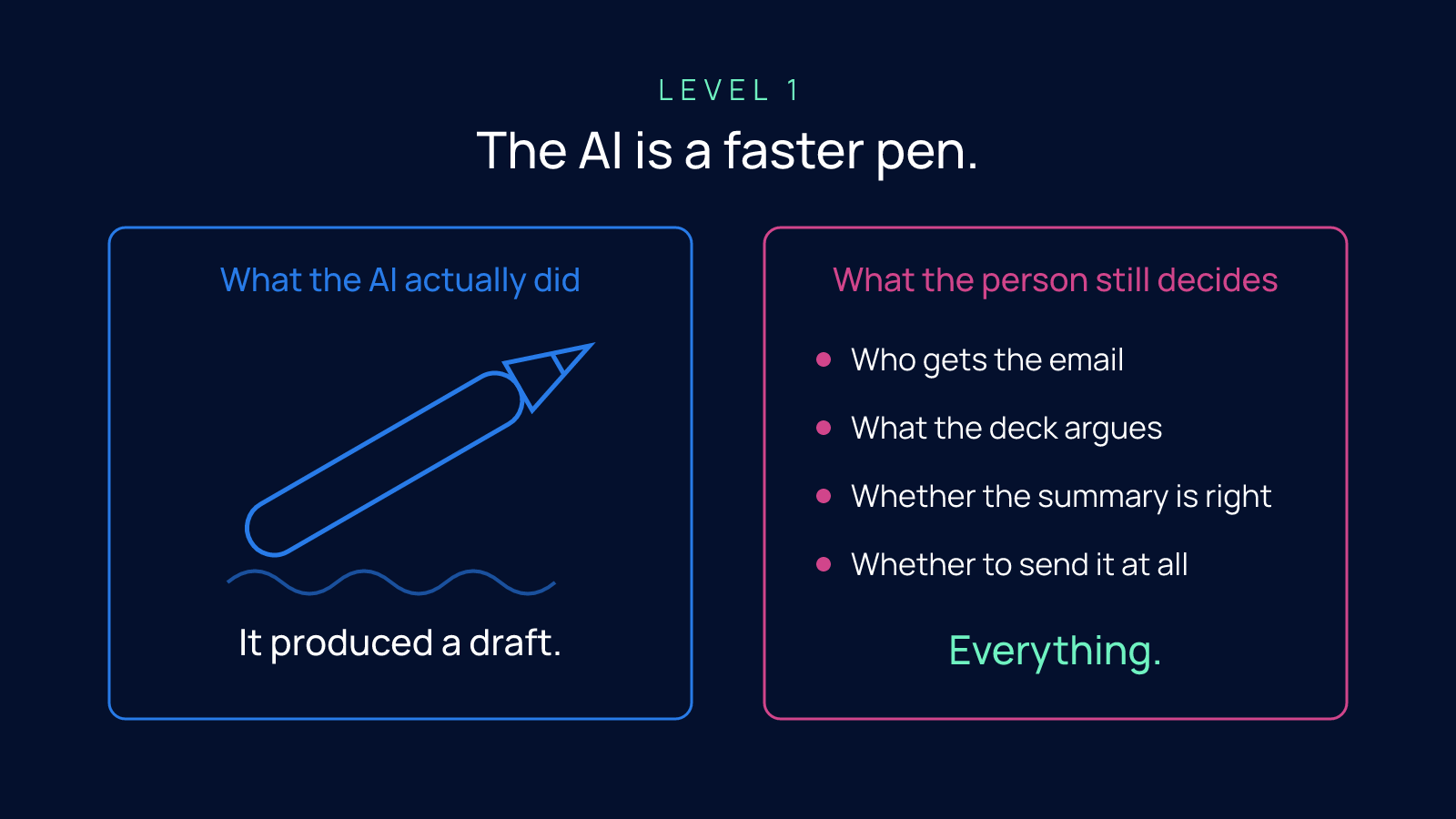
At Level 1, output goes up while nothing new exists. You get more of the same. More emails, more decks, more summaries. Better versions of them, often. But the emails go to the same list, the decks make the same pitch, the summaries summarize the same meetings.
Stand back and ask what the AI actually did. It produced a draft. Now ask what the person still decides. Everything. Who gets the email. What the deck argues. Whether the summary is right. Whether to send it at all. The judgment did not move. The work did not change shape. The AI is a faster pen.
That is fine as far as it goes. It just does not go very far, and a company that stops here has not built anything a competitor cannot copy by handing their team the same subscription next Tuesday.
The second part of the ceiling is quieter and does more damage. Most Level 1 use is ad hoc. Each person has their own prompts, their own habits, their own opinion about what the tool is good for. The salesperson who figured out a great follow-up prompt keeps it in a chat history nobody else can see. When she leaves, it leaves with her. The manager two desks over is still typing "make this sound better" and getting mush.
We put a line on the Edge8 home page that I will repeat here: "Ad-hoc usage of AI is limiting you to minimal gains." That is the whole warning in one sentence. The gains are minimal not because the tool is weak but because nothing about the use is shared, checked or repeatable. It is twenty people each running their own tiny experiment, with no way to keep the results.
Ad hoc Level 1 feels like progress because everyone is busy with AI. It is a plateau dressed up as a climb.
What Level 1 looks like when it is designed
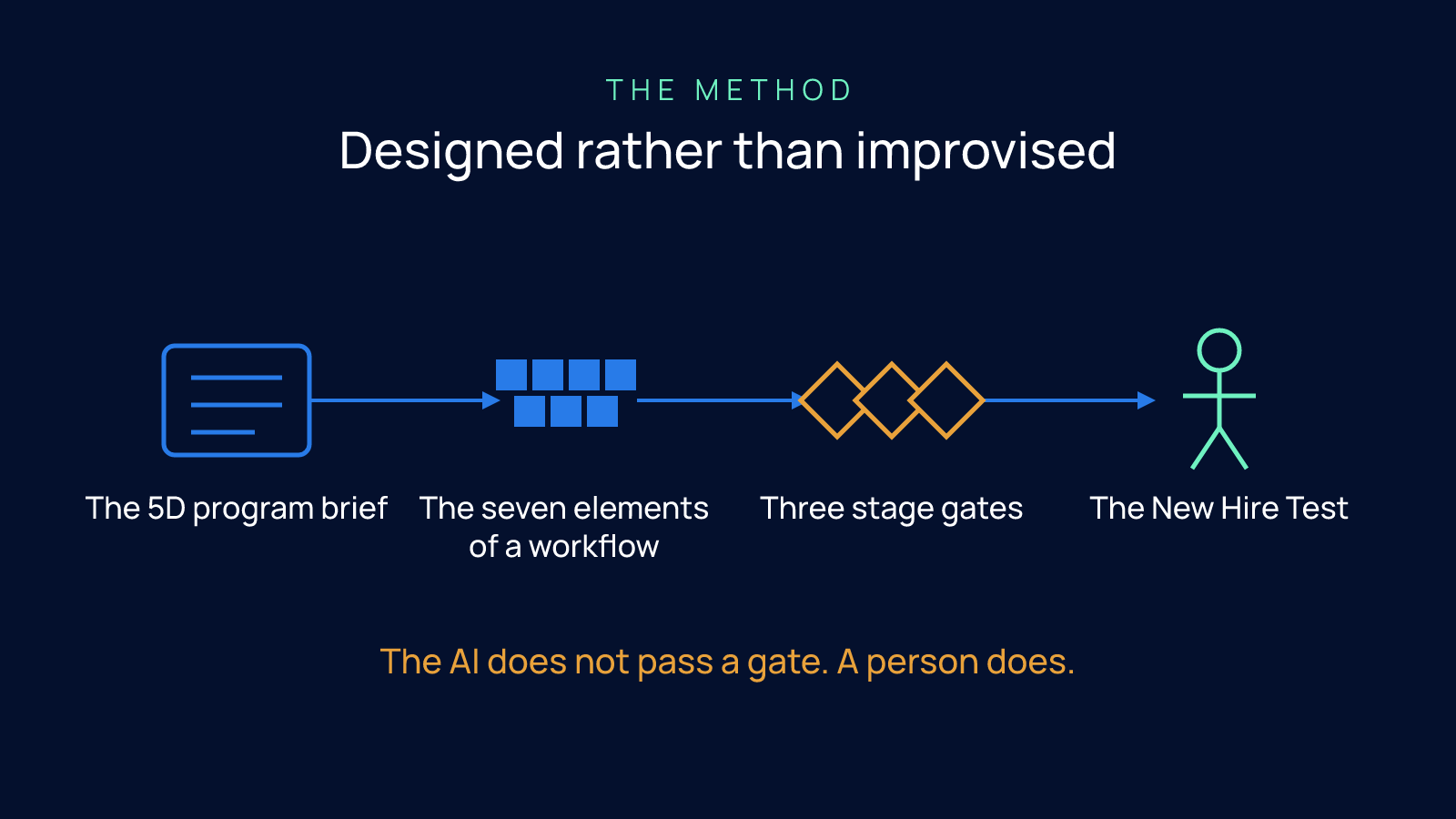
The answer is not to skip Level 1. You cannot. The answer is to do it properly, and properly means designed rather than improvised.
A designed workflow starts with a brief, not a prompt. The brief says what the workflow is for, who runs it, what goes in, what comes out, and what "good" looks like. Then the workflow is built from named parts, so two people running it get the same result, and it has checkpoints where a human decides whether the output is fit to move on.
I can point you at exactly what I mean, because Edge8 runs on these and we published them.
The workflow library at /workflows/ is the set of workflows Edge8 actually runs on, organized by the four offices we run the company through: Revenue, Talent, Operations and Innovation. Each workflow is marked either built or planned, so you can see what is live and what is still on the board. It is not a demo. It is the operating manual, in public.
The method behind them is at /workflows/method/. Four pieces matter for this conversation:
- The 5D program brief. Before anything gets built, the workflow gets a brief. This is the part ad hoc users skip entirely, and it is the reason their results cannot be repeated.
- The seven elements of a workflow. Every workflow is built from the same seven named parts. Naming them is what lets you compare two workflows, fix one, or hand one to a new person.
- The New Hire Test. The name tells you what it checks: could someone who joined the company this month pick up the workflow and run it without you in the room. If not, it is not a workflow yet. It is a habit that lives in one person's head.
- Three stage gates. Points where the work stops and a person decides whether it goes forward. The AI does not pass a gate. A person does.
Notice what the gates do to the Level 1 question. At every gate, the answer to "what did the AI just do" is clear (it drafted, summarized, sorted) and the answer to "what does the person still decide" is written down (whether it is right, whether it ships). Ad hoc use blurs that line. Designed use draws it in ink.
Run one of yours through it
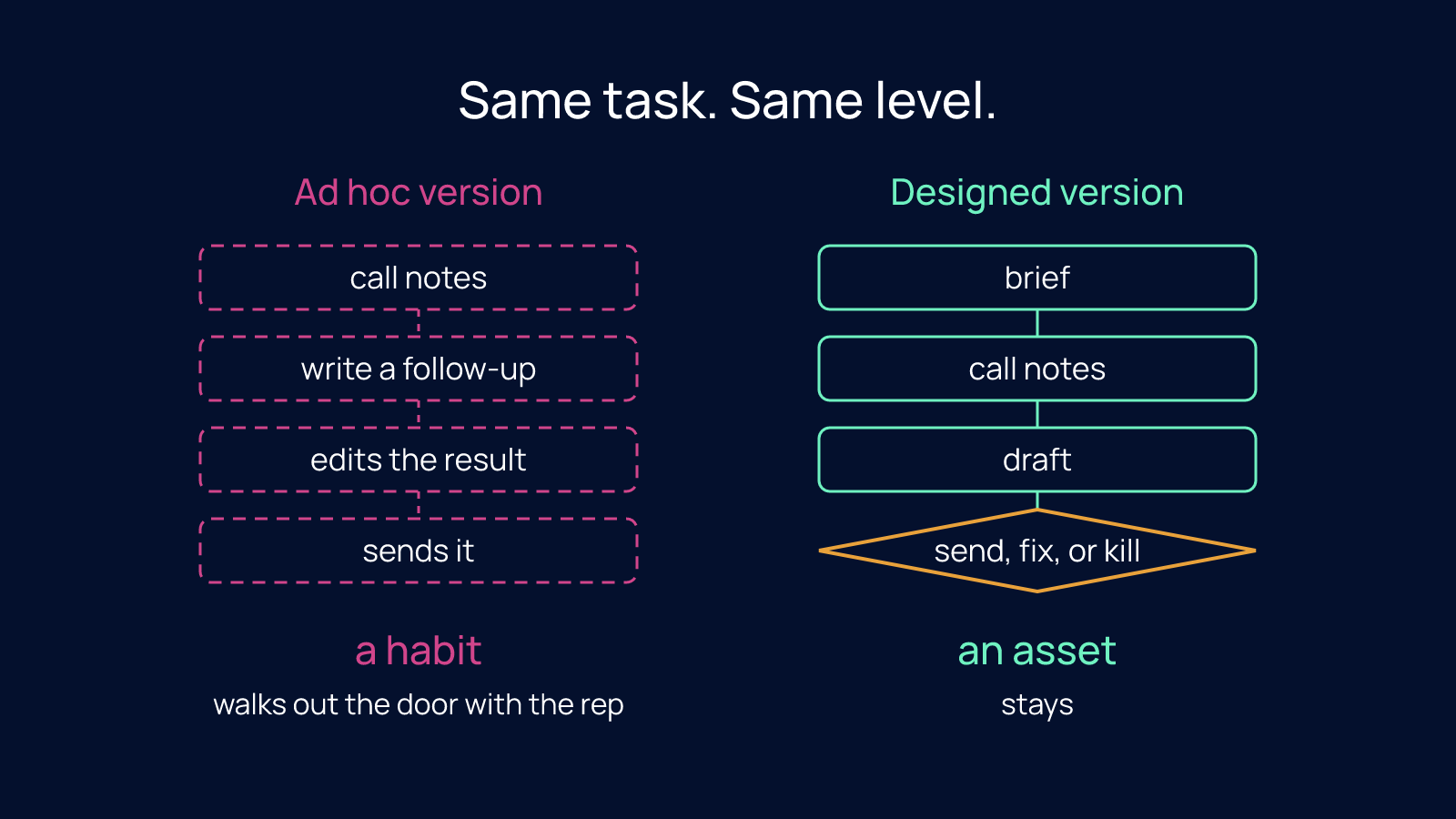
Take the follow-up email, since every company has it.
Ad hoc version: each rep pastes the call notes into a chat window, types something like "write a follow-up," edits the result, sends it. Some reps are good at this. Most are not. Nobody can tell which is which, and the good prompts are locked in individual accounts.
Designed version: there is a brief that says what a follow-up is for and what it must include. There is a defined input (the call notes, in a set format) and a defined output. The AI drafts against that brief. A person reads the draft at a gate and decides: send, fix, or kill. The workflow is written down clearly enough that a rep who started Monday can run it Tuesday.
Same task. Same level. The AI is still drafting and the person is still editing. But one of those is a habit and the other is an asset. One walks out the door with the rep. The other stays.
That is the difference between Level 1 as a plateau and Level 1 as a foundation.
Why this matters for the next level
This is why I am spending a whole post on a level everyone thinks they understand.
Level 2 is where something new exists. Something a customer touches, something the business could not do before, not just faster versions of last year's output. I will go deep on it in the next post in this series. But you cannot build Level 2 on top of ad hoc Level 1, for a simple reason: Level 2 needs workflows that run without the founder watching, and ad hoc use has no workflows. It has people.
Every designed workflow you build at Level 1 gives you three things you will need one level up: a written brief you can extend, a set of named parts you can rewire, and gates where a person already knows what they are deciding. Those are the foundations. Ad hoc use builds none of them.
There is one more thing ad hoc use never produces: an owner. When each person runs their own experiment, nobody owns the briefs, the elements, the gates, or the data those workflows need to run on. Twenty people being "good at prompting" does not add up to one person owning the design. Until someone does, the plateau holds.
So Level 1 done properly is not the whole strategy. It is the ground the strategy stands on. Done badly, it is a ceiling you will keep bumping into while telling yourself the company is "using AI."
The next step
Do this today. Open /workflows/ and find the workflow closest to something your team already does ad hoc. Read the method at /workflows/method/. Then pick one of your own ad hoc uses and write the brief for it. Just the brief. You will learn more about where your company actually stands from that hour than from another quarter of everyone prompting on their own.
Then reply and tell me which workflow you picked and what writing the brief showed you. If it showed you that nobody in the building owns the data it needs, say so. That is the most useful thing you can find out this week.
Level 2 is next, and it is closer than you think.
FAQ
How do I turn my team's ad hoc AI use into designed workflows that actually pay off?
Start with a brief, not a prompt: what the workflow is for, who runs it, what goes in, what comes out, and what good looks like. Then build it from named parts and add checkpoints where a person decides whether the output is fit to move on. Edge8 publishes the method it runs on: a 5D program brief, the seven elements of a workflow, the New Hire Test and three stage gates, applied across the four offices of Revenue, Talent, Operations and Innovation. Pick one thing your team already does ad hoc, such as the sales follow-up email, and write just the brief for it today.
Why does everyone on my team using ChatGPT feel like progress when nothing in the business has actually changed?
Because output is going up and the gains are real: if twenty people each save a few hours a week, that is meaningful capacity. But at Level 1, as defined in Beyond the Sky Custom Learning's three-level pyramid, the AI drafts and the person edits, so the emails go to the same list and the decks make the same pitch. Nothing new exists that a competitor cannot copy by handing their team the same subscription next Tuesday. When the use is also ad hoc, each of those twenty people is running a private experiment with no way to keep the results.
What should a repeatable AI workflow include so it does not depend on one person?
Four pieces, taken from the method Edge8 publishes and runs on: a written brief (the 5D program brief), the same seven named elements in every workflow, a New Hire Test, and three stage gates. The New Hire Test asks whether someone who joined the company this month could run the workflow without you in the room; if not, it is a habit living in one person's head, not a workflow. At each of the three gates a person, not the AI, decides whether the output is right and whether it ships.
Should I skip the basic AI efficiency work and go straight to building something new with AI?
No. The level where something new exists needs workflows that run without the founder watching, and ad hoc use has no workflows, only people. Every designed workflow you build at the efficiency level hands you three things you need one level up: a written brief you can extend, named parts you can rewire, and gates where a person already knows what they are deciding. Edge8 builds every one of its workflows from seven named elements and three stage gates for exactly this reason.
How do I know if my team's AI prompts are a real asset or just one person's habit?
Run the New Hire Test from the method Edge8 publishes: could a rep who started Monday run the workflow on Tuesday without you in the room. Take the follow-up email. In the ad hoc version each rep pastes call notes into a chat window, and the good prompts stay locked in individual chat histories that leave when the rep leaves. In the designed version there is a brief, a defined input and output, and a gate where a person decides to send, fix or kill; that kind of workflow is what Edge8 tracks across its four offices, each one marked built or planned.