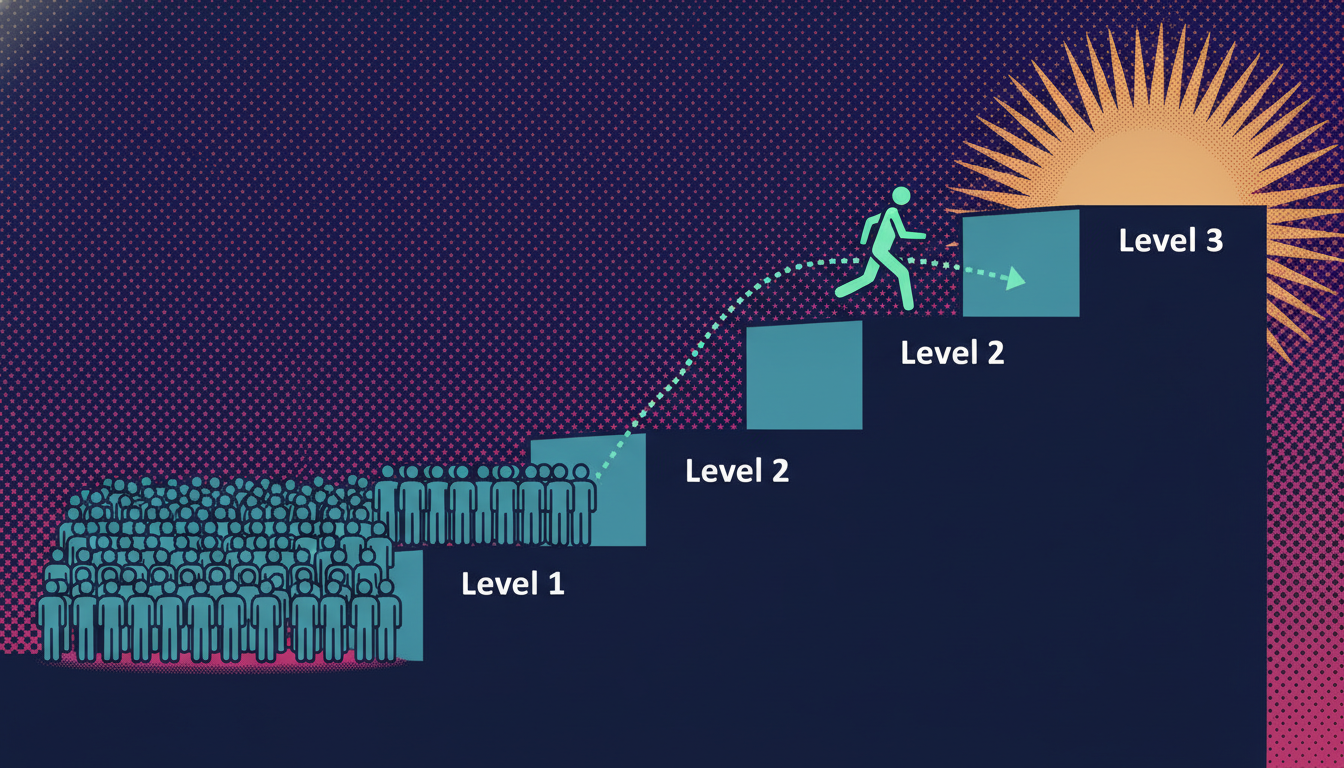
There are three levels of AI in a company. Level 1: do better what you already do. Level 2: do what you could not do before. Level 3: do what others cannot do.
Almost everyone is standing on the first one and calling it a strategy.
I hear it every week. A founder tells me they have rolled out AI. What they mean is that sales writes follow-ups faster, marketing turns a deck around in an afternoon, and somebody in operations gets a summary of every call. Those gains are real. But nothing new exists in that company that did not exist before. The same emails go out. The same decks get built. The same quiz questions get written for the same training. Faster.
This post anchors a short series; each level gets its own piece in the coming weeks. Today the job is the whole ladder: most of the time on the rung you are probably standing on, proof that the next rung is closer than you think, and an honest price on the top.
One credit first. The ladder is borrowed. Beyond the Sky Custom Learning drew it as a pyramid for AI in learning: at the bottom, the L&D team uses AI to design faster; in the middle, the learner engages with AI directly; at the top, learning is delivered by AI so seamlessly the learner does not realize AI is involved. Swap "learner" for customer, new hire or manager and it describes every business I have sat down with. The shape is theirs. The argument about where you stand is mine.
Level 1: doing better what you already do
Ad-hoc usage of AI is limiting you to minimal gains
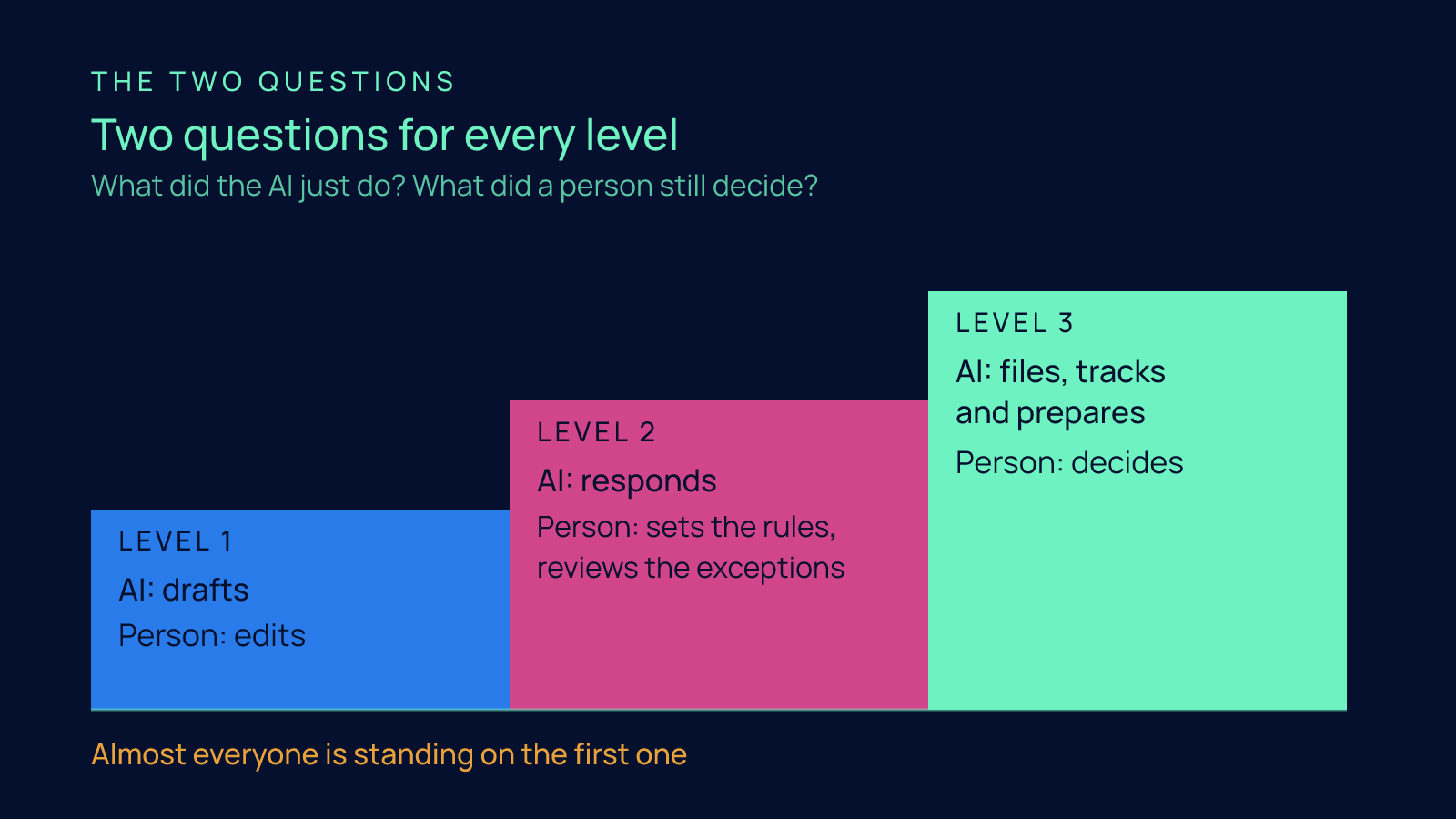
Here is the test I use for every level. Carry it through this whole piece. Ask two questions about any AI in your company: what did the AI just do, and what does the person still decide?
At Level 1 the answer is simple. The AI drafts. The person edits. Every output is reviewed by the same human who would have written it, and then it goes to the same place it always went.
The gains are real. A founder who dreaded the weekly investor update now gets a first draft in a minute and spends the time on the numbers instead of the sentences. A trainer who wrote quiz questions by hand now writes the brief and reviews twice as many. A support lead who used to pull call notes together at the end of the day reads a summary instead. If your team is doing this, good. You are ahead of the teams still arguing about whether to allow it.
Now the ceiling.
Output goes up. Nothing new exists. Your customer still waits until the office opens for an answer. Your new hire still learns from whatever the manager remembers to say. Your managers still walk into one-on-ones with whatever is in their head. The product is the same product, the process is the same process, and every competitor with a login to the same tools has the same speed you do. Level 1 does not compound. It gives you back hours, and hours are easy to fritter away.
Level 1 is also where all the arguments live. Is the writing any good? Will it make something up? Is it taking jobs? Should we ban it in sales? These are Level 1 arguments because Level 1 is the only level where a person reads every output before it leaves. When you review everything, the quality of the draft is the whole conversation. That conversation is worth having once. Most companies are having it for the third year.
The diagnosis is on our home page: "Ad-hoc usage of AI is limiting you to minimal gains." Ad hoc is the problem word. Ten people using ten different prompts in ten different ways is not a capability. It is ten hobbies.
What Level 1 looks like when it is done properly
There is a good version of Level 1, and it is worth reaching before you climb, because it teaches the discipline the next two levels demand.
The good version is written down. Every repeating job the AI drafts has a workflow behind it: what goes in, what comes out, who reviews it, and what a good result looks like. We publish the ones Edge8 actually runs on at /workflows/, organized by our four offices, Revenue, Talent, Operations and Innovation, each marked built or planned so you can see what is live and what is next. The built ones are not a promise. They are the work we run on every week.
The method behind them is at /workflows/method/. Four pieces matter. The 5D program brief, which forces you to define the job before anyone opens a tool. The seven elements every workflow needs so it runs the same way on Tuesday as it did on Monday. The New Hire Test, which asks one question: could someone new run this from what is written down? And three stage gates, the points where a workflow has to prove itself before it gets more responsibility.
Done that way, Level 1 stops being a hobby and becomes infrastructure. The AI still drafts. The person still edits. But now the edit is a decision, not a rescue, and the company owns something it can hand to the next person.
It is still Level 1. Do it properly, then climb.
Level 2: doing what you could not do before
Here is the line that separates the levels. At Level 1 your team interacts with the AI. At Level 2 the people on the other side of your business interact with the AI too.
A customer asks a question at midnight and gets an answer that knows their account, their history and their last ticket. Not a canned reply. A real, personalized answer while your team is asleep. A new hire submits actual work in their second week and gets feedback that afternoon, against the standard you set, not the standard the busiest manager happened to remember. A manager gets a coaching brief before every one-on-one: what this person shipped, what they committed to last time, what is slipping, what to ask.
None of those things existed in your company before. Nobody was answering at midnight. Nobody was reviewing the new hire's work on day nine. Nobody was preparing the manager. This is not the same thing faster. This is a thing that was not there.
Run the two questions. What did the AI just do? It responded, directly, to a customer or an employee. What does the person still decide? The rules. Who gets what answer, what the standard for feedback is, what a coaching brief must contain, and what counts as an exception a human needs to see. At Level 2 the person moves from editing every output to setting the rules and reviewing the exceptions. That is a different job, and it is the job most companies have nobody doing.
Why Level 2 feels further away than it is
When I describe Level 2 to a founder, the first reaction is usually some version of: that is a data science team and a two-year roadmap. It is not.
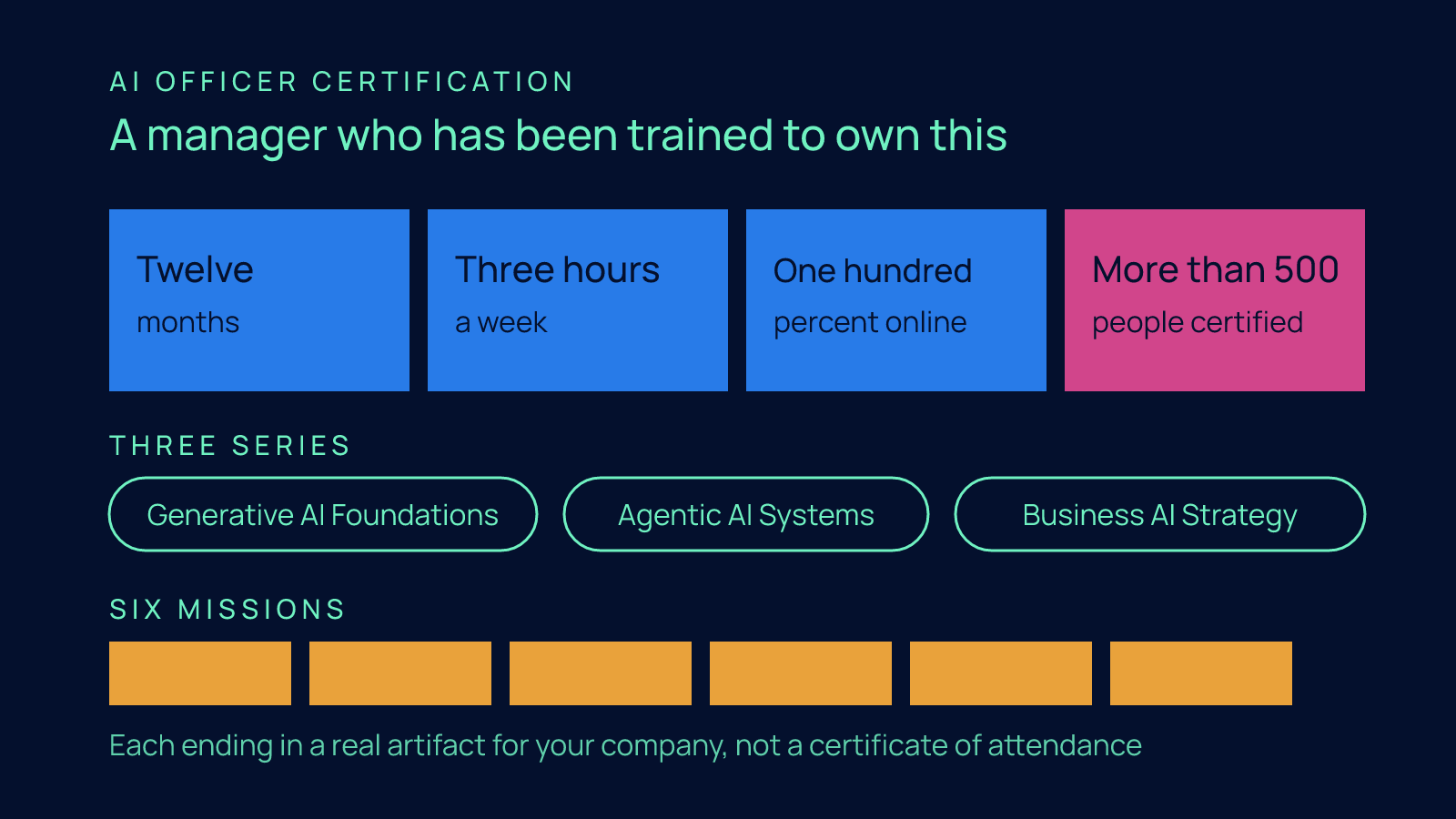
It needs one person in the company who can set the rules well. Someone who understands the business, understands what these systems can and cannot be trusted with, and can design the workflow the AI runs inside. Not a researcher. Not a prompt hobbyist. A manager who has been trained to own this.
That is what the AI Officer Certification exists for. It is at /training-and-certification/. Twelve months. Three hours a week. One hundred percent online. More than 500 people have been certified across Asia and North America. It runs as three series: Generative AI Foundations, Agentic AI Systems, and Business AI Strategy. Agentic, in plain language, means AI that takes a sequence of steps toward a goal and acts, rather than answering one question and stopping. That is the layer Level 2 is built on, and most managers have never been taught how to set rules for it.
The format is what makes it stick. It is challenge-based, laid out at /workflows/certification/: six missions, each ending in a real artifact for your company, not a certificate of attendance. By the end, the manager has built the things you need, in your business, on your data.
Three hours a week is a standing meeting. You can name the person this week and start this quarter. A year from now you have a Level 2 company with an AI Officer inside it who knows how it works. That is the surprise of this ladder: the middle rung is the one most leaders assume they cannot reach, and it is the one already within arm's length.
Level 3: doing what others cannot do
Level 3 is where the AI disappears.
Not because it is gone, but because it is so far inside the flow of work that nobody thinks of it as a tool anymore. The company runs on one set of data. Agents file the notes, track the commitments, and prepare the briefs. People walk into the room and decide. The customer, the new hire and the manager are all being served by AI and none of them would describe it that way. It is just how the company works.
Run the two questions one last time. What did the AI just do? It filed, tracked and prepared. What does the person still decide? Everything that matters. The direction, the exception, the trade-off, the call. The human is no longer editing drafts or setting rules for one workflow. The human is running a company where the administrative layer has been absorbed.
Here is the honest part. Level 3 is not a tool choice. You cannot buy it. A vendor cannot ship it to you on Thursday. It takes three things most companies do not have and cannot rent.
One database. Not one tool, one place where the people, the priorities, the customers, the money and the work delivered all live and refer to each other. Every stalled attempt at Level 3 I have seen traces back to data spread across systems that do not agree.
Designed workflows. The discipline from Level 1, applied everywhere. Written down, tested, gated.
A real commitment. Time, money and a leader who does not blink when the third week gets hard.
The payoff is a company others cannot copy. Your competitors can buy the same tools you buy. They cannot buy your data, your workflows or your decisions, and at Level 3 those three things are what the company is made of.
The path Edge8 offers
This is the work Edge8 does with a company, and I want to be concrete about what it costs, because vagueness here is how founders get burned.
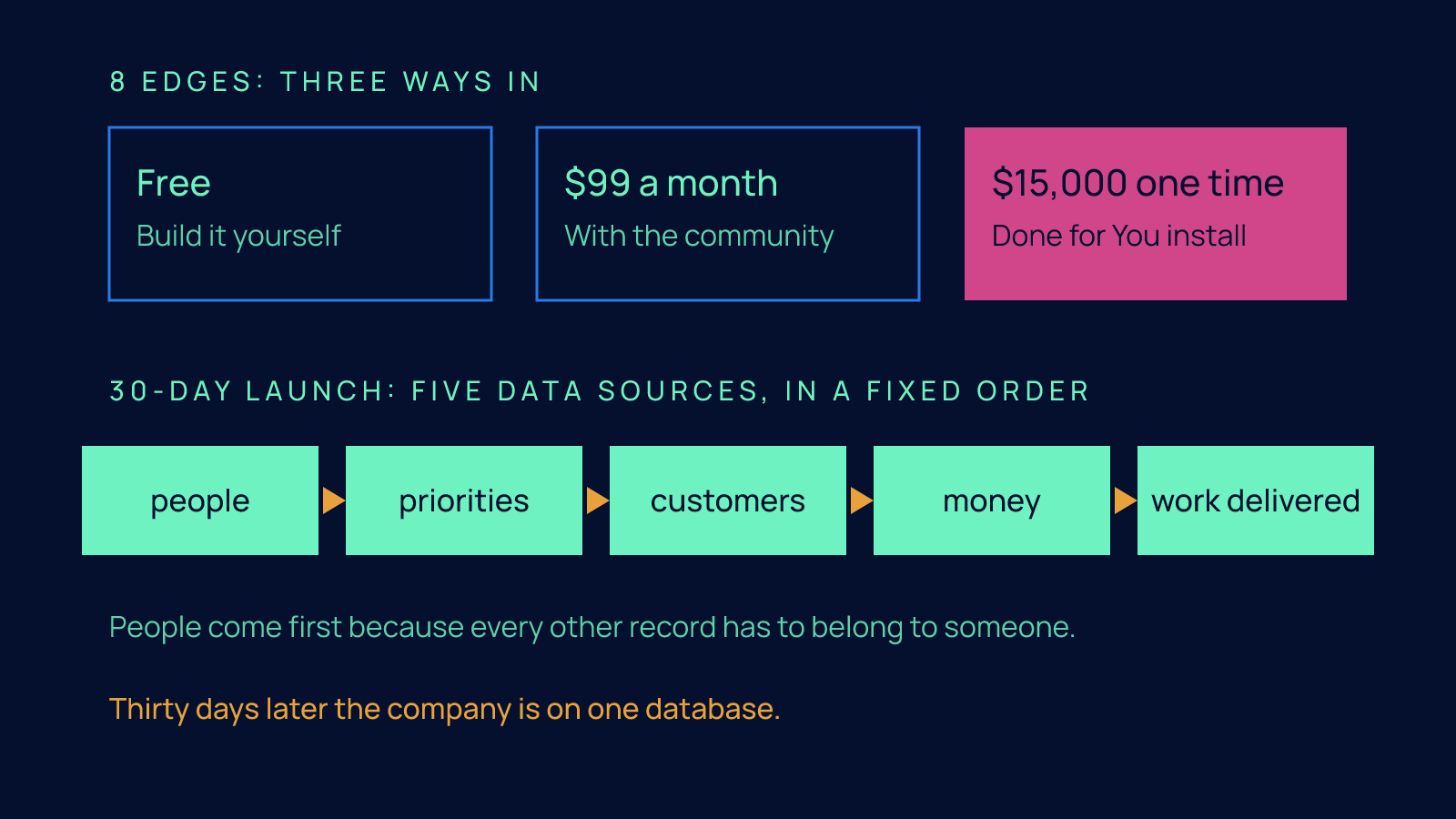
The system is 8 Edges, at /8-edges-app/. Three ways in. Free if you build it yourself. $99 a month with the community around you. Or $15,000 one time for the Done for You install, where we connect up to five data sources and migrate your data in.
The Done for You install runs on the 8 Edges 30-Day Launch workflow. Five data sources, in a fixed order: people, priorities, customers, money, work delivered. The order is the point. People come first because every other record has to belong to someone. Priorities come next so the work has a direction before you connect anything else. Then customers, then money, then the work actually delivered. Thirty days later the company is on one database, and the agents have something true to file into.
That is Level 3's first step. It is not the whole climb. But it is the part nobody can skip, and it is the part we have done enough times to price.
Which level is your company actually on
Here is the Monday question. Do not ask your team whether they use AI. Ask two things about the AI they use.
What did it just do? What did a person still decide?
If the AI drafts and a person edits, you are on Level 1. Make it proper: write the workflows down, start with the library at /workflows/ and the method at /workflows/method/, and stop calling ten hobbies a strategy.
If the AI responds to your customers or your people and a person sets the rules and reviews the exceptions, you are on Level 2. If you are not there and want to be, name the manager and enroll them in the AI Officer Certification this quarter. Twelve months, three hours a week.
If the AI files, tracks and prepares while your people decide, you are on Level 3, and you already know what it cost to get there.
Most of you reading this are on Level 1. That is not an insult. It is a starting point, and it is where the arguments are, which means it is where the leaders who climb will leave the arguments behind.
If you want to talk about what a 30-Day Launch would look like for your company, reply and tell me which level you think you are on. I will tell you honestly whether I agree, and what the climb to the next rung would actually cost you.
FAQ
What are the three levels of AI adoption in a company, and how do I know which one my business is actually on?
There are three levels: Level 1 is doing better what you already do, Level 2 is doing what you could not do before, and Level 3 is doing what others cannot do. To find your level, ask two questions about any AI in use: what did the AI just do, and what does a person still decide? If the AI drafts and a person edits every output, you are on Level 1; if the AI responds directly to customers or employees while a person sets the rules and reviews exceptions, you are on Level 2; if agents file, track and prepare on one database while people decide, you are on Level 3. Most companies are on Level 1 and calling it a strategy.
How do I tell whether my team is just using AI to work faster or actually doing something new with it?
Faster is Level 1: the same emails, decks and summaries go out, a person reviews every output, and nothing exists that did not exist before. Something new is Level 2: a customer gets a personalized answer at midnight, a new hire gets feedback on real work in week two, a manager gets a coaching brief before every one-on-one. The Edge8 home page puts the Level 1 problem plainly: ad-hoc usage of AI is limiting you to minimal gains, and ten people using ten different prompts in ten different ways is ten hobbies, not a capability.
How long does it take to train a manager to run AI that responds to customers and employees directly?
About a year at a standing-meeting pace. The AI Officer Certification runs twelve months, three hours a week, one hundred percent online, and more than 500 people have completed it across Asia and North America. It is organized as three series (Generative AI Foundations, Agentic AI Systems, Business AI Strategy) and six challenge-based missions, each ending in a real artifact built for the manager's own company rather than a certificate of attendance.
What does it take to get AI fully embedded in how my company runs, and what does it cost?
Three things you cannot buy off the shelf: one database where people, priorities, customers, money and work delivered all live together, designed workflows applied everywhere, and a leader who commits time and money. The concrete first step is the 8 Edges install, which is free if you build it yourself, $99 a month with the community, or $15,000 one time for the Done for You version that connects up to five data sources and migrates your data in. That install runs on a 30-Day Launch workflow connecting the five sources in a fixed order: people, priorities, customers, money, work delivered.
What should a written AI workflow include so it runs the same way every time?
Four pieces, taken from the Edge8 workflow method: a 5D program brief that defines the job before anyone opens a tool, the seven elements every workflow needs so it runs the same on Tuesday as on Monday, the New Hire Test (could someone new run this from what is written down?), and three stage gates where the workflow proves itself before it gets more responsibility. Edge8 publishes the workflows it actually runs on, organized across four offices (Revenue, Talent, Operations and Innovation), each marked built or planned. Done this way, Level 1 stops being a hobby and becomes infrastructure you can hand to the next person.