
You fought for her. Rounds of interviews, a counteroffer, a weekend of back and forth about the offer. She said yes. You told the team. Everyone exhaled.
Then day one arrives.
Nobody set up her laptop. Her manager is on a plane. Her email and her logins show up on Thursday, which would be fine except today is Monday. The person who was meant to walk her through the systems is in back-to-backs until Wednesday and has no idea she is sitting in reception.
She spent weeks deciding to join you. She turned something else down to do it. And now she is watching the company improvise.
First impressions run in both directions
We talk about first impressions as if they only run one way, as if the new hire is the one being judged. She is not. She is judging too. She already decided you were worth the risk, and the first month is where she finds out whether she was right.
A laptop that is not ready says: we were not expecting you. A manager who is away says: you were not a priority. Accounts on Thursday say: nobody owns this. None of it is said out loud. All of it lands.
A great hire lost to a bad month costs the same as a mis-hire
Everyone knows a mis-hire is expensive. The cost of the search, the ramp time before anyone is productive, the work that did not get done, the morale hit when the team realizes it is not working, the severance, then the whole search again. It is one of the most expensive mistakes a growing company makes, and most founders have made it at least once.
Here is the part people miss. A great hire who leaves after a bad first month costs exactly the same. Same search, same ramp, same gap in the team, same awkward conversation with the board. The only difference is that you got the hard part right and then threw it away on logistics.
That is what makes the chaotic first month so maddening. It is not a judgment problem. You judged well. It is a memory problem.
Why smart people skip steps
Atul Gawande's The Checklist Manifesto explains why smart people skip steps: surgeons and pilots use checklists not because they are forgetful but because complex work under time pressure guarantees skipped steps no matter how good you are.
Atul Gawande wrote The Checklist Manifesto after watching surgeons, pilots and construction crews work. His argument is simple and uncomfortable. These are some of the most highly trained people on earth, and they use checklists. Not because they are forgetful, and not because they are careless. They use checklists because complex work under time pressure guarantees skipped steps no matter how good you are.
Read that again. Guarantees. Not "makes likely." The surgeon who has done the operation more times than he can count still skips a step when the room is loud and the clock is running. The checklist is not an insult to expertise. It is an admission that expertise does not protect you from volume and pressure.
Onboarding is exactly that kind of work.
Onboarding is dozens of steps across IT, HR, payroll and the manager
Onboarding is exactly that kind of work, dozens of steps across IT, HR, payroll and the manager, spread over a month, for a person each of them sees once a year at most. Memory fails at that; a checklist does not.
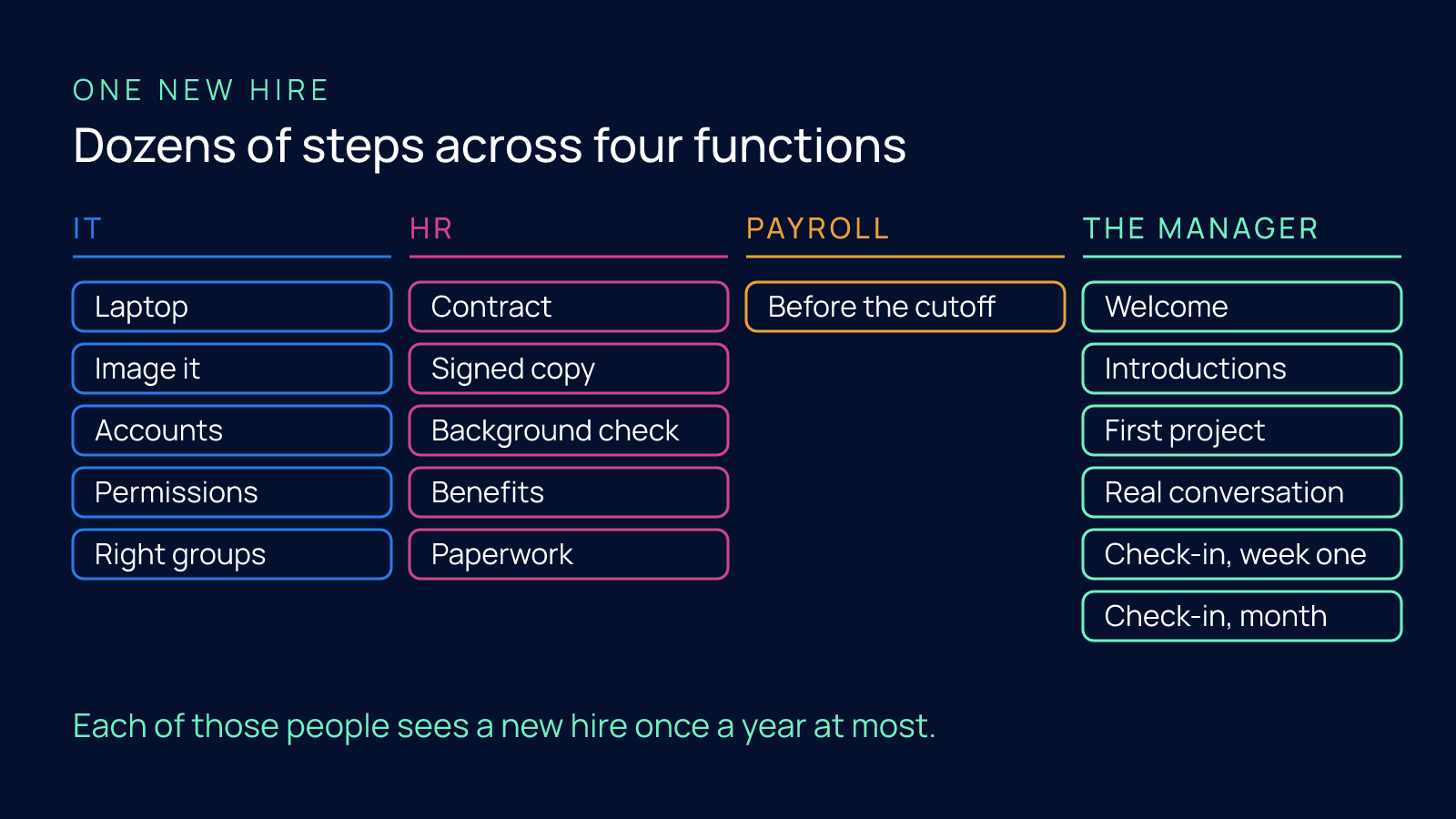
Walk through what has to happen for one person. IT has to order the laptop, image it, create the accounts, set permissions, add her to the right groups. HR has to send the contract, collect the signed copy, run the background check, enroll her in benefits, file the paperwork. Payroll has to set her up before the cutoff or she does not get paid. The manager has to book the welcome, line up introductions, pick a first project, schedule the first real conversation and the check-in at the end of week one and the one at the end of the month.
That is dozens of steps, spread across four functions (IT, HR, payroll and the manager) whose people do not sit together, over the span of a month. And here is the detail that breaks it: each of those people sees a new hire once a year at most. IT is not onboarding someone every week. Neither is the manager. The process never gets repetitive enough for anyone to hold it in their head.
So it lives in memory, and memory fails at exactly this. Somebody is traveling. Somebody is in back-to-backs. Somebody assumed somebody else had it. Not one of them is bad at their job. The work is simply the kind of work that skips steps.
A checklist does not skip steps. That is the entire point of a checklist.
Inside the onboarding board in our own Company OS
This is the third episode in the talent office of the 30-day 8 Edges season. Day 15 read the pile of applications. Day 16 put the human in charge of the AI's read. Day 17 picks up the moment after the hire is made, and it runs on something we use ourselves: the onboarding board is live in Edge8's own Company OS. What follows is how it works for us, not a mockup.
A card per hire, carrying the whole cycle
Every new hire is a card. Not a Slack message, not a thread, not a document someone has to remember exists. A card. And the card carries the full cycle: before day one, first week, first month. Open it and the whole arc of her first month is laid out in one place, in order.
That matters more than it sounds. The reason onboarding slips is that the steps are scattered across every inbox involved. Putting them on one card is not a productivity trick. It is the difference between a plan that exists and a plan everyone assumes exists.
The timeline builds itself from the start date
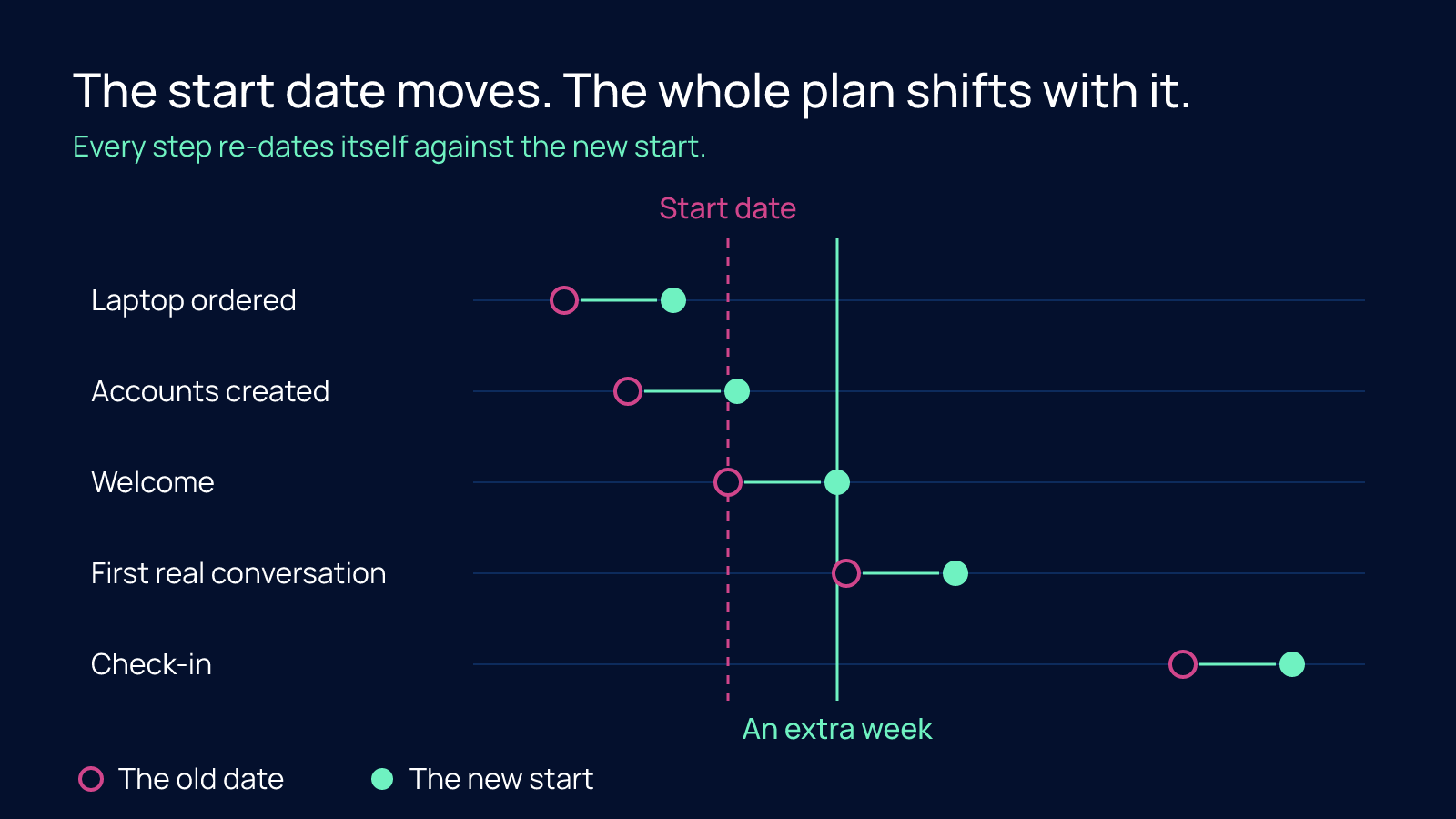
You enter the start date. The timeline builds itself from it. Laptop ordered a set number of days before. Accounts created a set number of days before. Welcome on day one. First real conversation at the end of week one. Check-in at the end of the first month.
Then the start date moves, as it does in nearly every real hire. She needs an extra week to finish out her notice. In the old world, that is the moment the whole plan quietly breaks, because the laptop order was placed against the old date and nobody told IT about the new one. On the board, you move the date and the entire plan shifts with it. Every step re-dates itself against the new start.
What did the AI just do? It rebuilt the schedule. What does the person still decide? Whether to move the date at all, and whether this particular hire needs a step the standard cycle does not have.
Every step has an owner and a day
Here is the discipline that makes the board work. Every step has an owner and a day. Not "IT" and "soon." A name and a date. The laptop is on a specific person's list for a specific day. The payroll setup is on a specific person's list before a specific cutoff. The welcome is on the manager's calendar, not in the manager's good intentions.
This is the same move we made on Day 9 when we wrote down who does what in a workflow. Ambiguity is where steps get skipped. When a step has one owner and one day, there is nowhere for it to hide.
The AI tracks what is due, what is done and what is slipping
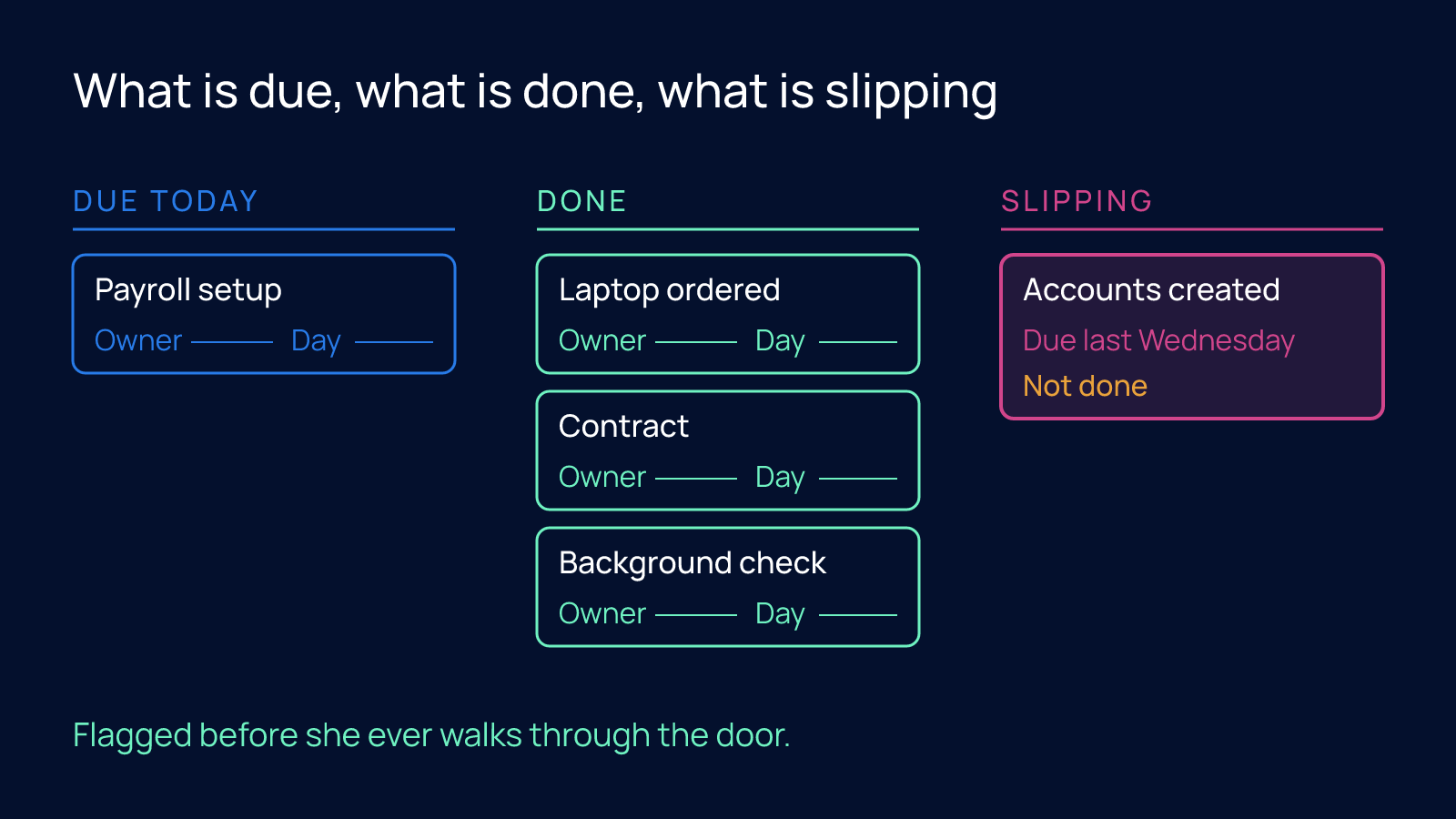
Now the part memory could never do. The AI tracks the board. What is due today. What has been done. What was due and has not been done, which is to say what is slipping.
That last one is the whole game. In the old world, nobody finds out the accounts are late until she arrives Monday and cannot log in. On the board, the step was due last Wednesday, it is not done, and it is flagged as slipping before she ever walks through the door. Someone can act on it while there is still time to act.
What did the AI just do? It watched every step against its date and surfaced the ones that are behind. What does the person still decide? What to do about it. Whether to chase IT, reorder the laptop, or call her and be honest that the first day will be a half day. The AI does not make that call. It makes sure someone can.
The system remembers. The manager does the human parts.
The manager still does the human parts, the welcome, the context and the first real conversation. What she no longer does is remember; the system remembers.
I want to be plain about where the line sits, because this is where onboarding software usually goes wrong. The temptation is to automate the welcome. Auto-send a greeting, auto-assign a buddy, auto-generate the first week's reading. That is not what this is.
The manager still does the human parts. The welcome, in person, on day one. The context: why we hired you, what the team is carrying, what good looks like here. The first real conversation, where she tells you what she is seeing with fresh eyes and you actually listen.
What the manager no longer does is remember. The manager does not have to hold the laptop order in their head while on a plane. They do not have to wonder whether payroll got set up. They do not have to keep a private list of the steps they are afraid someone else forgot. The system remembers. The manager shows up.
That division is the same one we drew in what AI should do and what your people should do. AI does the filing and the tracking. People do the judging and the relating. Onboarding is one of the clearest cases of it I know, because the tracking is tedious and the relating is irreplaceable.
A first month spent on the person, not the logistics
Picture the same day one with the board in place.
The laptop was on the desk Friday because the step was owned and dated and nobody had to remember it. The accounts worked Monday morning because the step that would have slipped got flagged on Wednesday and someone fixed it. Her manager rearranged the trip because the welcome was on the calendar as a dated step, not a vague intention. The person walking her through the systems had it blocked out because it was on his list with a day on it.
So the first month is not spent apologizing for logistics. It is spent on her. On the context, the introductions, the first project that actually matters, the conversation at the end of week one where she tells you something about your company you could not see from inside it.
That is what you fought for in the interview. The board is how you keep it.
Watch Day 17, then come back for Day 18
The Day 17 film walks the onboarding board live, card by card, so you can see the timeline rebuild when the start date moves and watch a slipping step surface. It is a few minutes, and it will tell you quickly whether this is the thing your company is missing.
Day 18 picks up where this leaves off: the first one-on-one, and how to walk into it prepared instead of winging it. If the first month is where she decides whether she was right to join, the one-on-one is where she decides whether to tell you the truth. That one is next.
The next step
If you have someone starting in the next month, go look at how her first day is being organized right now. If the honest answer is "it is in a few people's heads and one of them is traveling," you already know what the first day will feel like.
Reply and tell me how onboarding runs at your company today. We will show you the board as we actually use it, and we will tell you straight whether it fits what you are building.
FAQ
How do I build a new hire onboarding checklist that covers the whole first month so nothing gets skipped when IT, HR, payroll and the manager are all busy?
Start by admitting the scale: onboarding one person is dozens of steps spread across four functions (IT, HR, payroll and the manager) whose people do not sit together, over the span of a month, and each of them sees a new person starting once a year at most. Put the full cycle on one card per person, broken into before day one, first week and first month, instead of scattering it across inboxes and Slack threads. Then give every step one owner and one day, a name and a date rather than "IT" and "soon," so there is nowhere for a step to hide. Have the system, not the manager, track what is due, what is done and what is slipping.
Why does onboarding fall apart at my company even though everyone involved is good at their job?
Atul Gawande's The Checklist Manifesto explains it: complex work under time pressure guarantees skipped steps, no matter how skilled the people are, which is why surgeons and pilots use checklists. Onboarding is exactly that kind of work, dozens of steps across four functions over a month, and each person involved handles a new start once a year at most, so the process never gets repetitive enough to hold in memory. Somebody is traveling, somebody is in back-to-backs, somebody assumed somebody else had it. Not one of them is bad at their job; the work is simply the kind that skips steps when it lives in memory.
What happens to my onboarding plan when a new hire pushes her start date back a week?
If the plan lives in people's heads, that is the moment it quietly breaks: the laptop was ordered against the old date and nobody told IT about the new one. The fix is a timeline that builds itself from the start date, with the laptop ordered a set number of days before, accounts created a set number of days before, the welcome on day one, the first real conversation at the end of week one and the check-in at the end of the first month. When she needs an extra week to finish her notice, you move the date and every step re-dates itself against the new start. The person still decides whether to move the date and whether this particular hire needs a step the standard cycle does not have.
What should a manager still do personally in a new employee's first month, and what can AI handle?
The AI does the remembering: it watches every step against its date and surfaces what is due, what is done and what is slipping, so late accounts get flagged on Wednesday instead of discovered on Monday morning. The manager does the human parts: the welcome in person on day one, the context about why we hired you and what good looks like here, the first real conversation at the end of week one, and the check-in at the end of the first month. What the manager no longer does is hold the laptop order in their head while on a plane. The system remembers; the manager shows up.
How much does it cost me when a great new hire quits after a chaotic first month?
Exactly the same as a mis-hire: the same search, the same ramp time, the same gap in the team and the same awkward conversation with the board, and a mis-hire is one of the most expensive mistakes a growing company makes, one most founders have made at least once. The difference is that you judged well and then threw it away on logistics. First impressions run in both directions, and a laptop that is not ready on day one tells her you were not expecting her. Running the dozens of onboarding steps across four functions on a dated, owned checklist is how you protect the decision you fought for.