You have the idea. You have the notebook with the diagram in it, the spreadsheet that got out of hand, the chat window where you have been asking an AI to help you think it through at midnight. What you do not have is a system. Nothing runs unless you touch it. Every lead, every invoice, every follow-up starts with you remembering and ends with you doing it.
And there is a voice in your head that says: real systems cost money. Real systems need a team, or at least a budget line and somebody's sign-off. You will build this properly later, once you can afford to do it right.
That voice is wrong, and it is costing you months. I want to take it apart.
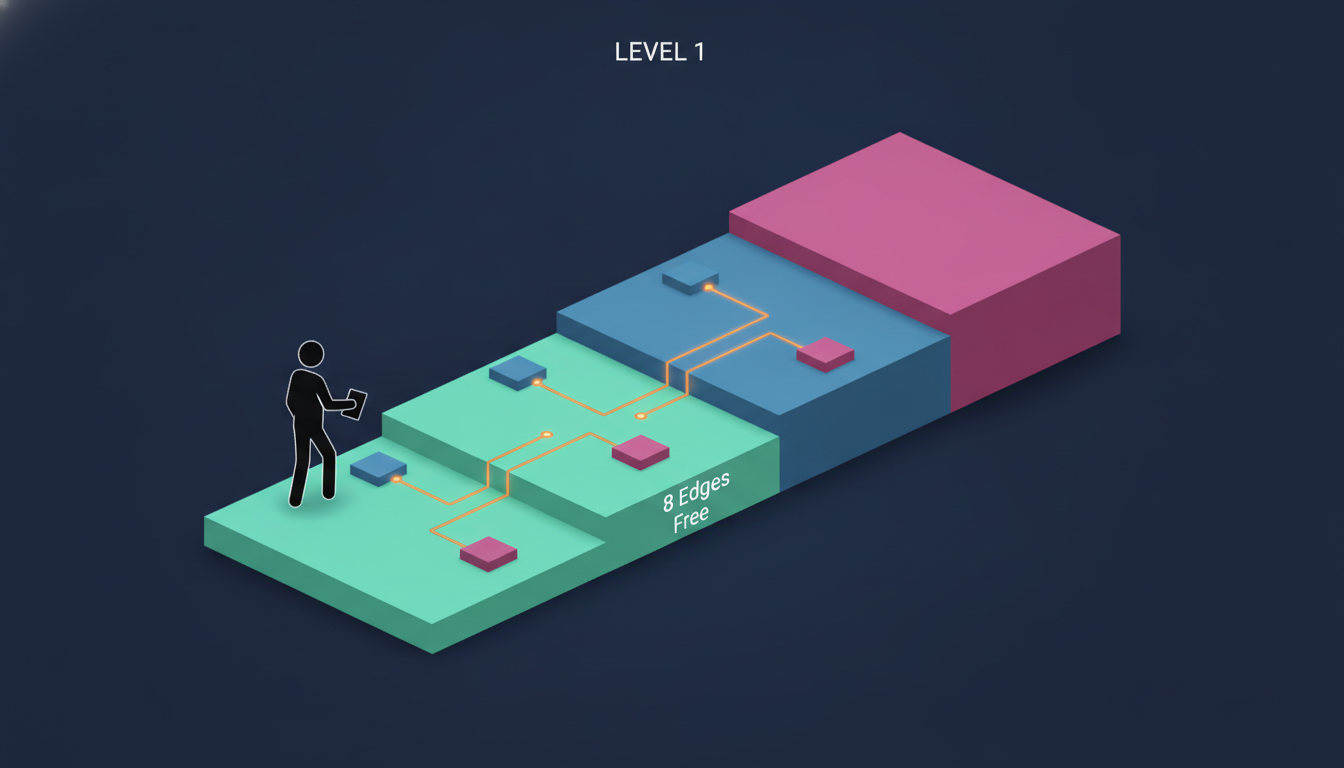
Earlier this week I laid out the three levels at which Edge8 works with people. This is the deep dive on the first one. Level 1 is 8 Edges: 100% free tools and APIs built to help you create your own workflows, your own systems, and the support a one-person company needs. No sales call in front of it. No budget to approve. You open the tools and you start building.
Most people do not start, and the reasons they give are not reasons. They are myths. Here are the four I hear most, and what is actually true.
Myth 1: Free means it is not real
8 Edges is 100% free tools and APIs, built to help people create their own workflows, their own systems and the support a one-person company needs.
The founder who has been burned, by a consultant who overpromised or by a tool that looked like a demo and behaved like one, hears "free" and translates it to "toy." Something you try for an afternoon and abandon. Something that cannot carry weight.
Free is a decision about who gets in the door. It says nothing about what is behind it.
We made Level 1 free on purpose. The first thing a founder needs is not a proposal or an advisory deck. It is a working version of something. A workflow that runs. A system that holds. Until you have that, every conversation about AI in your business is theoretical, and theoretical conversations are where money goes to die. 8 Edges exists so you can have the working version before you have spent a dollar on anything else.
Two plain-language definitions, because I do not want anyone nodding along at words they do not use. A workflow is the sequence of steps that gets a piece of work from start to finish, with a clear idea of who, or what, does each step. An API (application programming interface) is a plug. It is how one piece of software hands something to another piece of software without a person copying and pasting in the middle. 8 Edges gives you both: tools to build the workflows, and APIs so the pieces can talk to each other.
That is not a toy. That is the same layer larger companies pay people to own. You get to own it yourself first.
Myth 2: You need permission, a budget, or a team to start
The argument is that nobody needs permission or a budget to start building, so the first step is to try the tools.
This one is sneakier, because it sounds responsible. "I should get the plan right before I build anything." "I should find someone who knows what they are doing." "I should wait until the next round."
I have run companies for 20 years, and I started at Microsoft building automations that moved data and money at enterprise scale. I can tell you what waiting for permission gets you: a better-looking plan and the same empty system. Planning is not building. Handing it to an expert is not building either, not yet; the expert still has to build the system, and if you cannot describe what you need, they will build what they know, which is not necessarily what you need. I have watched founders pay for that lesson more than once, and it is an expensive one.
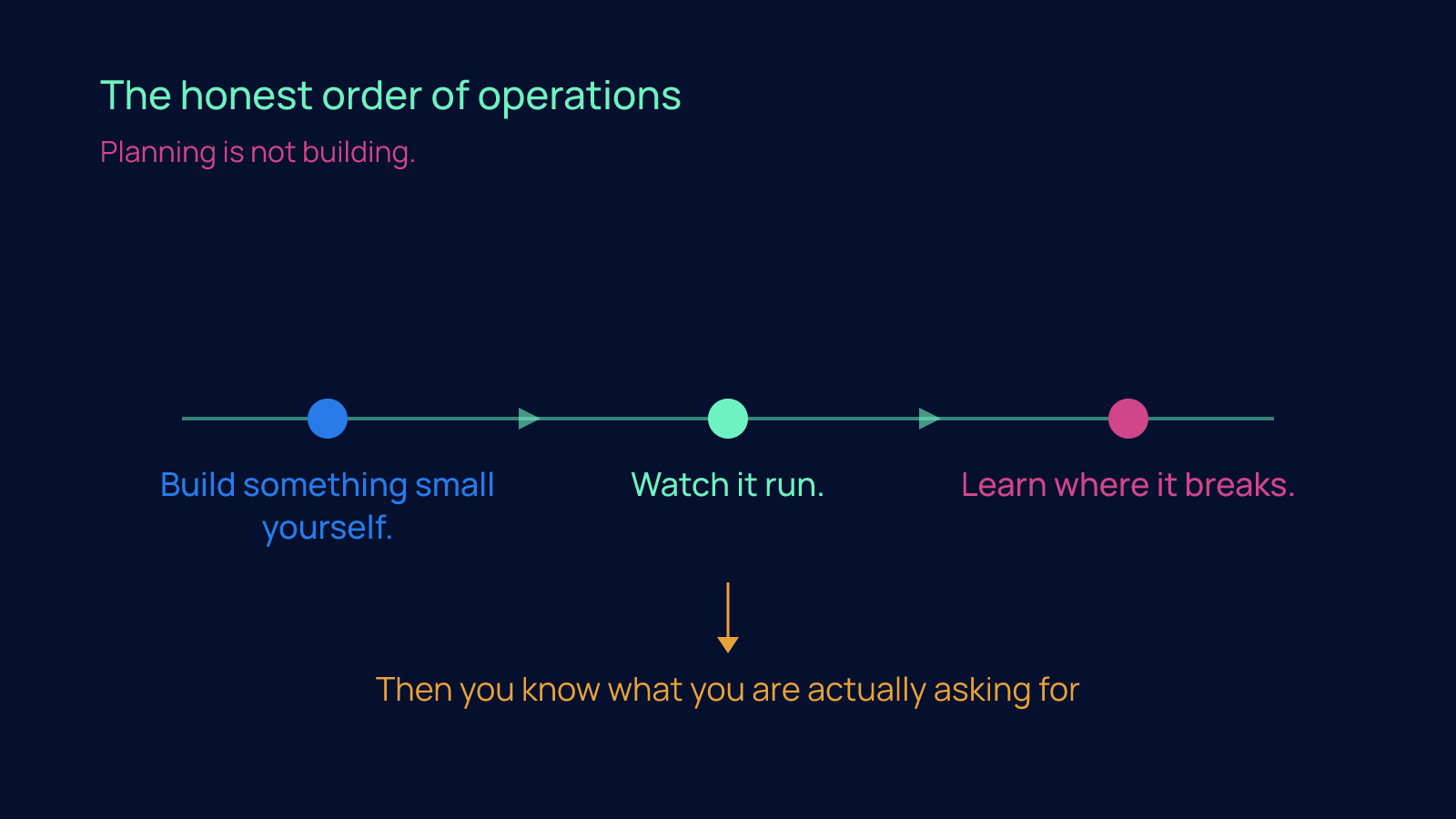
The honest order of operations for a one-person company is this. Build something small yourself. Watch it run. Learn where it breaks. Then you know what you are actually asking for, whether that is from a tool, a coach, or someone who builds the bigger version for you.
Level 1 is built for exactly that stage. Nobody is going to ask you for a business case. Nobody is going to ask who approved it. The only thing standing between you and your first workflow is you deciding which piece of your week you are tired of doing by hand.
Myth 3: The AI will build it, so I do not need to think
The AI does the building work in the tools; the person still decides what to build and whether it fits their business.
The opposite myth, and just as dangerous. Some founders hear "AI tools" and picture a machine that reads their mind, builds the business, and hands back the keys.
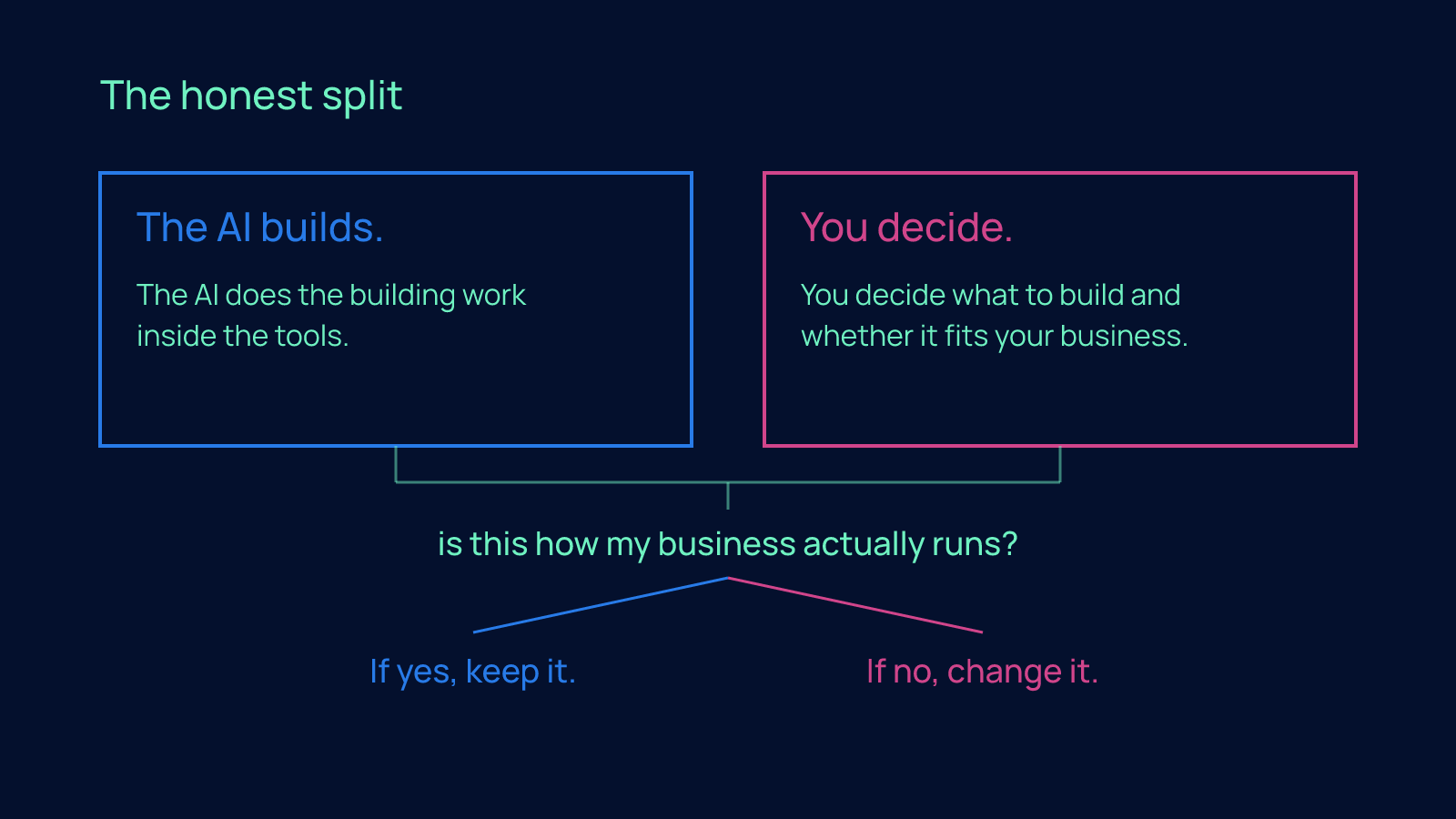
Here is the honest split, and it is the split I want every founder to carry into every AI decision they make from now on.
The AI does the building work inside the tools. You decide what to build and whether it fits your business.
That second half is not a disclaimer. It is the job. The AI can do a great deal of the assembly. It cannot know that your best customers come in through referrals and not through the website form, or that your invoicing has a quirk because of one client you took on in year one, or that the thing you call "onboarding" is really three different things depending on who is paying. You know those things. They are the whole reason your business is your business.
So when you use 8 Edges, the work divides cleanly. The AI builds. You look at what it built and ask one question: is this how my business actually runs? If yes, keep it. If no, change it. That decision stays with you at every level of working with Edge8, including the paid ones. The free level is where you learn to make it, on small things, before the stakes go up.
Myth 4: If I get stuck, I am on my own
Free tools usually come with free silence. You hit a wall, you search a forum, you give up.
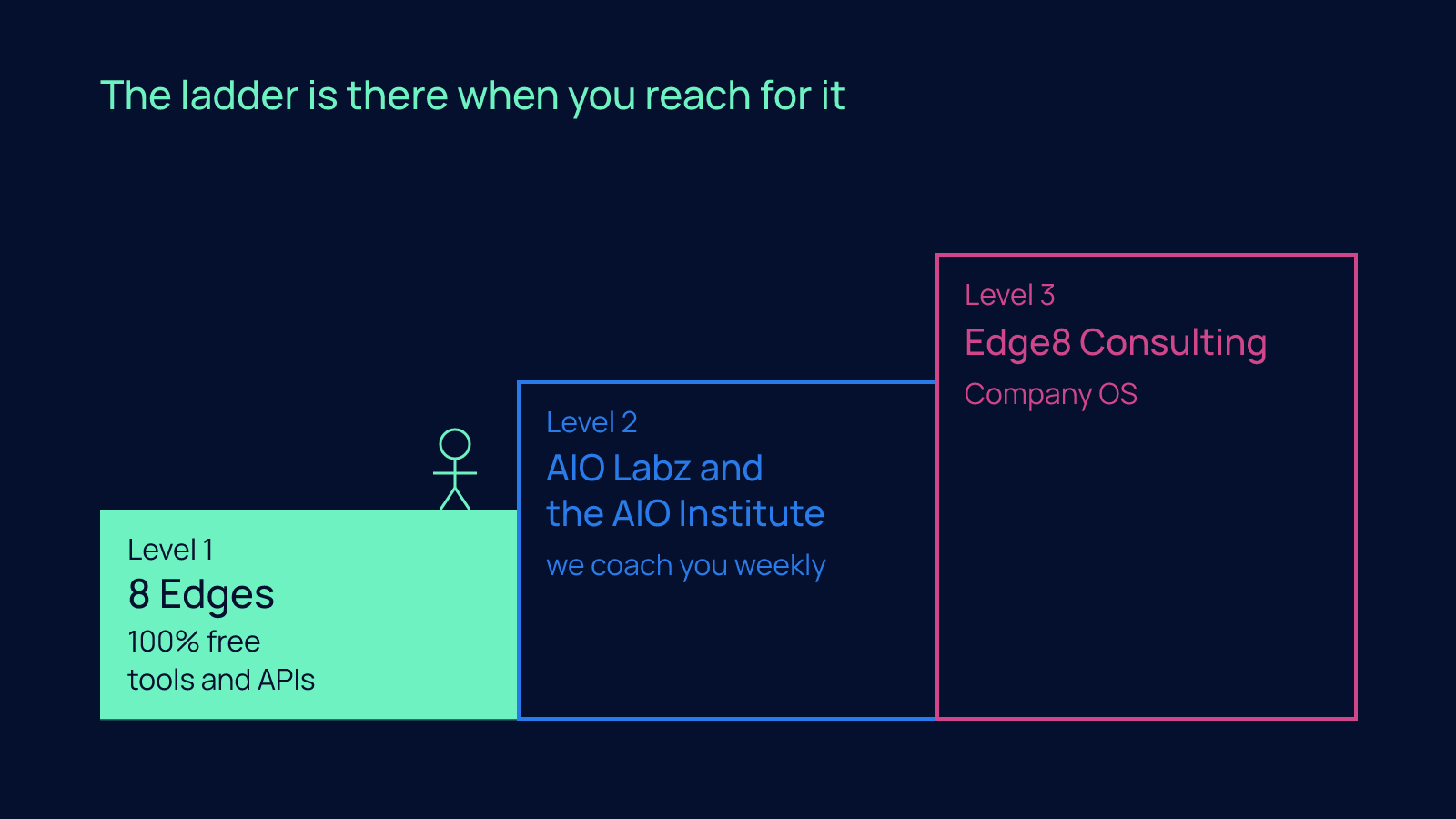
That is not how this ladder is built. Level 1 is the first step on a path, and the next two steps exist precisely for the moment you get stuck.
Level 2 is AIO Labz and the AIO Institute. If you explore the tools and hit something you do not understand, or you can see what you want and cannot get there, you can subscribe and we coach you weekly, directly, with communication throughout. Not a video library. People, on a schedule, who answer.
Level 3 is Edge8 Consulting. If you want your own system customized beyond what you can build yourself, we create your Company OS: a full customizable system tailored to your company. (Company OS is our name for the way your business runs, built as one system instead of a pile of disconnected tools.)
Here is the position I will take, since hedging is useless to you. Most people reading this should not pay us anything yet. If you have not tried the free level, you do not know what you need from the paid ones, and I would rather you find that out for free than buy a guess. The ladder is there when you reach for it. It is not there to be sold to you on day one.
What Level 1 is actually for
Strip away the myths and three things remain. They are what the free level is built to give you, in the words we use for them internally.
Your own workflows. The steps that make up your week, built so they run with less of you in them. Not a template of somebody else's business. Yours.
Your own systems. Workflows that connect, so a thing that happens in one place causes the right thing to happen in the next. This is where the APIs matter. The plugs are what turn a handful of workflows into a system.
One-person-company support. The honest condition most founders start in. One person, every hat, no one to hand anything to. Level 1 is built for that person. Not for the company you plan to be in three years. For the one you are running on a Tuesday.
If you are a CTO or technical leader reading this because your CEO forwarded it: the same logic holds. Before you ask for a budget or a person to own AI in your organization, build the small version and see where it strains. You will describe what you need far more precisely once you know which part of the system actually needs a human owner, and you will stop paying for the part that does not.
The first step is the whole point
I talk to founders every week who have decided they need AI in the business and have not built a single thing. They have read about it. They have a list of vendors. They have a name in mind. What they do not have is the one experience that makes all of those decisions easy: having built something small, watched it run, and felt where it fell short.
That experience costs nothing. It costs one hour and a willingness to be a beginner at something.
So here is the next step, and it is the only one. Go try the tools. Pick one piece of your week that you are tired of doing by hand. Build the workflow for it in 8 Edges. Let the AI do the building. Then make the decision that is yours: does this fit how my business runs?
When you have done that, and only then, reply and tell me what you built and where it broke. That is the conversation worth having, and it is the one that tells both of us whether you need coaching, a Company OS, or just another hour with the free tools.
FAQ
How do I start building my own workflows and systems with AI when I have no budget, no team and nobody to ask for permission?
You do not wait for any of those. Level 1 of working with Edge8 is 8 Edges, 100% free tools and APIs built so a one-person company can create its own workflows and systems without a sales call, a budget line or a sign-off. Dave Hajdu, who has run companies for 20 years, hears four myths that stop founders before step one, and the first fix is to pick one piece of your week you are tired of doing by hand and build the workflow for it yourself.
Are free AI tools good enough to run a real business on, or are they just toys I will abandon after an afternoon?
Free decides who gets in the door; it says nothing about what is behind it. 8 Edges was made 100% free on purpose because the first thing a founder needs is a working version of something, not a proposal, and the post gives two plain-language definitions so you know what you are building: a workflow is the sequence of steps that gets work from start to finish, and an API is a plug that lets one piece of software hand something to another without a person copying and pasting. That is the same layer larger companies pay people to own, and you get to own it yourself first.
What does the AI actually do when I build a workflow with it, and what do I still have to decide myself?
The AI does the building work inside the tools; you decide what to build and whether it fits your business. According to Dave Hajdu, that second half is the job, not a disclaimer, because the AI cannot know that your best customers come in through referrals, that your invoicing has a quirk from one client in year one, or that what you call onboarding is really three different things depending on who is paying. After the AI builds, you ask one question: is this how my business actually runs? If yes, keep it; if no, change it.
Where do I get help when my free AI workflow breaks and I cannot figure out why?
Edge8 works with people at three levels, and the next two exist for exactly that moment. Level 2 is AIO Labz and the AIO Institute, a subscription where you are coached weekly and directly by people on a schedule, not a video library. Level 3 is Edge8 Consulting, which builds your Company OS, one customizable system for how your business runs instead of a pile of disconnected tools. Dave Hajdu's position is that most readers should not pay anything yet, because until you have tried the free level you do not know what you need from the paid ones.
How long does it take to build my first AI workflow as a one-person company?
About one hour and a willingness to be a beginner, according to Dave Hajdu of Edge8. The honest order of operations is to build something small yourself, watch it run, learn where it breaks, and only then decide whether you need a tool, a coach or someone to build the bigger version. Level 1 is built for the founder wearing every hat with no one to hand anything to, which is why 8 Edges is 100% free and nobody asks you for a business case before you start.