Dear founder,
Try something at your next leadership meeting. Ask one question: what exactly should AI do in this company, and what should our people do?
Then count the seconds.
I have asked it enough times to know what happens. The room goes quiet. Half the table is afraid of handing AI too much. The other half is afraid of falling behind. Nobody wants to be the one who said the wrong thing out loud, so nobody says anything, and the agenda moves on to pipeline.
That silence is expensive, and it is not neutral. The question does not go away when you stop asking it. It gets answered anyway, by default, one shortcut at a time.
The split gets decided whether you decide it or not
Here is how the default version plays out. A rep pastes a customer email into a chatbot and sends the reply without reading it twice. A screener lets a tool rank the inbound stack and only opens the ones at the top. An ops manager builds an automation that moves data between two systems and nobody else knows it runs. A finance lead asks an assistant to summarize the month and pastes the summary straight into the board deck.
Every one of those is a decision about what AI does and what a person does. Each is small, local and reasonable on its own. Added up, they are your company's AI operating model, and nobody chose it. You cannot describe it, you cannot defend it to a customer, and when something goes wrong you cannot say who was accountable, because nobody was.
That is the cost of leaving the question unanswered. Not a dramatic failure. A slow drift into a company where the work has been quietly reassigned and the leadership team found out last.
Fifty percent human, fifty percent AI, as a management practice
Brooks Holtom at Georgetown, in The Other 50%, puts it plainly: leadership in this era is half human and half AI, as a management practice rather than a metaphor.
Brooks Holtom at Georgetown wrote a piece called The Other 50%, and he puts the answer more plainly than most. Leadership in this era is fifty percent human and fifty percent AI. He does not mean that as a metaphor or a mood. He means it as a management practice: a way of running the team that you can write down, teach and inspect.
I like that framing because it turns a scary question into one leaders already know how to answer.
Think about what you have always done with a piece of work. You looked at who was on the team, you judged who was best at that kind of task, you gave it to them, and you stayed accountable for the result. That is casting. Every good leader does it instinctively. You do not give the pricing model to the person who is great on customer calls, and you do not send your best analyst to run the kickoff.
AI is another performer on that roster. Nothing more mystical than that. You evaluate it the same way you evaluate anyone: on output. You give it the work it is best at and keep it off the work it is bad at. And you keep a human accountable for the result, the same way you would for someone fast and confident who has been on the team six weeks.
Once you see it that way, two things become obvious.
First, choosing who does what is a leadership act, not a technical one. It is not the CTO's call, and it is certainly not the vendor's. Your head of engineering can tell you what a model is capable of. Only you can decide what it is allowed to own.
Second, fifty fifty is not a quota. It is a reminder that both halves are real and both halves need to be assigned on purpose. In some functions AI will carry most of the execution. In others it will barely touch the work. The number that matters is not the percentage. It is the number of outcomes with a human name attached, and that number has to be all of them.
Two questions every AI claim has to answer
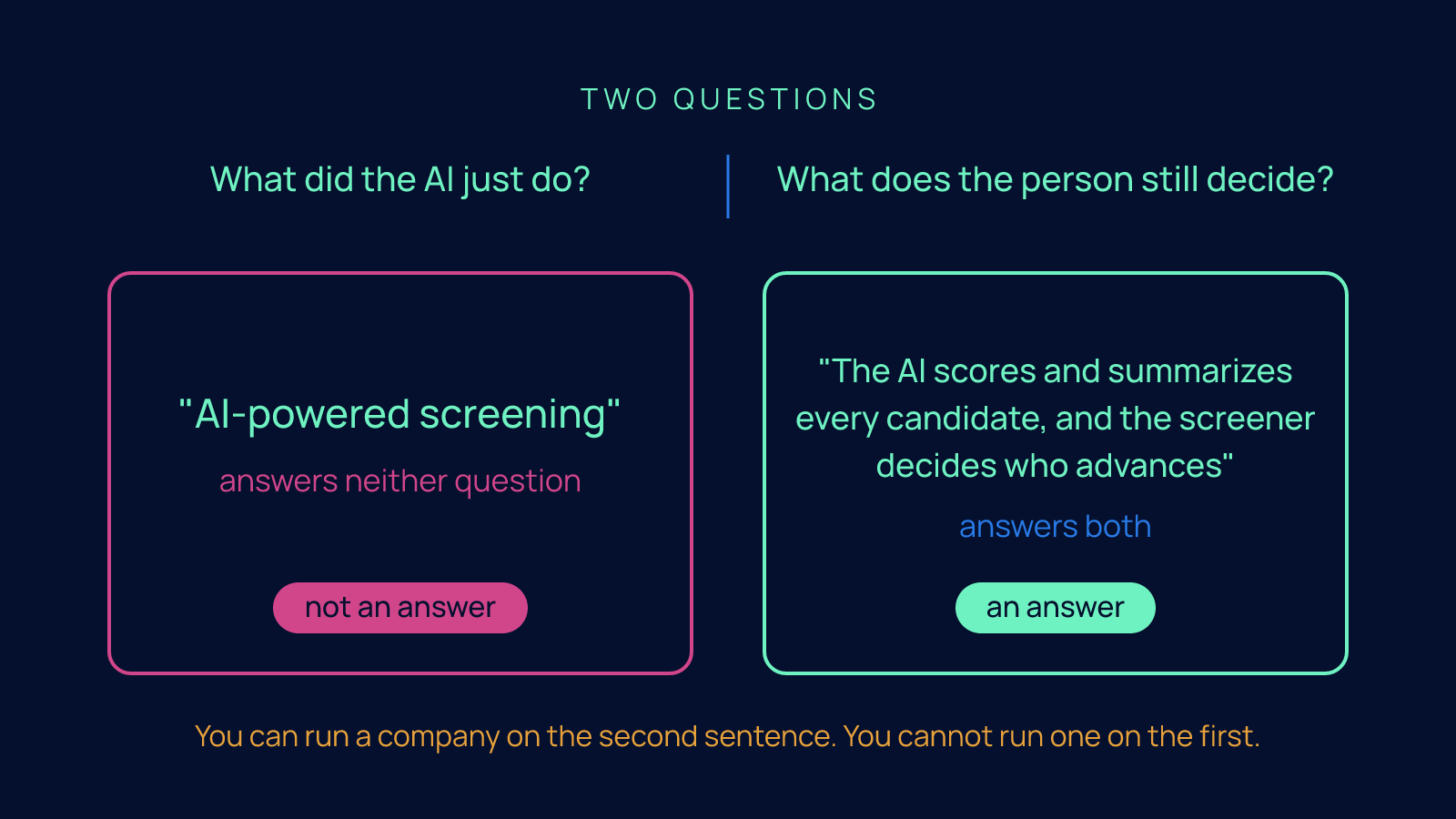
Before I show you what this looks like in practice, here is the test I use for any claim about AI in a company, including my own.
What did the AI just do? And what does the person still decide?
If a vendor, a new teammate or a slide cannot answer both questions in plain words, the split has not been made. It has been hidden. "AI-powered screening" is not an answer. "The AI scores and summarizes every candidate, and the screener decides who advances" is an answer. You can run a company on the second sentence. You cannot run one on the first.
Hold onto those two questions. Everything below is built on them.
What the fifty fifty looks like on a real screen
A slide that says "human in the loop" is cheap. I want to show you where the split is actually visible, so I will use the system we run Edge8 on, our own Company OS. These are live screens, not mockups.
Screen one: the candidate
In 8 Edges the split is visible: a screened candidate shows the AI's score and reasoning beside the screener's own assessment, and when they disagree the human wins and the system records the disagreement and learns from it.
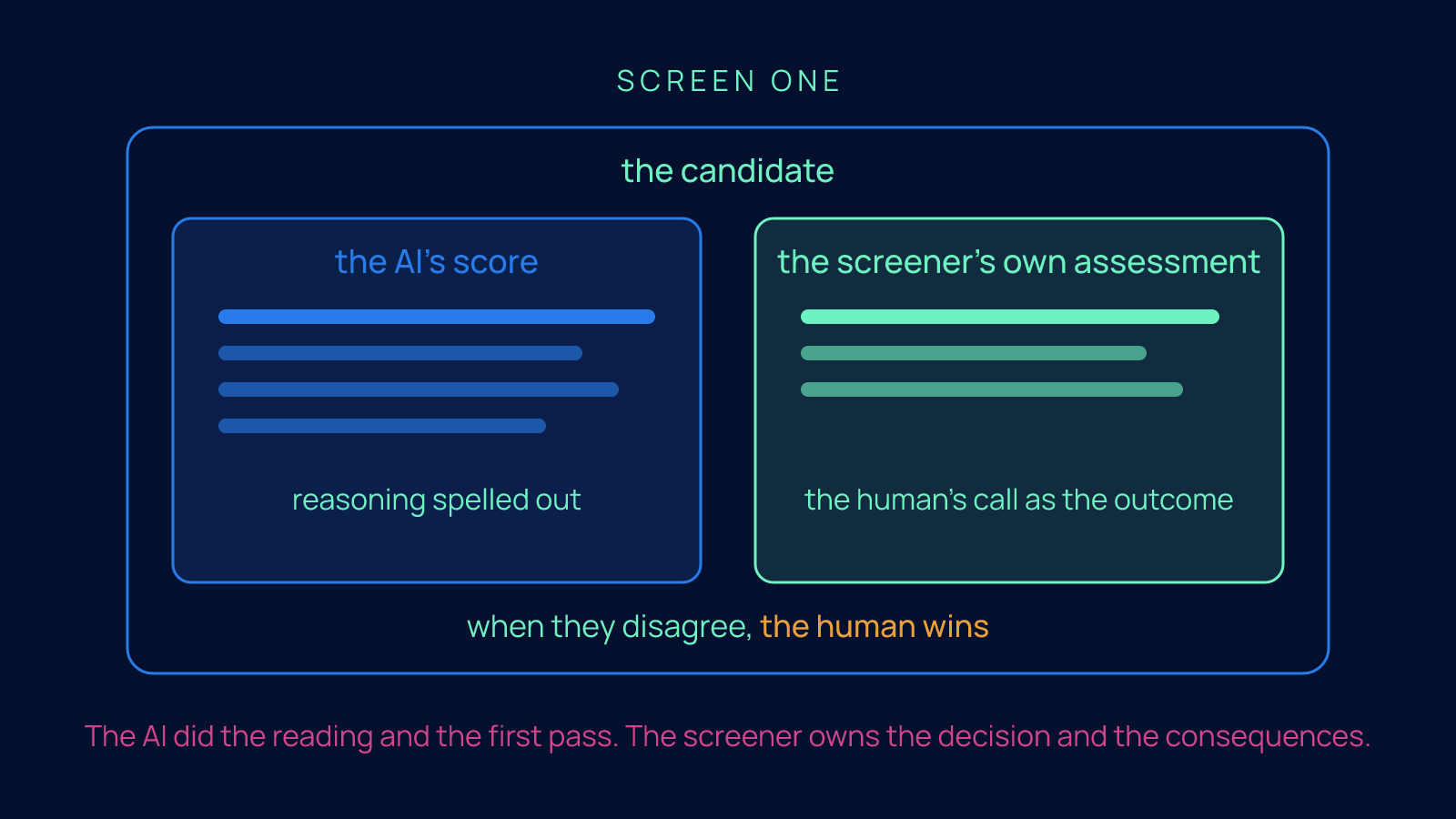
When a candidate comes through screening, the screener opens one record and sees two assessments side by side. On one side is the AI's score, with its reasoning spelled out: why it rated the person the way it did, against the role we defined. On the other side is the screener's own assessment of the same candidate.
So what did the AI just do? It read the candidate, scored them and wrote out why.
What does the person still decide? Everything that matters. Whether the candidate advances. Whether the AI's reasoning holds up. Whether the role definition the AI was scoring against was even right.
And when they disagree, the human wins. The screener's rating stands. The system does not quietly average the two or nudge the screener toward its number. It records the disagreement, keeps the human's call as the outcome, and learns from the gap. Every disagreement is a lesson it was forced to log, which means the AI's scoring is shaped by the judgment of the people who actually know what a good candidate looks like here.
That is the fifty fifty in a single screen. The AI did the reading and the first pass. The screener owns the decision and the consequences.
Screen two: the goal tree
Agents execute; accountability never delegates to software.
The second screen is the goal tree, the structure that connects what the company is trying to do this quarter to what each person works on this week. Plenty of goals in that tree are AI-led. An agent runs the steps: pulling the data, drafting the update, moving the record, chasing the follow-up.
Every one of those goals still carries exactly one accountable human name. Not a team. Not "the system." One person.
What did the AI just do? It executed the steps of the goal.
What does the person still decide? Whether the goal is the right goal, whether the output is good enough to ship, and what happens when it is not. If an AI-led goal misses, there is a human who answers for it, the same as any other goal in the tree.
Agents execute. Accountability never delegates to software. That is the rule, and it holds whether the goal is led by a person or by an agent.
Why "one name" is the whole thing
I want to sit on the one-name rule for a moment, because it is the part leadership teams most want to soften.
The temptation is to attach a team, or a function, or to say "the AI owns it and the manager reviews it." All of that is a way of attaching nobody. When an outcome has two owners, it has none. When it has a department, it has none. When it has a model, it definitely has none, because you cannot have a hard conversation with a model about why the number slipped.
One name does something else too. It forces the casting decision. The moment you have to write a human's name next to an AI-led goal, that human will ask what the AI is actually doing and whether they are comfortable standing behind it. That is exactly the question your leadership team went quiet on, and now it gets asked at the level where it can be answered, one goal at a time, by the person who has to live with it.
Do this before Day 7
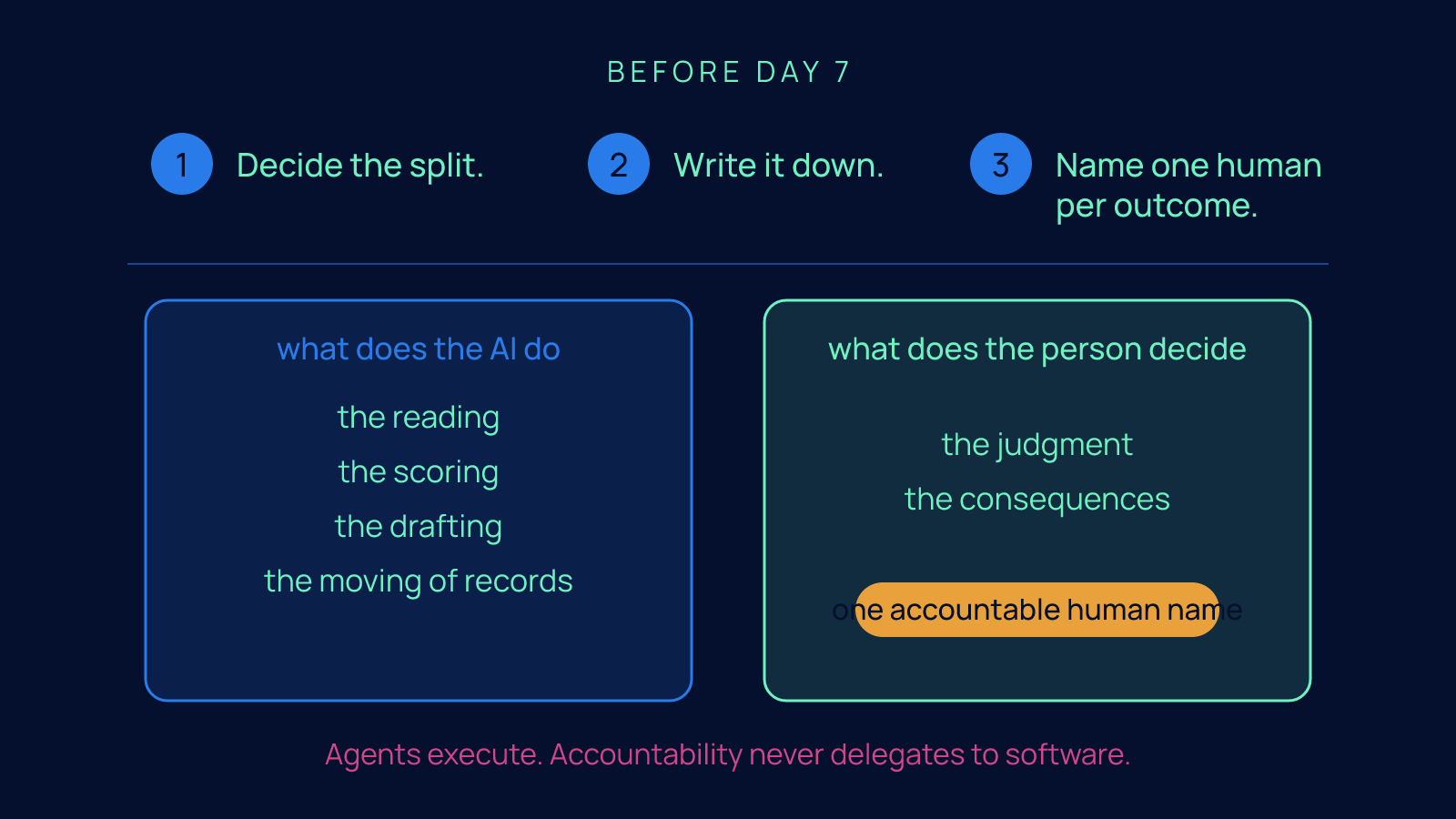
So here is the instruction, and it is not complicated.
- Decide the split. Take the pieces of work that make or break your company this quarter. For each one, answer the two questions out loud: what does the AI do, and what does the person decide. Cast on purpose. Give AI the reading, the scoring, the drafting, the moving of records. Keep the judgment and the consequences with people.
- Write it down. A paragraph per piece of work is enough. If it is not written, it is not decided, and the default will reassert itself inside a month.
- Name one human per outcome. Every goal, AI-led or not, gets exactly one accountable person. If you cannot find someone willing to put their name on an AI-led goal, that is information: either the goal is wrong or the AI should not be leading it yet.
Do that and the silence in the room goes away, because you have replaced a frightening abstract question with a list of casting decisions, and casting is something every leader in that room already knows how to do.
Watch Day 6, then come back for Day 7
This is Day 6 of the 30-day 8 Edges season. Day 5 made the case for installed frameworks over typed prompts. Day 6 asks the question that now defines leadership, how the work divides between AI and people, and answers it with Holtom's fifty fifty and two screens where the split is real rather than a slide. Day 7 closes Act 1 with the plan.
Watch the Day 6 film and look at the candidate screen and the goal tree for yourself. Then do the three steps above, and ask the question at your next leadership meeting.
If you get to a piece of work you cannot cast, or a goal nobody will put their name on, reply to this and tell me what it is. That is the conversation I have most, and it is the one I am best at.
Dave Hajdu Founder, Edge8
FAQ
How do I decide what AI should do and what my people should do in my company, and who stays accountable when the two disagree?
Treat it as a casting decision, not a technical one: for each piece of work that makes or breaks the quarter, answer two questions out loud, what does the AI do and what does the person decide. Give AI the reading, the scoring, the drafting and the moving of records, and keep judgment and consequences with people. Brooks Holtom of Georgetown, in The Other 50%, frames leadership in this era as fifty percent human and fifty percent AI, as a management practice you can write down and inspect. When the AI and the person disagree, the human's call stands, and every outcome, AI-led or not, carries exactly one accountable human name.
What is a simple test to tell whether an AI feature in my company is actually defined or just marketing?
Ask two questions of any AI claim: what did the AI just do, and what does the person still decide. If a vendor, a slide or a teammate cannot answer both in plain words, the split between AI and people has not been made, it has been hidden. A phrase like AI-powered screening fails the test; a sentence like the AI scores and summarizes every record and a person decides what advances passes it. You can run a company on the second sentence and not on the first.
What does it mean to run leadership as fifty percent human and fifty percent AI?
It comes from Brooks Holtom at Georgetown, who wrote a piece called The Other 50% arguing that leadership now is fifty percent human and fifty percent AI, meant as a management practice rather than a metaphor. In practice it means casting AI like any other performer on the roster: evaluate it on output, give it the work it is best at, keep it off the work it is bad at, and keep a human accountable for the result, the same way you would for someone fast and confident who has been on the team six weeks. Fifty fifty is not a quota; in some functions AI will carry most of the execution and in others barely touch it. The number that matters is how many outcomes have a human name attached, and that number has to be all of them.
Who should win when my AI tool and my team member disagree on a call?
The human wins, every time, and the system should keep the human's rating as the outcome rather than averaging the two or nudging the person toward the AI's number. In Edge8's own Company OS, one record shows two assessments side by side: the AI's score with its reasoning spelled out, and the person's own assessment of the same record. When they disagree, the person's call stands and the system logs the gap and learns from it, so the AI's scoring is shaped by the judgment of people who know what good looks like in that company. The AI did the reading and the first pass; the person owns the decision and the consequences.
Can an AI agent be the owner of a goal, or does a person always need to be accountable?
A person always owns it: agents execute the steps, and accountability never delegates to software. In the goal tree that connects quarterly strategy to weekly work, plenty of goals are AI-led, with an agent pulling the data, drafting the update and moving the record, yet every one still carries exactly one accountable human name, not a team and not the system. When an outcome has two owners it has none, and when it has a model it definitely has none, because you cannot have a hard conversation with a model about why the number slipped. If nobody will put their name on an AI-led goal, either the goal is wrong or the AI should not be leading it yet.