
It is 11:47 on a Tuesday night. A customer in a time zone you do not staff types a question that is specific to her account, her order, her problem. She gets an answer that is about her, not a canned help page, and it is right. Nobody on your team is awake.
A new hire finishes a draft proposal on day nine. Before anyone senior sees it, he gets feedback on the actual document: what is missing, what is weak, what your best people would have caught. He fixes it before it lands on a manager's desk.
A manager opens her calendar at 8:55 for a 9:00 one on one. Waiting for her is a short brief: what this person shipped this month, where they are stuck, what they said last time they would do. She walks in prepared instead of opening with "so, how's it going?"
For most companies, none of those three things was possible before now. Not faster. Not cheaper. Not possible. That is Level 2.
The line that matters is who is on the other side
The line that matters is who is on the other side: at Level 1 only your team touches the AI, at Level 2 the people you serve are interacting with it.
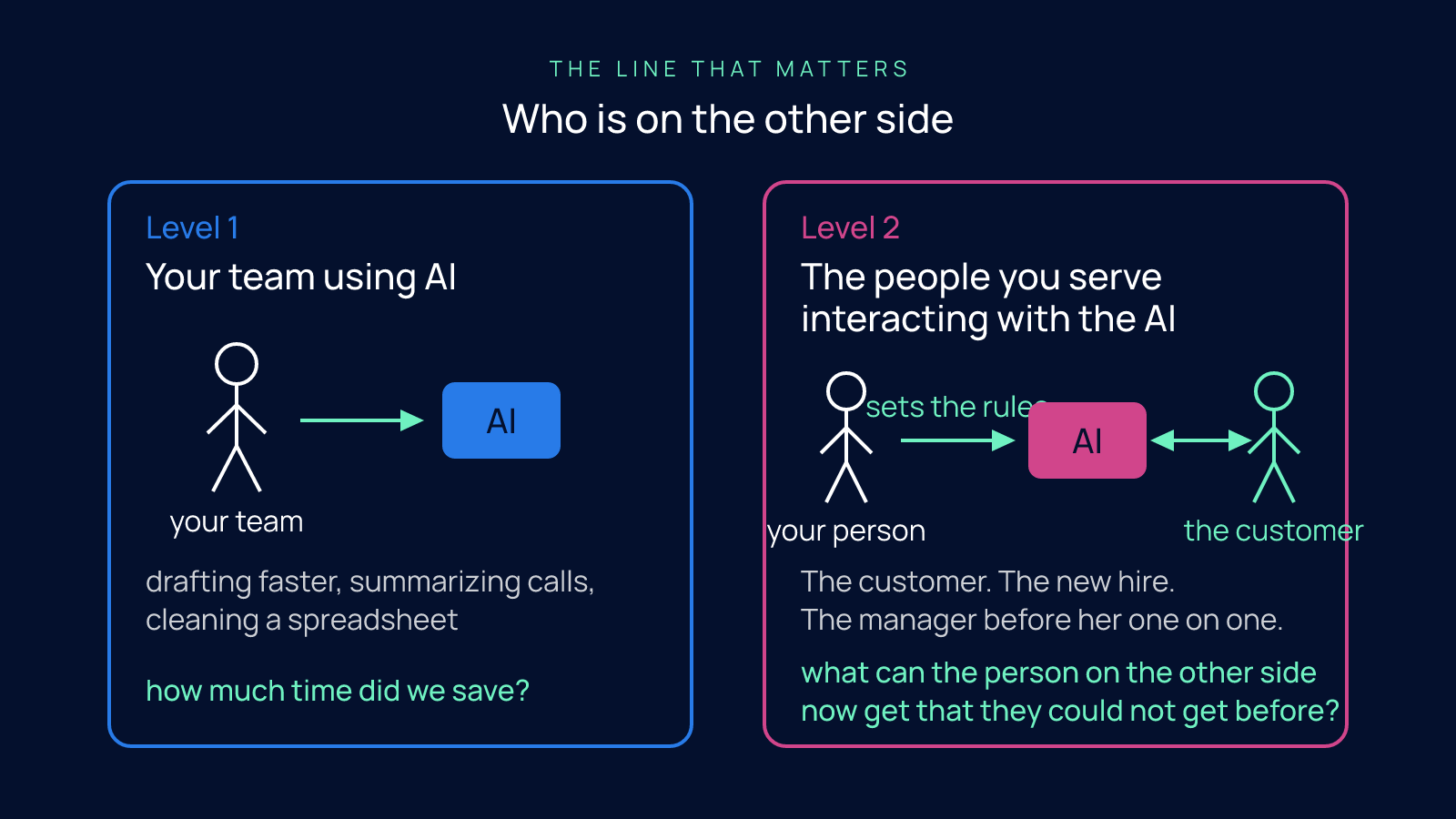
Beyond the Sky Custom Learning drew a three-level pyramid for AI in learning. At Level 1, the instructor uses AI. At Level 2, the learner engages with AI. I have been borrowing that pyramid for any business since the anchor piece in this series, because the shift it describes is exactly the one most companies are missing.
Swap "instructor" for "your team" and "learner" for "the people you serve." Level 1 is your team using AI: drafting faster, summarizing calls, cleaning a spreadsheet. Useful, but faster is not new. Level 2 is the people you serve interacting with the AI themselves. The customer. The new hire. The manager before her one on one.
The question changes with it. Level 1 asks "how much time did we save?" Level 2 asks "what can the person on the other side now get that they could not get before?"
Here is the part I insist on every time, because it is where founders get burned. At Level 2 the AI responds, and your person sets the rules and reviews the exceptions. Look at the three moments again through that lens.
- The midnight answer. What the AI did: read the customer's context, answered inside the boundaries it was given, handed off what it was not allowed to touch. What your person still decides: what it may say, what it must escalate, and which conversations get read the next morning.
- The feedback on real work. What the AI did: compared the draft to a standard and told the new hire where it fell short. What your person still decides: what "good" looks like in your company, and the final review before the work goes out.
- The brief before the one on one. What the AI did: pulled the month together into a page. What your person still decides: what to actually say to a human being across the table.
Nothing about Level 2 removes your people. It moves them from typing the answer to designing the answer.
Why most teams stop at Level 1
Teams that settled at Level 1 are waiting for a big programme before they try Level 2.
Talk to founders who have settled at Level 1 and you hear the same sentence: "We'll get to that when we do the big AI project." They picture a vendor, a budget line, a six-month build, a data migration, a steering committee. So they wait. Meanwhile their team keeps using AI as a faster typewriter and the customer at midnight still gets an autoresponder.
This is the most expensive misunderstanding in AI right now. Level 2 is not a program. It is a skill. One manager who knows how to design a workflow where someone else interacts with the AI, set its rules, and review its exceptions can take a company from Level 1 to Level 2 on one process, then the next, then the next. The gap is not money. It is that nobody on the team has been taught how to build it.
Which is a solvable problem, and it has a shape.
What a manager needs to learn, in order
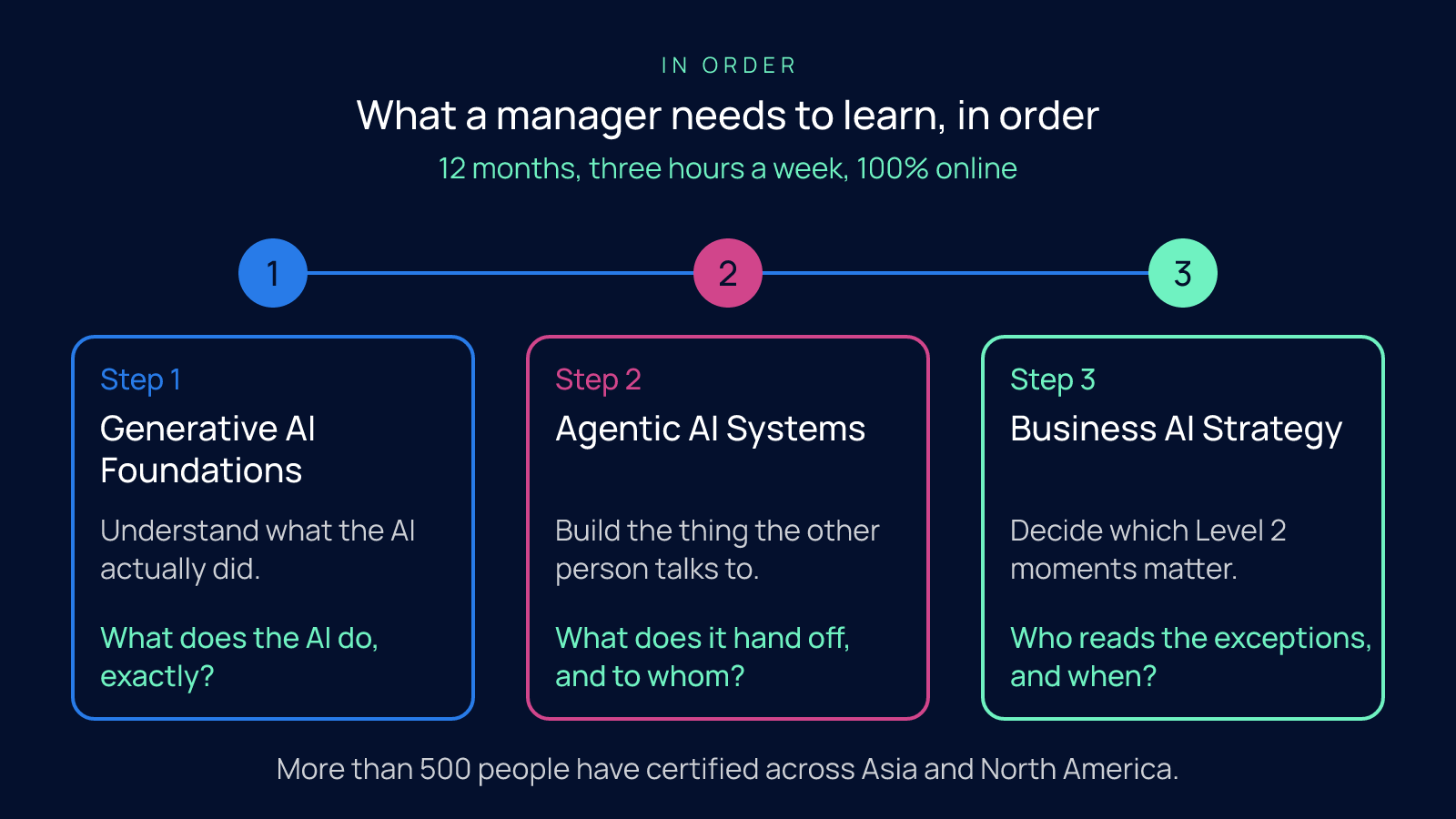
I founded the AI Officer Institute because I kept watching this gap open up in companies that had plenty of budget and no builder. The AI Officer Certification is designed for exactly this step: a working manager, 12 months, three hours a week, 100% online. More than 500 people have certified across Asia and North America. It is organized as three series, and the order of the series is the how-to.
Step 1: Generative AI Foundations. Understand what the AI actually did.
Before you put an AI in front of a customer, you have to be able to explain what it did and why. Foundations is where a manager stops treating the model as magic and starts treating it as a component: what it is good at, where it fails, how to check its work. This is the series that turns "we use AI" into "we know why it gave that answer."
Skip this and you build Level 2 on hope. The founders I have sat with who got burned by an AI rollout skipped this step, usually because a vendor told them they could.
Step 2: Agentic AI Systems. Build the thing the other person talks to.
Agentic, in plain words: the AI takes a sequence of actions toward a goal instead of answering one prompt and stopping. This is where Level 2 lives. It is the series where the midnight answer becomes buildable: an AI that can look at the customer's situation, follow the rules you set, respond, and hand off what it should not touch. The same shape gives the new hire his feedback and the manager her brief. The manager learns to design the loop: what the AI is allowed to do, what it must escalate, what gets reviewed by a person.
Step 3: Business AI Strategy. Decide which Level 2 moments matter.
Not every process should be Level 2, and a manager who builds the wrong one first loses the room. Strategy is where a manager learns to choose: which customer moments, which employee moments, in what order, and how to tell whether the person on the other side actually got something new. This is the series that turns one working workflow into a plan a CEO will fund.
Three questions to ask of any Level 2 workflow
Whether or not the manager is certified yet, these are the three questions I use to check a Level 2 design. If the manager cannot answer all three, it is not ready for the customer.
- What does the AI do, exactly? One sentence. "It reads the order history and answers questions about delivery status." If the sentence needs the word "anything," start over.
- What does it hand off, and to whom? Refunds over a threshold. Complaints with certain words. Anything the model is unsure about. A named person, not "the team."
- Who reads the exceptions, and when? Every morning, once a week, before the next one on one. A Level 2 workflow without a review habit is a Level 2 workflow you will regret.
The certification's three series map onto these questions almost one to one: Foundations for the first, Agentic AI Systems for the second, Business AI Strategy for the third.
Six missions, six things you can point to
The format matters as much as the syllabus. The certification runs as a challenge: six missions, and each one ends in a real artifact. Not a quiz score. Something that exists when the mission is over and that a manager can put in front of the team.
That is why I tell founders a manager can reach Level 2 on this path rather than on a course that ends in a PDF. By the end, the manager has built things, not watched things. The artifacts are the proof that the skill transferred. The format is laid out at /workflows/certification/.
Do the math on three hours
It is closer and easier than they think, because it is a skill a manager can build, and there is a certification designed to take a manager there in a year at three hours a week.
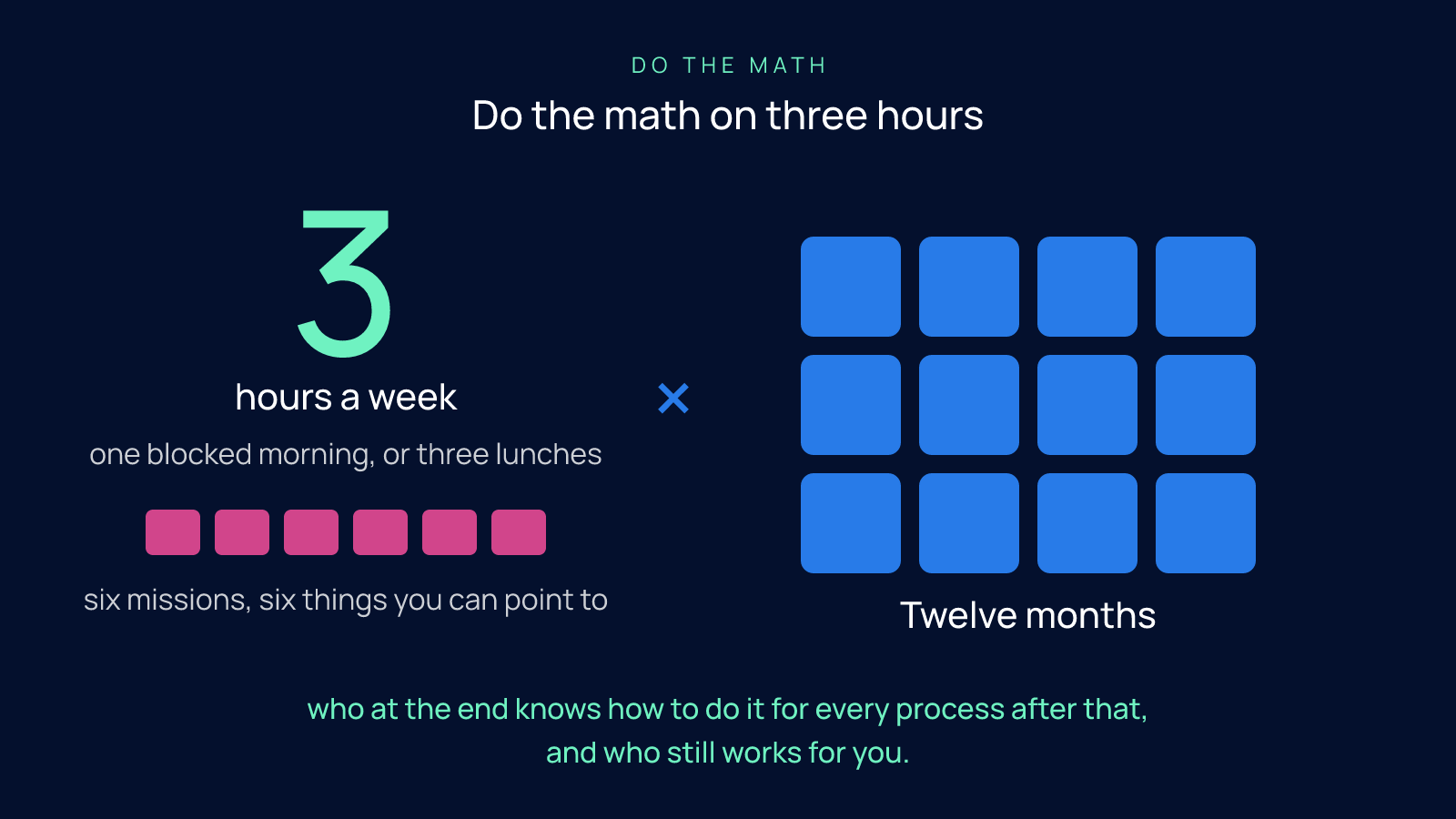
Three hours a week. That is one blocked morning, or three lunches. Twelve months. If you are a founder, ask yourself what you would pay an outside firm to design one Level 2 workflow, and then compare it to one manager's three hours a week for a year, who at the end knows how to do it for every process after that, and who still works for you.
That math is why I say Level 2 is closer than you think. Not because the technology got easy. Because the skill is now teachable to a manager, in a shape a manager can fit around a real job.
What to do this quarter
Three moves, in order.
Pick the manager. Not the most technical person in the building. The one who owns a process where someone else (a customer, a new hire, a team) is on the receiving end, and who is quietly frustrated that Level 1 did not change anything for those people. Curiosity beats credentials here.
Pick the moment. Take one of the three from the top of this piece, or your own version of it. The midnight answer. The feedback on real work. The brief before the one on one. Write down in one sentence what the person on the other side gets that they cannot get today. That sentence is the target for the whole year, and it is what the six artifacts should add up to.
Start the certification. Enroll this quarter, not next. The three series take the manager from understanding what the AI did, to building the thing the other person interacts with, to deciding where it goes next. Three hours a week, twelve months, and a company that stops waiting for a big program that was never the point.
If your team is at Level 1, Level 2 is not the far-off project you have been putting off. It is one manager and three hours a week. Start it at /training-and-certification/.
FAQ
How do I get my customers interacting with AI directly instead of only my team using it, and how many hours a week does a manager need to learn to build that?
The shift is who is on the other side: at the first stage only your team touches the AI to draft and summarize faster, while at the next stage the customer, the new hire, or the manager before a one on one interacts with the AI themselves, and your person sets the rules and reviews the exceptions. It is a skill one manager can learn, not a program you buy. The AI Officer Certification is built for a working manager at three hours a week over 12 months, 100% online, and more than 500 people have certified across Asia and North America. It runs as three series in order: Generative AI Foundations, Agentic AI Systems, and Business AI Strategy.
What is the difference between my team using AI tools and my customers actually using AI?
When your team uses AI you get faster drafts, call summaries, and cleaner spreadsheets, and the question you ask is how much time was saved. When the people you serve use it, the question becomes what they can now get that they could not get before. Picture a customer at 11:47 on a Tuesday night getting a correct answer specific to her account with nobody awake, a new hire getting feedback on a real proposal on day nine, or a manager opening a prepared brief at 8:55 for a 9:00 one on one. For most companies, none of those three things was possible before, not just faster or cheaper.
Do I need a big AI project or an outside vendor to put AI in front of my customers?
No, and believing you do is the most expensive misunderstanding in AI right now. Founders picture a vendor, a budget line, a six-month build, a data migration, and a steering committee, so they wait while the customer at midnight still gets an autoresponder. One manager who knows how to design a workflow where someone else interacts with the AI can move a company forward one process at a time. Compare what you would pay an outside firm to design one such workflow against one manager's three hours a week for a year, who at the end can do it for every process after that.
How do I make sure an AI that talks to my customers does not say the wrong thing?
Check every design against three questions before it reaches a customer. First, what does the AI do, exactly, stated in one sentence; if the sentence needs the word anything, start over. Second, what does it hand off and to whom: refunds over a threshold, complaints with certain words, anything it is unsure about, routed to a named person rather than the team. Third, who reads the exceptions and when, whether every morning, once a week, or before the next one on one, because a workflow without a review habit is one you will regret.
Who on my team should learn to build AI workflows that customers and employees use directly?
Pick the manager who owns a process where someone else is on the receiving end and who is quietly frustrated that faster AI did not change anything for those people, not the most technical person in the building, because curiosity beats credentials here. Then pick one moment, such as the midnight answer or the brief before the one on one, and write one sentence about what the person on the other side gets that they cannot get today. The AI Officer Certification path runs as six missions, and each one ends in a real artifact the manager can put in front of the team, not a quiz score. Three hours a week for 12 months, and start it this quarter rather than next.