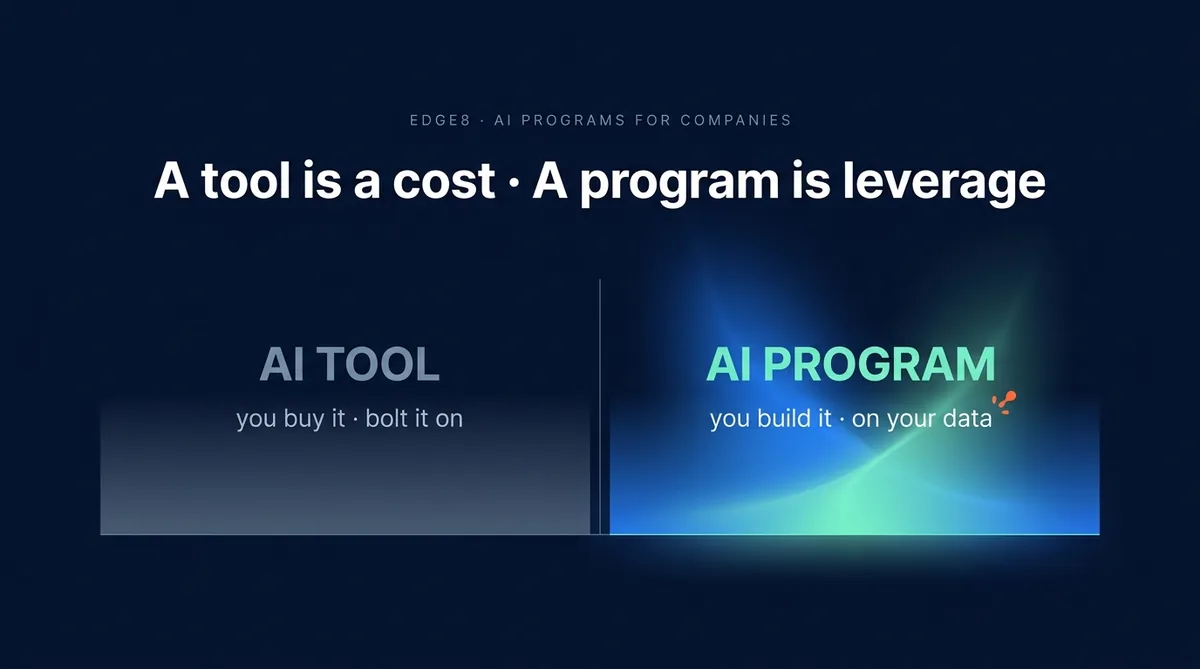
Most companies are buying AI tools right now. Seats, subscriptions, a chatbot bolted onto the side of the business. Almost none of them are building an AI program: a system that runs on their own data and does real work.
I teach the difference for a living. This week I stopped teaching it and built one, on myself, in a day. It rated my own leadership and handed me a number I did not want to see. That is the part founders need to understand, so let me start there and work back.
What I built, and why it is not a tool
I have built versions of this system for years, going back to wiring automations by hand in the old Make.com days. There was always something running: a packaged tool with a limited routine, an automation that did one slice of the job. The curriculum I teach for EO Vietnam and EO Perth, built on concepts I teach with Dr. Brooks C. Holtom of Georgetown, says every leader should build an AI coach for their team. I always had. What I never had was a way to build it exactly right.
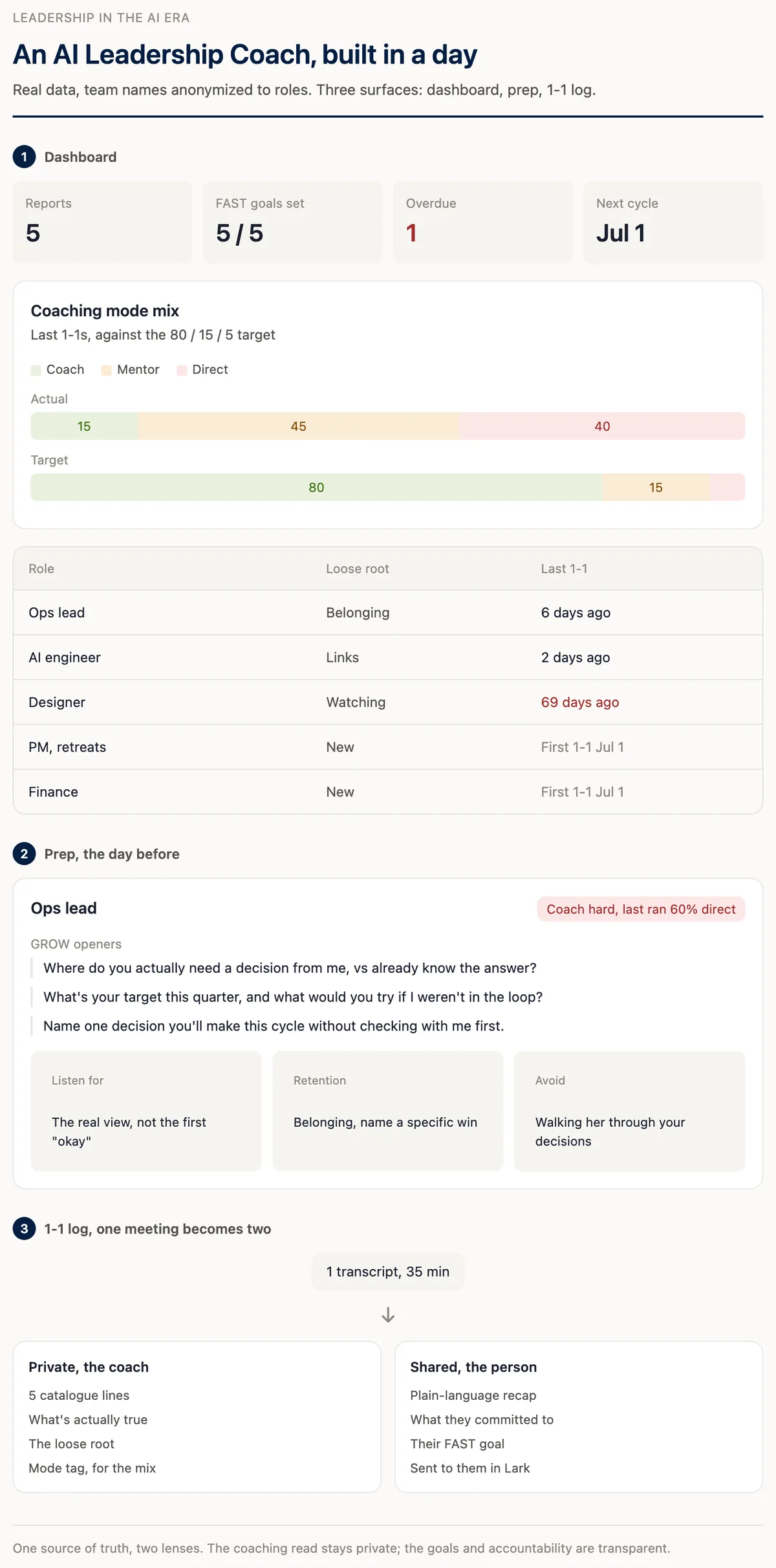
This week I did, and here is the part that matters to you: I did not write the code. I assembled it. I directed Claude Code, Anthropic's agentic development tool, to read my datasets and the frameworks and wire the whole system together in Lark. I was the architect. The agent did the build. Start to finish, in a day. Not a chatbot. A system that prepares me before every one-on-one, writes two separate recaps after, follows up on commitments, and tracks how I am leading over time. Built on my real data and my five real direct reports.
This is the distinction that matters for your company. A tool is something you buy and bolt on. A program is something you assemble on your own data, with agentic development, to do a real job. The hard part is the thinking inside the frameworks. The assembly is fast, because you direct an agent and it does the wiring. One is a cost. The other is leverage.
What a real AI program looks like under the hood
Here is the anatomy, because the shape is the same whether it is a coaching system, a sales system, or an operations system.
A reasoning engine and the frameworks behind it. The foundation is not the data, it is the model doing the thinking (I used Claude) and the frameworks that make it more than a chatbot. Mine runs on an OCEAN personality read of each person and the GROW model for the conversation. Your program reads your business and the proven frameworks of your domain: your goals, your customers, your process, the way your best people already work. The frameworks are the work. A tool without them is clever autocomplete.
A clean backbone. One database, a few tables, no duplication. I built mine in Lark: company OKRs (Objectives and Key Results), team goals, an accountability log, with people pulled from the org directory we already have. Boring infrastructure is the point. It is what everything else stands on.
A privacy split that earns trust. Two views of the same data. My private read on each person never leaves my space. Their view holds only the shared work: their goal, how it ladders to a company objective, what they committed to. Same source, two lenses. Any program that touches people has to get this right or it dies on contact with the team.
An engine that does the work. After each meeting, it pulls the transcript and produces two outputs from one conversation: a private extraction for me, a clean recap for them. The thing I did by hand for years, now on a schedule.
A mirror that tells the truth. This is the part that separates a real program from a dashboard. More on that next.
None of this is exotic. The difficulty is not the technology. It is knowing what to build and having the discipline to build it on real data.
Want to see exactly how one of these gets assembled? I wrote up the full system, step by step, every framework and every command: the full AI Leadership Coach Assembly guide.
The number that stung
I asked it to rate my last one-on-one with each person on the Coach, Mentor, Direct mix. Coaching is asking questions so people grow. Mentoring is sharing your experience. Directing is just giving the answer. The research target for a strong leader is roughly eighty percent coaching, fifteen mentoring, five directing.
It read three of my actual transcripts. I was running fifteen percent coaching, forty-five mentoring, forty directing. The near-exact inverse of where I should be. With one long-tenured person, I was directing sixty percent of the time.
My own leadership profile had predicted it months earlier. It says I skip to my answer and over-direct. I wrote that about myself, then ignored it, until a system I built held me to it with data instead of a feeling.
Sit with that as a founder. A program built right does not flatter you. It tells you the truth about your own performance, on a schedule, whether you want to hear it or not. A dashboard shows you numbers. A real AI program shows you yourself. If what you bought only ever agrees with you, you bought a tool, not a program.
Why most companies cannot build this themselves
I built mine in a day because I have spent years building the method: the frameworks, the datasets, the order of operations, and more tool generations than I can count to learn what actually matters. Most leadership teams have the opposite problem. They have the data and the urgency, and no map. So they buy another tool, bolt it on, and wonder why nothing changes. The years of false starts are exactly what you are paying to skip.
A real program takes three things most companies are missing at the same time. The method, so you build the right system and not a clever toy. The data discipline, so it runs on your actual business and not a demo. And the honesty to let the thing tell you the truth once it is built. Any one of those is rare. All three together is the work.
This is what we do at Edge8
That is the work Edge8 does. We are a consulting firm that builds AI programs like this one for companies: on your data, aimed at a real job, designed to tell you the truth rather than flatter you. Not seats. Not a chatbot bolted onto the side. A system that does the half of the work AI can do, so your people spend their time on the half it cannot. That is what eight times the leverage actually looks like.
If you have been buying tools and waiting for leverage that never arrives, that is the gap. The fix is not another subscription. It is a program built on your business.
Book a conversation with us. We will start with what your company actually needs, before anyone writes a line of code.
For AI programs built on real company data, see our case studies.
Frequently asked questions
What is the difference between an AI tool and an AI program?
An AI tool is software you buy and bolt onto the business: seats, a subscription, a chatbot. An AI program is a system you build on your own data to do a specific job. A tool is a cost. A program is leverage. The program runs on your goals, your customers, and your process, and it does work a generic tool cannot.
What does a real AI program look like?
It has five parts: a foundation of real frameworks and a reasoning model to run them (for a coaching system that means OCEAN personality profiles and the GROW model), a clean database backbone, a privacy split so it can touch people without breaking trust, a work engine that does the repeatable jobs, and a mirror that reports the truth about performance instead of flattering you.
Why can't most companies build an AI program themselves?
It takes three rare things at once: the method, so you build the right system and not a clever toy; the data discipline, so it runs on your real business and not a demo; and the honesty to let the system tell you the truth once it is built. Most teams have the data and the urgency but no map, so they buy another tool and nothing changes.
What does Edge8 do?
Edge8 is a consulting firm that builds AI programs for companies: systems built on your data, aimed at a real job, designed to tell you the truth rather than flatter you. The work starts with what your business actually needs, before any code is written.