The first question I get from anyone new to Edge8 is always the same: where do I start?
It is a fair question, because from the outside Edge8 can look like three different companies. There are free tools. There is a coaching subscription. There is a consulting arm that builds custom systems. Three names, three doors, and a founder on the sidewalk wondering which one to knock on.
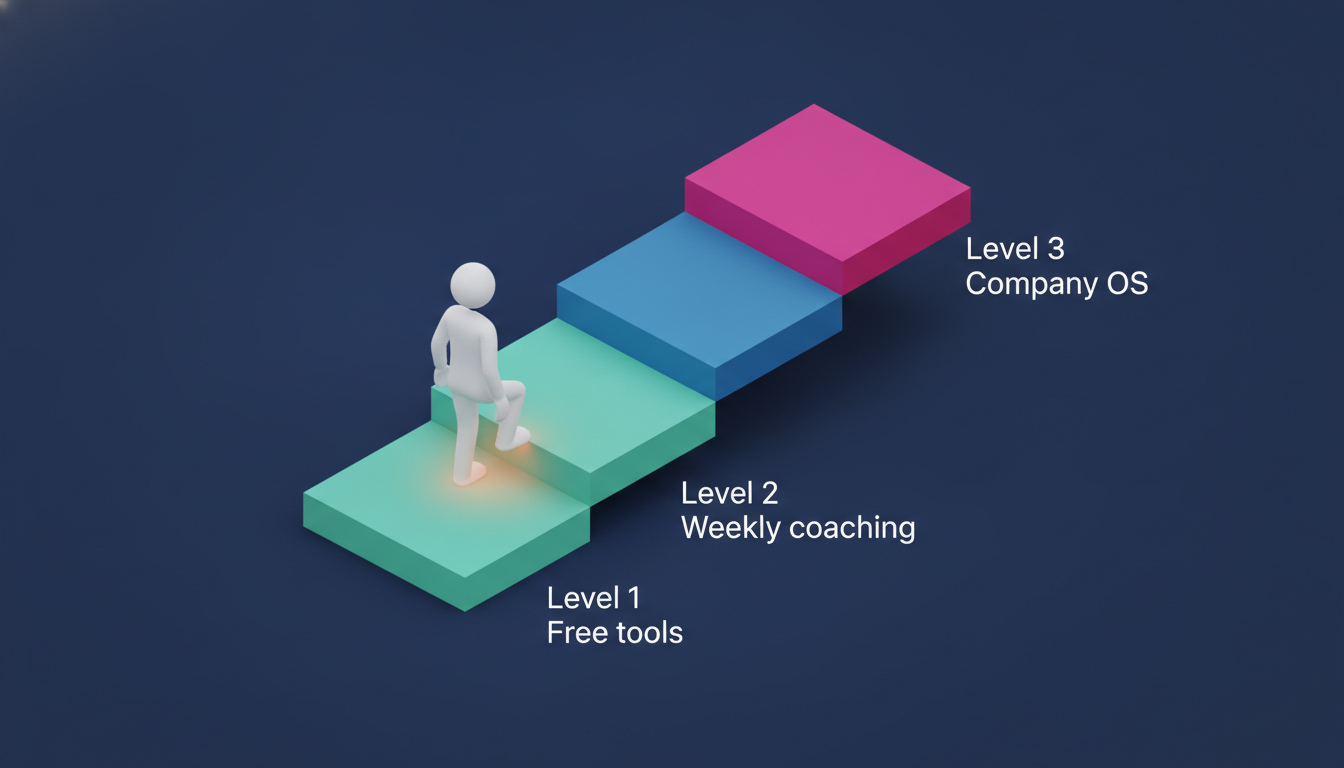
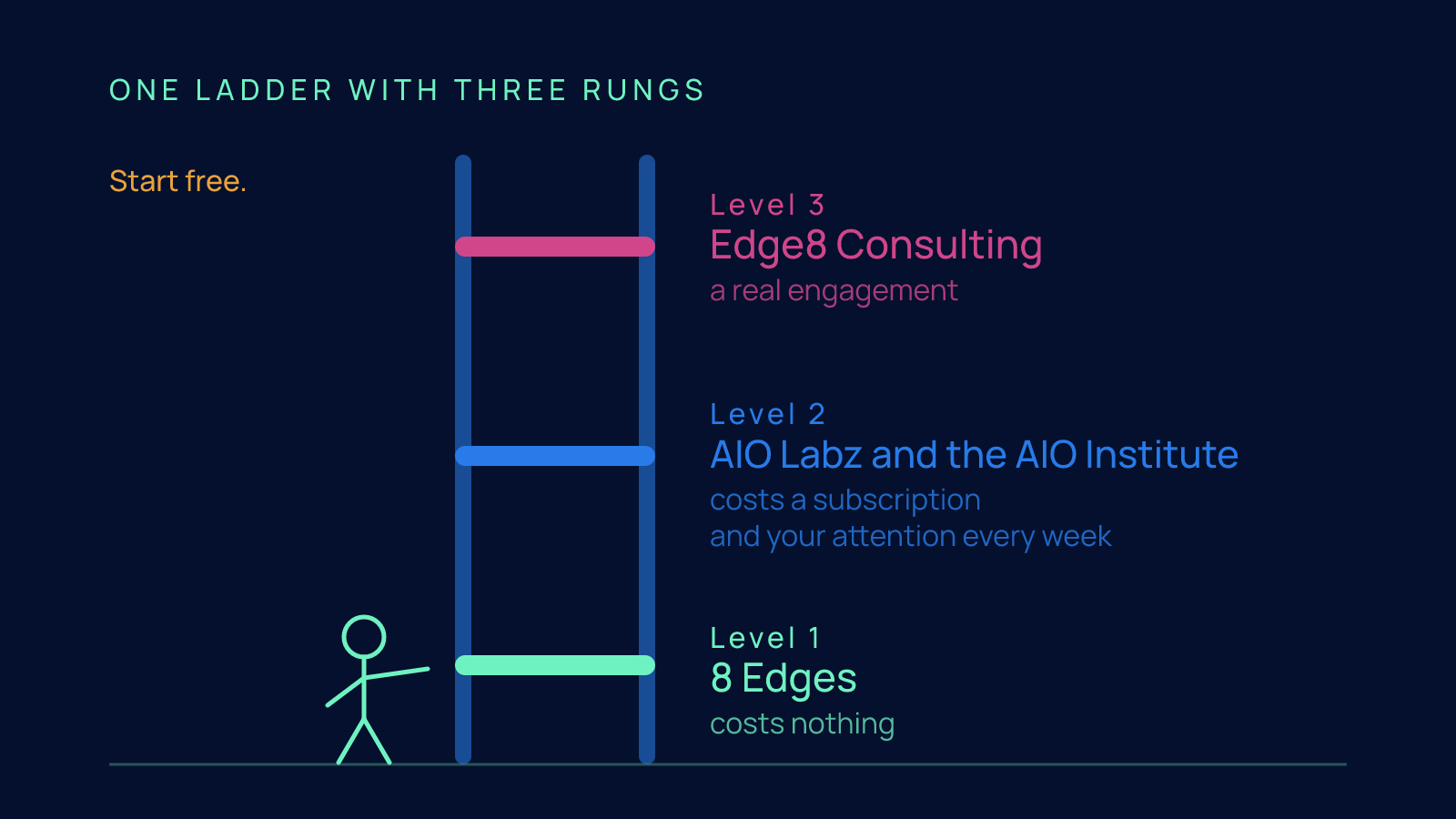
Here is the answer. Edge8 is not three products. It is one ladder with three rungs. Level 1 is 8 Edges. Level 2 is AIO Labz and the AIO Institute. Level 3 is Edge8 Consulting. You climb only as far as your business needs, and you can stand on any rung for as long as you like.
The ladder, not the catalog
Edge8 is not three separate products. It is one ladder with three rungs, and a person climbs only as far as they need.
Most companies that sell AI help sell it like a menu. Pick a package. Pay the price. Hope it fits.
That is backwards. You do not know how much help you need until you have tried to do the work yourself. A founder who has never built a workflow cannot tell whether the hard part is the tool, the thinking, or the fact that the business has outgrown anything off the shelf. Those are three different problems with three different answers.
So the ladder is ordered by commitment. The bottom rung costs nothing. The middle rung costs a subscription and your attention every week. The top rung is a real engagement where we build something that belongs to you.
The right way in is the smallest one. Start free. Ask for help only when you are stuck. Pay for a custom build only when the business asks for it.
Level 1: 8 Edges, the free tools
Level 1 is 8 Edges: 100% free tools and APIs that help people build their own workflows, systems and one-person-company support.
8 Edges is the ground floor, and it is 100% free. It is a set of tools and APIs (an API is simply a way for one piece of software to talk to another, so a tool can plug into the things you already use) built to help you create your own workflows, your own systems, and the kind of support a one-person company needs in order to run.
Who it is for. Anyone who wants to put AI to work inside their company and is willing to roll up their sleeves. Solo founders. Small teams. The CTO who wants to see how the pieces fit before anyone signs anything. If you have been following the 8 Edges Season on this blog, you have been watching Level 1 in action, one workflow at a time.
What you do. Pick one workflow that is costing you time, open the tools, and build it yourself. No sales call. No invoice.
What the AI does, and what you decide. The tool runs the step you hand it. You decide which steps to hand over, in what order, and what happens with the result. That is not a disclaimer, it is the design. You are learning how your own business works by writing it down and watching a machine try to follow it. Where the machine stumbles, you have found a place where your process was never clear to begin with.
What you still decide. Whether to stay here. Plenty of people should. If the tools do what you need and you understand what they are doing, you are done, and you owe us nothing. You move up only when you hit a wall.
Level 2: AIO Labz and the AIO Institute, weekly coaching
Here is what a wall looks like. You tried to build the workflow. Something did not work, or it worked and you do not understand why, or you can see the shape of what you want and cannot get there alone. You are not short on tools. You are short on someone who has done this before and can look at your screen.
That is Level 2. You subscribe to AIO Labz and the AIO Institute and we coach you. Weekly. Directly. With communication throughout, not a check-in once a quarter and a support queue in between.
Who it is for. Founders and operators who have already touched Level 1 and have a real question. Not "what is AI," but "I built this, it does this, I wanted it to do that, what am I missing." The question is specific because the work came first.
What you do. Subscribe, bring the thing you are stuck on, and work through it with us every week. You keep building. We keep you unstuck.
What the AI does, and what you decide. The AI still runs the steps you give it. What changes is that you are no longer guessing which steps to give it. The coaching is about your judgment, not about taking the keyboard away from you. You still decide what gets automated and what stays human, and you make that call with someone beside you who has seen the pattern before.
What you still decide. Whether coaching is enough. For most people it is. You get unstuck, you learn the pattern, and the next workflow is easier than the last. Some people reach a point where the question stops being "how do I do this" and becomes "this is bigger than me and the tools, and the business needs something built for it." That is the signal to look at the top rung.
Level 3: Edge8 Consulting, your own Company OS
Level 3 is Edge8 Consulting. This is where we build your own Company OS: a full, customizable system tailored to your company. (OS stands for operating system. One system that runs the way your company actually works, instead of a pile of tools that each know one job.)
Who it is for. A business that has decided, after trying the free tools and usually after coaching, that off the shelf is not enough and it wants a system shaped around how it really runs.
What you do. Engage us to build it. We design it with you, around your company, not around a template.
What the AI does, and what you decide. The system runs your workflows the way we built them together, and you own every decision about what those workflows are. A Company OS is only as good as the thinking that goes into it, which is exactly why the free tools and the coaching come first. By the time you reach Level 3 you know your business well enough to tell us what to build and why.
What you still decide. Whether the business is really asking for this. Not whether it would be nice. Whether it is asking. If you cannot point to the place where the tools and the coaching ran out, you are not ready, and I will tell you so. Sending you back down a rung is a better outcome for both of us than building something you cannot yet use.
Why starting at the top is a mistake
The argument is that the right way in is the smallest one: start free, ask for help only when stuck, and pay for a custom build only when the business asks for it.
I will take the position plainly: starting at the top is a mistake, even for companies that can afford it.
A company that buys a custom system before it has run a single workflow itself is buying something it cannot evaluate. It does not know which steps matter. It does not know where its own people will push back. It will spend the engagement discovering things the free tools would have taught it for nothing.
A company that subscribes to coaching before it has touched the tools is paying someone to answer questions it does not have yet.
And a company that stays at Level 1 forever, grinding against a problem the tools were never going to solve alone, is spending the one thing a founder cannot get back, which is time.
The ladder fixes all three. Each rung tells you whether the next one is worth it. You never pay for a level you have not earned your way to, and you never stay stuck on a level that has stopped serving you. That is why Edge8 is built this way, and why I keep telling newcomers to start at the bottom even when they walk in asking for the top.
How to tell which rung you are on today
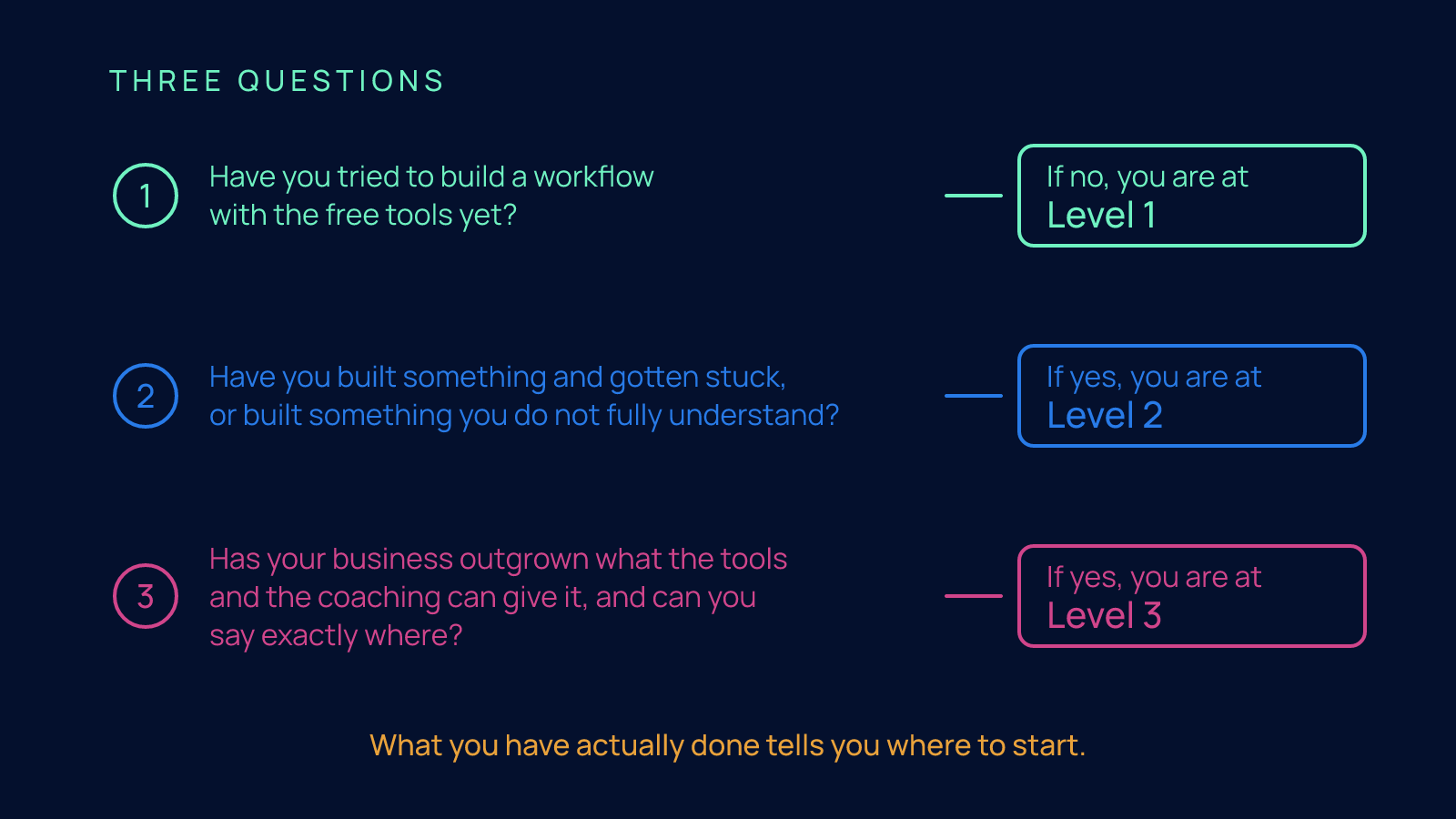
Three questions. Answer them honestly.
- Have you tried to build a workflow with the free tools yet? If no, you are at Level 1, whatever you think you need. Go build one.
- Have you built something and gotten stuck, or built something you do not fully understand? If yes, you are at Level 2. The fix for stuck is a person, not another tool.
- Has your business outgrown what the tools and the coaching can give it, and can you say exactly where? If yes, you are at Level 3. If you cannot say where, you are not there yet.
Notice what is not on the list. Company size. Budget. How much you have read about AI this year. None of that tells you where to start. What you have actually done tells you where to start.
This week: one deep dive per level
This post is the map. The three posts that follow it this week are the territory.
- Level 1: a close look at 8 Edges, what the free tools and APIs are for, and how to get your first workflow running on your own.
- Level 2: inside AIO Labz and the AIO Institute, what weekly coaching looks like in practice, and how to know when you need it.
- Level 3: Edge8 Consulting and the Company OS, what gets built, how we build it with you, and the signal that tells you the business is ready.
Read the one that matches your answer to the three questions above. Skip the others until you need them.
Your next step
Pick your rung.
If you have not built anything yet, start with 8 Edges. It is free, and it will teach you more about your company than any sales call ever will.
If you are stuck, subscribe and bring the stuck thing to your first coaching session. Do not spend another month on it alone.
If your business has outgrown the tools and the coaching and you can say exactly where, reply and tell me where. That conversation is the start of Level 3.
Whichever it is, you decide. Edge8 is a ladder, not a funnel. Climb as far as you need and no further.
FAQ
How do I figure out how much AI help my company actually needs, free tools, weekly coaching or a fully custom system, before I pay for any of it?
Treat the options as one ladder with three rungs ordered by commitment, not a menu of three products, and start on the smallest rung. Level 1 is a set of tools and APIs that is 100% free, Level 2 is weekly direct coaching on a subscription, and Level 3 is a custom Company OS built around how your business actually runs. Edge8 founder Dave Hajdu's rule is to start free, ask for help only when you are stuck, and pay for a custom build only when the business asks for it, because each rung tells you whether the next one is worth it.
What is the cheapest way to start putting AI to work in a small company without a sales call or a contract?
Start with free tools and build one workflow yourself. The ground floor of the ladder, called 8 Edges, is 100% free: a set of tools and APIs (an API is just a way for one piece of software to talk to another) for building your own workflows and systems, with no sales call and no invoice. Pick the one workflow that is costing you the most time, hand the AI a step, and watch where it stumbles, because that is where your process was never clear in the first place.
When should I pay for AI coaching instead of trying to figure out my workflows on my own?
Pay for coaching when you have hit a wall: you built something and it does not work, or it works and you do not understand why, or you can see what you want and cannot get there alone. That is Level 2 of the three rungs, weekly direct coaching with communication throughout rather than a check-in once a quarter and a support queue in between. The coaching sharpens your judgment about which steps to automate; you keep the keyboard and still decide what gets automated and what stays human.
How do I know if my business has outgrown off-the-shelf AI tools and needs a custom operating system?
Ask three questions in order: have you built a workflow with the free tools, have you built something and gotten stuck, and has the business outgrown what the tools and the coaching can give it in a way you can point to exactly. Only a yes to the third question puts you at Level 3, a custom Company OS (one system that runs the way your company works instead of a pile of tools that each know one job). Company size, budget and how much you have read about AI this year are not on the list; what you have actually done is what tells you where you are.
Why is it a mistake to buy a custom AI system for my company before trying free tools first?
Because a company that buys a custom build before running a single workflow itself is buying something it cannot evaluate: it does not know which steps matter or where its own people will push back, and it spends the engagement learning things the 100% free tools would have taught it for nothing. The same logic cuts the other way too, since staying on Level 1 forever against a problem the tools cannot solve alone burns the one thing a founder cannot get back, which is time. The three-rung ladder fixes both, so you never pay for a level you have not earned and never stay stuck on one that stopped serving you.