Somebody on your team typed this today: "Act as a senior marketing strategist and write our positioning." Somebody else typed "Act as an experienced HR director and draft this job description." A third person asked it to be a sales coach. All three got back something polished, competent and completely interchangeable. Put the three outputs side by side and you cannot tell which company they came from.
That is not an accident. It is what the expert persona prompt is built to produce.
Most AI advice gets this backwards, so I will say it plainly: better prompts will not fix it. The prompting industry has your whole team polishing phrasing, stacking adjectives, adding "be specific" and "think step by step," and the result is the same thing, just longer. If everyone is prompting and everyone is getting the polished average of the internet, you do not have a prompt problem. You have a thinking problem, and the fix is not in the text box.
The expert persona returns the average expert
Asking the AI to act as an expert produces what it produces for everyone else, which is not productivity but mediocrity at scale.
When you tell an AI to act as an expert, you are asking it to reach for everything it has ever read that sounds like an expert and hand you the middle of it. The middle of the internet is fine. It is also exactly what every one of your competitors gets when they type the same line, because they are typing the same line.
So the output is tidy, confident and lifeless. It has no position. It takes no risk. It could have been written for any company in your category, and in a real sense it was.
People call this productivity because the document arrived fast. It is not productivity. It is mediocrity at scale: the same average, produced faster, by more people, in more corners of the business at once.
The founders I talk to feel this before they can name it. They tell me the AI is "fine" or "good for first drafts," and then they spend an hour rewriting the first draft because it says nothing. The tool is not the issue. What you fed it is.
The fault was never the AI
The fault was never the AI; it was the thinking it was fed.
An AI can only reason with the structure you point it at. Give it a persona and it has a costume, not a method. Give it a method and it has something to actually think with.
This is the whole shift, and it is smaller than it sounds. Stop telling the AI who to be. Start telling it what to use.
Point it at a named framework and watch it change
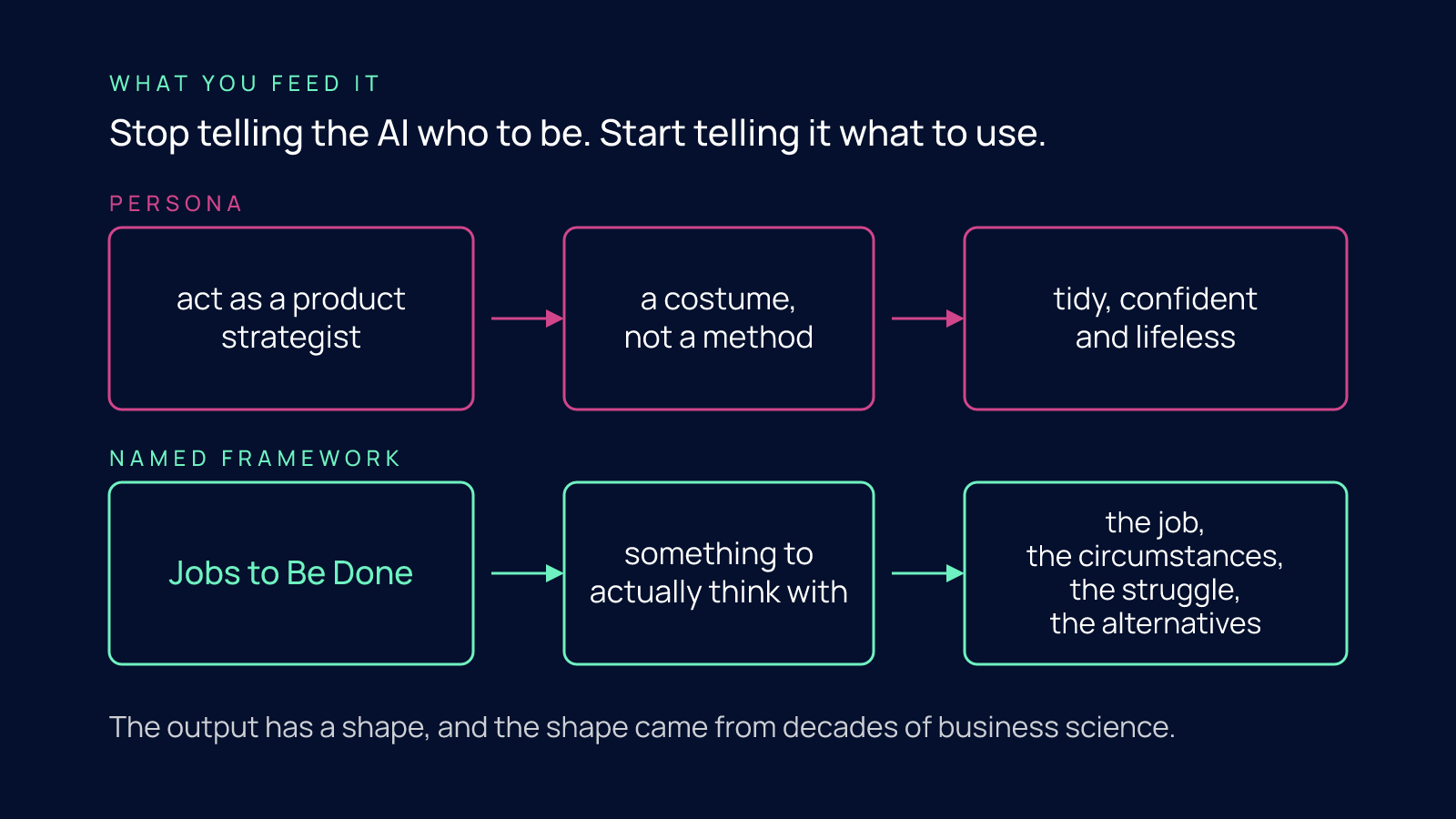
Take the single example from the Day 5 film. Instead of "act as a product strategist," you tell the AI to analyze your customer using Jobs to Be Done, Clayton Christensen's framework from Harvard.
Jobs to Be Done, in plain language, says people do not buy products, they hire them to get a job done in their life, and if you understand the job you understand the purchase. It is a specific way of asking questions, in a specific order, looking for specific things.
The moment you name it, the AI stops averaging and starts reasoning. It walks your customer through the job, the circumstances, the struggle, the alternatives they rely on today. The output has a shape, and the shape came from decades of business science rather than from the mood of the internet on a given Tuesday.
Here is the part that should feel like relief. You do not need to know how Jobs to Be Done works. You only need to know that it exists, because the AI already knows it. The whole library of named, tested management thinking is sitting inside the model, waiting to be called by name. Nobody on your team has to read the book. They have to know the title.
That is a very different skill from prompt polishing. It is knowing which frameworks exist and which one fits the problem in front of you. Most founders already know more of those than they think. They just stopped using them because the persona prompt felt easier.
Two questions for every AI claim
I hold every AI claim, including my own, to the same two questions. What did the AI just do, and what does the person still decide?
In the Jobs to Be Done example, the AI ran the framework on your customer. The person decided which framework to call and what to do with the answer. That is a healthy split: the machine does the structured thinking, the human owns the judgment on top of it. Those two questions matter even more at the next level, so keep them in mind.
A company that prompts well still depends on one person
So now one person on your team is good at this. They know to name Jobs to Be Done for customer work and GROW for coaching, they get the sharp output, and everyone else asks them to "do the AI thing." That is a step up from the persona prompt. It is also a single point of failure.
A company that prompts depends on whoever typed best today. When that person is on vacation, the quality drops. When they leave, it leaves with them. Two managers run the same process and get two different results because one of them named the framework and one of them typed "act as a coach." Consistency becomes a matter of luck and memory.
Some companies try to solve this with a shared prompt library. It helps less than you would hope. A library is still a pile of text that someone has to remember exists, open, paste and adapt. The thinking is still typed, every time, by a person who may or may not be having a good day.
The level above a person who prompts well is a company where nobody has to.
Installed, not typed: two screens from Edge8's own Company OS
I will show you what that looks like, because it is not theory. These two screens are live in Edge8's own Company OS, the 8 Edges system our company runs on day to day. We use them on ourselves.
Screen one: the resume screen
Every resume that comes into Edge8 is screened against the job's own criteria. Not a generic sense of "good candidate," but the specific requirements of that specific role. The AI reads each resume and scores it against the same structured rubric every time. The first resume in the pile and the last resume in the pile get the identical treatment, because the rubric does not get tired and does not play favorites.
What did the AI just do? It screened each candidate against the job's criteria using one rubric. Nobody typed a prompt. The thinking was installed when the workflow was built, and every resume since has inherited it.
Screen two: the GROW brief
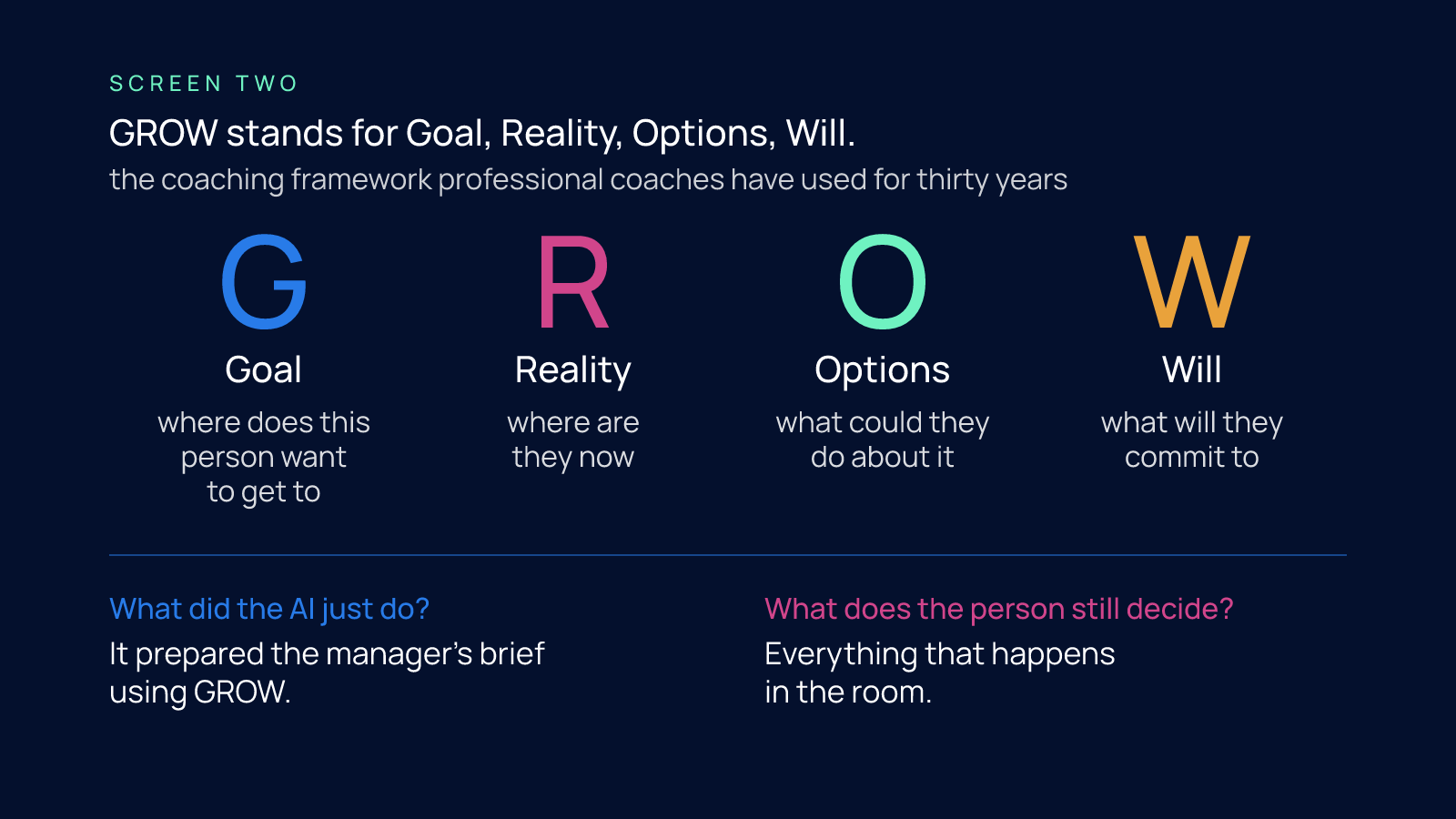
Before every one-on-one, every manager at Edge8 receives a brief the AI prepared using GROW, the coaching framework professional coaches have used for thirty years. GROW stands for Goal, Reality, Options, Will. In plain words: where does this person want to get to, where are they now, what could they do about it, and what will they commit to.
What did the AI just do? It prepared the manager's brief using GROW. What does the person still decide? Everything that happens in the room. The manager still walks into the one-on-one, holds the conversation and does the actual coaching. The AI made sure they walked in with structure instead of walking in cold.
Again, nobody typed a prompt. The manager did not have to remember GROW exists. The company remembered for them.
Consistent by design
A company that prompts depends on whoever typed best today; a company that runs on frameworks is consistent by design.
Put those two companies side by side.
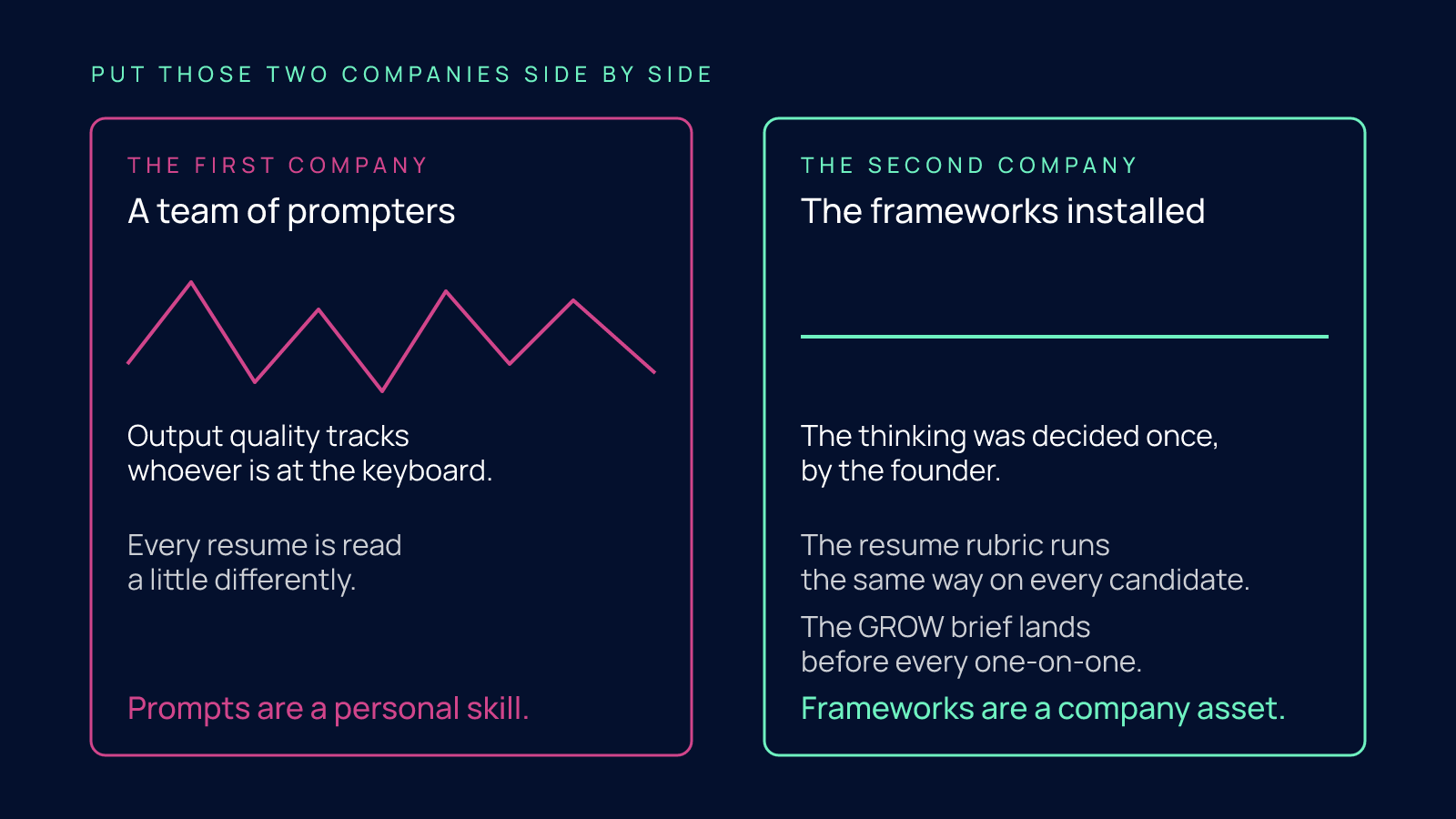
The first company has a team of prompters. Output quality tracks whoever is at the keyboard. Every resume is read a little differently. Every one-on-one depends on whether the manager found time to prepare. The frameworks live in people's heads, which means they leave in people's heads.
The second company has the frameworks installed. The resume rubric runs the same way on every candidate. The GROW brief lands before every one-on-one. The thinking was decided once, by the founder, and now every person and every agent in the business inherits it without being asked.
The second company is not smarter. It just stopped relying on the daily lottery of who typed best. That is what consistent by design means, and it is the real reason frameworks beat prompts. Prompts are a personal skill. Frameworks are a company asset.
Where this sits in the season
This is Day 5 of the 30-day 8 Edges season, the fifth diagnosis in Act 1. Day 4 showed that AI pilots fail for want of designed workflows running on real data. Day 5 names the next trap: even with the tools in hand, a team that prompts produces the same average, and the fix is already built into 8 Edges.
Day 6 asks the question this one sets up. Once the frameworks are installed, what should the AI do and what should the people do?
Your next step
Do this in order.
Watch the Day 5 film. It is short, and it shows the resume screen and the GROW brief running rather than described.
Then pick one framework your team already argues about and name it in the next prompt instead of asking the AI to act as an expert. Notice the difference in the first paragraph it returns.
Then, if you want to see what installed looks like in your business rather than mine, reply to this post or book a demo of 8 Edges. I will walk you through both screens on our own system, and we can talk about which frameworks your company should install first.
Stop polishing prompts. Install the thinking once.
Dave
FAQ
How do I get consistent results from AI across my team when everyone is prompting and getting the same generic answer?
Stop polishing prompts and point the AI at a named, tested framework instead of an expert persona: tell it to use Jobs to Be Done for customer work or GROW for coaching and the output stops averaging and starts reasoning. Then go one level up and install the framework inside the workflow so nobody has to type it, because a company that prompts depends on whoever typed best today. In the post, two managers run the same process and get two different results because one named the framework and one typed 'act as a coach', and that gap only closes when the thinking is installed once. Day 5 of the 30-day 8 Edges season shows two screens running this way: a resume screen that applies one rubric to every candidate and a GROW brief that lands before every one-on-one.
Why does AI give everyone on my team the same generic answer when they ask it to act as an expert?
Because the expert persona prompt asks the model for the middle of everything it has ever read that sounds like an expert, and the middle of the internet is exactly what every competitor typing the same line gets too. Put three outputs from three different persona prompts side by side and you cannot tell which company they came from. That is not productivity, it is mediocrity at scale: the same average produced faster, by more people, in more corners of the business at once.
Do I need to understand a framework like Jobs to Be Done before I can tell AI to use it?
No. You only need to know the framework exists and name it, because the AI already knows how it works; nobody on your team has to read the book, they have to know the title. GROW, for example, is the coaching framework professional coaches have used for thirty years, and the AI can prepare a one-on-one brief with it the moment you call it by name. The real skill is knowing which frameworks exist and which one fits the problem in front of you, not stacking adjectives in the text box.
What happens when only one person on my team is actually good at prompting AI?
You have a single point of failure. When that one person is on vacation the quality drops, and when they leave it leaves with them; two managers run the same process and get two different results because one named the framework and one typed 'act as a coach'. A shared prompt library helps less than you would hope, because it is still a pile of text someone has to remember exists, open, paste and adapt. The level above a person who prompts well is a company where the frameworks are installed and nobody has to prompt at all.
How do I tell whether an AI output is actually useful or just polished filler?
Hold every AI claim to the same two questions: what did the AI just do, and what does the person still decide? In the Jobs to Be Done example the AI ran the framework on your customer, and the person decided which framework to call and what to do with the answer. In a GROW brief the AI prepares the brief and the manager still walks into the one-on-one and holds the conversation. If the output has no position and could have been written for any company in your category, it was averaged, not reasoned, and the fix is a named framework, not a longer prompt.