Day 15 ended with a pile of resumes and a ranked list. Software read every one of them, scored them, and put them in order on a recruiter's screen. If you watched it, you were thinking what every founder thinks the first time they see that list: fine, but who checks the AI?
That is the right question, and it deserves a real answer, because most of the industry does not give one.
The fear is not that the AI is slow. The fear is that it is quietly wrong.
Nobody worries that AI will read resumes badly in an obvious way. If it ranked a plumber first for a data engineering role, you would catch it in a second and laugh.
The fear is the quiet failure. The candidate who writes in a second language and gets marked down for it. The person whose last job title does not match the keyword but who has done exactly the work you need. The one whose salary expectation looks high on paper until you learn what they would actually bring. A machine filters that person out, nobody sees it happen, and the best hire you could have made this year never gets a phone call.
Handing hiring to a machine sounds efficient right up until it drops the one person you needed. So when a vendor says "trust us, the model is good," that is not an answer. It is a request. Founders who have been burned before, by a consultant, by a hire, by a tool that demoed well and delivered nothing, are right to refuse it.
A policy document is not an answer either
The standard response from the AI hiring industry is a policy. "A human reviews all AI decisions." It goes in the handbook. Legal signs it off. Nobody opens it again.
A policy nobody reads changes nothing about what happens on the screen at four o'clock on a Thursday when a recruiter has a long list and a deadline. If the screen makes the AI's score the first thing you see and the thing you act on, the policy loses. Every time. People do what the interface makes easy, and a score sitting alone at the top of a page is a decision already made.
So the answer has to live in the screen itself. Not beside it. Not in a document about it. In it.
Topgrading got this right before the software existed
Brad Smart's Topgrading rests on one idea: hiring decisions belong to people, built on structured evidence, verified history and real interviews, and the judgment is never outsourced.
Brad Smart's Topgrading is the hiring method I keep coming back to, and it rests on one idea: hiring decisions belong to people. You build them on structured evidence, verified history, and real interviews with real candidates. You do not delegate the judgment. Not to a gut feeling, not to a resume keyword, and not to a machine.
That principle predates AI by a long way and holds up better now than when it was written. Topgrading never said "do not use tools." It said the tool gathers evidence and the person decides. The structure can be as rigorous as you like. The call stays human.
That is exactly the line I wanted drawn in software. So at Edge8 we did not write it on a poster. We made it a rule inside the screen.
What you see on a candidate's page in Edge8
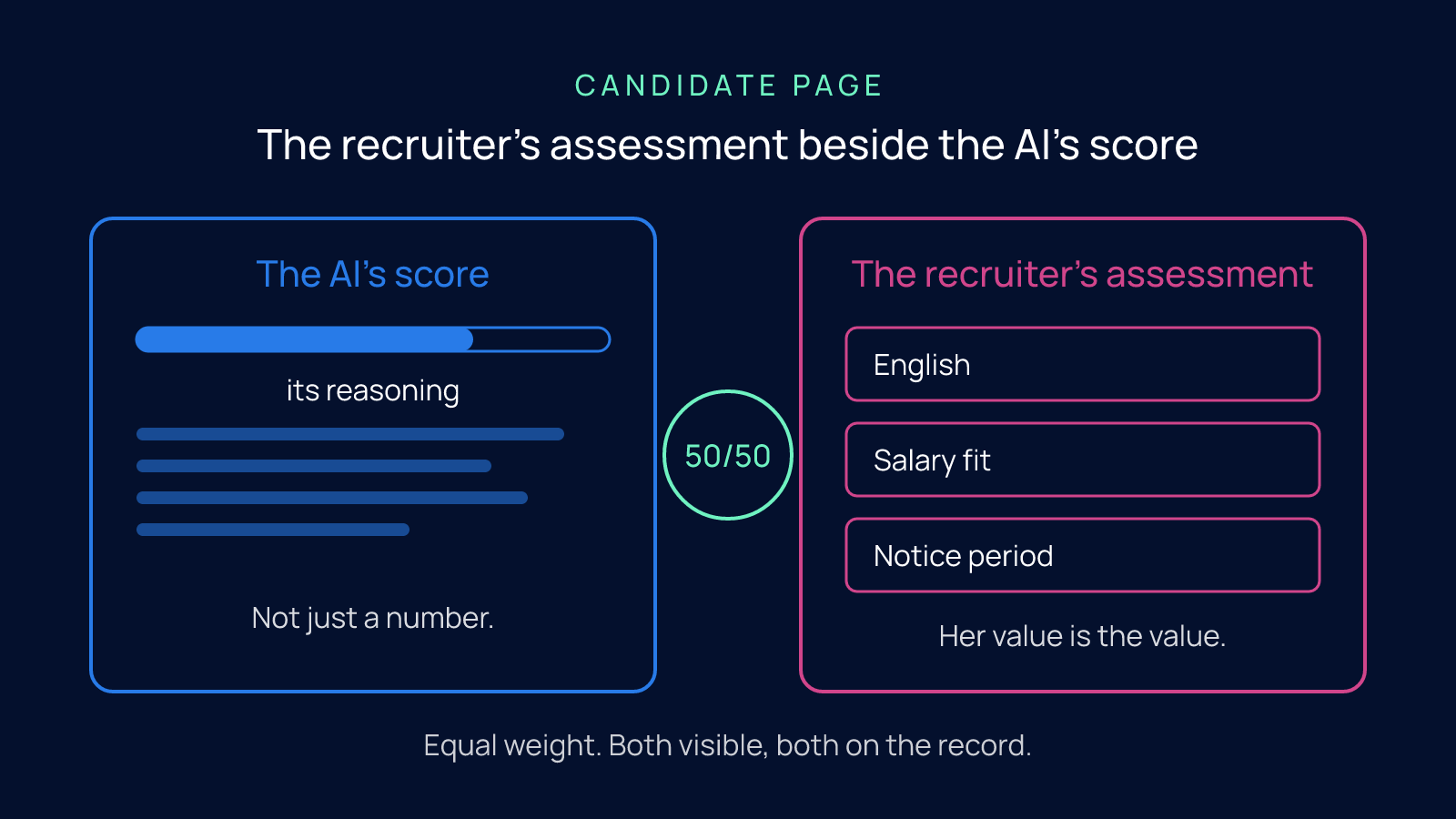
Here is the candidate page in Edge8's Company OS, the one the Day 16 film walks through. Day 6 framed it as a 50/50 split: the AI's score on one side, the recruiter's assessment on the other. Day 16 is where you watch that split get tested.
On one side: the AI's score for the candidate and its reasoning. Not just a number. The AI shows why it landed where it did, which parts of the resume it weighed and how it read them. If it marked someone down, you can see what it marked them down for. No black box, no "the algorithm decided."
On the other side: the recruiter's own assessment. In this episode that is three fields she fills in herself. Her read on the candidate's English. Her read on salary fit. Her read on notice period. Those are her calls, made from a conversation, from a reference check, from years of knowing what "available immediately" actually means in a given market.
The two sit next to each other on the same page. Equal weight. Nothing hidden behind a tab or buried in a settings menu. The AI's opinion and the person's opinion, both visible, both on the record.
When they disagree, the human wins. Always.
When they disagree, the human wins, always: she types her number, saves, and hers stands, and the AI's opinion does not argue back.
This is the part Day 16 exists to show.
The recruiter looks at the AI's score. She disagrees. Maybe the AI read "conversational English" off a resume and she just spent twenty minutes on a call with someone who is plainly fluent. She types her value. She saves. Hers stands.
The AI does not argue back. It does not pop up a warning asking if she is sure. It does not make her justify herself in a comment box. It does not blend her number with its own and present an average as a fair compromise. Her value is the value. The candidate moves forward or does not based on what she entered.
That is the rule we built. The person holds the judgment. The machine holds the structure. Not the other way round, and not a negotiation between the two.
Here is why that matters. The moment a system makes the override feel like an exception, something she has to defend, people stop overriding. They take the score because the score is the path of least resistance. Then your "human in the loop" is a formality, and the quiet filtering you were afraid of is happening with a person's name on it. The override has to be the normal, expected, unremarkable thing. In Edge8 it is a field and a save button.
The disagreement does not vanish
The AI is not grading the recruiter; the recruiter is training the AI.
Here is where it gets more interesting than a simple override button.
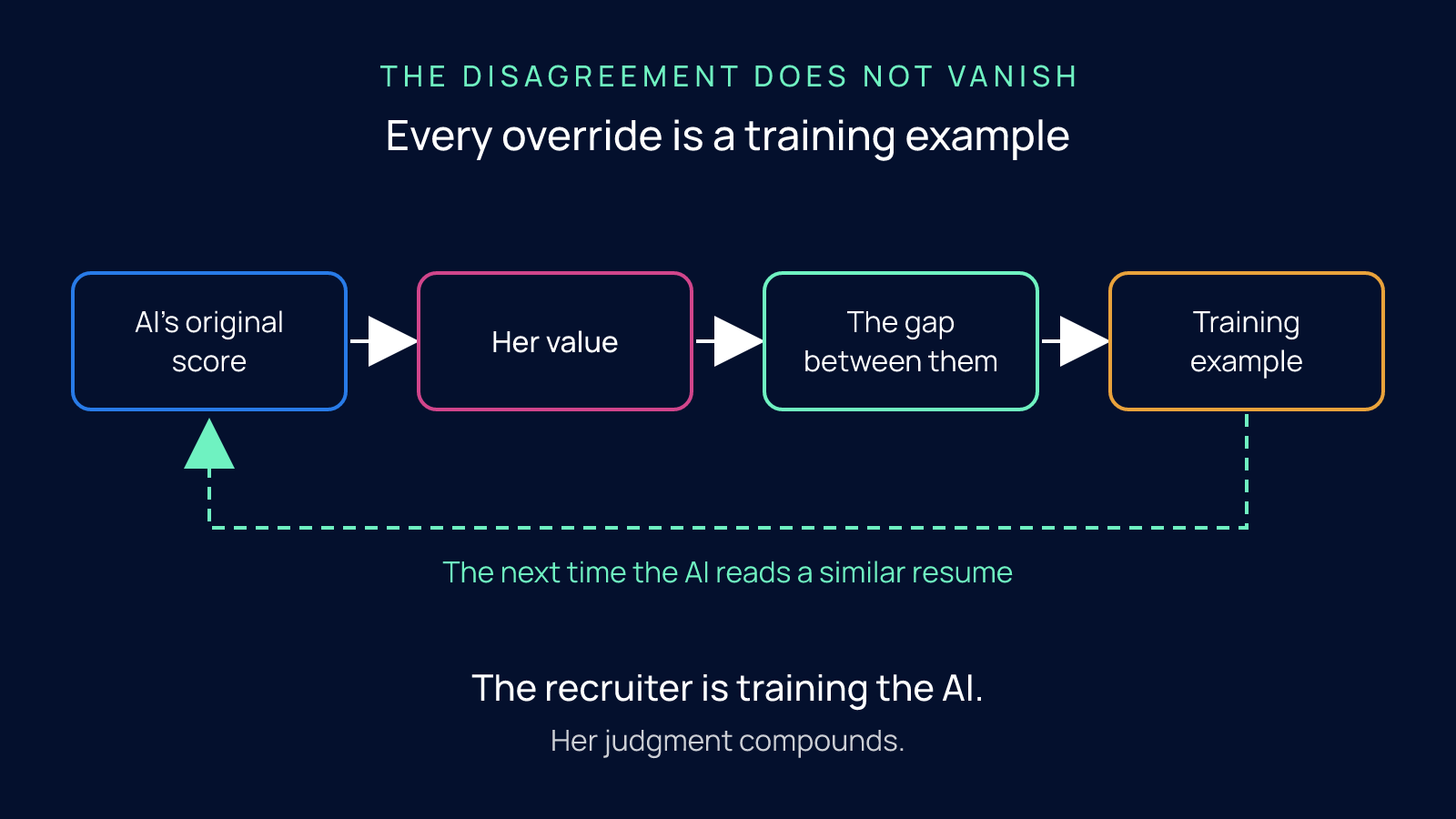
Every correction the recruiter makes is recorded. The system keeps the AI's original score, keeps her value, and keeps the gap between them. That correction feeds back into the screen. The next time the AI reads a similar resume, it has her correction as an example of what it got wrong and what right looked like.
So every override is a training example. Every time she disagrees with the machine and wins, the machine gets a little sharper at reading the next candidate the way she would. Her judgment compounds. It stops living only in her head and starts living in the screen her whole team uses.
Think about what that means for the direction of authority. The AI is not grading the recruiter. The recruiter is training the AI. She is the senior person in the room. The software is the junior who reads fast, shows its work, and learns from being corrected.
That direction never flips. Not after a week of corrections, not after a year. The AI does not earn the right to overrule her because its score has gotten good. It gets good precisely because she keeps overruling it where it is wrong. Take away her authority and you take away the thing that was making it better.
The ranked list is the demo. The override is the product.
The ranked list from Day 15 is the thing that gets demoed. It looks impressive. A pile of resumes becomes an ordered screen while you watch.
But the ranked list is not the product. The override is the product. Without the override and the recorded correction, a ranked list is just a faster way to make the same quiet mistake you were already afraid of. With it, the list becomes the start of a conversation between a fast reader and an experienced judge, and the judge always has the last word.
If you are evaluating any AI hiring tool, from us or from anyone else, ask the vendor to show you this exact screen. Not the ranking. The disagreement. Where does the recruiter's own assessment live on the page? What happens when she enters a different value? Does hers stand, or does the system "take it into account"? Is the correction recorded, and does the model learn from it, or does it make the same call next week?
If the honest answer is "we have a policy," walk away.
What this takes in your company
You do not need a data science team to hold this line. You need two things.
First, a screen where the human's assessment sits beside the AI's score with equal visibility. If one is a headline and the other is a footnote, the headline wins.
Second, a rule, enforced by the software and not by the handbook, that the human's value stands and the disagreement is kept. That is a design decision. It is made once, by whoever builds or buys the system, and it protects every hiring decision after it. Someone has to decide where the recruiter's fields live, what the AI is allowed to score, and how corrections flow back. That is not a setting. It is a job.
The two questions, asked of every screen
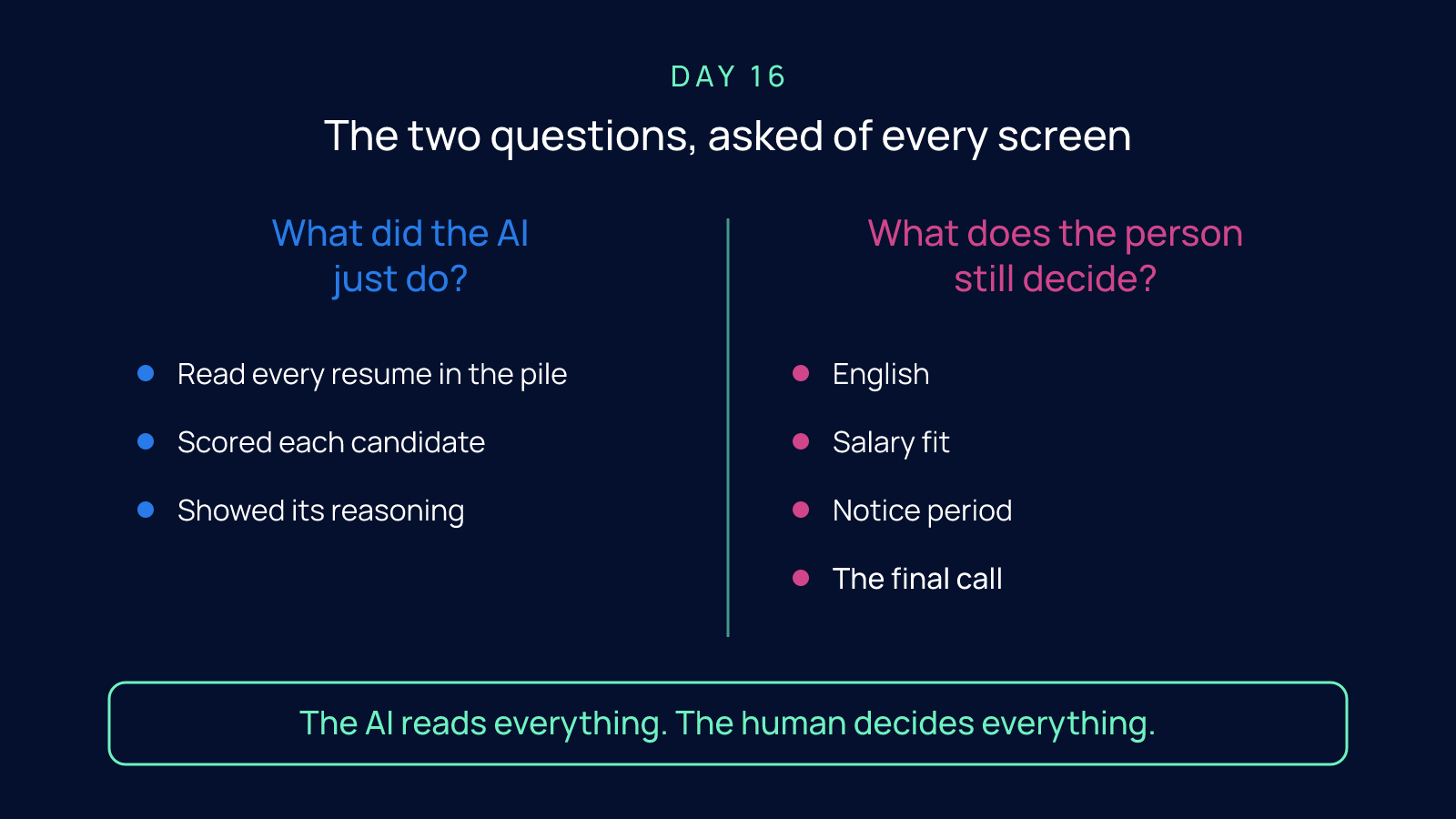
At Edge8 every claim we make about AI has to answer the same two questions, and this episode is no exception.
What did the AI just do? It read every resume in the pile, scored each candidate, and showed its reasoning on the candidate page.
What does the person still decide? English, salary fit, notice period, and the final call, with her value standing whenever the two disagree and her correction becoming what the AI learns from next.
If a tool cannot answer those two questions that cleanly, it does not matter how good its demo is.
The AI reads everything. The human decides everything.
That is the whole of Day 16 in one line, and it is the only way I will let a machine anywhere near a hiring decision in a company I am responsible for.
Topgrading said hiring judgment is never outsourced. We wrote that into the screen: the recruiter's assessment beside the AI's score, hers wins every time they disagree, and every disagreement makes the system sharper.
Your next step
Watch the Day 16 film and see the override happen on screen, start to finish. Then come back for Day 17, where this 30-day season moves to the first month after the hire, because getting the right person in the door is only the beginning.
And if you want to see the candidate page running on your own roles, reply and tell me what you are hiring for. We will walk you through it live, and you can try to make the AI argue back. It will not.
FAQ
How do I keep a human in charge when AI screens candidates so it does not quietly filter out the best one?
Do not rely on a policy that says a human reviews the AI; build the rule into the screen itself. On the candidate page in Edge8's Company OS the recruiter's own assessment sits beside the AI's score and reasoning in the 50/50 split Day 6 of the 8 Edges season framed, with three fields she fills in herself: English, salary fit and notice period. When the two disagree she types her value, saves, and hers stands, and the correction is recorded so the AI learns from it next time.
What happens when my recruiter disagrees with an AI's score on a resume?
Her value wins, every time, with no warning box and no averaging of her number with the machine's. In the Day 16 episode the AI reads conversational English off a resume, the recruiter has just spent twenty minutes on a call with someone who is plainly fluent, and she simply types her read and saves. The system keeps the AI's original score, her value and the gap between them, so the disagreement becomes a training example rather than vanishing.
Is a policy that says a human reviews all AI decisions enough to stop biased candidate screening?
No. A policy nobody reads changes nothing about what happens on the screen at four o'clock on a Thursday when a recruiter has a long list and a deadline, because people do what the interface makes easy. You need two things instead: a screen where the human's assessment has equal visibility with the AI's score, and a rule enforced by the software that the human's value stands and the disagreement is kept.
What should I ask an AI resume screening vendor to show me before I buy?
Ask to see the disagreement, not the ranking. Every claim about AI should answer the same two questions: what did the AI just do, and what does the person still decide. In this case the AI reads every resume, scores each candidate and shows its reasoning, while the recruiter decides English, salary fit, notice period and the final call, and if the honest answer to where her override lives is a policy, walk away.
Can AI screening actually learn from my recruiter's judgment over time?
Yes, if every correction is recorded and fed back into the screen, which is how Edge8's Company OS works as shown in Day 16 of the 30-day 8 Edges season. Each override gives the AI an example of what it got wrong and what right looked like, so the recruiter is training the AI rather than the AI grading her. That direction of authority never flips, and you do not need a data science team to hold the line, only the two design decisions about where her fields live and how corrections flow back.