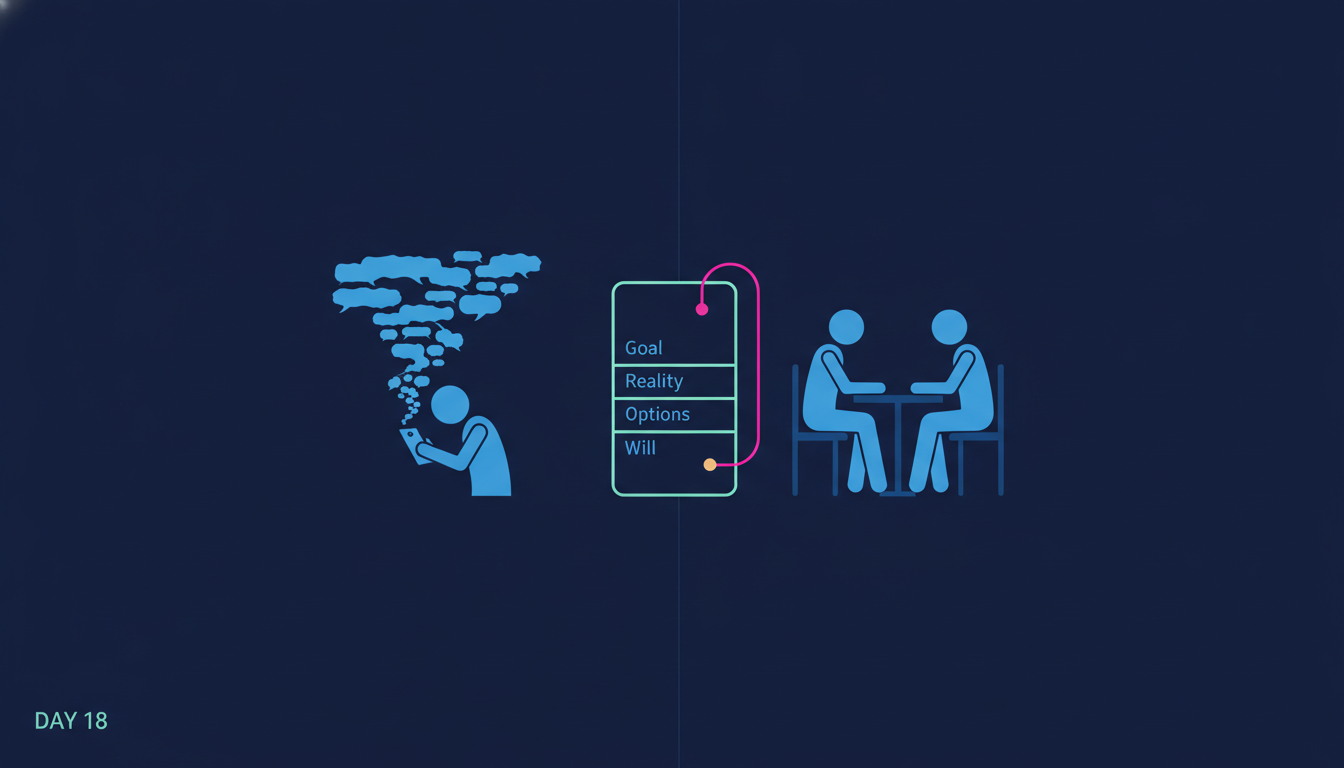
It is three minutes before the one-on-one. The manager has the chat window open and is scrolling up, looking for what was agreed last time. Something about a handoff. Maybe something about where this person wants to be next year. The scroll does not find it. The clock does. The meeting starts.
So the manager asks the only question available to someone who walked in blank: what are you working on? The person answers. The manager nods. Fine. Anything blocking you? Not really. Same time in two weeks.
That is a status update. It is not a one-on-one, and the person across the table knows the difference.
Walking in blank is itself a message
Walking in blank is itself a message, and it says this meeting matters less to the manager than it does to them.
The one-on-one is the single best development tool a manager has. Nothing else in the company puts one person's goals, one person's problems and one person's growth in front of the one leader who can actually do something about them, on a regular cadence, with nobody else in the room.
And in most companies it runs on improvisation.
Here is what managers miss when they treat it that way. The person on the other side of the table prepared. They thought about what to raise. They remembered what was agreed last time, because it was about their work and their career. When the manager cannot remember, that is not a neutral gap. It is a signal, and it says this meeting matters less to the manager than it does to them.
Nobody says that out loud. But the meeting shrinks to fit it. Status in, status out, and the thing that could have been coaching becomes a calendar entry both people quietly resent.
The structure everyone knows and nobody can hold
Most managers know GROW exists; almost none can hold the structure in the sixth meeting of a Thursday.
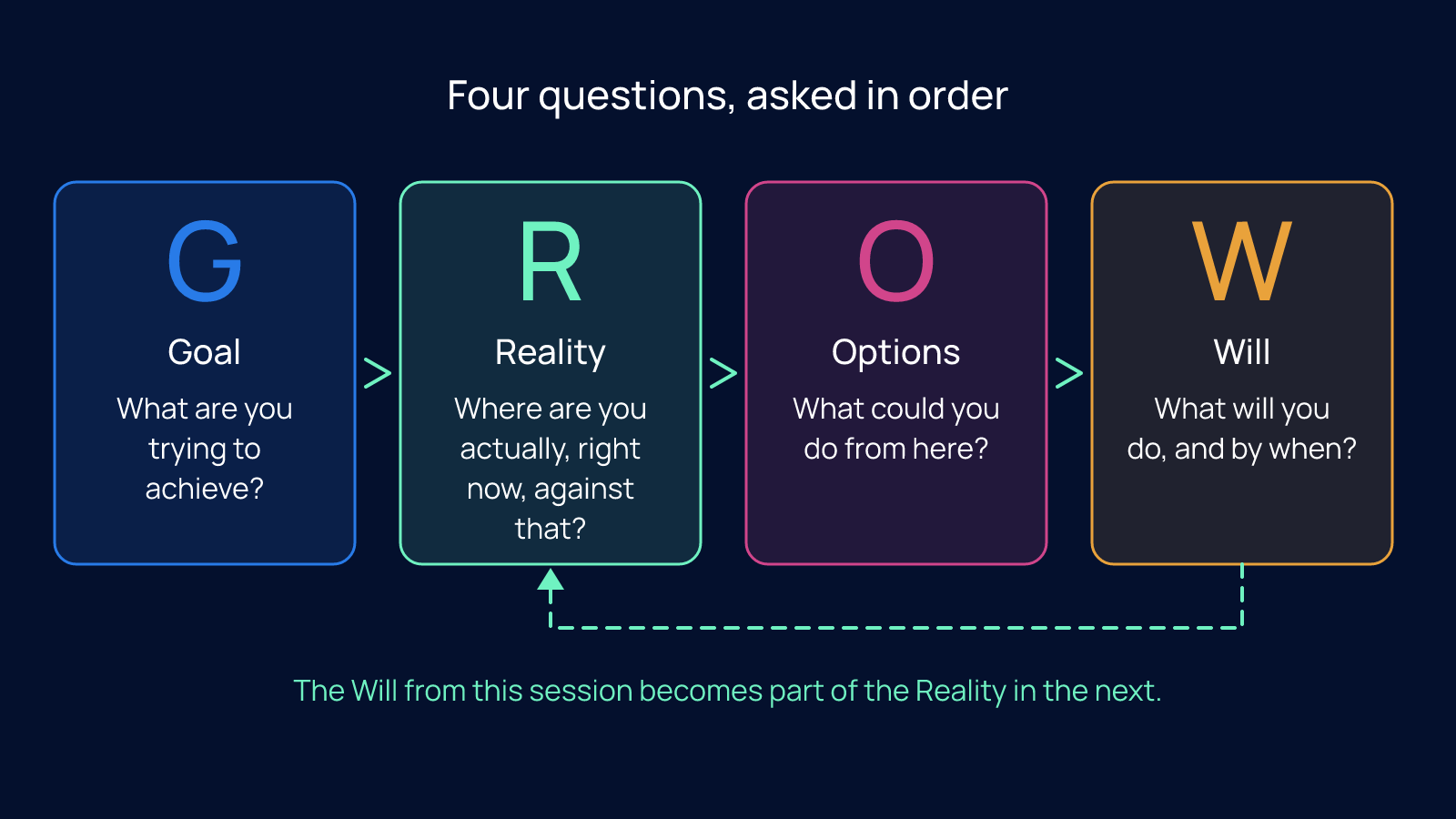
Sir John Whitmore gave coaching its most used structure in Coaching for Performance. He called it GROW, and it is four questions asked in order.
Goal. What are you trying to achieve?
Reality. Where are you actually, right now, against that?
Options. What could you do from here?
Will. What will you do, and by when?
Ask those four in that order and a status update becomes a coaching conversation. The order matters. Jump to Options before Reality is on the table and the manager is solving a problem the person has not finished describing. Hold the sequence and the person leaves with a decision they made, not a list the manager read back to them.
Most managers know GROW exists. Plenty have been trained on it. Almost none can hold the structure in the sixth meeting of a Thursday, after a client call ran long and before the budget review that is already pinging. Under a full calendar the structure is the first thing to go, and what fills the gap is the easy question: what are you working on?
That is not a character flaw. It is a workload problem. The manager is being asked to do the reading and the coaching in the same thirty minutes, and the reading loses every time.
Stop asking managers to try harder
The usual fix is another training, a template in a shared drive, a reminder to prep. Every one of those asks the manager to carry more into a day that is already full, and every one of them fails for the same reason the structure failed in the first place. There is no gap in the day for it to land in.
Edge8 stopped asking them to.
The better fix is to hand the manager the structure already filled in. Not a blank GROW template to complete at a desk they will not sit at before the meeting, but a brief that is already written, about this person, under those four headings, waiting when the manager opens it.
That is what sits in the coaching space of 8 Edges, and it is live in Edge8's own Company OS. Here is how it works, section by section.
Step one: open the brief, not the chat
Before every session, the manager opens a brief the AI has already prepared. It was built from three things that already exist in the system: the person's goals, their check-ins since the last session, and what was agreed last time.
The AI read all of that. The manager reads the brief. It is short by design, because the point is to be ready in the time it takes to walk from one meeting to the next, not to do homework.
Step two: Goal, already in front of you
The first heading restates what the person is working toward. Not the manager's recollection of it, the goal as the person actually set it and has been checking in against.
What the AI did: pulled the goal from where the person recorded it.
What the manager decides: whether that goal still holds, and whether to open the conversation there or somewhere more urgent.
Step three: Reality, from the check-ins
The second heading lays out where things actually stand. This comes from the check-ins the person has been filing since the last session: what moved, what stalled, what they flagged.
What the AI did: gathered the check-ins and set them against the goal.
What the manager decides: which of those threads is worth the room. The brief surfaces the reality. The manager chooses what to pull on.
Step four: Options, framed so you can ask
The third heading is where coaching happens. It frames the question the manager should be asking: given the goal and the reality, what could this person do from here?
What the AI did: laid out the ground so the manager knows what the options are about.
What the manager decides: everything. This is the part no brief can do for you. The manager asks, listens, pushes back, and helps the person see choices they had not seen. A brief gets you to the question. It does not ask it.
Step five: Will, with last time's agreements already there
The fourth heading carries forward what was agreed in the last session. Not from memory, from the notes. The manager can see, before the meeting starts, what this person committed to and what the manager committed to in return.
What the AI did: brought the last session's agreements forward.
What the manager decides: whether those commitments were met, what the new ones are, and how to hold both sides to them without the meeting turning into a scorecard.
That is the scroll through chat, done before the meeting, by something that does not forget.
Step six: write the notes, and the next brief starts here
After the session, the manager writes the notes and they go back into the system. That is the step that makes the whole thing compound. The next brief starts where this one ended. The Will from this session becomes part of the Reality in the next. Nothing agreed in October has to be rediscovered in November.
The manager never loses the thread, and the person never has to wonder whether the manager remembers.
The split, stated plainly
The AI did the reading; the manager does the coaching.
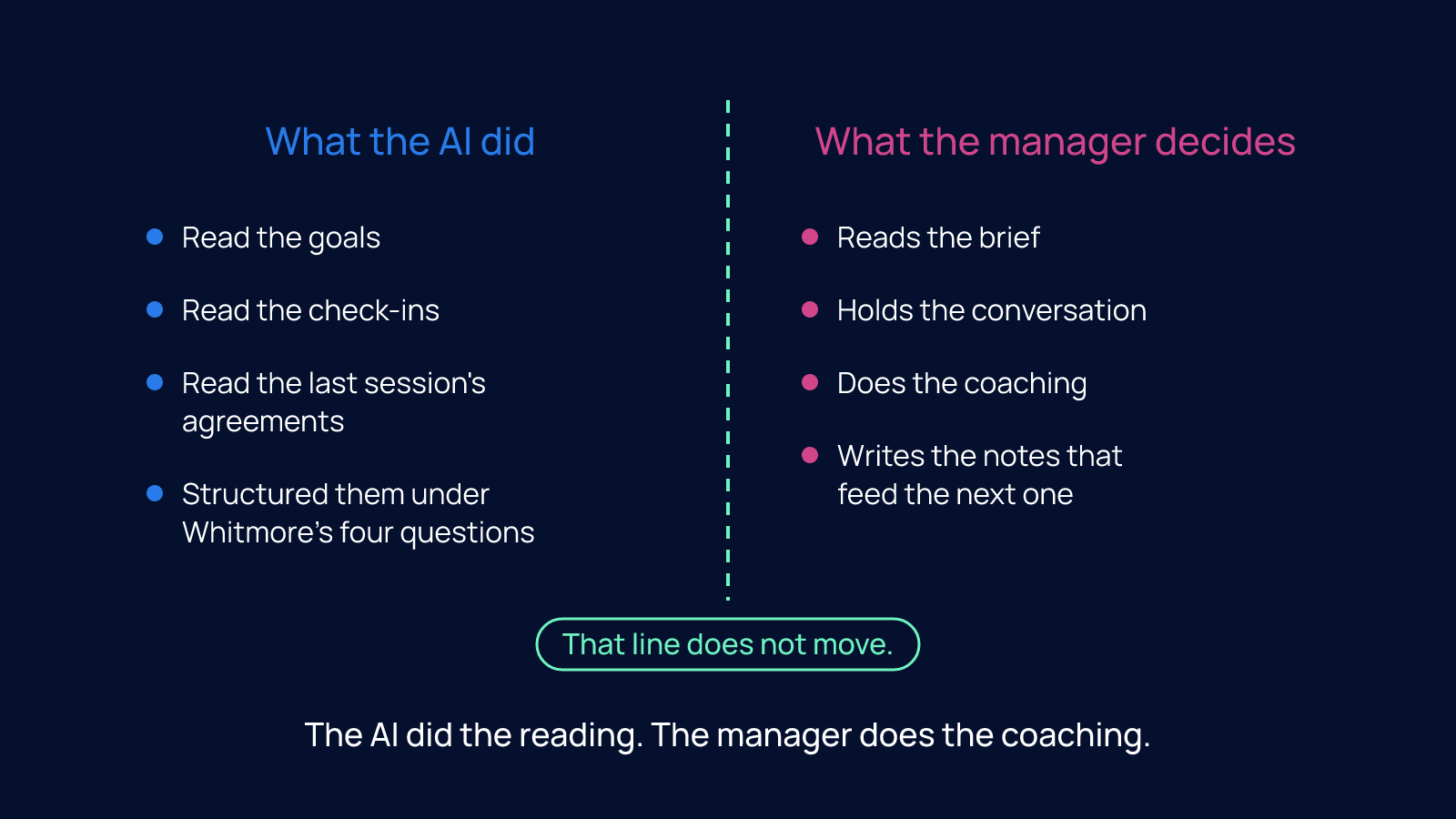
Every claim we make about AI at Edge8 answers the same two questions: what did the AI just do, and what does the person still decide.
In this workflow the AI read the goals, the check-ins and the last session's agreements, and structured them under Whitmore's four questions.
The manager reads the brief, holds the conversation, does the coaching, and writes the notes that feed the next one.
The AI did the reading. The manager does the coaching. That line does not move.
What changes when every manager is prepared every time
A manager who is prepared once has a good meeting. A manager who is prepared every single time has a different relationship with every person who reports to them.
The conversations stop collecting statuses and start developing people. Goals get revisited instead of forgotten. Agreements get kept because both sides can see them. The person across the table stops wondering whether this meeting matters to the manager, because the evidence is in front of them before the first question.
That is the point of the whole thing, and it is why this sits in the Talent block of the season. Prepared managers hold conversations that develop people, and people who are developed on a regular cadence are higher performing talent. Not because of a new incentive or a new org chart, but because the one meeting that was always meant to do this job finally does it.
Where this sits in the season
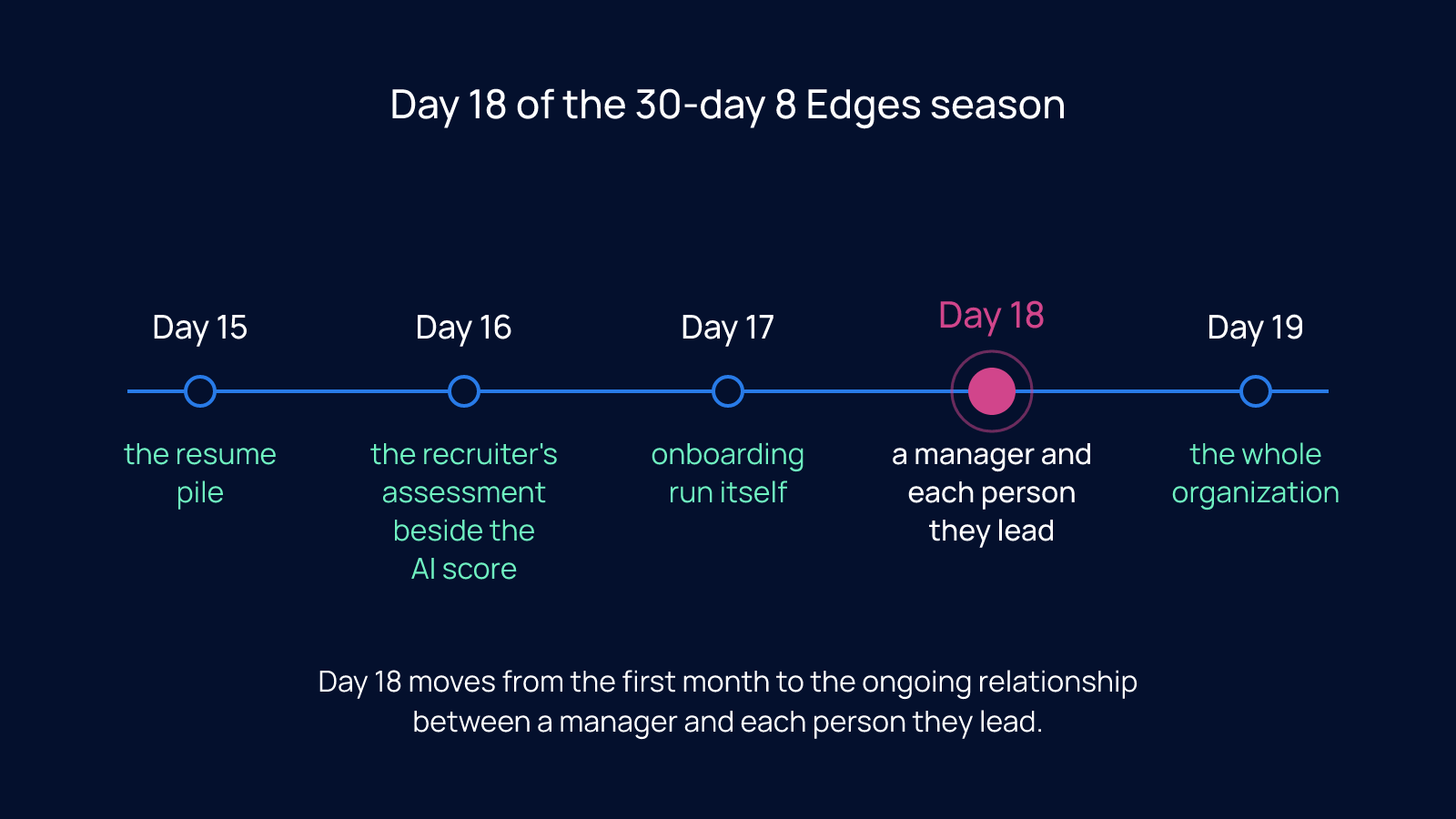
This is Day 18 of the 30-day 8 Edges season. The Talent block has been following one person from first contact onward: Day 15 took the resume pile, Day 16 put the recruiter's assessment beside the AI score, Day 17 made onboarding run itself. Day 18 moves from the first month to the ongoing relationship between a manager and each person they lead.
Day 19 zooms out to the whole organization: who reports to whom, and how people are really doing, not on the chart but in practice.
Watch the Day 18 film
The film shows the brief itself, open in Edge8's Company OS, under the four GROW headings, and the manager walking into the session with it. It is short. Watch it, then look at your own calendar for this week and count how many of those one-on-ones you will walk into prepared.
If the honest answer is not all of them, reply to this post. We will show you the coaching space running live and talk about what it would take to put it in front of your managers.
FAQ
How do I walk into every one-on-one prepared instead of scrolling chat to remember what we agreed last time, so the meeting becomes coaching and not another status update?
Stop asking yourself to do the reading three minutes before the meeting and hand that job to something that does not forget. The post describes a brief built from three things that already exist in the system: the person's goals, their check-ins since the last session, and what was agreed last time, laid out under the four GROW questions from Sir John Whitmore's Coaching for Performance. You read the brief in the time it takes to walk from one meeting to the next, open on the Goal, and the first question is no longer what are you working on.
What is the GROW model and how do I use it in a one-on-one meeting?
GROW is the coaching structure Sir John Whitmore set out in Coaching for Performance, and it is four questions asked in order: Goal (what are you trying to achieve), Reality (where are you right now against that), Options (what could you do from here) and Will (what will you do, and by when). The order matters: jump to Options before Reality is on the table and you are solving a problem the person has not finished describing. Hold the sequence and the person leaves with a decision they made, not a list you read back to them.
Why do my one-on-ones keep turning into status updates?
Because the manager is being asked to do the reading and the coaching in the same thirty minutes, and the reading loses every time. Most managers know GROW exists and plenty have been trained on it, but almost none can hold the structure in the sixth meeting of a Thursday after a client call ran long. When the structure goes, the easy question fills the gap, the person answers, and it is same time in two weeks. That is a workload problem, not a character flaw, and the person across the table knows the difference.
What should an AI prepare before a one-on-one, and what should I still do myself?
The post draws the line with two questions: what did the AI just do, and what does the person still decide. The AI reads three sources, the person's goals, their check-ins and the last session's agreements, and structures them under Whitmore's four headings. The manager reads the brief, chooses which thread is worth the room, asks the Options question, listens, pushes back and writes the notes. A brief gets you to the question; it does not ask it.
How do I keep continuity between one-on-ones so what we agreed last time does not get lost?
Make the notes the last step of every session and the first input to the next, which is step six of the six-step workflow the post walks through. The manager's notes go back into the system, so the next brief starts where this one ended and the Will from this session becomes part of the Reality in the next. Nothing agreed in October has to be rediscovered in November, and both sides can see what the person committed to and what the manager committed to in return.