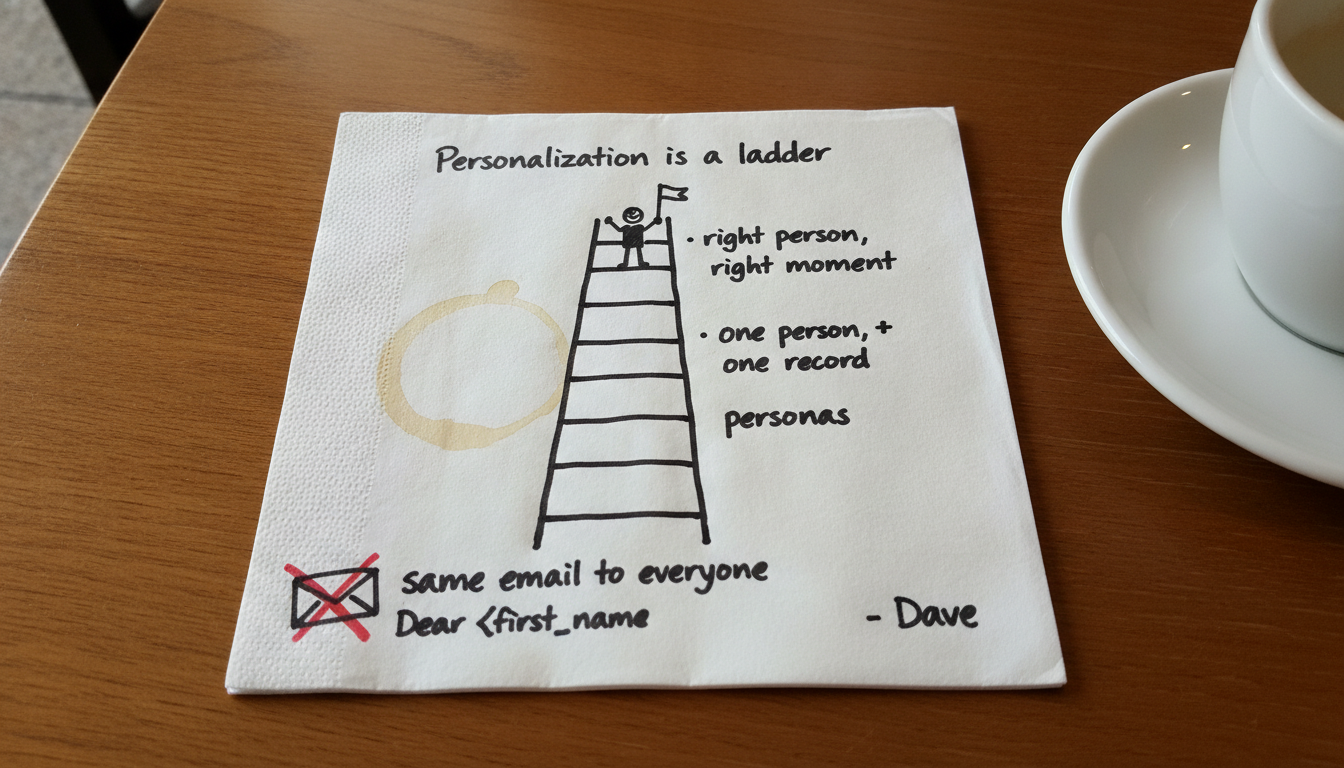
Two definitions are fighting for the same word, and the wrong one is winning by default.
The industry definition: personalization is a name field and a segment code. You bought a tool, it merges {first_name} into the greeting, it splits the list by industry or plan tier, and the dashboard says "personalized." Every vendor deck you sat through this year used the word this way.
The Edge8 definition: hyper-personalization is one message, one briefing or one conversation written for one specific person from what you actually know about them. Not from which bucket they fell into. From the record.
We wrote the formula down in the post on centralizing company data and it is the whole thing: right data plus right time plus right message. Right data means a record you own about this person. Right time means a moment when the message is worth reading. Right message means words that could only have been written for them. Miss any of the three and you are back to the name field.
This post anchors a week on the subject. It gives you a ladder to place your own company on, names the four ways the method fails, shows where Edge8 honestly stands on each of the three streams where we run it, and ends with something you can do today.
The prize, in the research's numbers
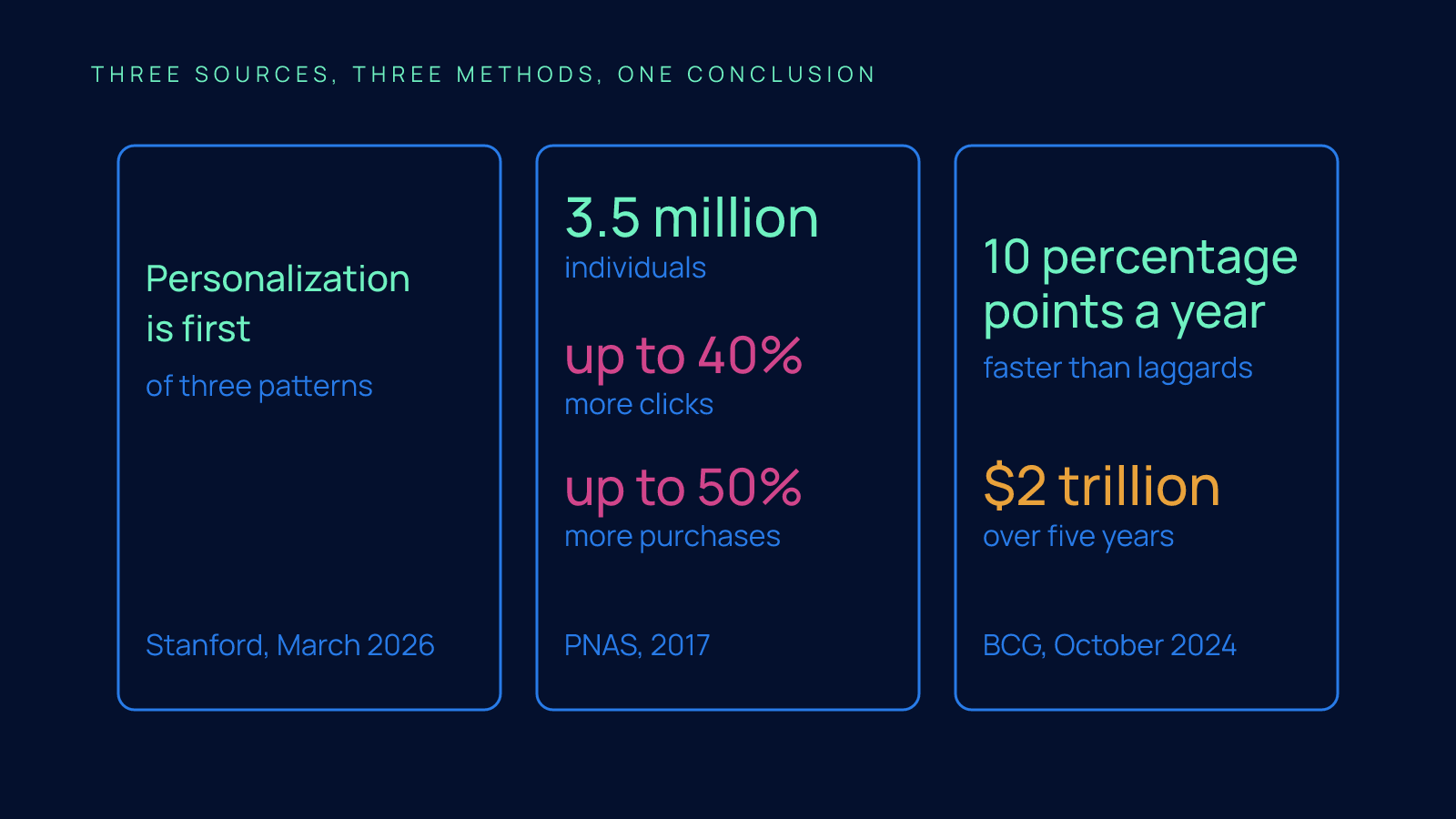
Revenue from AI is real, but still rare, and follows three patterns.
Persuasive appeals that were matched to people's extraversion or openness-to-experience level resulted in up to 40% more clicks and up to 50% more purchases than their mismatching or un-personalized counterparts.
Most personalization research is written to sell a tool. These three sources are different. They come from economists, psychologists and a consulting firm that each measured behavior at scale, and they point one direction.
Start with Stanford. The Digital Economy Lab's Enterprise AI Playbook (Pereira, Graylin and Brynjolfsson, March 2026) looked at where AI actually produces money and concluded: "Revenue from AI is real, but still rare, and follows three patterns." The patterns, in their order: "Personalization that converts, speed that wins deals, and internal tools repackaged as products." Personalization is first. The same report warns that "Data foundations are a major line item," which is the polite way of saying you do not get the first pattern without paying for the record.
Then the field experiment that should end the argument. Matz, Kosinski, Nave and Stillwell (PNAS, 2017) ran "three field experiments that reached over 3.5 million individuals with psychologically-tailored advertising." Their finding: "Persuasive appeals that were matched to people's extraversion or openness-to-experience level resulted in up to 40% more clicks and up to 50% more purchases than their mismatching or un-personalized counterparts." Same product. Same channel. 3.5 million people, up to 40% more clicks, up to 50% more purchases, and the only variable was whether the message matched the person.
Then the money at the company level. BCG's October 2024 work on its Personalization Index found that leaders grow revenue about 10 percentage points a year faster than laggards, and estimates that roughly $2 trillion in revenue will shift toward companies that personalize well over five years. Ten points a year is not a marketing statistic. It is the gap between a company that compounds and one that gets acquired.
Three sources, three methods, one conclusion: matched messages move people, and the companies that can produce them at scale pull away. Now the harder question. Can your company produce one?
Place yourself on the ladder
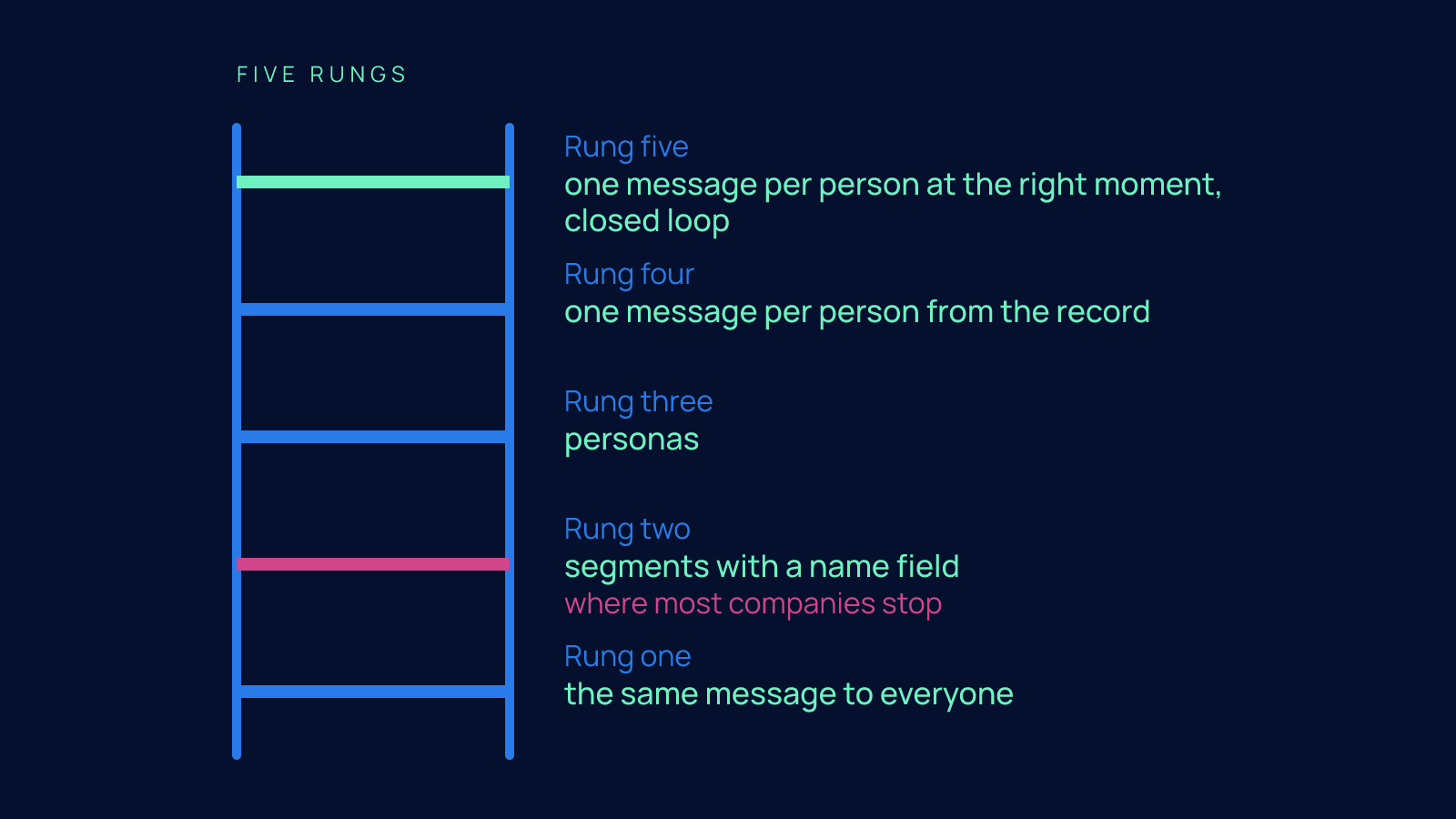
Here is the ladder we use to place any company, including our own. It is not a product and it has no name. Five rungs.
Rung one: the same message to everyone. The newsletter, the all-hands email, the broadcast. Honest, at least. Nobody is pretending.
Rung two: segments with a name field. The list is split by plan, industry or region, and the greeting merges a first name. This is where most companies stop and call it personalization. It is not. The person got the segment's message with their name stapled to the top.
Rung three: personas. Someone wrote up "the skeptical CFO" and "the technical founder" and the messaging is tuned to the type. Better, because the words changed. Still not the person. A persona is a guess about a crowd.
Rung four: one message per person from the record. You own data about this individual (what they said, what they bought, what they committed to, how they tend to decide) and the message is written from it. Nobody else could have received it.
Rung five: one message per person at the right moment, closed loop. Rung four, plus timing, plus the response goes back into the record so the next message is better. Closed loop means exactly that: what they do with the message becomes part of what you know. This is the formula complete.
Be strict about where you are. If your "personalized" output could go to anyone else in the segment without changing a word, you are on rung two. If you have personas but no record of the individual, you are on rung three. The vendor who told you otherwise was describing the tool, not your output.
The four ways it fails
The oversight level should match the stakes.
The research is just as clear about failure, and each failure has a name attached. These are not edge cases. They are what happens by default when you buy the tool before you fix the order of operations.
Failure one: covert data. Aguirre, Mahr, Grewal, de Ruyter and Wetzels (Journal of Retailing, 2015) found that personalized ads earn more clicks when the data behind them was collected openly, and fewer clicks when people realize it was gathered without their knowledge. They call it the personalization paradox. Same message, same data, and it helps or hurts depending on whether the person knew you had it. So the first question is not "what do we know" but "did they know we were keeping it."
Failure two: flattery. Sharma and colleagues at Anthropic (2023) tested five leading AI assistants and found they consistently tell people what they want to hear, and that humans, and the preference models trained on human ratings, sometimes prefer a convincingly written flattering answer over a correct one. Point a language model at a person's record and ask it to write to them, and left alone it drifts toward what they would like to read. A personalized message that is not true is worse than a generic one that is.
Failure three: generic at scale. The nudge that worked in the pilot shrinks toward zero when you send it to everyone. Later this week, in the students post, we go through the Kizilcec finding on exactly this, so I will hold the detail. The short version: personalization that stops being personal as it scales is rung two with a bigger list.
Failure four: feedback that harms. Feedback is the most personal message there is, and delivered badly it makes the person worse about a third of the time. The coaching post covers Kluger and DeNisi on this, and the number is uncomfortable. If your hyper-personalization reaches into how people are coached, the guardrail is not optional.
Notice the shape. Covert data is a data problem. Flattery is a model guardrail problem. Generic at scale is a message problem. Harmful feedback is a delivery problem. Right data, right message, right time, and human oversight around all three. Stanford put the principle plainly: "The oversight level should match the stakes." Getting hyper-personalization right is an order of operations and a set of guardrails, not a tool.
The order of operations we lived
Here is the order we followed at Edge8, because we got it wrong before we got it in order.
First, one owned home for the data. Not a marketing platform's database, not a CRM export. A record we own that every stream writes to.
Second, a sender that can address one person. Not a broadcast tool with a merge field. A system that looks up one record and writes one message.
Third, enriched profiles. The record gets deeper: what the person said in a call, what they committed to, how they decide.
Fourth, personalized content at scale. Only now.
We are between steps two and three. That is not modesty. It is the scoreboard.
The honest scoreboard
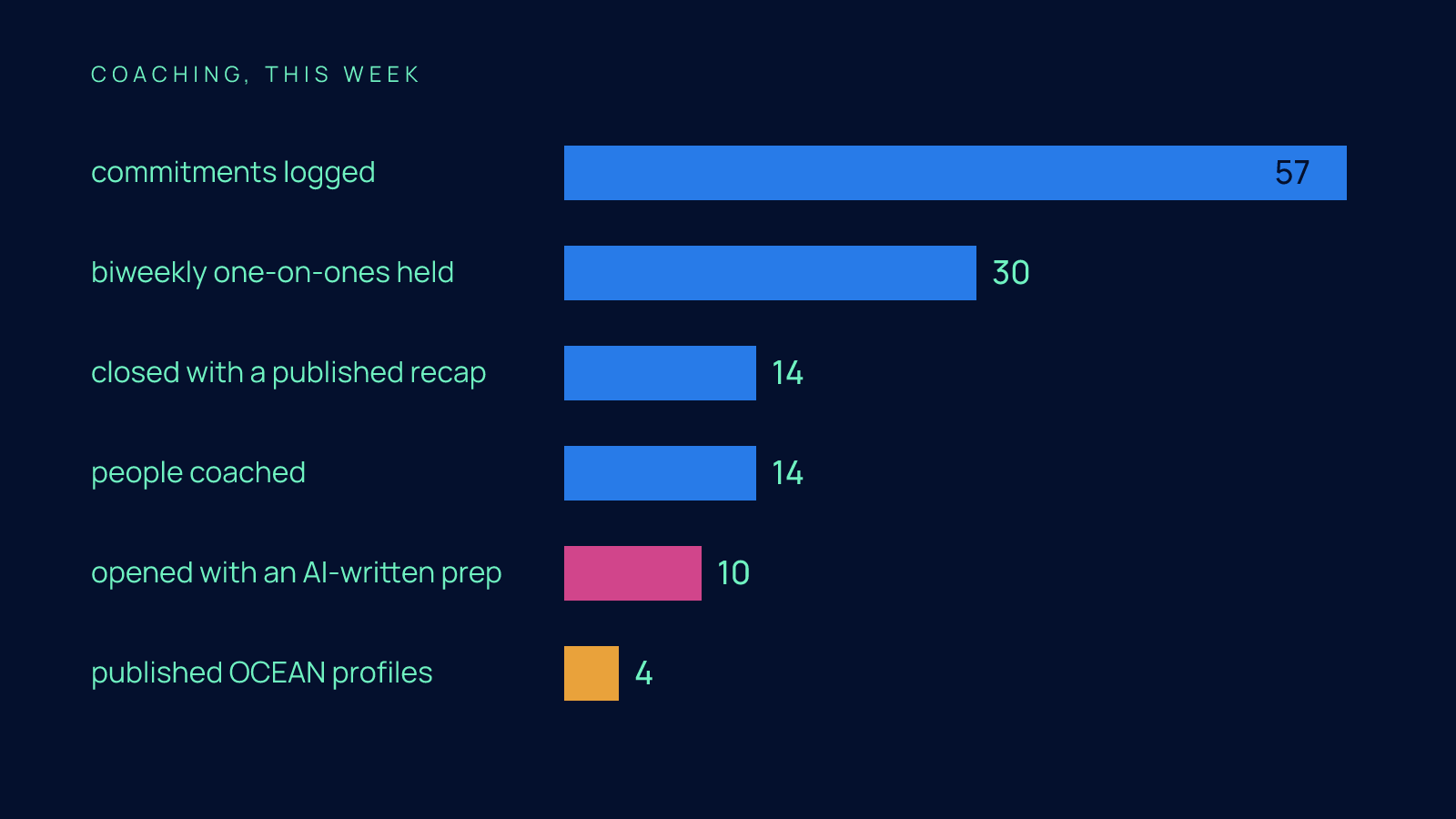
Three streams run the method today. Here is where each one stands this week.
Coaching. 30 biweekly one-on-ones held. 10 opened with an AI-written prep drawn from the person's record. 14 closed with a published recap. 57 commitments logged. 4 published OCEAN profiles (the five-trait personality model behind the Matz experiment: openness, conscientiousness, extraversion, agreeableness, neuroticism) out of 14 people coached. This is our rung-four stream: one briefing, one person, from the record. The one-on-ones post shows how the prep gets built, and this week's coaching post takes on the feedback failure directly.
Sales. 45 leads and 47 open deals, and 92 people who will each get one note a week written for them instead of the broadcast. So far, one broadcast has gone through the rebuilt sender. No lift measured, because there is nothing to measure yet. This stream sits between rung two and rung four: the record exists, the sender exists, the one-per-person notes do not. The outreach post shows the plumbing.
Students. A retailer's cohort is in the AI Officer certification, and their progress is mirrored nightly into the record as modules completed per track. The encouragement note that would use that progress does not exist yet. Rung one, honestly, with a rung-four record waiting behind it. The students post later this week covers the generic-at-scale failure and what we will build to avoid it.
The guide at the end of the week rolls all three up into one method you can run.
We are not great at any of these yet. We are writing the whole thing down in public because the writing is how the process gets fixed. Every time I have to put a number in a post, I find the step we skipped.
The role this creates
Look back at the four failures and the order of operations and ask who inside your company owns them.
Someone has to own the record: what is collected, whether the person knows, where it lives. Someone has to own the guardrails: that the model is not flattering, that the message stays specific as it scales, that feedback is delivered in a way that helps. Someone has to own the loop, so the response feeds back into the record.
That is not a vendor. A vendor sells rung two and calls it rung four. It does not sit in marketing either, because the record spans customers, candidates and your own team. It is a role inside the company: an AI officer who owns the data layer and the workflow around it, or an AI engineer who builds the sender and the enrichment and keeps the guardrails in code. Everything above is the argument for why that role exists and what it has to be able to do.
Your next step
Take the last five messages your company sent to anyone: a customer, a candidate, a team member. Put each one on the ladder. Be strict: if it could have gone to someone else in the segment unchanged, it is rung two, whatever the tool called it.
Reply to Edge8 with the five rungs. That is the whole conversation starter. We will talk about who should own the record that moves them up.
FAQ
How do I get hyper-personalization right instead of just putting a first name in the subject line?
Start with the formula: right data plus right time plus right message, where right data is a record you own about one specific person and right message is words that could only have been written for them. Then place your output on a five-rung ladder that runs from the same message to everyone, through segments with a name field and personas, up to one message per person from the record and finally one message per person at the right moment with the response fed back in. The payoff is real: in three field experiments reaching over 3.5 million people, Matz, Kosinski, Nave and Stillwell (PNAS, 2017) found messages matched to a person's psychology produced up to 40% more clicks and up to 50% more purchases than mismatched or generic versions.
What is the difference between segmentation and real personalization?
Segmentation splits a list by plan, industry or region and merges a first name into the greeting, so every person in the bucket gets the same message with their name stapled on top; that is rung two of five. Real personalization is one message written for one individual from what you actually know about them, which is rung four, and the strict test is whether the message could go to anyone else in the segment unchanged. The gap is measurable: in field experiments with over 3.5 million people, messages matched to the individual's extraversion or openness produced up to 40% more clicks and up to 50% more purchases than unmatched ones (Matz et al., PNAS, 2017), and BCG's October 2024 Personalization Index found leaders grow revenue about 10 percentage points a year faster than laggards.
Does personalizing my messages actually increase revenue?
Yes, and the evidence comes from three independent methods. Stanford's Digital Economy Lab Enterprise AI Playbook (Pereira, Graylin and Brynjolfsson, March 2026) found that revenue from AI follows three patterns and lists personalization that converts first. BCG's October 2024 work on its Personalization Index found leaders grow revenue about 10 percentage points a year faster than laggards and estimates roughly $2 trillion in revenue will shift toward companies that personalize well over five years. The same Stanford report warns that data foundations are a major line item, so the revenue does not arrive without paying for the record.
Why does personalization sometimes backfire and make people trust us less?
There are four documented failure modes. Aguirre and colleagues (Journal of Retailing, 2015) found personalized ads earn more clicks when the data was collected openly and fewer clicks when people realize it was gathered without their knowledge, which they call the personalization paradox. Sharma and colleagues at Anthropic (2023) tested five leading AI assistants and found they consistently tell people what they want to hear, so a model pointed at someone's record drifts toward flattery unless guarded. Generic nudges shrink toward zero when sent to everyone, and feedback delivered badly makes the recipient worse about a third of the time, which matters once personalization reaches into coaching.
Who in my company should own the data behind personalized messaging?
It should be a role inside the company, not a vendor and not marketing alone, because the record spans customers, candidates and your own team, and a vendor sells segments with a name field and calls it personalization. That owner is accountable for three things: the record (what is collected and whether the person knows), the guardrails (no flattery, messages that stay specific at scale, feedback that helps), and the loop that writes responses back into the record. The order of operations matters more than the tool: one owned home for the data, then a sender that can address one person, then enriched profiles, and only then content at scale. Edge8's own scoreboard shows why sequence matters: 30 biweekly one-on-ones held, 10 opened with an AI-written prep from the person's record, 57 commitments logged, and in sales 92 people queued for one note a week with no lift measured yet because the one-per-person notes do not exist yet.