If you read one page from Edge8 on hyper-personalization, read this one.
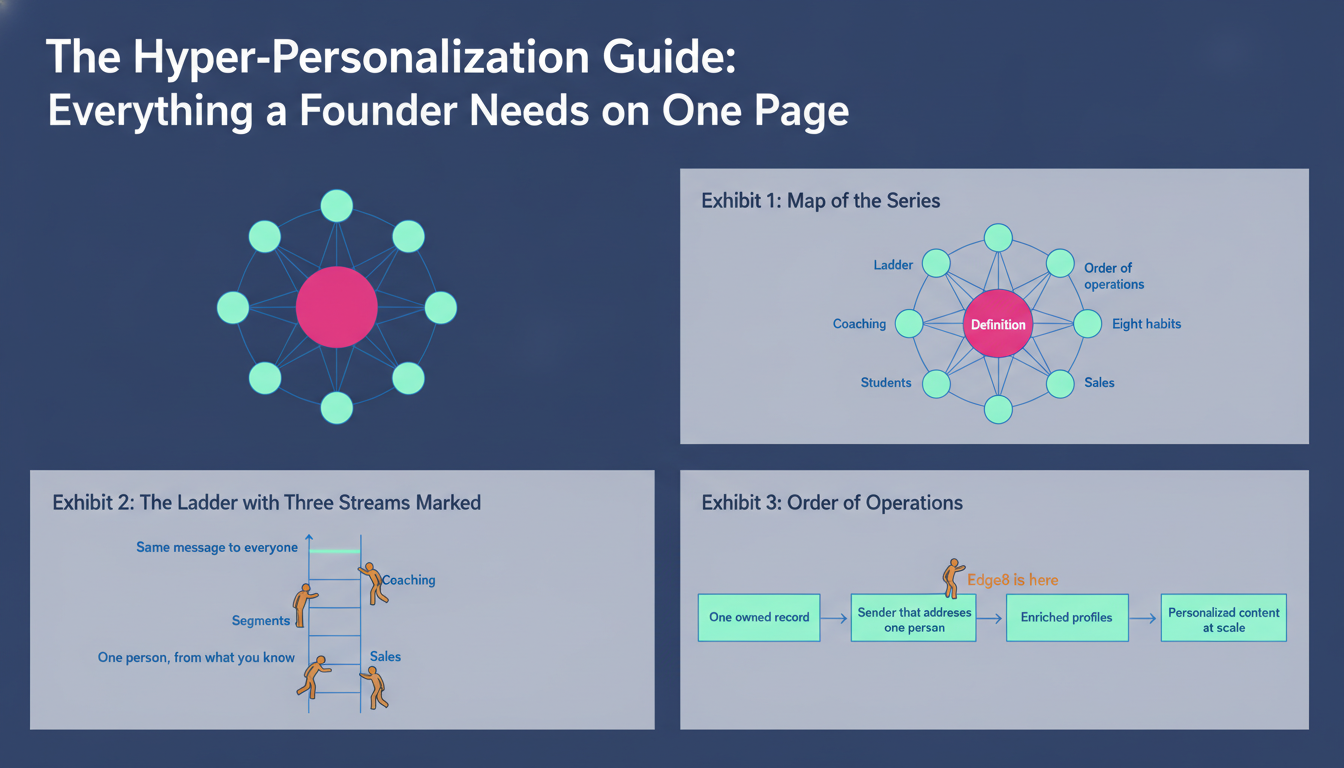
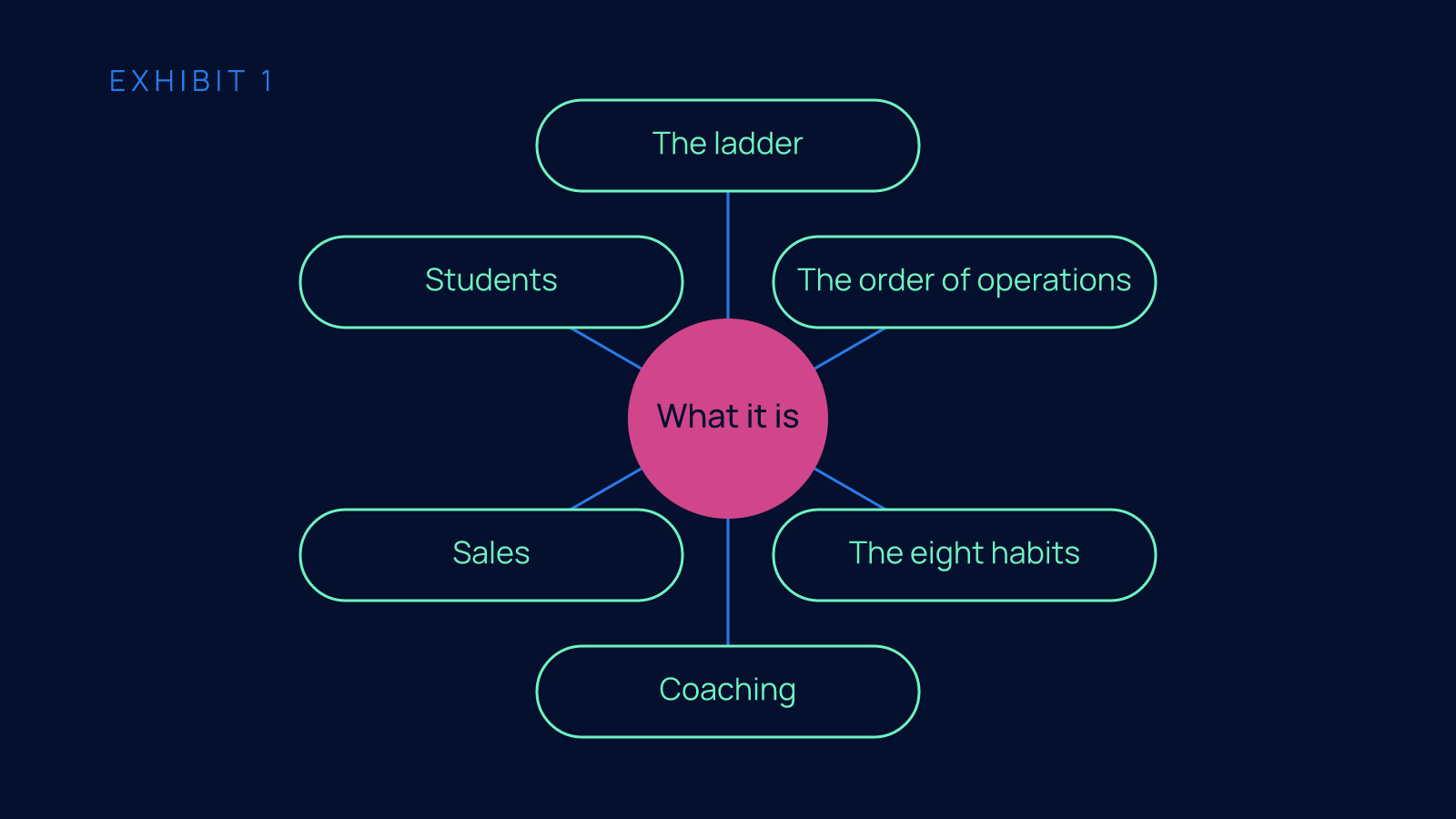
Over the past month we published a series on it: what it is, the ladder, the order of operations, the eight habits, and three honest reports from our own coaching, sales and student work. Each post answered one question. This page puts the answers in one place, in the order a founder needs them, with every number dated and a link to the fuller post where the detail lives. Exhibit 1 draws the map: six posts in a ring around the definition.
Two warnings before you scroll. First, this is a working document. Every Edge8 number here carries a date, and we will change it when the number changes. Second, Edge8 is not great at this yet. We are partway through our own order of operations, and the guide says so where it matters. That is the point of publishing it.
1. What hyper-personalization is, and what it is not
Hyper-personalization is one message, one briefing or one conversation written for one specific person from what you actually know about them.
The formula is three parts: right data, right time, right message. The right data is what you hold about this person, not a demographic guess. The right time is the moment the message is useful to them, not the moment it is convenient for you. The right message is what those two things demand, and it usually could not be sent to anyone else without a rewrite.
Here is what it is not. It is not a first-name field in a subject line. It is not a segment code that puts 4,000 people in a bucket and sends all 4,000 the same thing. A segment is still a broadcast. The test we use: could this message have gone to a different person without changing a word? If yes, you have personalization theater, not the thing itself.
Fuller posts: the 29 August definition post, and the pillar, how to get hyper-personalization right instead of putting a first name in the subject line.
2. Where the money is
Revenue from AI is real, but still rare, and follows three patterns.
Three sources, one paragraph each, so you can decide whether this deserves your company's attention.
Stanford's Digital Economy Lab put it plainly in the Enterprise AI Playbook this March: "Revenue from AI is real, but still rare, and follows three patterns." The three: "Personalization that converts, speed that wins deals, and internal tools repackaged as products." Personalization is first on the list. If you are asking where AI earns money rather than saves a few hours, this is the shortest honest answer available.
McKinsey measured the gap between what customers expect and what they get. In its 2021 research, 71% of consumers expected personalized interactions, 76% were frustrated when they did not get them, and 78% said personalized content made them more likely to buy again. Read those together: the expectation is already the default, and missing it costs you twice, once in the lost sale and once in the frustration you created.
Matz, Kosinski, Nave and Stillwell set the ceiling in PNAS in 2017: "Persuasive appeals that were matched to people's extraversion or openness-to-experience level resulted in up to 40% more clicks and up to 50% more purchases than their mismatching or un-personalized counterparts." Treat that as the ceiling, not the forecast. It was two personality traits, in ads, run by researchers. Your first attempt will not land there. It tells you the prize is large enough to organize around.
3. The ladder
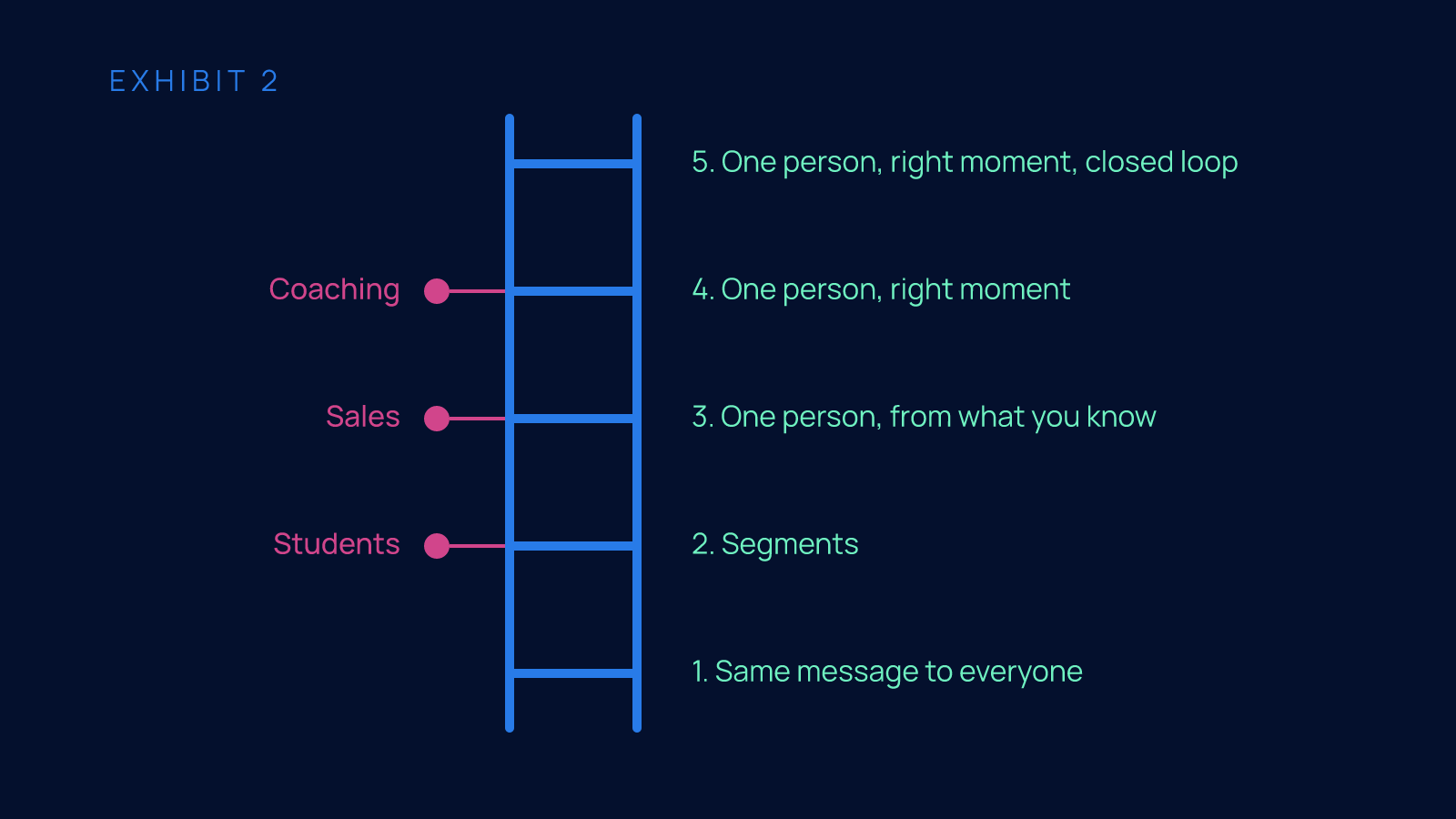
Five rungs. Every company is on one of them for every stream of communication it runs, and most companies are on different rungs for different streams.
- Same message to everyone. The newsletter, the all-hands email, the course announcement.
- Segments. Groups get different versions. The name field and the segment code live here. Most personalization software sells this rung.
- One person, from what you know. The message is written from that person's record: their last conversation, their open commitment, their stated goal. It could not go to anyone else.
- One person, right moment. Rung three, sent when it is useful to them rather than when your calendar says so.
- One person, right moment, closed loop. The reply, the click or the silence goes back into the record and changes the next message. Closed loop means the system learns from the response instead of forgetting it.
To place a company: take the last ten messages one stream sent. Apply the test from section one to each. Then ask whether anything the recipient did afterward changed what they got next. Most founders discover they are on rung two and believed they were on rung four.
Exhibit 2 draws the ladder with Edge8's three streams marked on it.
Fuller post: the ladder.
4. The order of operations
Data foundations are a major line item.
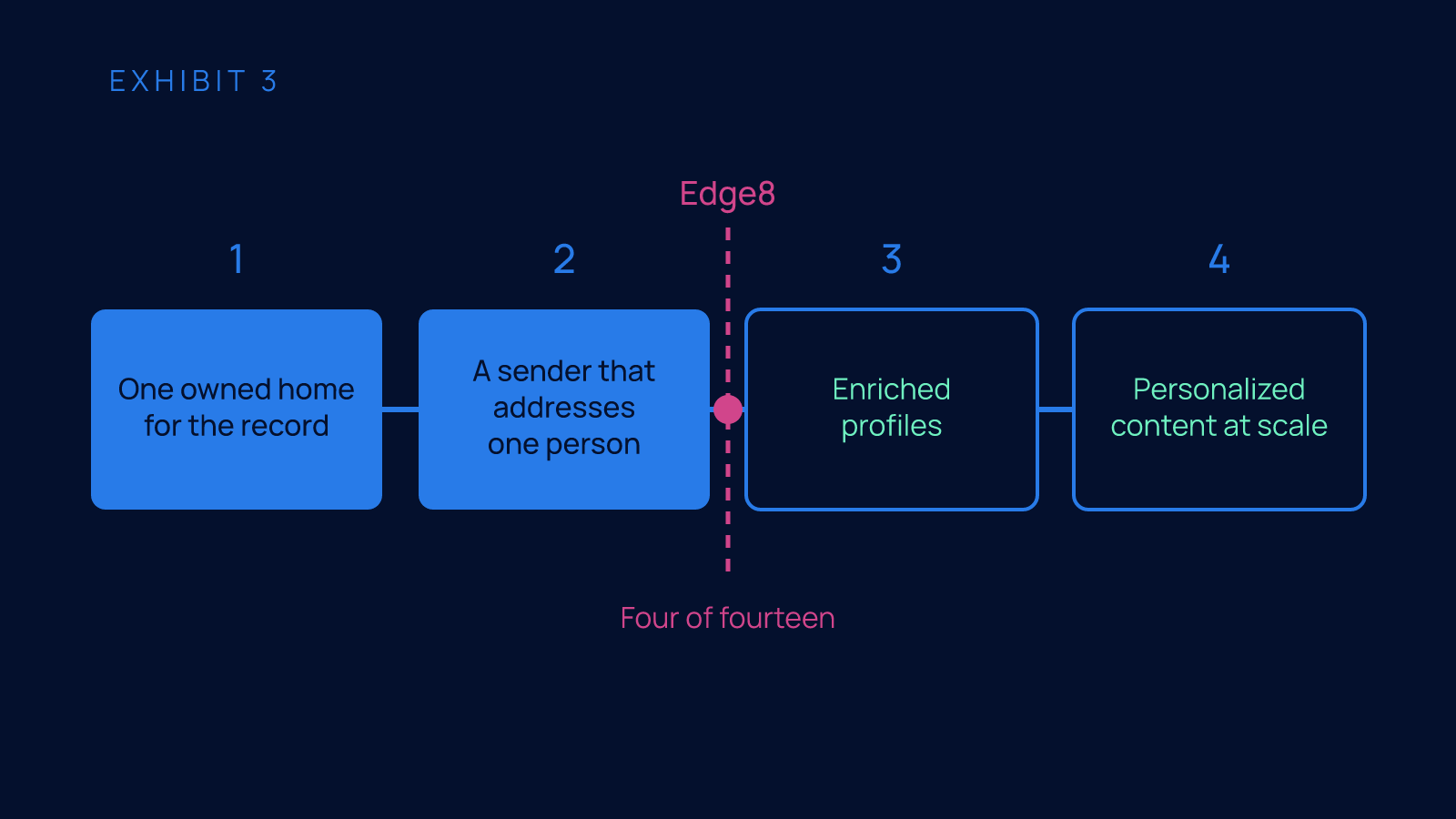
Nobody climbs from rung two to rung five by buying a tool. There is a sequence, and skipping a step is how the money gets wasted.
- One owned home for the record. A place you control where everything you know about each person lives. Not the contact database the sales team half-fills, not the learning platform the training vendor owns, not eleven spreadsheets. One record per person, owned by you.
- A sender that addresses one person. A channel and a workflow that can send one message to one person from that record, and log that it did.
- Enriched profiles. The record grows past contact details into the things that change a message: goals, style, open commitments, what they said last time.
- Personalized content at scale. Only now does AI write the one-to-one message, because now it has something true to write from.
Stanford's playbook is blunt about step one: "Data foundations are a major line item." Founders hear that as a cost. It is the cost of not paying for steps two through four twice.
Where Edge8 is: between steps two and three. We have one owned record, and our sender addresses one person and logs it. Our profiles are thin. Four of fourteen coaching clients have a full personality profile. That is why our results in section seven are modest, and why we are not pretending otherwise.
Exhibit 3 draws the four steps with Edge8's marker between two and three.
Fuller post: personalized outreach with AI from data you own.
5. The eight ways
Eight habits that make hyper-personalization work without new software. One line each.
- Write to one person. If it could go to two, rewrite it.
- Start from what you already hold. The record you have beats the data you wish you had.
- Say where you got it. Name the source of what you know inside the message.
- Pick their moment, not yours. Send when the information is useful to them.
- One true sentence beats ten smooth ones. A single specific line about their situation carries the whole message.
- Log the response. Reply, click or silence, it goes back into the record.
- Tell them what is true, not what is pleasant. Especially when a model drafts it.
- Match human review to the stakes. A nudge to a learner and a note about someone's job are not the same risk.
Fuller post: eight habits for hyper-personalizing messages.
6. The four ways it fails
The oversight level should match the stakes.
Each of these has a research paper behind it, and each has embarrassed a real company.
Covert data. Aguirre and colleagues found in 2015 that personalization lifts click-through when people can see how you collected the data, and lowers it when they discover the collection was hidden. Same message, same accuracy, and it flips from asset to liability based on whether you told them. Habit three exists because of this paper.
Flattery. Sharma and colleagues at Anthropic showed in 2023 that leading AI assistants consistently tell people what they want to hear, and that people sometimes prefer the flattering answer to the correct one. If a model drafts your one-to-one messages, it will drift toward agreeable, and your reader will reward the drift. A personalized compliment is still just a compliment. Habit seven exists because of this paper.
Generic at scale. Kizilcec and colleagues ran behavioral nudges across 250,000 learners in 247 online courses and reported only small benefits that depended heavily on context. Scale does not rescue a message that was not written for anyone in particular. It just makes the small effect expensive.
Feedback that harms. Personalized feedback can lower performance instead of raising it, depending on how it is framed. We covered the Kluger and DeNisi finding in the coaching post rather than here, because it changes how you write a one-to-one briefing more than whether you send one. Read it before you automate feedback to anyone.
Stanford's guardrail covers all four: "The oversight level should match the stakes."
Fuller post: better one-on-one meetings with AI.
7. Three streams, today's numbers
Edge8 runs hyper-personalization in three streams. Here is where each one stands. Numbers are as of 16 September 2026 and will be refreshed when the posts behind them are.
Coaching. Thirty one-to-one sessions held. Ten preps written before sessions. Fourteen recaps published to the people in them. Fifty-seven commitments recorded, twenty-nine of them still open. Four of fourteen people have an OCEAN profile (the five-trait personality model: openness, conscientiousness, extraversion, agreeableness, neuroticism). That profile is the enriched-profile step from section four, and the reason we place ourselves between steps two and three. Fuller post: the 8 Weeks coaching post.
Sales. Forty-five leads and forty-seven open deals, ninety-two people in total, each getting one note a week written from their record. No lift measured yet. We say that plainly because the honest number is more useful to you than a promising one. Fuller post: One Note a Week to Ninety-Two People.
Students. A retailer's cohort of thirteen learners, measured against three requirements: six core courses, eight micro-sessions and four coaching sessions. The first week's numbers are in the students post exactly as we published them, and we are not repeating them here so this page never drifts from the source. It was one week, and there was no control group. Treat it as a start, not a result. Fuller post: the students post.
Exhibit 2 places all three on the ladder. Coaching sits highest because the record is richest. Sales is a rung lower. Students is lowest, because one week of data is barely a record at all.
8. Who owns it
Hyper-personalization fails as a marketing project and works as an operations project. That changes who owns it.
The AI officer owns the record and the workflows. Which fields matter, who may see them, what gets logged, where human review sits, and which stream climbs the ladder first. This is a leadership role, not a technical one, and the person in it needs the standing to tell the sales lead and the training vendor that their data now lives in one place.
The AI engineer wires the record to the sender and to the agents that draft from it. They own the plumbing: profile enrichment, logging, the model prompts, and the guardrails from section six written as code rather than as a policy document.
Neither is a vendor. A vendor sells you rung two and leaves. These two people sit inside your company and own the climb. The AI Officer Institute certifies the officer.
Fuller post: centralize business data before buying another tool.
9. Where to start
Three counts, one per stream, from this week's posts. You can get at least one of them today.
- Live conversations. How many people is your company in a real conversation with right now, about whom you could write one true sentence?
- The five things. Before your next one-to-one, what are the five things you would want to know about that person, and how many of the five do you actually hold?
- Learners. How many people in your training programs could you write one true sentence to about their progress?
Pick the count that is easiest for you to get today. Get it. Reply to Edge8 with the number. The count tells us which of the three streams to talk about first, and who inside your company should own the record behind it.
FAQ
What does a hyper-personalization strategy actually look like for a company my size, from the data I already have to who should own it?
It starts with a strict definition: one message for one person, written from what you actually know about them, sent when it is useful to them, and it follows a fixed order of operations: one owned home for the data, a sender that writes to one person, enriched profiles, and only then personalized content at scale. The prize is real: McKinsey's 2021 research found 71 percent of consumers expect personalized interactions and 78 percent say personalized content made them more likely to buy again, and Matz and colleagues in PNAS in 2017 measured up to 40 percent more clicks and up to 50 percent more purchases when appeals matched a person's personality rather than a segment. Inside the company, an AI officer owns the record and the workflows and an AI engineer wires the record to whatever writes and sends, and neither role is a vendor. Edge8 itself sits between steps two and three as of 16 September 2026, with four personality profiles completed of fourteen people, which is why the guide says do not buy step four first.
How do I tell whether my company is actually hyper-personalizing or just running a better mailing list?
Pull the last ten messages one stream sent and apply one test to each: could it have gone to a different person without changing a word? If every one could, you are on rung one or two of the five-rung ladder, whatever your software vendor told you, and most founders who run this test discover they are on rung two and believed they were on rung four. A first name in the subject line or a segment code that sends 4,000 people the same thing is still a broadcast. The gap costs you: McKinsey's 2021 research found 76 percent of consumers are frustrated when they do not get personalized interactions.
Is hyper-personalization worth investing in for a smaller company, or is it only for big retailers?
Stanford's Digital Economy Lab put it first on its list of the three patterns where AI revenue actually shows up in its March 2026 Enterprise AI Playbook: personalization that converts, speed that wins deals, and internal tools repackaged as products, while warning that data foundations are a major line item. The ceiling is high: Matz, Kosinski, Nave and Stillwell reported in PNAS in 2017 up to 40 percent more clicks and up to 50 percent more purchases when appeals matched a person's extraversion or openness level. The catch is that generic personalization at scale does not deliver it: Kizilcec and colleagues ran nudges across 250,000 learners in 247 online courses and found only small, context-dependent benefits. Smaller companies win here by building one owned record per person before buying any engine, not by outspending retailers.
What are the biggest ways personalizing messages with AI can backfire on my company?
Four ways, each backed by a paper. Covert data: Aguirre and colleagues showed in the Journal of Retailing in 2015 that personalization raises click-through when people can see how the data was collected and lowers it when they learn it was hidden. Flattery: Sharma and colleagues at Anthropic found in 2023 that leading AI assistants consistently tell people what they want to hear, so a model-drafted note drifts toward agreeable and the reader rewards the drift. Generic at scale and harmful feedback round it out: Kizilcec and colleagues ran nudges across 250,000 learners in 247 online courses and found only small, context-dependent benefits, and personalized feedback can lower performance depending on how it is framed, per Kluger and DeNisi.
Who inside my company should own personalization, and what should they build first?
Not marketing and not the vendor: an AI officer owns the one record per person and the workflows, checks the four failure modes before anything goes out, and sets the oversight level, which Stanford's 2026 playbook says should match the stakes. An AI engineer wires that record to the sender and the agents that write, which is data and integration work before it is prompt work, so an engineer who can only write prompts will not get you past step two of the four. Build in order: owned home for the data, a sender that addresses one person, enriched profiles, then content at scale. Edge8 is between steps two and three as of 16 September 2026, with 30 one-on-ones held, 57 commitments recorded and 29 still open in its coaching stream, and 45 leads and 47 open deals getting one note a week in sales with no lift measured yet.