Walk the floor of almost any growing company and you will see the same picture. Heads down. Calendars stacked. Chat windows lit up. Everyone is working hard. Nobody is slacking.
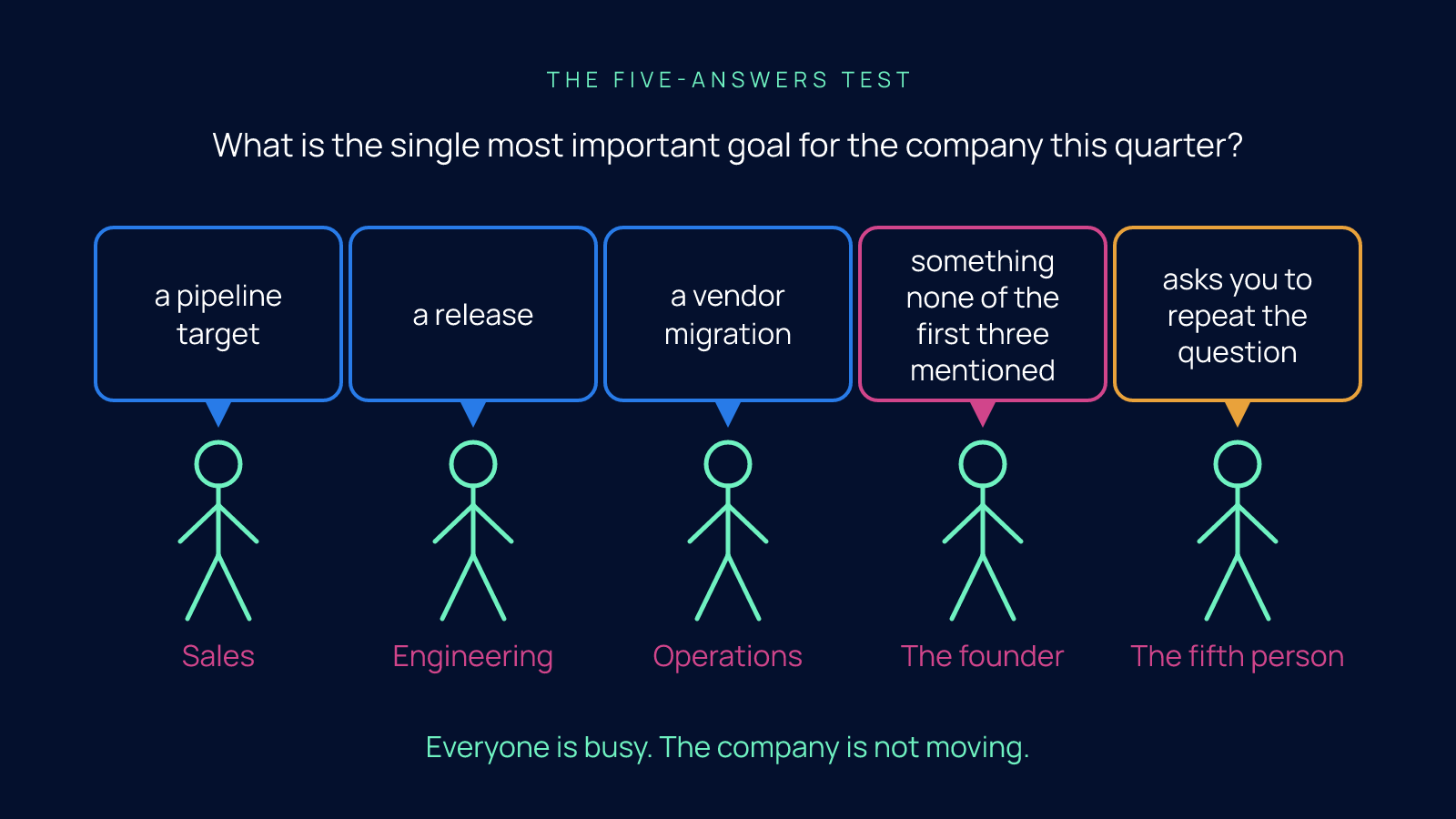
Now run the test I run with founders. Stop five people on that floor and ask each one the same question: what is the single most important goal for the company this quarter? You will get five answers. Sales names a pipeline target. Engineering names a release. Operations names a vendor migration. The founder names something none of the first three mentioned. The fifth person asks you to repeat the question.
That is the gap. Everyone is busy. The company is not moving. Activity without a shared target is motion, not movement, and most companies have confused the two for so long that they can no longer tell them apart.
This is Day 26 of the 30-day 8 Edges season, the second episode of Act 3, and the episode where Edge8 finally sets its own goals. We left that until now on purpose, and I will get to why. First, the beliefs that keep busy companies stuck, because the cure for the five-answers problem is not more effort. It is a different shape.
Myth one: a full calendar is progress
Activity without a shared target is motion, not movement.
Reality: a full calendar is a full calendar.
Founders fall for this one because busyness looks like health. Meetings happen, tickets close, the inbox empties and refills. Measure a company by how occupied people are and every company looks like it is winning.
But occupation is not direction. Ten people working hard in ten directions produce a lot of heat and very little distance. If your people cannot name the same top goal, they are not pulling on the same rope. They are each pulling on their own.
Progress is the distance between where the company stood at the start of the quarter and where it stands at the end, measured against a target everyone could name on day one. Anything else is motion.
Why Edge8 set its goals last, and why that is the point
Edge8 set its own goals last in the season, on purpose, because a goal system with no data underneath it is theatre.
Here is the confession the Day 26 script makes. Edge8 went through most of the season, the data layer and the workflows, before it set a single goal in the system. That looks backwards. Every leadership book says start with goals.
We did it in that order because a goal system with no data underneath it is theater.
Picture the usual version. Leadership goes offsite, writes goals on a whiteboard, someone types them into a slide. Then the quarter runs. Nobody can see whether the revenue goal is on track because the books are weeks behind. Nobody can see whether the talent goal is on track because the org chart was drawn for a board meeting and is already wrong. At the quarterly review, the owner of each goal reads out a status that is mostly a guess and partly a defense. Everyone nods. The slide gets updated. That is theater, and the audience knows it.
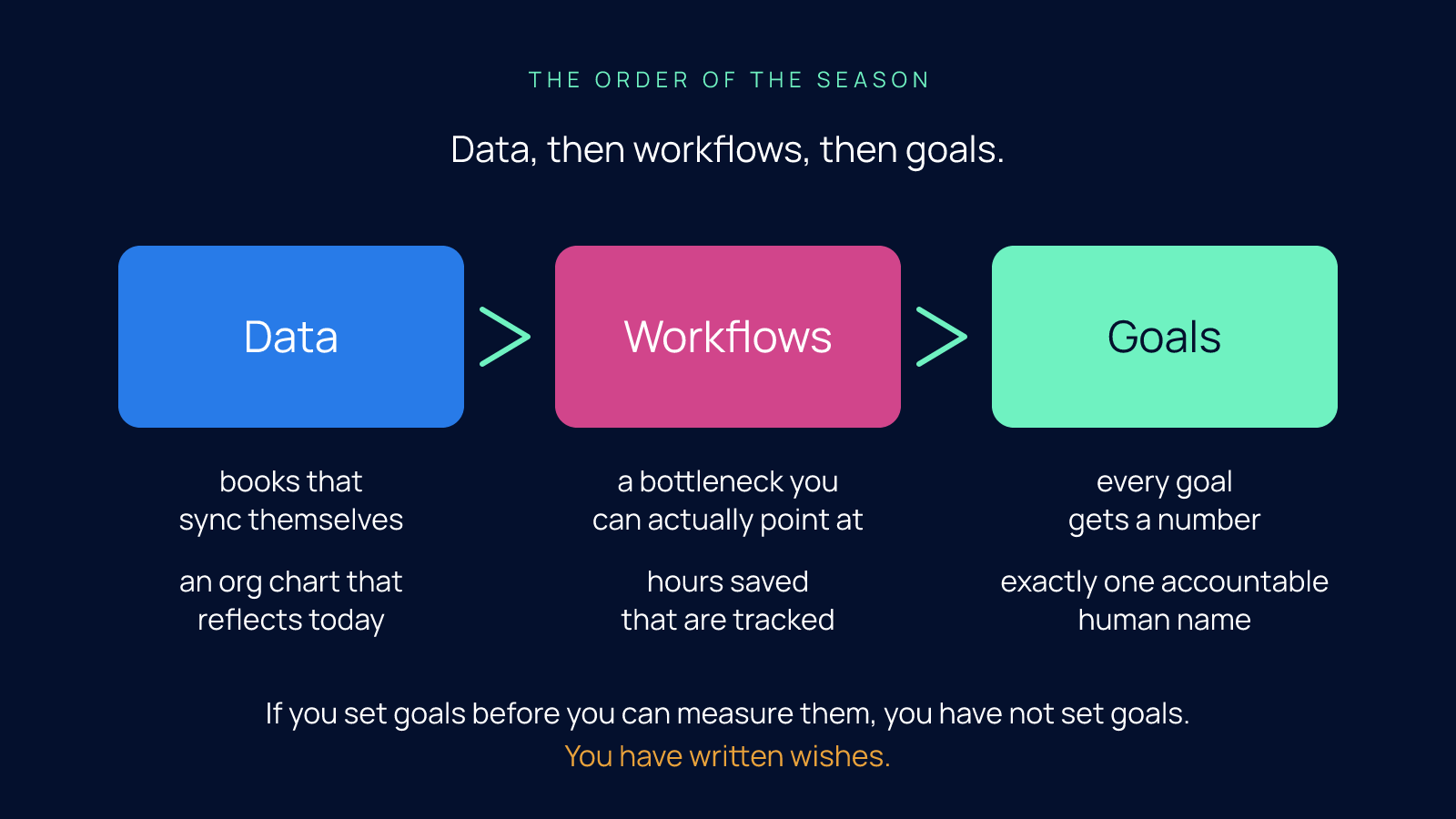
Day 2 of the season showed the goal tree as the cure for the execution gap. Day 26 returns to it once there is something real beneath it: books that sync themselves, an org chart that reflects today, a bottleneck you can actually point at, hours saved that are tracked rather than imagined. A goal that sits on live data can be checked on a Tuesday afternoon. A goal that sits on a slide can only be argued about.
So the order is not a quirk. Data, then workflows, then goals. If you set goals before you can measure them, you have not set goals. You have written wishes.
Myth two: more goals means more ambition
Reality: more goals means less of everything.
The strategist Richard Rumelt has a line I quote to founders more than any other: a long list of goals is not a strategy. Good strategy picks a few things and says no to the rest.
I see the opposite constantly. A company lists every priority it can think of for the quarter and calls it ambition. What it actually is, is an inability to choose. Every team gets a goal so nobody feels left out, and the result is the five-answers floor. When everything is a priority, nothing is, and the people doing the work end up making the strategic call the leadership team dodged. They pick whichever goal is loudest that week.
Saying no is the whole job. The founder who names a few things and kills the rest will move further in a quarter than the founder who names everything and funds it all a little. Few goals is not timidity. It is the only way the company can point.
Myth three: a goal without a number is still a goal
Reality: a goal without a number is an opinion.
John Doerr wrote the OKR playbook down in Measure What Matters. OKR stands for Objectives and Key Results. The objective is what you want to achieve, in plain words. The key result is the number that tells you, without debate, whether you achieved it. The rule that matters most from that book is simple: every goal gets a number.
Without the number, two people can read the same goal and disagree about whether it was hit. "Improve retention" is hit in the eyes of whoever is defending it and missed in the eyes of whoever is challenging it. Put a figure on it and the argument ends. You either reached it or you did not, and the conversation moves to why.
The number also does something quieter. It forces the person setting the goal to think about what success actually looks like before the quarter starts. Vague goals survive because they are comfortable. Numbered goals are uncomfortable on purpose.
Myth four: "do your best" brings out the best
Reality: specific, hard goals beat "do your best" every time.
This one is not my opinion. Locke and Latham spent decades studying what happens when people are given different kinds of goals, and the finding held across the research: people given a specific, difficult target outperform people told to do their best. Not sometimes. Consistently.
Founders resist this because a hard target feels like pressure and "do your best" feels like trust. But "do your best" gives a person nothing to aim at. They cannot tell whether they are ahead or behind, so they default to the pace of the room. A specific, hard goal tells them exactly where the bar is, and most people, given a clear bar, reach for it.
Ambitious does not mean impossible. It means the target is set where reaching it would matter, not where it is guaranteed.
The recipe, and what it looks like on the page
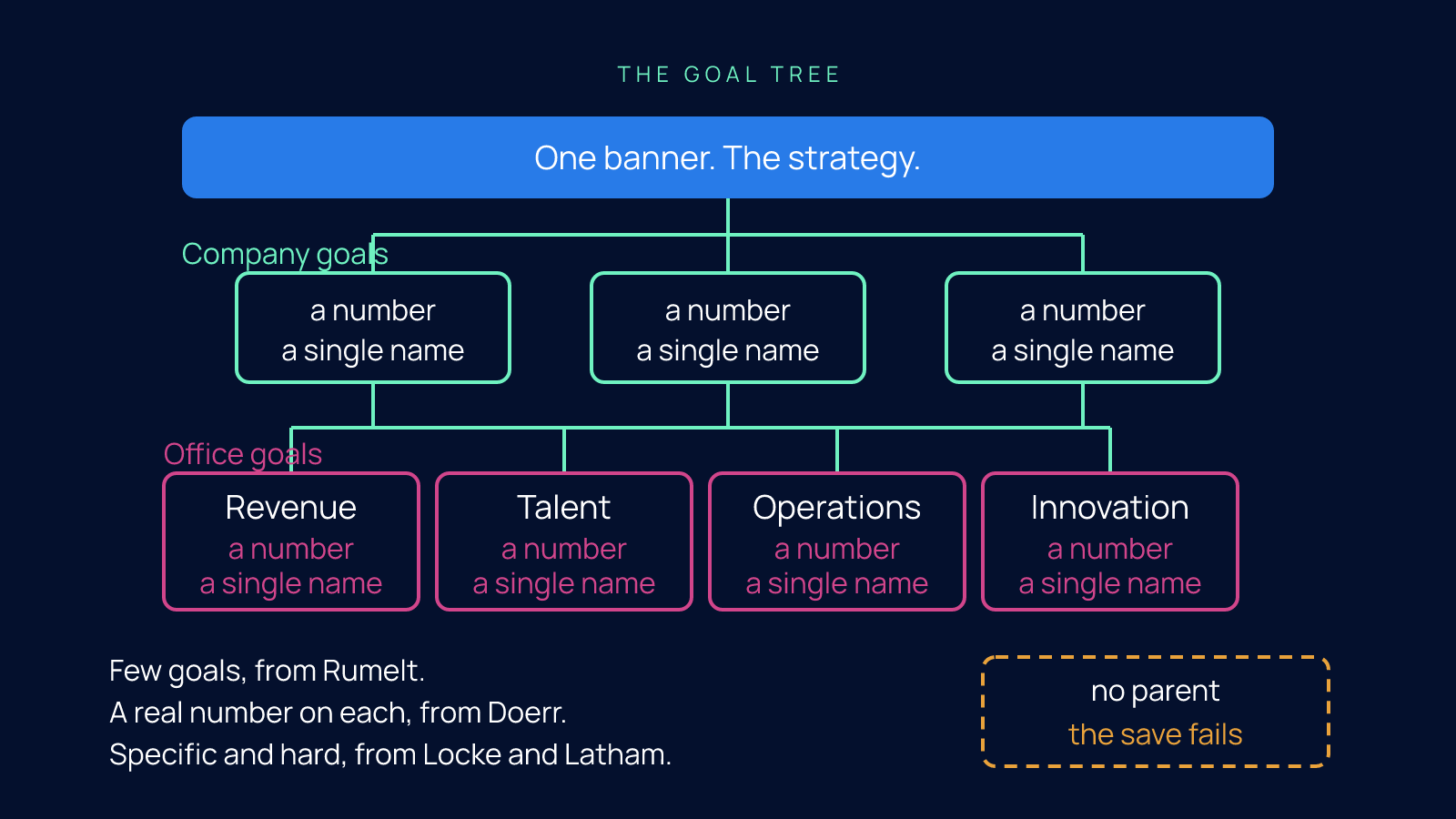
Put the three together and you get the recipe Edge8 runs on now. Few goals, from Rumelt. A real number on each, from Doerr. Specific and hard, from Locke and Latham.
In 8 Edges that recipe is the shape of the page. Open the goals view in our own Company OS, which is the operating system Edge8 built to run Edge8, and here is what you see.
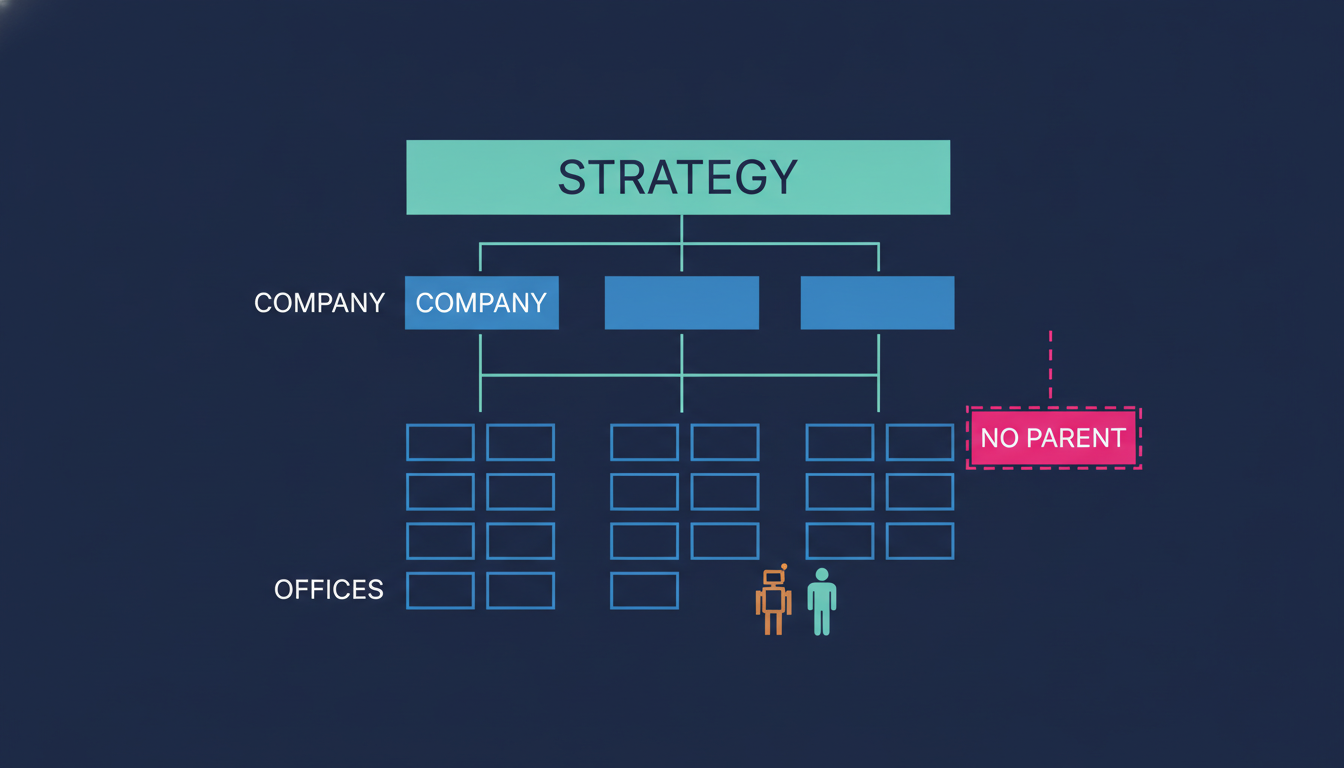
At the top, one banner. That is the strategy, the single statement of what the company is trying to become. Not a list. One line.
Beneath the banner sit the company goals. Few enough to count on one hand, and each one carries a target number.
Beneath those sit the office goals, one tier per team. Revenue, talent, operations, innovation. Every office goal hangs from a company goal above it.
On every goal, at every level, two things are fixed. A number, so you know whether you hit it. And exactly one accountable human name. Not a team, not a department, not "shared". One person.
And then the rule that holds the whole thing together. The system refuses to save a goal that does not connect to the level above it. Try to create an office goal with no parent and the save fails. A goal that cannot say which outcome it serves does not get set. Nothing floats free.
That rule sounds like a small piece of software behavior. It is actually the fix for the five-answers floor. If every goal must name the goal above it, and every goal above it must name the strategy, then every person on the floor can trace their own work up to the one banner. Ask five people the top goal and they may name their own office goal first, but they can all name the same thing it serves.
Myth five: if the agent does the work, the agent owns the goal
Every goal carries a number and exactly one accountable human name, including the goals where an agent does most of the work: agents execute, accountability never delegates to software.
Reality: agents execute. Accountability never delegates to software.
Some of the goals on our tree have an AI agent doing most of the execution. The agent drafts, sorts, follows up, moves the pieces. On the page, the agent sits right beside the person. It is visible, it is doing real work, and it has no name in the accountable slot.
That is deliberate, and it answers the two questions I ask of every AI claim. What did the AI just do? It executed the tasks that make up the goal. What does the person still decide? Everything that matters: which few goals the company picks, what number sits on each one, who holds the accountable name, and which outcome the goal serves.
A founder who lets accountability slide onto the software has not automated a goal. They have abandoned it. When the number is missed, "the agent was handling it" is not an answer anyone will accept, and it should not be. The human on the goal is the one who checks the agent, redirects it, and owns the result. The agent makes the human faster. It does not make the human optional.
Four outcomes, one strategy
When the recipe and the tree are both in place, something changes on the floor. Revenue, talent, operations and innovation stop being four teams pulling four ways. They become four branches of one strategy, each with few goals, each goal with a number, each number with a name.
Run the five-answers test on that floor and the answers converge. Not because people memorized a slide, but because the work they do each day is connected, by the system, to the thing at the top. That is the difference between motion and movement. The company is finally pointed somewhere, and everyone can see where.
What to do this week
Run the test. Stop five people and ask for the top goal of the quarter. Listen to the answers. If they do not match, you have the problem this episode is about, and no amount of extra effort will fix it.
Then watch the Day 26 film. It walks the goal tree in Edge8's own Company OS: the banner, the goals beneath it, the number and the single name on each, the agent beside the person, and the save that fails when a goal has no parent. It is the clearest picture I can give you of what few goals, real numbers and hard targets look like when they are built into the way a company runs rather than written on a wall.
Day 27 follows with the weekly meeting that keeps those goals pointed where they were set, because a goal tree you only visit at the quarterly review is a slide with better formatting.
If you want to see the goal tree running on your own data, reply and we will set up a demo of 8 Edges. Bring the five answers you heard on your floor. We will start there.
FAQ
How do I set goals that actually move my company when everyone is already busy and five people give five different answers about what matters most this quarter?
Start by admitting the five answers are the problem, not the effort: activity without a shared target is motion, not movement. Then change the shape of your goals instead of adding more work: pick a few goals, following Richard Rumelt's rule that a long list of goals is not a strategy; put a number on every one, the core rule of John Doerr's OKR playbook in Measure What Matters; and make each one specific and hard, which Locke and Latham found beats do your best consistently across decades of research. Finally, connect every goal to the level above it so each person on the floor can trace their work up to one strategy banner, and nothing floats free. Run the five-person test again at the end of the quarter and the answers should converge.
How many goals should my company set each quarter?
Few enough to count on one hand at the company level, each one carrying a target number and sitting under a single one-line strategy. Richard Rumelt's point is that good strategy picks a few things and says no to the rest; a company that lists every priority has not shown ambition, it has shown an inability to choose. Ten people working hard in ten directions produce a lot of heat and very little distance, and when everything is a priority the people doing the work end up picking whichever goal is loudest that week.
Should I give my team hard targets or just ask them to do their best?
Give them a specific, hard target with a number on it. Locke and Latham spent decades studying this and the finding held: people given a specific, difficult goal outperform people told to do their best, not sometimes but consistently. Without a number, two people can read the same goal and disagree about whether it was hit, which is why John Doerr's OKR rule in Measure What Matters is that every goal gets a number. Ambitious does not mean impossible; it means the target sits where reaching it would matter, not where it is guaranteed.
Who is accountable for a goal when an AI agent does most of the work?
Exactly one human, by name. On every goal at every level, two things are fixed: a number so you know whether you hit it, and one accountable human name, not a team, not a department, not shared. The agent sits beside the person on the page, drafts, sorts and follows up, and still has no name in the accountable slot. When the number is missed, the agent was handling it is not an answer anyone will accept; the human checks the agent, redirects it and owns the result.
Should I set company goals before or after I fix my company data?
After. A goal system with no data underneath it is theater: leadership writes goals on a whiteboard, nobody can check the revenue goal because the books are weeks behind, and the quarterly review becomes a status that is mostly a guess and partly a defense. That is why, in a 30-day season on running a company this way, goal setting waited until Day 26, after the data layer and the workflows existed. The order is data, then workflows, then goals, because a goal that sits on live data can be checked on a Tuesday afternoon, while a goal on a slide can only be argued about.