
Every founder I know keeps a someday pile. Innovation sits at the top of it. We will get to the new ideas when the quarter closes, when the migration is done, when things calm down.
Things never calm down. I have been running companies for a long time and I have never had a calm quarter. Neither have you. The someday pile is where innovation goes to wait, and waiting is the polite word for dying.
But the someday pile is a symptom, not the disease. Good ideas do not disappear in your company because they are bad, and they do not disappear because you are busy. They disappear because they have nowhere to live.
The idea is still in chat. Nobody will ever find it.
The real reason good ideas disappear is not that they are bad; it is that they have nowhere to live.
Picture it. Someone on your team notices that prospects keep asking the same question right before they sign, and she types a quick note into the team channel: what if we just put that answer on the pricing page? Two people react with a thumbs up. Someone types good call. Then a customer escalation lands, the thread moves on, and the idea sits under a full day of other messages.
Six months later nobody can find it. Not her, not her manager, not you. The pricing page still does not have the answer. Prospects are still asking.
Here is the part that should bother you more than the lost idea: she noticed. Someone close to the work saw a fix, took the trouble to say it out loud, and the company did nothing with it. Not because anyone disagreed. Because nothing in the company was built to catch it.
Silence teaches your team to stop suggesting things
A company that lets ideas scroll away is not neutral about innovation. It is training people out of it.
Every time a suggestion gets a couple of reactions and no follow-up, the person who posted it learns something: this is not worth my time. They do not say it. They do not complain. They just stop. The next time they see the waste, they work around it quietly and keep their head down. Multiply that across your whole team for a year and you get a company that looks calm and is actually silent.
You did not decide to run a company where nobody suggests anything. You just never gave the suggestions a place to go, and your people drew the obvious conclusion. Own that failure, because it is the one you can fix.
Kaizen and Lean Startup agree on one thing
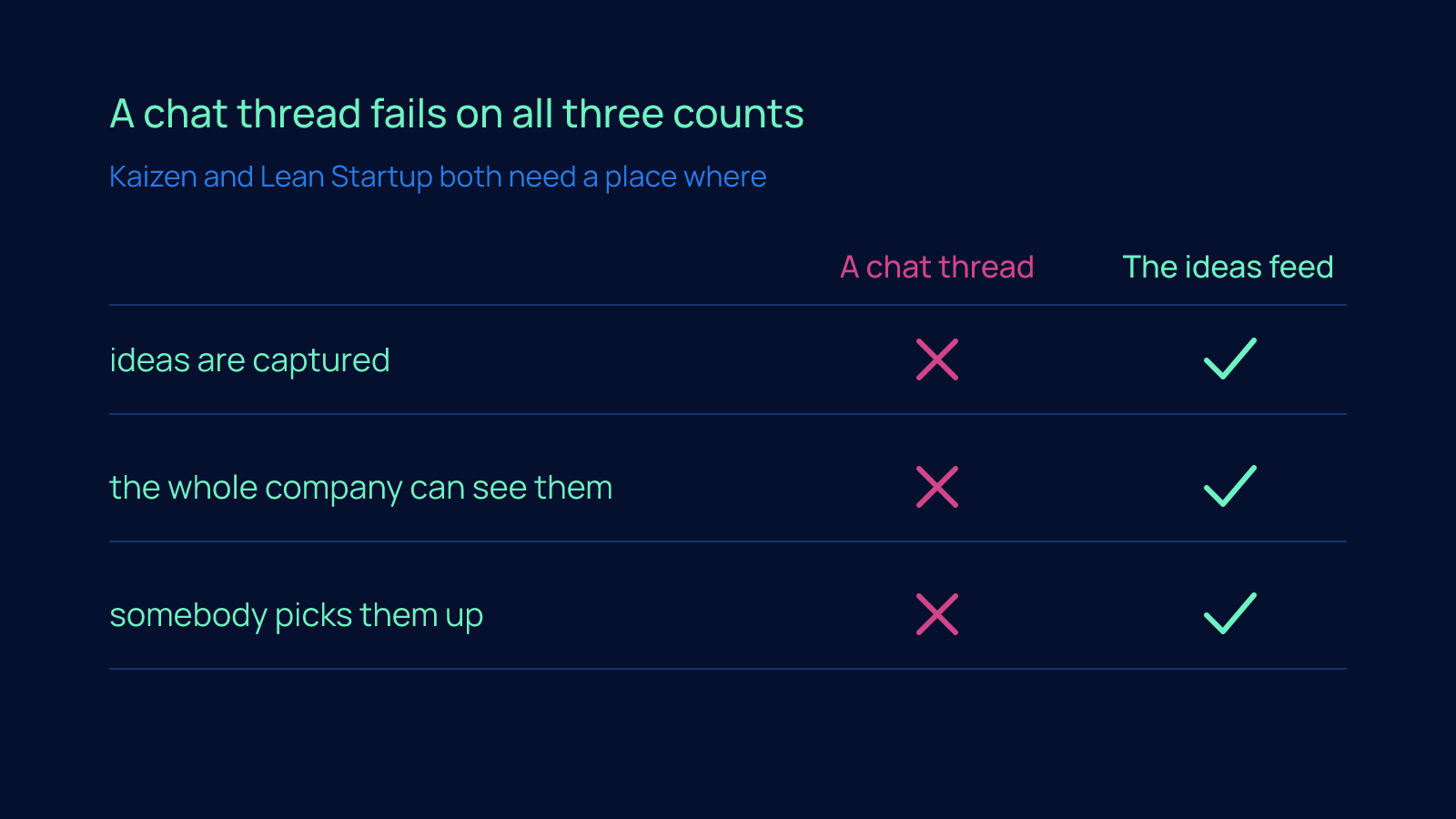
Both depend on one thing the chat thread cannot provide: a place where ideas are captured, seen by the whole company and picked up.
Two frameworks have been telling us what to do about this for years. They come from different worlds and land on the same requirement.
Kaizen is the Toyota idea. In plain language: improvement comes in small steps, and it comes from the people closest to the work, because they see the waste first. The person on the line sees the wasted motion before the plant manager does. The salesperson hears the pricing question before the founder does. Kaizen says do not wait for a big initiative. Let the person who sees the problem fix a small piece of it, then another.
Lean Startup is Eric Ries. Also plain: do not debate an idea in a meeting, test it. Build the smallest version that could work, measure what happens, learn, and go again. Opinion is cheap. Evidence is what you want.
Here is what both quietly depend on. Kaizen only works if the person closest to the work has somewhere to put what they see. Lean Startup only works if someone can look across all the ideas and pick what to test next. Both need a place where ideas are captured, where the whole company can see them, and where somebody picks them up.
A chat thread fails on all three counts. It captures nothing you can find later. It shows the idea only to whoever happened to be online that hour. And nobody owns the next step, so there is no next step.
A suggestion box nobody opens is not a home
Before you tell me you already have an ideas channel, or a form, or a column on a board somewhere: be honest about whether anyone opens it.
The test for a real home is three questions. Can anyone in the company post without asking permission? Can everyone see what everyone else posted, not just leadership? Does leadership look at it on a rhythm and decide something, out loud, where the poster can see it? A no on any of them means you have a suggestion box with the lid shut. It teaches the same lesson chat does, just more slowly.
Inside the ideas feed in Edge8's own Company OS
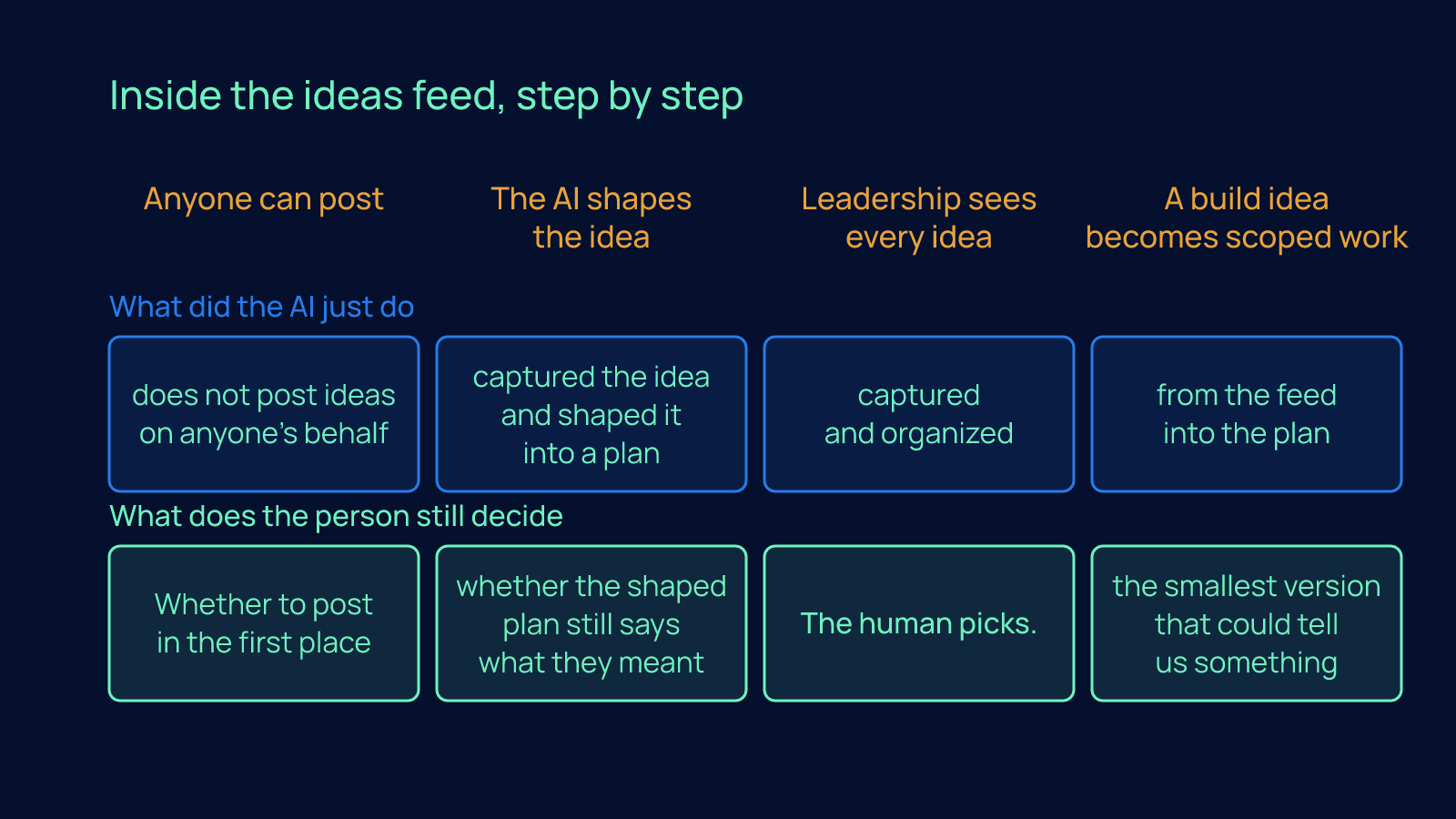
Day 25 of the 30-day 8 Edges season walks through the ideas feed as it runs inside Edge8's own Company OS. Not a mockup. The one we use every week. Here is what it does, step by step, with the line I draw in every episode: what did the AI just do, and what does the person still decide.
Anyone can post
The feed is company-wide. There is no gate and no approval step. If you are on the team and you noticed something, you post it. That is the Kaizen half: the people closest to the work see the waste first, so they have to be able to speak without friction.
The person decides to post. Nothing goes into the feed unless a human put it there.
Two kinds of post: build ideas and learnings
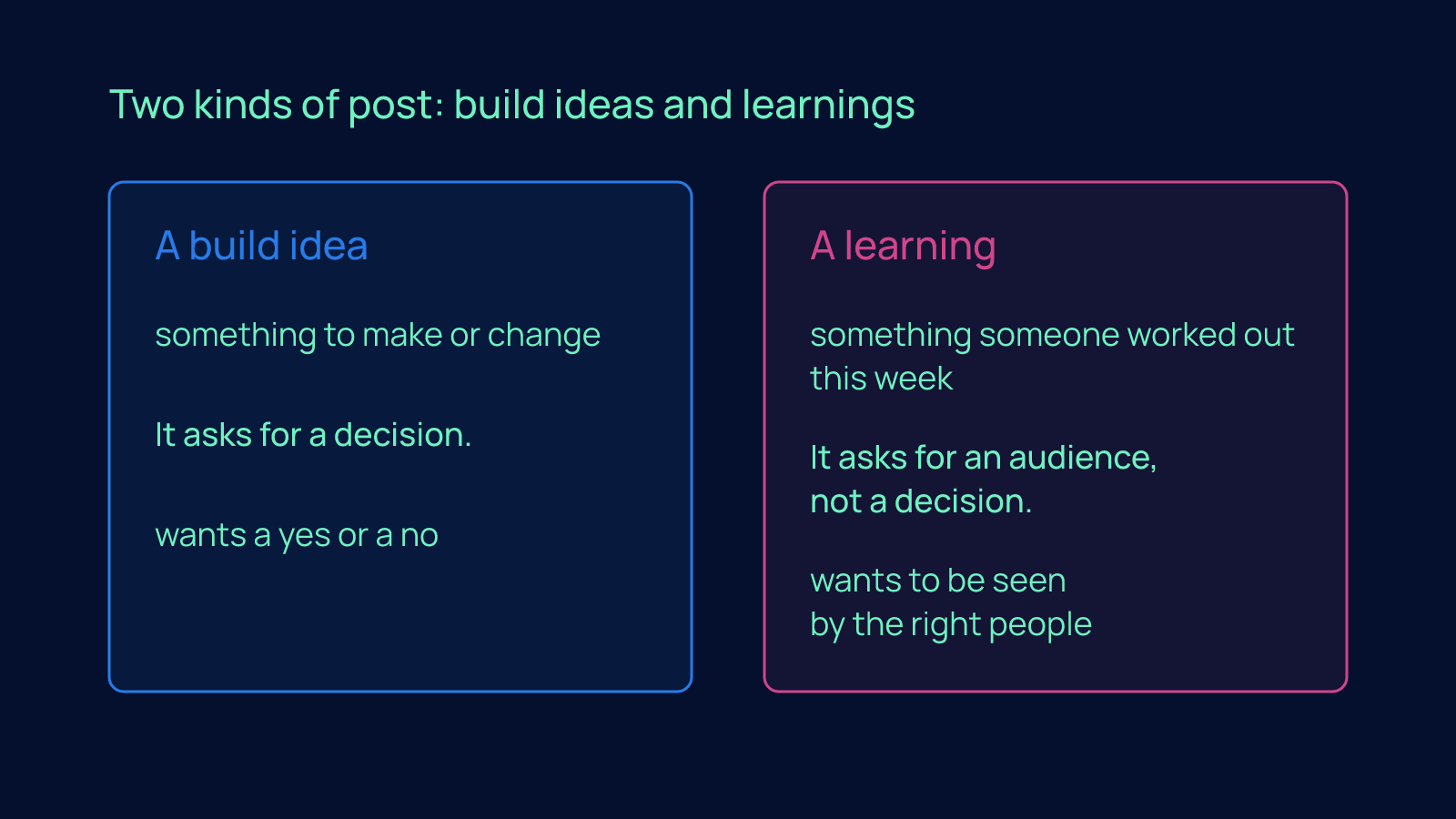
Every post is one of two things.
A build idea is something to make or change: a page, a workflow, a step in a process, a tool we should stop using. It asks for a decision.
A learning is something someone worked out this week that everyone else should know: a phrase that landed with a client, a setting that saved an afternoon, a mistake not to repeat. It asks for an audience, not a decision.
The split matters more than it sounds. A build idea wants a yes or a no. A learning just wants to be seen by the right people. Mix them in one channel and the learnings bury the build ideas while the build ideas make the learnings feel like homework. Separating them is how both survive.
The AI shapes the idea. The person decides what it says.
The AI captures and shapes; a human decides what gets built.
When someone posts a build idea, the AI shapes it into a real plan: what problem it solves, who it is for, what the smallest version looks like, what it would take to try. A one-line suggestion comes out the other side as something leadership can actually evaluate.
So, the two questions. What did the AI do? It captured the idea and shaped it into a plan. What does the person decide? Whether to post in the first place, and whether the shaped plan still says what they meant. The AI does not post ideas on anyone's behalf, does not rank them by importance, and does not decide which ones matter.
Leadership sees every idea in one admin view
Every idea lands in one admin view. Leadership can filter by kind, build ideas or learnings, and read the whole picture of what the company is noticing. Nothing is scattered across channels. Nothing has to be remembered. Nothing scrolls away.
This is the part a chat thread can never give you, and it is the part Lean Startup needs: someone looking across the whole set of ideas and choosing what to test next. The AI captured and organized. The human picks.
A build idea becomes scoped work
When leadership picks a build idea, it becomes scoped work: the smallest version that could tell us something, assigned and tracked, so the person who posted it watches their idea move from the feed into the plan. That is build, measure, learn, running inside a company instead of inside a book.
And the person who posted it just learned the opposite lesson from the one chat teaches. Suggesting things is worth doing.
An innovative culture is what you get when every idea has a home
Culture is not a value on the wall. It is what people learn from what happens after they act. Post an idea and watch the thread move on, and you learn silence. Post an idea and watch it get captured, shaped, seen by leadership, and either tested small or answered, and you learn to keep posting.
That is the whole thesis. Innovation is not a project you will start when things calm down. It is the simple, repeatable fact that in your company, ideas have somewhere to go and someone picks them up. Give every idea a home and you do not need an innovation program. You have an innovative culture.
Where this sits in the season
Act 2 closed on Day 24 with the hours given back by the operations workflows, and an open question: where does that time go? Day 25 opens Act 3, the act where the rebuilt company runs, and answers with the fourth outcome. Some of that time goes into the ideas feed, the first of the operating rhythms. Day 26 turns to goal setting.
Your next step
Watch the Day 25 film and see the ideas feed run inside our own company, build ideas and learnings included.
Then do one uncomfortable thing. Scroll back through your team chat and find the last good idea someone posted. Check whether anything happened to it. If the answer is nothing, that is the lesson your team has been learning.
If you want to see what a home for ideas looks like inside your company, book a demo of 8 Edges. Or reply to this post and tell me where your last good idea died. I read every reply, and I will tell you straight whether 8 Edges is the right home for it or whether you need something else first.
FAQ
How do I stop good ideas from dying in chat so my team keeps suggesting improvements instead of quietly giving up?
Give every idea a home outside the chat thread: a company-wide feed anyone can post to without permission, that everyone can see, and that leadership reviews on a rhythm and decides on out loud. In chat, a suggestion gets two thumbs-up reactions, then a customer escalation lands and six months later nobody can find it, not the person who posted it, not her manager, not you. Each time that happens the poster learns suggesting is not worth their time and stops, so the fix is a place where ideas are captured, seen and picked up, and the person who posted watches it turn into scoped work.
Why do Kaizen and Lean Startup not work in my company even though everyone has read the books?
Both frameworks quietly depend on the same thing: a place where ideas are captured, where the whole company can see them, and where somebody picks them up. Kaizen, the Toyota idea, needs the person closest to the work to have somewhere to put what they see; Lean Startup, from Eric Ries, needs someone who can look across all the ideas and choose what to test next. A chat thread fails on all three counts, because it captures nothing you can find later, shows the idea only to whoever was online that hour, and assigns nobody the next step.
Should employee improvement ideas and lessons learned go in the same channel?
No. Separate them into two kinds of post: a build idea, something to make or change that needs a yes or no from leadership, and a learning, something someone worked out this week that everyone should know and that needs an audience, not a decision. Mix them in one channel and the learnings bury the build ideas while the build ideas make the learnings feel like homework. Keeping the two kinds apart, and letting leadership filter by kind in one admin view, is how both survive.
How do I know whether my employee suggestion box is actually working or just a channel nobody opens?
Run the three-question test. Can anyone in the company post without asking permission? Can everyone see what everyone else posted, not just leadership? Does leadership look at it on a rhythm and decide something out loud where the poster can see it? A no on any of the three means you have a suggestion box with the lid shut, and it teaches your team the same silence a chat thread does, just more slowly.
What should AI do with my team's ideas and what should I still decide myself?
The AI captures each idea and shapes a one-line build idea into a real plan: what problem it solves, who it is for, what the smallest version looks like, and what it would take to try, then organizes everything into one admin view. The person decides whether to post in the first place and whether the shaped plan still says what they meant, and leadership decides which idea gets tested and what gets built. The AI does not post on anyone's behalf, does not rank ideas by importance, and does not pick which ones matter; this is the setup running every week inside the company shown on Day 25 of the 30-day season.