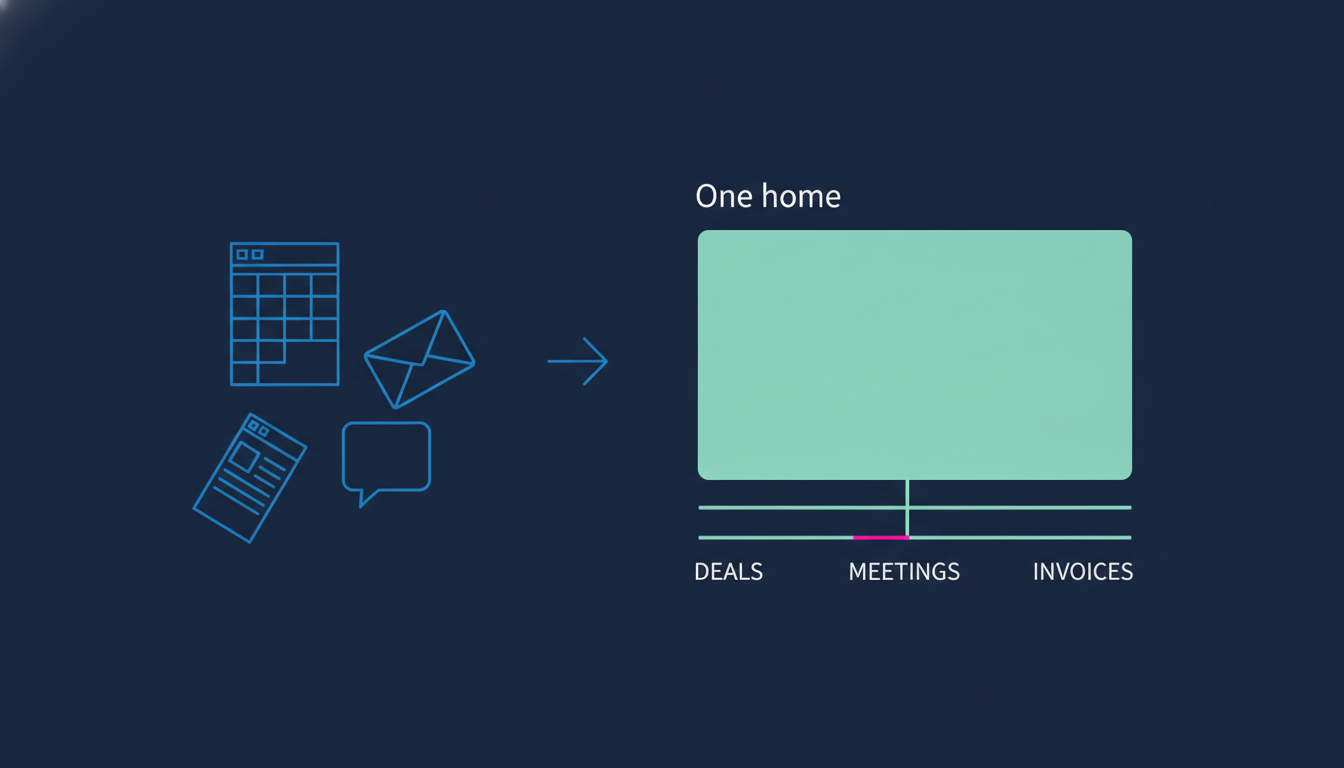
Ask a simple question in your company this week. Where does the deal we have been working for a month actually stand?
Then watch what happens. Someone pings the account lead. The account lead opens a spreadsheet, then asks ops to check a second one. Ops points to an email thread that the person who asked is not on. Three people and two spreadsheets later, you have an answer, and you are only mostly sure it is right.
Nobody lied. Nobody was lazy. The information exists. It just lives in so many places that nobody can see the company they are running.
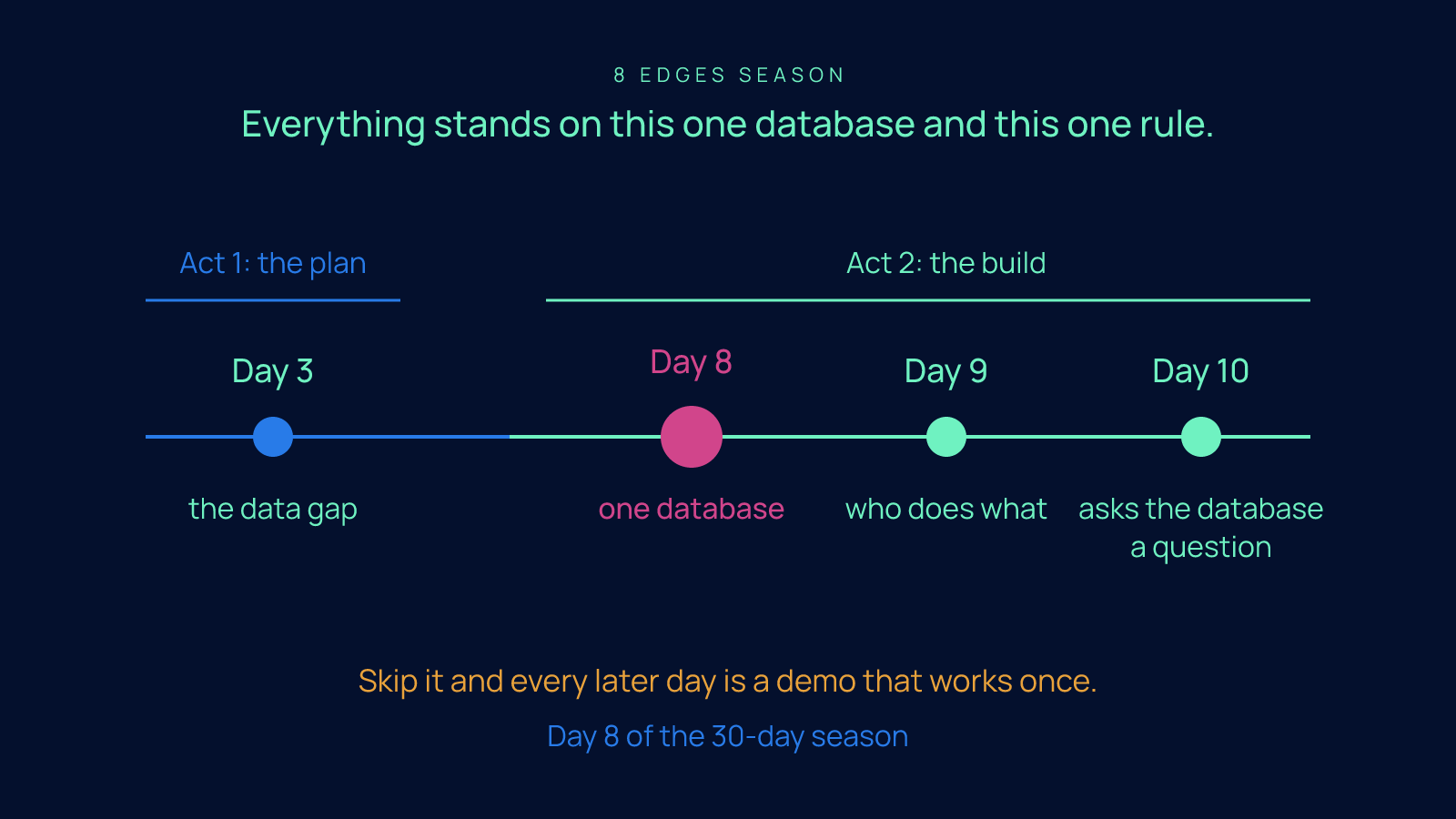
This is Day 8 of the 30-day 8 Edges season and the first day of Act 2, the build. Act 1 ended with the plan. Now the foundation goes in, and the first piece of it is the data gap Day 3 diagnosed: before any workflow, any agent or any dashboard, there is one database. Most founders skip it, and they skip it because of a handful of myths that sound reasonable until you look at them. Here they are, one at a time.
Myth one: you cannot see your company because your people are sloppy
It is a places problem, not a people problem.
The instinct when the deal question takes three people is to fix the people. Send the note about updating the CRM. Hold the meeting about discipline. Assign someone to chase everyone.
It works for a while, then it drifts back, and the founder concludes the team does not care.
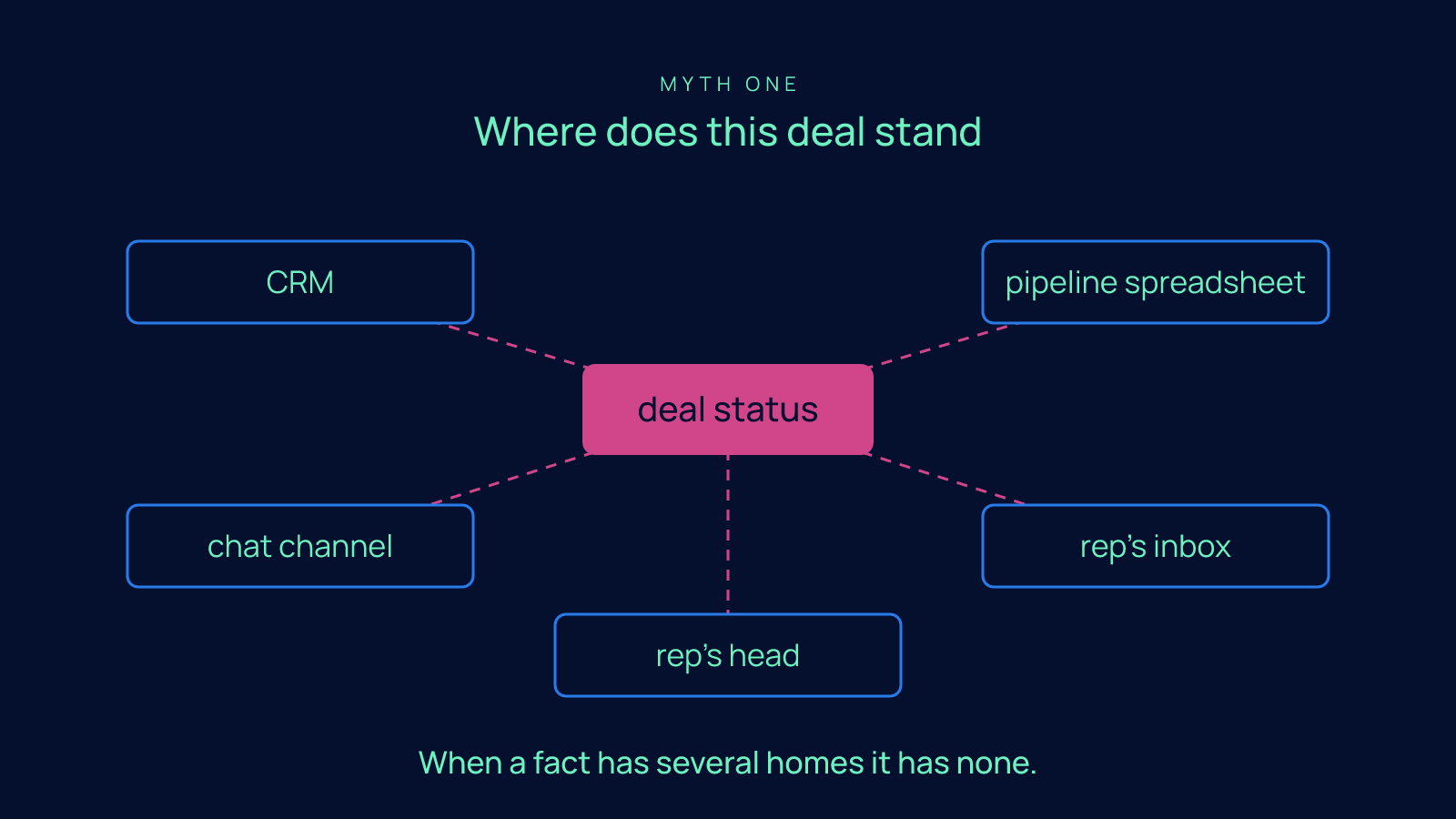
The team does care. The problem is that the fact has several legitimate homes. The deal status can live in the CRM, the pipeline spreadsheet, the chat channel, the rep's inbox and the rep's head, and every one of those is a reasonable place to put it. When a fact has several homes it has none. You cannot fix that with a reminder, because the reminder does not remove the other places.
It is a places problem, not a people problem. Fix the places and the people problem mostly disappears. Fix the people and the places problem comes right back.
Myth two: a single source of truth is a big data project
Say "single source of truth" to a technical leader and many of them hear a warehouse project: a copy of data pulled from every system into one reporting layer, with a long and expensive integration effort behind it. Say it to a founder and they hear dozens of tools taped together with connectors.
Neither is what I mean, and neither is what Edge8 runs on.
A single source of truth, in plain words, is one place where a fact lives, and everywhere else points at it. For a company that means one database. Not a reporting copy of your tools. The actual system of record for the whole business. In it, a customer is one record. A person is one record. A deal is one record. Everything that happens to a customer, a person or a deal attaches to that one record: the meeting, the note, the proposal, the invoice, the complaint.
That is the whole framework. It is old and it is boring, and it is boring on purpose. The moment it gets clever, with a dozen systems syncing to each other, you are back to several homes for one fact and a new argument about which one is right.
Myth three: "if it is not in the system, it did not happen" is too harsh
The rule that changed Edge8 more than any technology is simple: if it is not in the system, it did not happen.
Here is the rule that changed Edge8 more than any technology we have adopted: if it is not in the system, it did not happen.
Founders push back on this one every time. It sounds rigid. It sounds like it punishes the rep who closed a deal on a phone call and simply has not typed it in yet.
So let me be honest about what the rule costs. The deal sitting in an inbox does not exist. The customer feedback shared in a hallway does not exist. The commitment made on a call and never logged does not exist. As far as the company is concerned, none of it happened, and the company will plan, forecast and staff as if none of it happened.
That is harsh. It is also the exact moment the company becomes visible.
Because here is what the rule buys. When every fact has one home, the question "where does this deal stand" has one answer, and you get it by looking, not by asking. The founder sees the same company the rep sees, which is the same company ops sees. Nobody has to be interrupted. Nobody has to reconstruct the truth from memory. The rule is harsh on the day you adopt it and generous every day after.
Myth four: AI will read across all your tools anyway
This is the one that costs the most, because it lets a founder skip the foundation and go straight to the fun part.
The pitch sounds like this: the AI will connect to the CRM, the email, the spreadsheets and the chat tool, read everything, and tell you where the deal stands. Why build one database when the model can just read all of them?
Think about what you are actually asking for. If the deal is in three places with three different statuses, the AI reads three different answers. It will pick one. It will sound confident. You will trust it until the day it is wrong on the deal that matters, and then you will trust it on nothing.
Stanford's Digital Economy Lab studied successful AI deployments and found that very few of the companies they looked at had data that was ready for AI at all. Not that the models were weak. Not that the teams lacked ideas. The data was not ready. A small club of companies had it, and most did not.
The rule is the entry fee to that club. AI can only see what has one home. Put every fact in one place and the model reads the company as it actually is. Leave the facts scattered and the model reads a rumor.
Myth five: this is a software decision for the CTO
It is a leadership commitment, not a software feature.
The software is the easy part. I mean that. The tables, the fields and the records are well-defined work for the right engineer, and we will walk through Edge8's own in a moment.
The hard part is the commitment, and it cannot be delegated down.
A single source of truth holds only as long as the leader refuses the other answers. The day the CEO accepts "let me check my email" as a status update, the rule is dead and everyone knows it. The day the founder keeps a private spreadsheet because the system is "not quite right yet," the rule is dead. The person at the top has to look only at the system, ask only the system, and send people back to the system when they bring the answer from somewhere else.
That is a leadership commitment, not a feature. Whoever owns the data layer keeps the records clean and builds what sits on top. They cannot make the founder care. Only the founder can do that, and it is the first thing I look for in any company that wants to build on its data, because an engineer building the data layer in a company without the rule is building on sand.
What it looks like inside Edge8
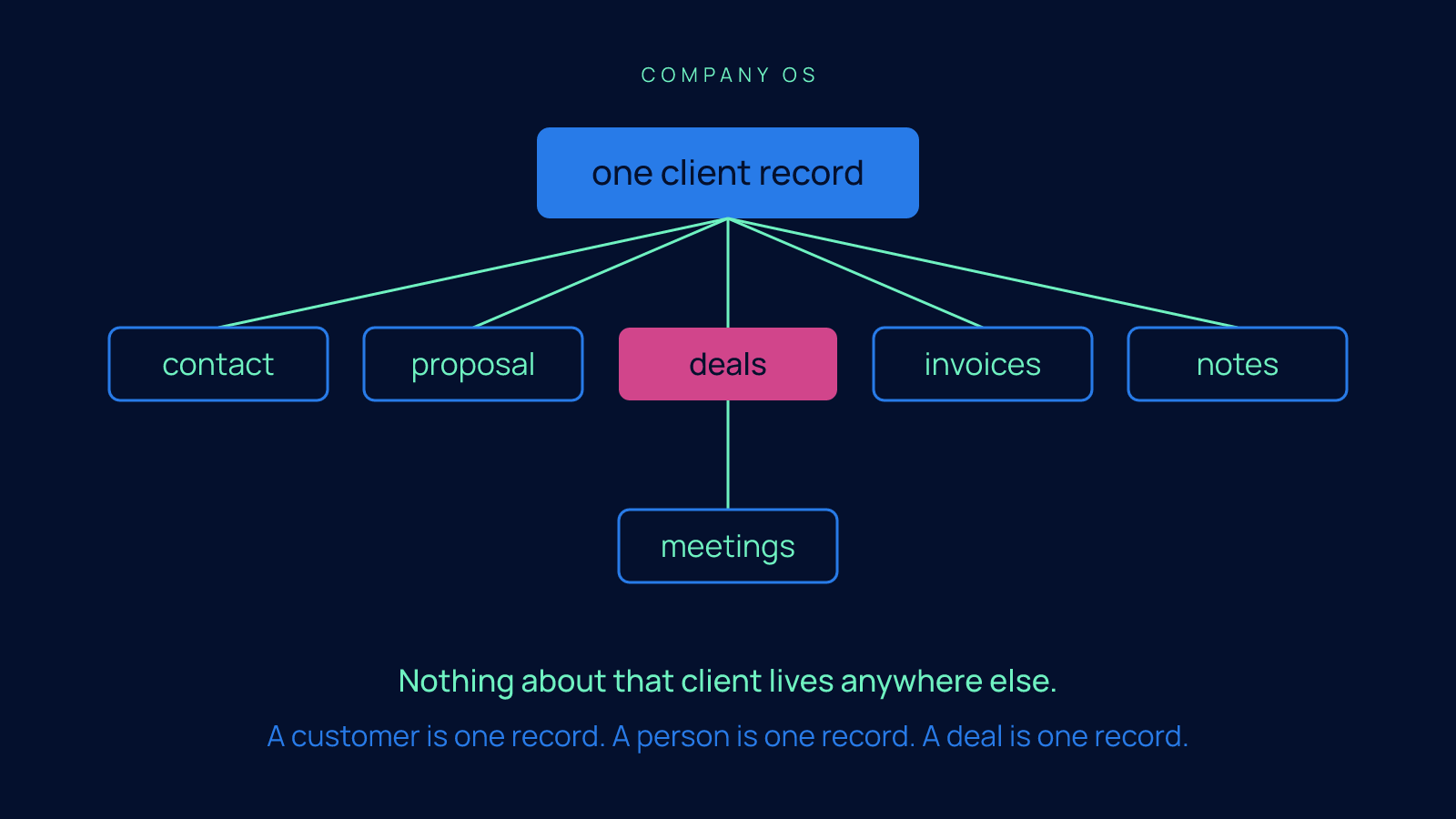
Inside the 8 Edges season we are building on Edge8's real company, not a demo. At the time of recording, Edge8's own database holds its tables, its people, its companies and its deals in one place. That is the whole Company OS at this stage. No warehouse, no sync jobs, no second copy.
Open one client record and you see its deals. Under those deals, every meeting we have had with them. Alongside, every invoice we have sent them. The contact, the proposal, the notes from the last call all hang off the same record. Nothing about that client lives anywhere else, because the rule says it cannot.
Now the two questions I ask of every AI claim.
What did the AI just do? It read every record attached to that client. Every deal, every meeting, every invoice, in one pass, because they are all in one home.
What do the people still decide? What those facts mean and what to do about them. Whether the quiet client is drifting away or just busy. Whether the stalled deal needs a call, a different offer or a graceful exit. The AI sees the company. The people run it.
That division only works because of the first part. If the records were scattered, the AI would not be reading the client. It would be reading one of several versions of the client, and the people would be deciding on bad information.
Why the foundation is boring on purpose
Nobody will share Day 8 because it is thrilling. It is a database with people, companies and deals in it, and a rule about using it. That is the point.
Day 9 writes down who does what, which is only possible when the work is visible in one place. Day 10 asks the database a question, and it gets an answer because of what Day 8 built. Everything we build in the weeks ahead, every workflow, every agent, every customer-facing piece, stands on this one database and this one rule. Skip it and every later day is a demo that works once.
If you cannot answer the deal question by looking, you do not have a people problem. You have a places problem, and the fix is older and simpler than anything an AI vendor will sell you.
The next step
Watch the Day 8 film and see the Company OS open on a real client record. Then reply to this post, or email me directly, and tell me one of two things: that you want to see the Company OS for yourself, or that you want to talk about who in your company should own the data layer before anything gets built on top of it. Either way, we start with where your facts live today.
FAQ
How do I build a single source of truth for my company when finding out where one deal stands takes three people, two spreadsheets and an email thread?
Start with one database that is the actual system of record for the whole business, not a reporting copy of your tools. In it a customer is one record, a person is one record and a deal is one record, and everything that happens to them (the meeting, the note, the proposal, the invoice, the complaint) attaches to that one record. The three-person, two-spreadsheet answer happens because the deal status has several legitimate homes, the CRM, the pipeline spreadsheet, the chat channel, the rep's inbox and the rep's head, and when a fact has several homes it has none. Fix the places and the people problem mostly disappears.
Do I need a data warehouse to get a single source of truth, or is there a simpler way for a small company?
You do not need a warehouse. A warehouse is a copy of data pulled from every system into one reporting layer with a long integration effort behind it, while a single source of truth is one place where a fact lives and everywhere else points at it. For a company that means one database with no sync jobs and no second copy. The moment it gets clever, with a dozen systems syncing to each other, you are back to several homes for one fact and a new argument about which one is right.
Should I enforce a rule that only what is logged in the system counts, even if it feels harsh on my sales reps?
Yes, and be honest about what it costs: the deal sitting in an inbox does not exist, the feedback shared in a hallway does not exist, and the company will plan and forecast as if none of it happened. What it buys is a company that is visible. When every fact has one home, the question of where a deal stands has one answer and you get it by looking, not by asking three people. The rule is harsh on the day you adopt it and generous every day after.
Why can't AI just read across my CRM, email and spreadsheets instead of me building one database first?
Because if the deal is in three places with three different statuses, the AI reads three different answers, picks one, and sounds confident until the day it is wrong on the deal that matters. Stanford's Digital Economy Lab studied successful AI deployments and found that very few of the companies they looked at had data that was ready for AI at all; the models were not weak and the teams did not lack ideas, the data was not ready. AI can only see what has one home. Put every fact in one place and the model reads the company as it actually is; leave the facts scattered and it reads a rumor.
Who should own the single source of truth in my company, the CTO or the founder?
The software is the easy part: the tables, the fields and the records are well-defined work for the right engineer, and whoever owns the data layer keeps the records clean and builds what sits on top. The commitment is the hard part and it cannot be delegated down, because the day the CEO accepts a private spreadsheet or an email check as a status update, the rule is dead and everyone knows it. That is why this one database comes first, on Day 8 of a 30-day build, before any workflow, any agent or any dashboard. An engineer building the data layer in a company without the rule is building on sand.