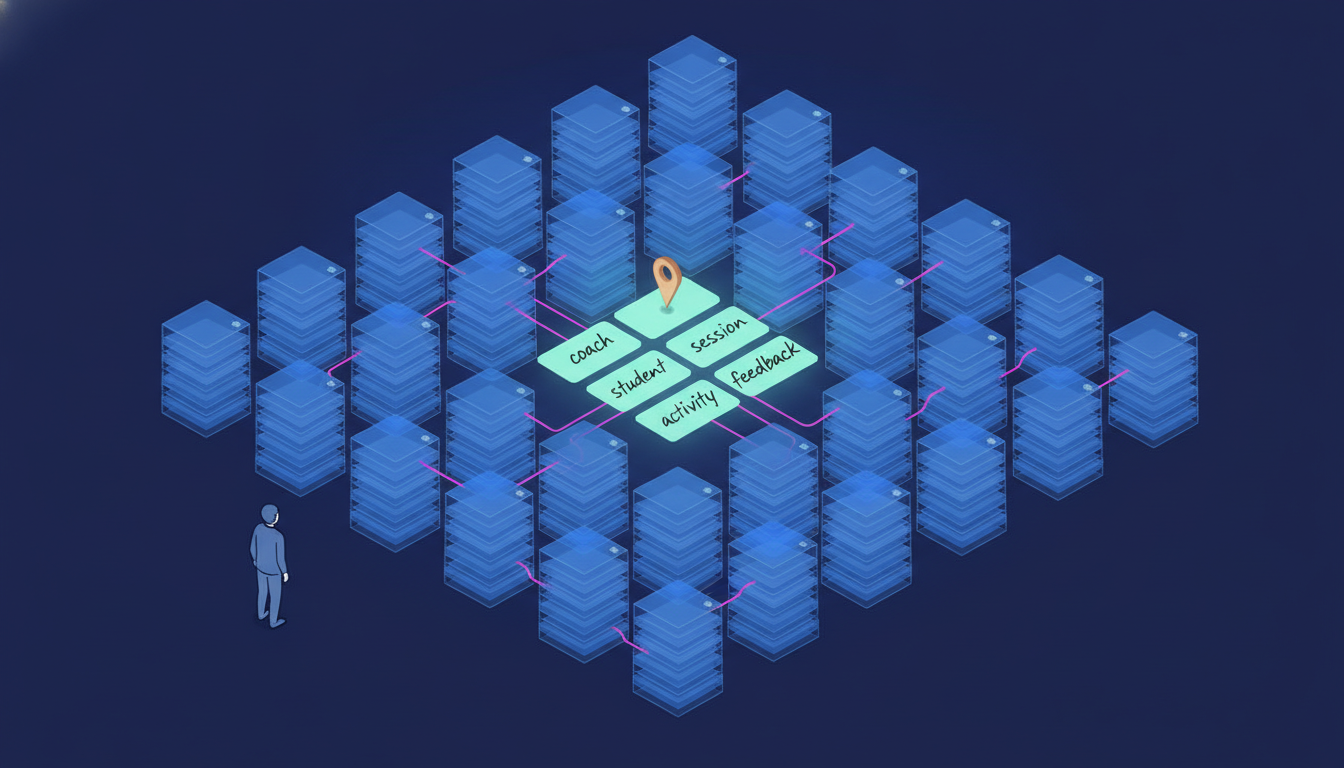
My friend Justin Parkes runs Parkes Performance Coaching in Ho Chi Minh City, and the thing he is genuinely great at is analysis: watching an athlete move and seeing what their body is doing that nobody else would catch. That is his edge. Until this week, it lived almost entirely in his head.
So that is what we are building around. A new student comes in and gets assessed. The assessment becomes a video that shows the coach exactly where that person is today. The coach plans from it. On the day, they record, assess and analyse, and the loop keeps running on the off days. In between, every student gets coaching that is personal to them: a prompt to book an InBody scan, upload their Whoop data or log their tennis, whatever their sport and goals call for.
Here is the part founders do not expect: almost none of that is custom. Around 120 tables covers roughly 80% of what almost any company actually does. Justin's coaches, students, sessions and invoices have the same shape as everyone else's. The 20% that is his, the analysis, is where the build effort goes. That rule is why his system was in front of him fast, and it answers the question every founder asks in week one: how big is this thing going to be?
First, what a table is, in plain language
A table is a list of one kind of thing your business cares about. One table for people. One for companies. One for invoices. Each row is one person, one company, one invoice, and each column is a fact about it: name, email, amount, date. A database is just a set of these lists that know how they connect to each other. An invoice points to a customer. A session points to a coach and a student. That is the whole idea.
When founders hear "database design" they picture something only an engineer can touch. It is not. It is a description of how your business works, written as lists that point at each other. I have been building systems that move data around since my first job at Microsoft, and the truth has not changed: if you can draw your business on a napkin, you can understand your schema (the map of which tables exist and how they connect).
The Pareto principle, applied to your data
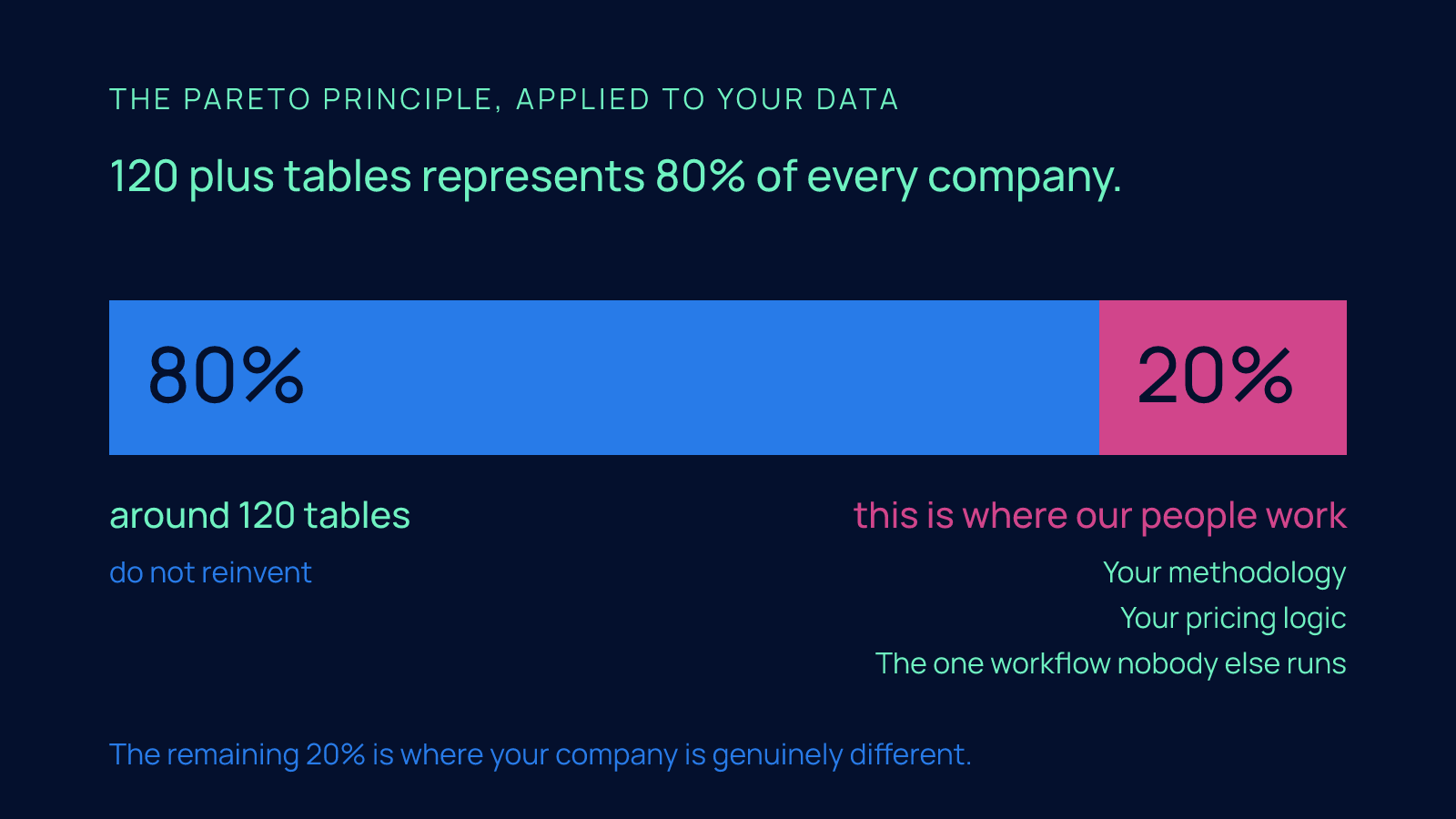
And so in Edge8, we believe that 120 plus tables actually represents 80% of every company.
You know the 80/20 rule. Roughly 80% of the outcome comes from roughly 20% of the causes. It is called the Pareto principle, and it shows up in revenue (a fifth of the customers pay most of the bills), in support tickets, in which features anyone actually uses.
At Edge8 we apply it to database design, and the claim is specific: 120 plus tables represents 80% of every company.
Not 80% of a software company, or 80% of a services company. Every company. Because underneath the branding and the industry vocabulary, businesses do the same handful of things. They have people inside and people outside. They sell something to someone. They schedule work, do the work, record what happened, bill for it, and follow up. They set goals, assign tasks, and check whether the tasks got done. Each of those is a table or a small cluster of tables, and when you lay them all out you land in the same neighborhood every time: a bit over a hundred.
The remaining 20% is where your company is genuinely different. Your methodology. Your pricing logic. The one workflow nobody else runs. That part is worth custom effort. The 80% is not, and the mistake almost every company makes is spending its first months rebuilding the 80% from scratch as if it were special.
What the 120 actually look like
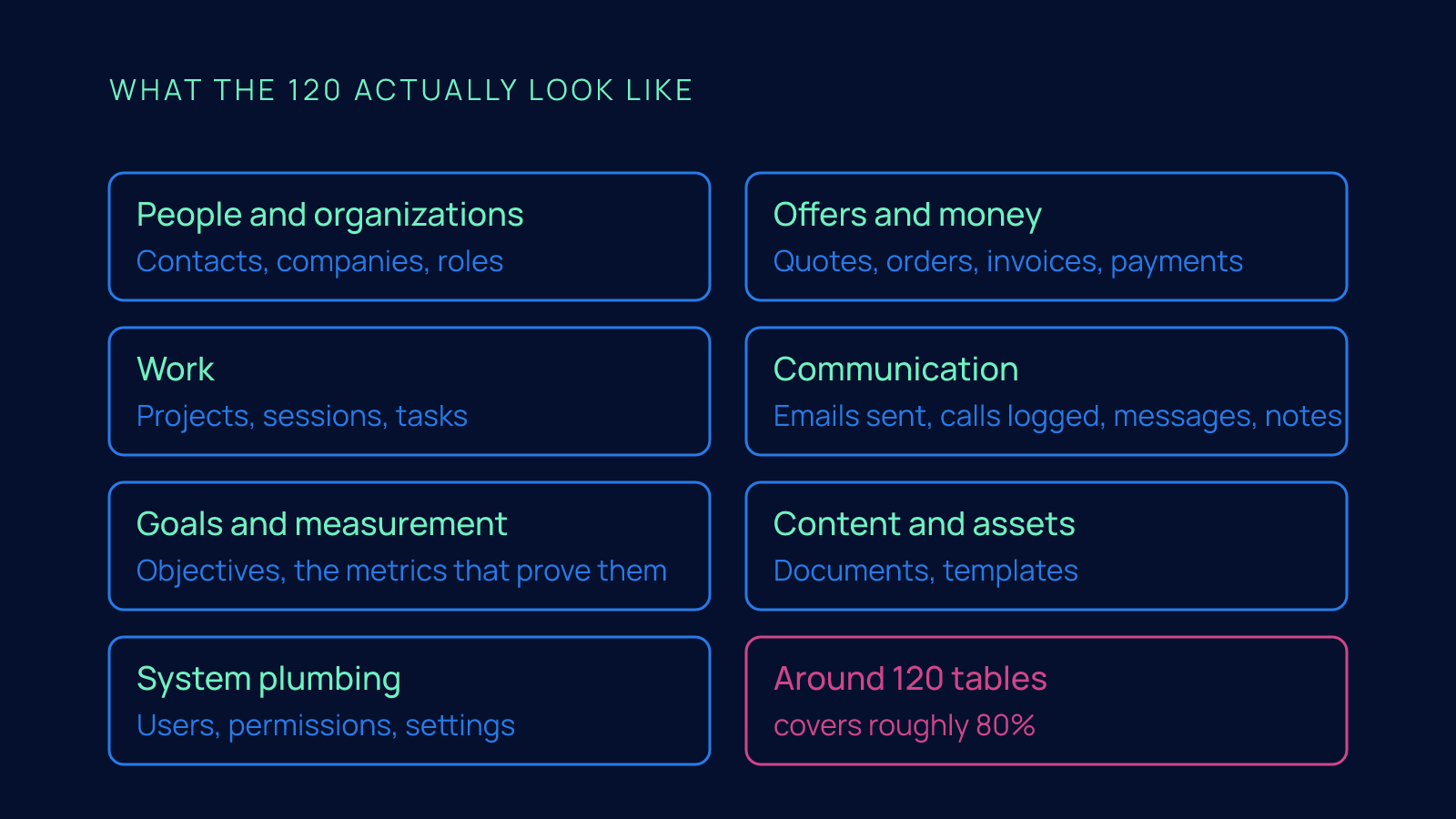
I am not going to list all of them here, but the shape is worth seeing so you can check it against your own business.
- People and organizations. Contacts, companies, roles, the relationships between them. Everyone has this.
- Offers and money. Products or services, prices, quotes, orders, invoices, payments. Everyone has this too, even a solo coach.
- Work. Projects, sessions, tasks, activities inside those sessions, who did them and when.
- Communication. Emails sent, calls logged, messages, notes, feedback given and received.
- Goals and measurement. Objectives, the metrics that prove them, the weekly numbers.
- Content and assets. Documents, templates, the things you reuse.
- System plumbing. Users, permissions, settings, a record of who changed what. Boring and non-negotiable.
Read that list back as a founder and you will notice something. None of it is exotic. All of it is currently scattered across your CRM, your calendar, your invoicing tool, a handful of spreadsheets and someone's inbox. The 120 tables are not a new idea. They are your existing business, finally sitting in one place where a system (and an AI) can see all of it at once.
Proof point: a coaching company, spun up fast
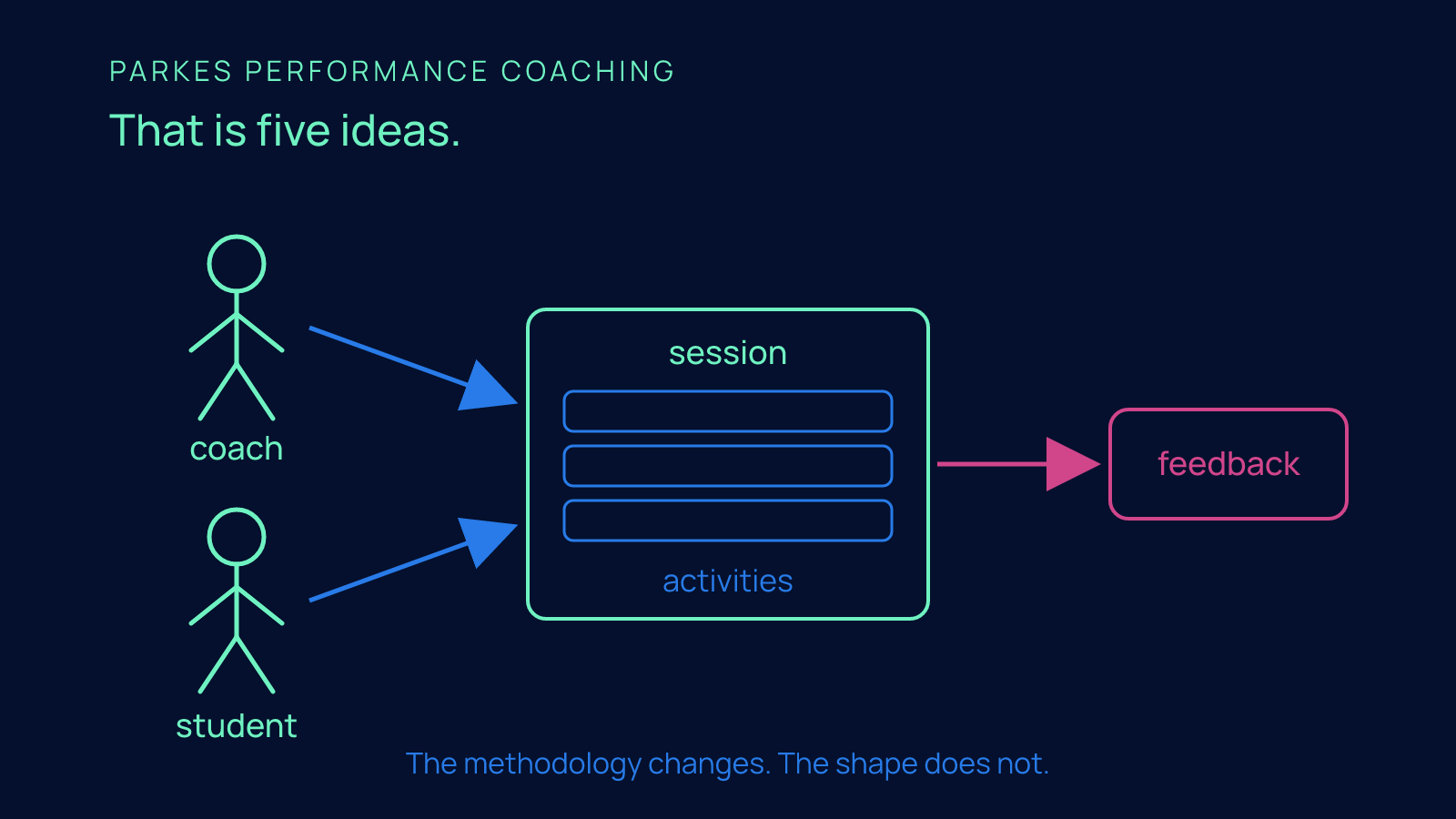
You know, there's a coach, there's a student, there's a session, and then from that session there's activities within the session. There's feedback often, and so these principles are kind of the same thing.
This is where it stops being theory.
I am sitting with Justin as I write this. We spun up his web app on Edge8, and when I say web app I do not mean a landing page. I mean the application that runs his company: the company operating system. Coaches, students, sessions, what happens inside each session, the feedback that comes out of it.
The first version was branded and in front of him rapidly. Not a wireframe. A working, good-looking system with his name on it. And it was fast precisely because of the 80% rule. We did not sit in a room for weeks debating what a coaching business needs. We already knew. The 120 tables were the starting point, and the coaching-specific shape sat on top.
Here is the part I want founders to really sit with. Coaching looks like a hundred different businesses from the outside. Athletic coaching. Business coaching. Group coaching for a room full of founders. Different clients, different language, different price points. But the data shape is the same every time:
- There is a coach.
- There is a student.
- There is a session.
- Inside that session there are activities.
- And from that session there is feedback.
That is five ideas. Everything else in a coaching business hangs off those five. The methodology changes. The shape does not. Which is exactly why the 80% was ready before Justin finished describing his business, and why the work now is the interesting part.
The next few days are where the value is
I think that's really where the power is when you realize that if you can actually organize your data and hyper personalize for your students, gamify the process, all of a sudden your business becomes amazing.
Over the next few days we are refining the system around Justin's methodology and the way he actually thinks about coaching. His framework for sessions. His ideas about what progress looks like. That is the 20%, and it is the only part that deserves custom thinking.
What becomes possible once the data is organized is the real reason to do any of this:
Hyper-personalization. When every student, every session, and every piece of feedback is in one place, each student can get a version of the program shaped to them, not the same worksheet everyone gets. Hyper-personalization just means the system knows enough about each person to treat them individually, at scale, without the coach doing it by hand.
Gamification. Progress you can see. Streaks, milestones, levels, whatever fits the methodology. Gamification is simply using game mechanics (points, progress bars, levels) to keep people engaged with something that is good for them. You cannot gamify what you cannot measure, and you cannot measure what is spread across six tools.
Organize the data, hyper-personalize for your students, gamify the process, and all of a sudden the business becomes something clients talk about. That is the sequence. Data first. Personalization and engagement second. And the data part is mostly done before you start, if you accept the 80% rule instead of fighting it.
Why this is a people problem, not a software problem
You might read all of this and think it is a pitch for a platform. It is not. It is an argument about where your people should spend their time.
If the 80% is known and repeatable, then the engineers and AI leaders inside your company should not be spending their first quarter reinventing it. They should be spending it on the 20%: your methodology, your workflows, the personalization logic that makes your clients stay. That is work for someone who understands both the business and the data layer, and who accepts up front that your company is 80% the same as every other company and 20% unique. The whole job is getting to the 20% fast.
The same logic runs the other way. If someone tells you the first six months are plumbing, one of two things is true. Either they are rebuilding the 80% by hand, or they have not seen enough companies to know that it repeats. Neither should cost you two quarters.
How to use the number
Here is what I would do with this if I were running your company:
- Stop asking "how many tables do we need." The answer is around 120 to cover 80% of the business. Argue with me if you want, but argue with a number, not a shrug.
- Write down your five. Just like coach, student, session, activity, feedback. What are the five ideas everything in your business hangs off? If you cannot name them, that is your first job.
- Separate the 80 from the 20. Everything that is standard goes in the "do not reinvent" pile. Everything that is yours goes in the "this is where our people work" pile.
- Point your people at the 20. Measure the engineer or AI leader who owns your data layer on how fast they get to your methodology, not on how long they spend on plumbing.
The takeaway
A coaching company got a branded, working operating system on Edge8 rapidly, and the reason is not magic. It is that 120 tables already covered 80% of what Justin needed, and we spent the time on the part that was actually his.
Your company is not as different as you think, and that is good news. It means the foundation is known, the clock does not have to run forever, and your people can start on the work that matters on day one.
If you want to talk through which of the 120 you already have and which of your 20% deserves real engineering, reply to this and tell me your five. That is the conversation I have every week, and it is the one that saves founders months.
FAQ
How many tables should my company database have to cover most of what the business actually does before we build anything on top of it?
Around 120 tables covers roughly 80% of what almost any company actually does, whether it sells software, services, or coaching. Those tables are the standard stuff every business has: people and organizations, offers and money, work, communication, goals and measurement, content, and system plumbing. The remaining 20% is where your company is genuinely different, and that is the only part worth custom effort. Stop asking an engineer how many tables you need and argue with the number instead of a shrug.
What is the 80/20 rule for database design and how do I apply it to my business data?
The Pareto principle says roughly 80% of the outcome comes from roughly 20% of the causes, and applied to database design it means a bit over a hundred standard tables (about 120) cover 80% of every company. Underneath the industry vocabulary, every business has people inside and outside, sells something, schedules and records work, bills for it, sets goals and assigns tasks. To apply it, write down the five ideas everything in your business hangs off, then separate the standard 80% into a do-not-reinvent pile and your unique 20% into the pile where your people actually work.
What are the core tables a coaching business needs to run everything on one system?
A coaching business comes down to five ideas: a coach, a student, a session, the activities inside that session, and the feedback that comes out of it. Athletic coaching, business coaching, and group coaching for a room full of founders all share that same data shape, even though the clients, language, and price points differ. Everything else hangs off those five, and the methodology is what changes, not the shape. Parkes Performance Coaching got a branded, working operating system fast for exactly that reason, since the 80% was ready before the founder finished describing his business.
How do I stop my engineers from spending their first six months on database plumbing before they get to our actual workflows?
If someone tells you the first six months are plumbing, either they are rebuilding the standard 80% by hand or they have not seen enough companies to know it repeats, and neither should cost you two quarters. The standard roughly 120 tables are known and repeatable, so the engineer or AI leader who owns your data layer should spend the first quarter on your 20%: your methodology, your pricing logic, the one workflow nobody else runs. Measure that person on how fast they get to your methodology, not on how long they spend on plumbing.
What data do I need in one place before I can personalize a coaching program or add gamification for students?
Every student, every session, and every piece of feedback has to sit in one place before each student can get a version of the program shaped to them instead of the same worksheet everyone gets. You cannot gamify what you cannot measure, and you cannot measure what is spread across six tools like your CRM, calendar, invoicing tool, spreadsheets and someone's inbox. The sequence is data first, then personalization and engagement, and the data part is mostly done before you start if you accept that roughly 120 tables already cover 80% of the business.