
There is a deal dying in your inbox right now.
You know the one. The call went well. The buyer leaned in, asked the right questions, and said "send me something." You meant to. Then Tuesday happened, Wednesday had a board deck in it, and by Friday the thread had slipped below the fold. Nobody decided to drop that deal. Nobody would. It just stopped moving, and it is still sitting there, quietly turning into a no.
This is Day 11 of the 30-day 8 Edges season and the first episode set in the revenue office. Days 8 to 10 built the foundation: one database, the anatomy of a designed workflow, and talking to your own data. Today that foundation goes into the room where the money is, through its sharpest pain: follow-ups that slip, deals that rot in silence, and a loss that never shows up anywhere because nobody is counting it.
You did not lose it to a competitor
Most companies do not lose their deals to a competitor. They lose them to their own follow-up.
Here is the uncomfortable truth, and I will state it plainly because I have watched it happen in every company I have run and most of the ones I advise: most companies do not lose their deals to a competitor. They lose them to their own follow-up.
That is Edge8's observation, not a study, and I am not going to dress it up with a statistic. Check it against your own pipeline instead. Think about the last handful of deals that went nowhere. How many ended with a buyer picking someone else? And how many ended with nothing at all? A good call, a promise to circle back, then a slow fade where the buyer never said no. They just stopped hearing from you.
The buyer does not experience that as a decision either. They had a problem, they talked to you, you seemed to understand it, and then you went quiet. So they assumed you were not that interested, or too busy, or not that good. They moved on. Not to a rival. Just on.
Silence is not a line item
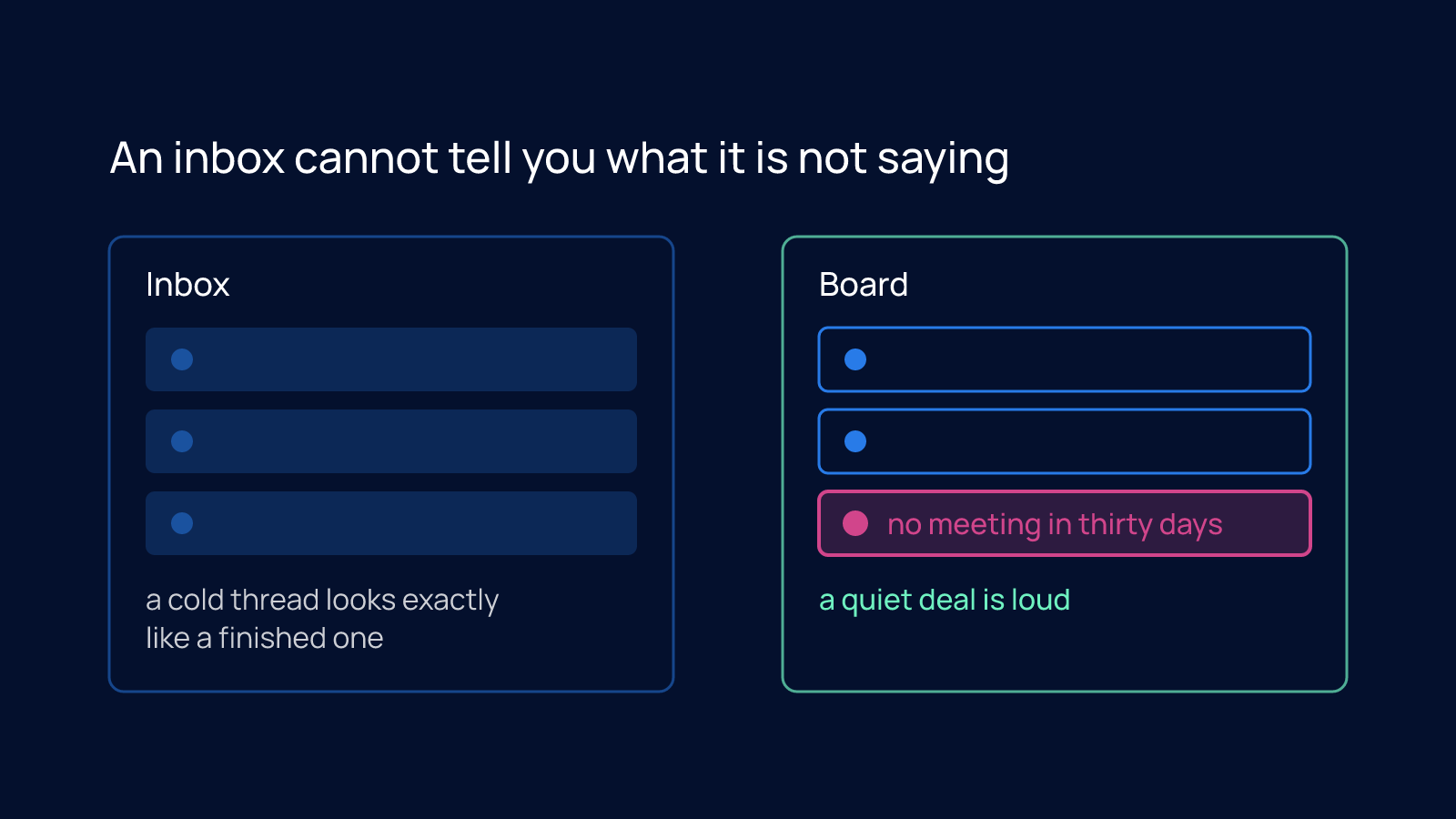
This keeps happening because the loss is invisible.
When a deal is lost to a competitor, there is a story. Someone writes it up. Pricing, features, timing, a relationship the other side had. It goes into the pipeline review, everyone nods, and the team learns something, or at least argues about it.
When a deal is lost to silence, there is no story, because nothing happened. There is no moment where it died. There is no email saying "we have decided to go another way." There is no lost-deal reason to pick from the dropdown, because "we forgot" is not on the dropdown. The deal sits in the pipeline marked open until someone cleans it up next quarter, and by then nobody remembers the call, let alone why the follow-up never went out.
So your reports tell you a comforting lie. Win rate looks reasonable. Losses look explainable. And the biggest leak in the business, the one you could actually fix, never appears on a single page you read.
That is why the pipeline cannot live in an inbox. An inbox is very good at telling you what arrived and useless at telling you what did not. To the inbox, a cold thread looks exactly like a finished one. An inbox cannot tell you what it is not saying.
The fix is a rule, not a tool
At this point most founders reach for a tool. A new CRM, the system that is supposed to hold every customer and every deal. A better one, with more automation and a nicer dashboard. I have bought those tools. They did not fix this, because the problem was never the tool.
The fix is a rule: one CRM, and every interaction logged. Every call. Every meeting. Every note. On the record, in one place, against the deal and the company it belongs to.
Notice what that rule does not say. It does not say which CRM. It does not say you need a bigger one. It says there is one, singular, and nothing about a customer lives anywhere else. Not in your head, not in a rep's notebook, not in a thread between two people that the third person has never seen.
If you watched Day 8, you have heard this before in a different room. Day 8's rule was blunt: if it is not in the system, it did not happen. There it was about building one database so the company stopped keeping its truth in spreadsheets and memory. Day 11 is the same rule, grown teeth. In the revenue office, "it did not happen" is not a figure of speech. If the call is not logged, then as far as the business is concerned the call did not happen, the promise was not made, and the deal does not exist in any form you can manage. You cannot follow up on something the company does not know occurred.
When everything is logged, silence becomes a signal
Once every interaction is logged, a deal with no activity stops being quiet and becomes visible, and silence turns from a loss you discover next quarter into a signal you can act on this week.
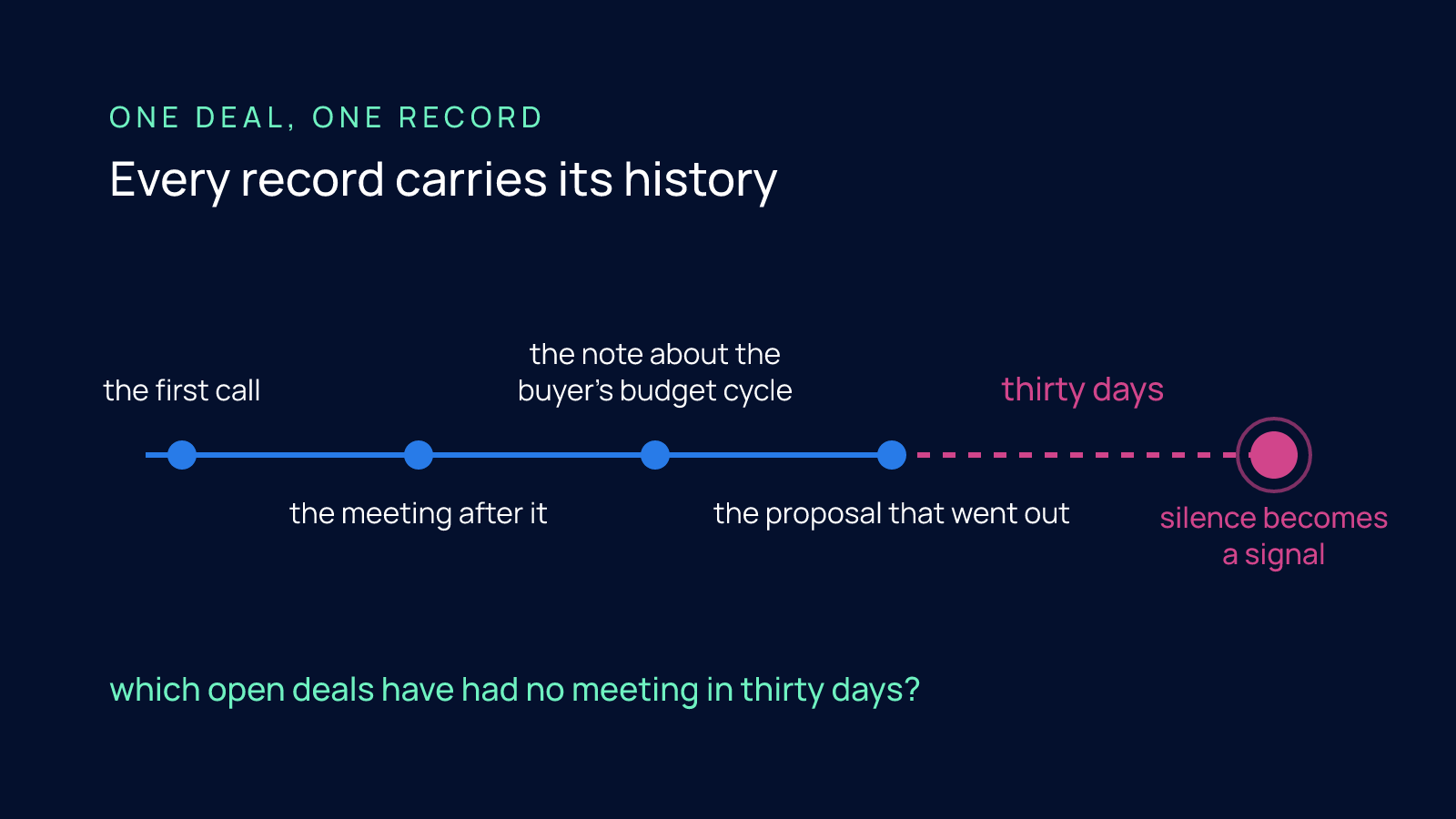
Here is what changes the moment the rule holds. A deal with no activity stops being quiet. It becomes visible.
Every deal on the board (the board is simply the CRM laid out so you can see every deal at once) has a record, and every record carries its history: the first call, the meeting after it, the note about the buyer's budget cycle, the proposal that went out. Which means every deal also carries a date on its most recent activity. And that date lets you ask the board a very simple question: which open deals have had no meeting in thirty days?
That is the Day 10 question, if you remember it. Day 10 was about talking to your data and getting an answer straight away instead of waiting on a report. Day 11 is where that question earns its keep, because the answer is a list of deals that are dying right now and could still be saved.
Before the rule, silence was a loss you discovered next quarter, during the pipeline cleanup, when it was far too late to do anything but delete the row. After the rule, silence is a signal you act on this week. The deal is not dead. It has just gone quiet. You pick up the phone. Maybe it was never going to close, and now you know, and you can stop carrying it. Maybe the buyer got busy and is relieved you called. Either way you made a decision instead of letting the calendar make it for you.
The best closer is the worst note-taker
Logging cannot depend on discipline, because the best closer is the worst note-taker and always will be, so the AI does the logging and the record keeps itself.
So why does every company that adopts this rule drift back within a few months?
Because they made the rule depend on discipline. They told the sales team to log everything, the sales team said yes, and then the sales team went back to selling.
I want to be fair to salespeople here, because the failure is structural, not moral. The best closer on your team is the worst note-taker on your team, and always will be. The traits that make someone great in the room (the energy, the focus on the next conversation, the instinct to move) are exactly the traits that make them terrible at stopping after the call to type up what happened. You can nag them. You can tie it to commission. You will lose. And you will trade the thing you actually want from them, which is closing, for marginally better notes.
So the logging cannot rest on a person. It has to rest on the system.
This is where the AI belongs, and I am going to be precise about what it does and what it does not do, because that precision is the whole point of the 8 Edges season.
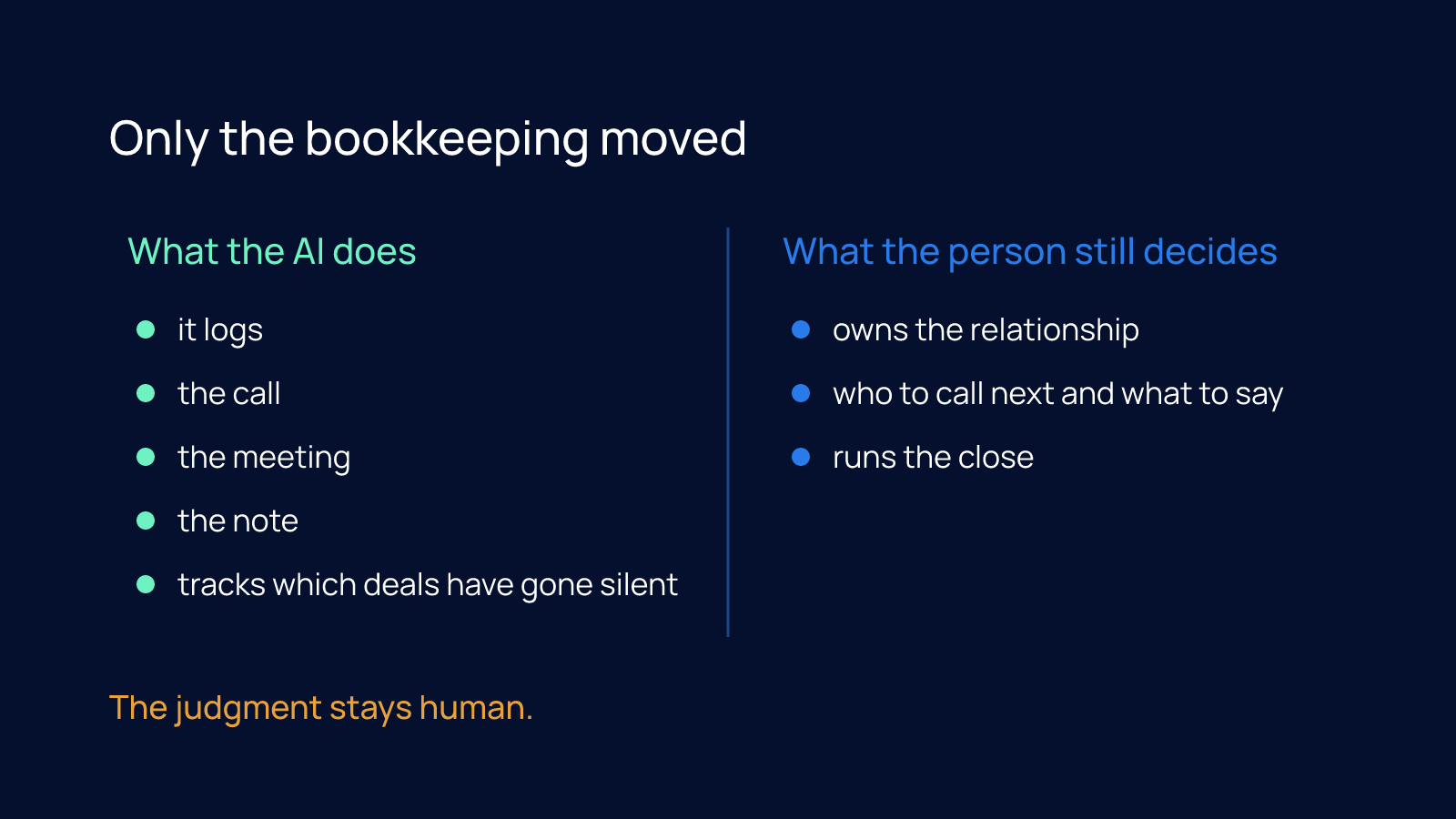
What the AI does: it logs. The call happens, and the AI puts the call on the record, against the right deal and the right company, with what was discussed. The meeting happens, and it is logged. The note is made, and it lands in the same place. Then the AI watches the board and tracks which deals have gone silent, so the thirty-day question has a live answer every day without anyone building a report.
What the person still decides: everything that matters. The salesperson owns the relationship. The salesperson decides who to call next and what to say. The salesperson runs the close. The AI never talks to the buyer and never decides a deal is dead. It makes sure the record exists and tells you where the record has gone quiet. The judgment stays human. Only the bookkeeping moved.
Put those two together and the rule stops depending on anyone's discipline. The record keeps itself. Your best closer can be exactly as bad at notes as they have always been, and the board is still complete.
How Edge8 runs its own board
I do not like telling people to do things we do not do ourselves, so here is our pipeline.
Every deal Edge8 is working is on one board. Every company we have talked to is on that same board, deals or no deals, because the company record is where the history lives even when nothing is open. Open one deal and you get the whole story on the record: the first conversation, every meeting since, the notes, the proposal, who said what and when. Nobody has to ask the person who took the call. Nobody has to find the thread. It is there, because the AI put it there.
Alongside the deals there is a meetings log. Every meeting, logged against the deal and the company, so the board knows not only that a deal exists but when we last actually sat down with the people behind it.
And then there is the question. Open deals with no meeting in thirty days. We ask it against live data, the same data the AI has been keeping, and we get a list. Some of those deals we chase. Some we close out, honestly, because the silence told us what the buyer was too polite to say. None of them slip.
The result is simple to describe. No deal at Edge8 dies of forgetfulness. If we lose one, we lose it on the merits: the buyer chose someone else, or chose nothing, or the fit was not there. Those are losses I can live with and learn from. A deal that died because nobody noticed it was quiet is a loss I am not willing to accept, and with the rule in place I do not have to.
The inbox is where deals go to die
Go back to that deal in your inbox. The good call, the follow-up that never went out.
It is not dead yet. But it is in the one place where nobody will ever notice when it dies. The inbox is where deals go to die. The board, one CRM with every interaction on it, is where they go to close, because on the board a quiet deal is loud.
So here is the rule again, and I want you to adopt it as a rule, not shop for it as a tool. One CRM. Every call, every meeting, every note, logged. The AI keeps the record, so it does not depend on anyone remembering. Your people keep the relationship and the close, because that is the part that needs a human. And you ask the board, this week and every week, which deals have gone silent.
Your next step
Watch the Day 11 film. It walks the Edge8 board on camera: the deals, a record with its full history, the meetings log, and the thirty-day question running on live data. It is the clearest way to see what "every interaction logged" actually looks like when a company lives by it.
Then come back for Day 12, where we take a single sales call and turn it into a live proposal in one designed workflow, so the follow-up that used to slip goes out before you have left the room.
And if you want to see this running on your own pipeline rather than ours, reply to this post or message me and say "demo". We will walk your deals, show you where the silence is hiding, and talk about what it would take to make it visible.
FAQ
How do I stop deals dying quietly in my inbox when a good sales call never gets a follow-up and nobody notices for thirty days?
Move the pipeline out of the inbox and onto one CRM where every call, meeting and note is logged against the deal and the company it belongs to, because an inbox cannot tell you what it is not saying and a cold thread looks exactly like a finished one. Once everything is logged, every deal carries the date of its last activity, so you can ask the board which open deals have had no meeting in thirty days and get a live list of deals that are dying right now and could still be saved. Edge8 runs its own pipeline this way and the result is that no deal dies of forgetfulness; if one is lost, it is lost on the merits.
Why do my pipeline reports never show deals lost to a missed follow-up?
Because a deal lost to silence has no story: there is no email saying the buyer went another way and "we forgot" is not on the lost-reason dropdown, so the deal sits marked open until someone cleans it up next quarter. Win rate looks reasonable, losses look explainable, and the biggest leak in the business never appears on a single page you read. Edge8's observation, offered plainly as an observation and not a study, is that most companies lose more deals to their own follow-up than to a competitor, and the only way to see that leak is to log every interaction in one CRM so a deal with no activity becomes visible instead of quiet.
How do I find open deals in my pipeline that have gone silent?
Ask one simple question of your CRM against live data: which open deals have had no meeting in thirty days? That question only works if every call, meeting and note is logged on the record, because then every deal carries a date on its most recent activity. Ask it this week and every week; some of those deals you chase, some you close out honestly because the silence told you what the buyer was too polite to say, and none of them slip.
What should AI log in my CRM and what should my salespeople still decide?
The AI does the bookkeeping: it puts every call, meeting and note on the record against the right deal and company, then watches the board and tracks which deals have gone silent so the thirty-day question has a live answer every day without anyone building a report. The salesperson keeps everything that matters: the relationship, who to call next, what to say, and the close. The AI never talks to the buyer and never decides a deal is dead; it only makes sure the record exists and tells you where it has gone quiet.
Why do my sales reps stop logging calls in the CRM a few months after we make it a rule?
Because the rule was made to depend on discipline, and the best closer on your team is the worst note-taker on your team and always will be; the energy and instinct to move that win the room are exactly what make someone terrible at stopping to type up the call. Nagging and tying it to commission will lose, and you trade the closing you actually want for marginally better notes. The fix is to rest the logging on the system instead of the person, with the AI keeping the record of every interaction on one CRM, so the board stays complete and the thirty-day silence check keeps working no matter how bad your best closer is at notes.