Every week, 925 people get a letter from me. An agent drafts it from the week's three posts. I edit it. It goes out with tracked links, one recipient at a time, through a sender we rebuilt this month so that it re-checks each person against the live CRM (the system that holds every contact and conversation we have) the moment before it fires and respects their send window. It is a good letter. If you want to see how it is built, the Email Broadcasts workflow is written up in full.
Here is what it cannot do. It cannot say one thing about you. It does not know that we met three weeks ago, that you asked about an AI officer rather than an engineer, that your next step is a scoping call and you have not confirmed it. It knows nothing about you, because it is one message written for 925 people, and a message written for 925 people has to be true of all of them.
That is where most companies stop and call it personalization: a first name in the subject line, a segment or two, a good broadcast. The broadcast is not the problem. The problem is that we were treating it as a follow-up, and a newsletter is not a follow-up.
So this week Edge8 started sending something else to the 92 people who matter most this quarter. This is the case study, written at the start instead of the end: what the note is written from, what the research predicts, what we will measure, and what we have measured so far, which is nothing.
Why 92 people come before the other 833
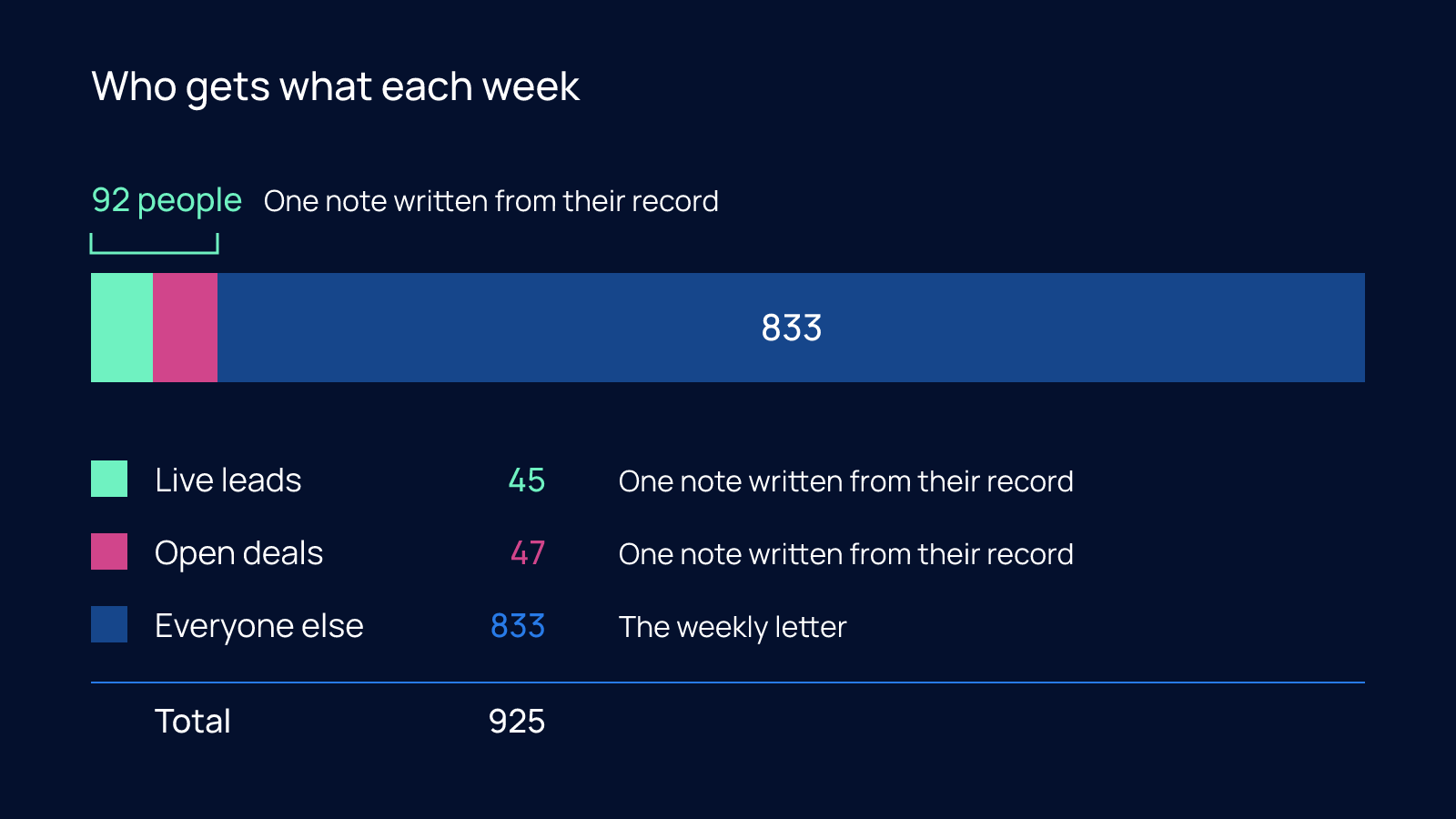
Inside the 925 are 45 live leads: people who have asked Edge8 for something and are in an active conversation. And 47 open deals: conversations with a stage, a next step and a date. That is 92 people. Everyone else keeps receiving the weekly letter, unchanged.
Exhibit 1: who gets what each week
| Group | People | What they receive | |---|---|---| | Live leads | 45 | One note written from their record | | Open deals | 47 | One note written from their record | | Everyone else | 833 | The weekly letter | | Total | 925 | |
Why these 92 first? Because they are the people whose next email from me decides whether a revenue conversation moves or stalls. A founder who asked about an AI engineer three weeks ago and has heard only a newsletter since has been told, politely, that they are one of 925. That is the wrong message to send to the person you most want to talk to. The other 833 have not asked for anything yet, and the letter is the right thing for them: useful, regular, easy to ignore until they need us.
The math matters too. Ninety-two notes a week is a person's afternoon plus an agent. Nine hundred and twenty-five is not. Scope is what makes this possible at all, and scope is the first decision, not the last.
What the research says the prize is
Persuasive appeals that were matched to people's extraversion or openness-to-experience level resulted in up to 40% more clicks and up to 50% more purchases than their mismatching or un-personalized counterparts.
Personalization that converts, speed that wins deals, and internal tools repackaged as products.
Four sources shaped the bet, and I want to show you what each one actually says, because the gap between what personalization research finds and what vendors claim it finds is wide.
Stanford's Digital Economy Lab published The Enterprise AI Playbook in March 2026 (Pereira, Graylin and Brynjolfsson). Their first revenue pattern, in their words: "Personalization that converts, speed that wins deals, and internal tools repackaged as products." Personalization is first on the list, and the qualifier is the phrase that converts. Not personalization that feels nice. Personalization that moves a deal.
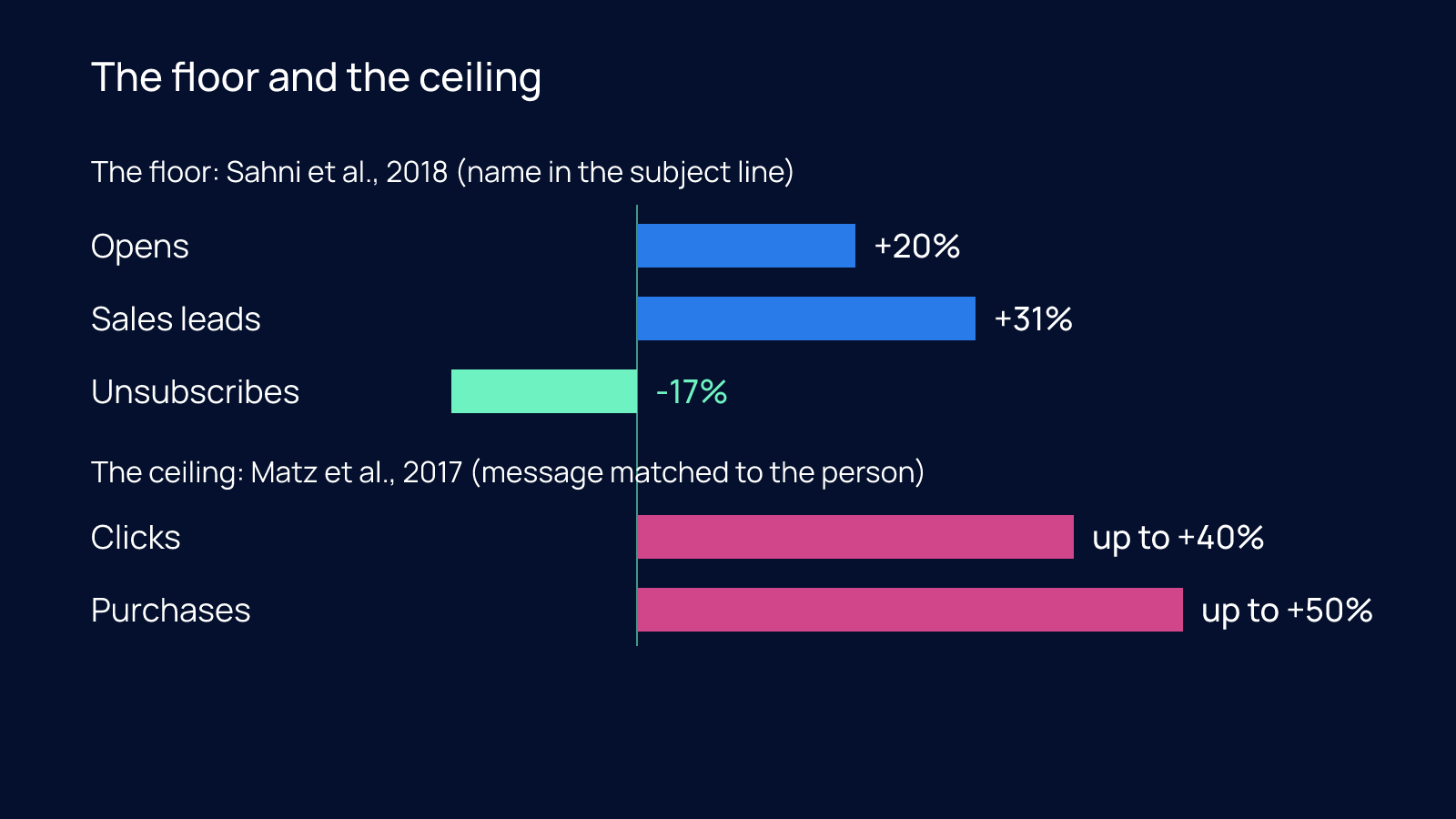
The floor comes from Sahni, Wheeler and Chintagunta in Marketing Science (2018). In randomized experiments with millions of recipients, putting the recipient's name in the subject line lifted open rates by about 20%, lifted sales leads by 31%, and cut unsubscribes by 17%. That is the cheapest personalization there is, a merge field, and it moved leads by nearly a third. I call it the floor because it is what you get for almost nothing, and anything we build has to beat it or it was not worth building.
The ceiling comes from Matz, Kosinski, Nave and Stillwell in PNAS (2017). They matched persuasive messages to a person's psychological profile and found that "Persuasive appeals that were matched to people's extraversion or openness-to-experience level resulted in up to 40% more clicks and up to 50% more purchases than their mismatching or un-personalized counterparts." Matching the message to the person, not just addressing it to them, is where the large numbers live: up to 40% more clicks, up to 50% more purchases.
Exhibit 2: the floor and the ceiling
| Measure | Sahni et al., 2018 (name in the subject line) | Matz et al., 2017 (message matched to the person) | |---|---|---| | Opens | +20% | | | Sales leads | +31% | | | Unsubscribes | -17% | | | Clicks | | up to +40% | | Purchases | | up to +50% |
McKinsey's 2021 research explains why the ceiling is worth reaching for. 71% of consumers expect personalized interactions and 76% are frustrated when they do not get them. 76% said personalized communication drove their consideration of a brand, and 78% said it made them more likely to buy again. That is a consumer survey, and our 92 are founders and CTOs, but I do not believe a founder who has sat through three meetings with us expects less attention than a consumer buying shoes.
Two cautions come from the same body of work, and both shaped the design. First, personalization built from data people did not knowingly give you tends to backfire: when a message reveals that you know something they never told you, clicks fall rather than rise. Second, a language model left to draft on its own flatters. It reaches for warmth it has not earned, and a founder can smell that from the first line.
What one note reads from
Exhibit 3 is the whole design in one table. Every note is written from one person's record, and the record holds exactly six kinds of thing.
Exhibit 3: what one note reads from
| Field | What it holds | Where it came from | |---|---|---| | Company | Who they are and what they do | The form they filled in or the first call | | Deal and stage | Where the conversation stands | Our own pipeline | | Next step and its date | What was agreed and when | The last meeting | | Last meeting | The summary of the most recent one (347 meetings in the database) | Our notes | | Transcript | The call recording where there is one (39 transcripts, each scored) | The call itself | | The original ask | What they first asked Edge8 for | Their own words, on a form or in a conversation |
Notice what is not on the list. No profile scraping. No funding news. No inferred personality. Nothing is written from data the person did not give us in a conversation or on a form. That is the answer to the first caution above. If the note says you asked about an AI officer rather than an engineer, it is because you said that to us, and you will recognize it as a thing you said.
This is the revenue side of owning your data. I wrote earlier this month about personalized outreach built on data you own. The 347 meetings and 39 transcripts are the record. The note is what the record is for.
How a note gets made and sent
The oversight level should match the stakes.
An agent drafts the note from the record. It reads the six fields and it is told what a note is: one message, a few sentences, about this person's situation and their next step. It is not told to sell, and it is not allowed to invent.
I read and change every one before it goes. Every single one. Some edits are a word. Some drafts get thrown out. This is the 80/20 in practice: the agent does the bulk of the work, the reading across 347 meetings and 39 transcripts that I could not do every week, and I do the small part that takes judgment, which is deciding what this person should hear.
It sends through Resend (the email service we use), one recipient at a time, through the same sender the letter uses, with the same live CRM re-check and the same send window. If a deal closed or a lead asked us to stop between the draft and the send, the note does not go. One broadcast has gone through the rebuilt sender so far. The notes ride the same rails.
Nothing goes without a human on the button. Stanford's playbook puts it plainly. "Human oversight is not a tax on productivity." And: "The oversight level should match the stakes." The stakes here are Edge8's reputation with the 92 people most likely to become clients this quarter. A note that flatters, gets a stage wrong or refers to the wrong meeting costs more than an afternoon saved. So the oversight is total, and it stays total until the numbers tell us something. That is the answer to the second caution.
If you are a CTO wondering whether a personalized outreach agent is a data project or a copy project, the four steps answer it. Three of the four are data and plumbing: the record, the sender, the re-check, the send window. The copy is the easy part, and the agent does most of it. What made this possible was an engineer who wired the record to the sender, not a better prompt.
What we will measure, decided before the first send
Here is the part most case studies leave out, because they are written after the numbers came in and the numbers were good.
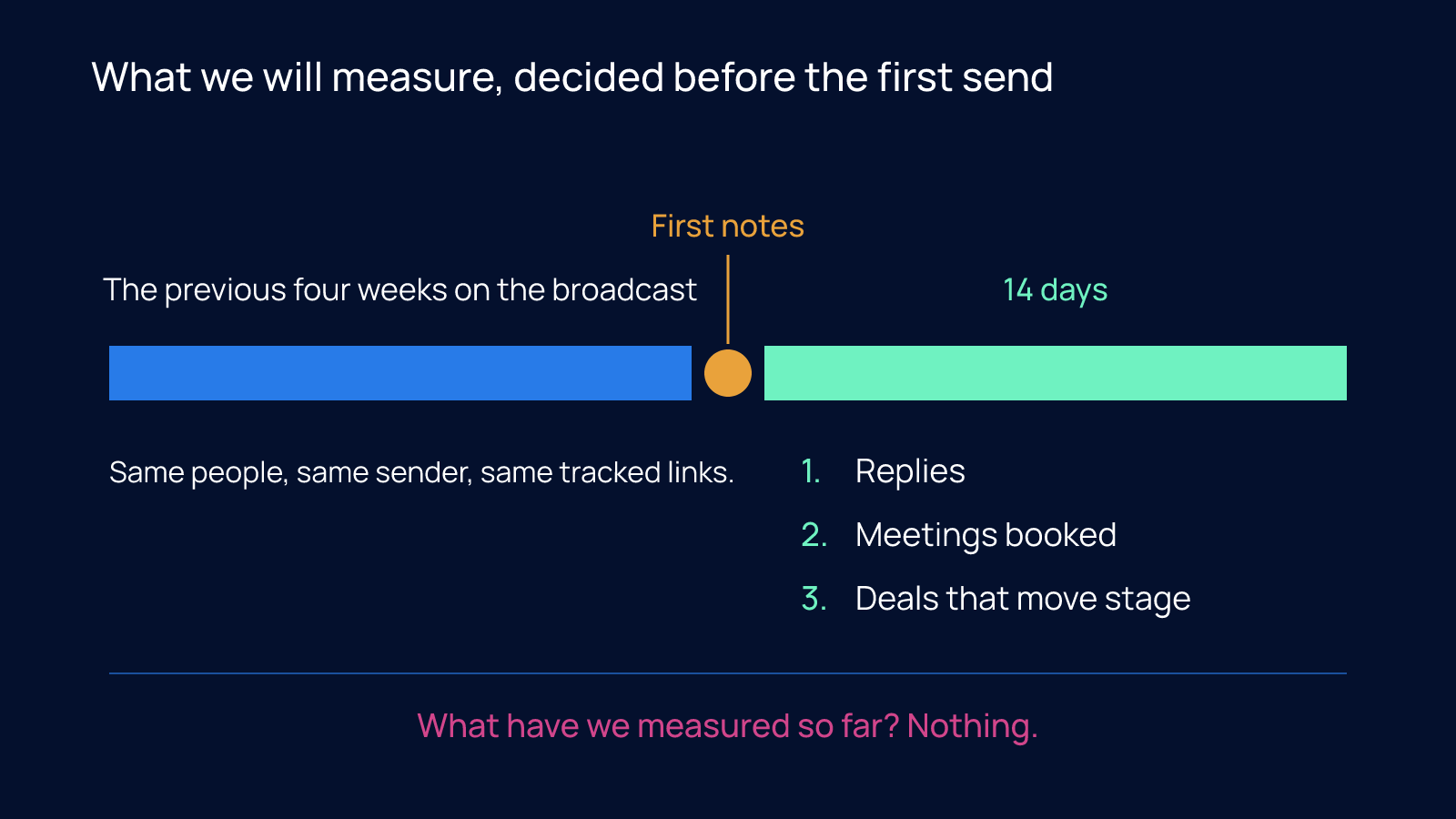
We decided the measures before the first note went. Three of them, for each of the 92 people, within 14 days of a note:
- Replies.
- Meetings booked.
- Deals that move stage.
The comparison is the same 92 people's previous four weeks on the broadcast. Same people, same sender, same tracked links. The only thing that changes is that the message is about them.
What have we measured so far? Nothing. The first notes went out this week. Fourteen days have not passed. I do not have a reply rate, a meeting count or a deal that moved, and I am not going to imply one.
What I will promise is this: we will publish what we measure, including a null result. If 92 agent-drafted, human-edited notes move replies, meetings and stages no more than the letter did, you will read that here, with the table. The research says the prize is real. The research also says most personalization programs never reach it. We are going to find out which side of that line a small firm with a clean record lands on.
The same method already runs inside the company
The record and the method are not new to us. The same pattern, an agent drafting from a person's record and a human editing before it goes, is how we run our one-on-one cycle, which I wrote about in better one-on-one meetings with AI. There the record is a team member's goals, last meeting and open commitments. Here it is a lead's original ask, stage and next step. Same shape. Same data discipline. Same human on the button.
That matters for the question underneath all of this: who owns the record. The engineer who owns your data layer and wires the record to the sender is the same engineer who wires it to your one-on-ones, your onboarding and your renewals. That is not a marketing role and not a prompt engineer (someone who writes instructions for a model but does not touch where the data lives). It is an AI engineer who understands your record end to end, and that person belongs on your team, not at a vendor who leaves when the contract ends.
What to do this week
Do not build anything yet. Do this first.
List the people in your pipeline who are live right now: they asked for something, they are in a conversation, they have a next step or should. Count them. Then write one sentence per person that your newsletter would never say. If you cannot write the sentence, you do not have the record yet, and that is the first thing to fix.
If the count is under a hundred, one note a week each is a person's afternoon plus an agent. That is the whole scope.
Reply to Edge8 with the count. We will talk about who wires your record to your sender.
Sources
- Stanford Digital Economy Lab, "The Enterprise AI Playbook", Pereira, Graylin and Brynjolfsson, March 2026. https://digitaleconomy.stanford.edu/app/uploads/2026/03/EnterpriseAIPlaybook_PereiraGraylinBrynjolfsson.pdf
- Sahni, Wheeler and Chintagunta, "Personalization in Email Marketing: The Role of Noninformative Advertising Content", Marketing Science, 2018. https://pubsonline.informs.org/doi/abs/10.1287/mksc.2017.1066
- Matz, Kosinski, Nave and Stillwell, "Psychological targeting as an effective approach to digital mass persuasion", PNAS, 2017. https://www.pnas.org/doi/10.1073/pnas.1710966114
- McKinsey, "The value of getting personalization right, or wrong, is multiplying", November 2021. https://www.mckinsey.com/capabilities/growth-marketing-and-sales/our-insights/the-value-of-getting-personalization-right-or-wrong-is-multiplying
- Edge8, "Email Broadcasts". https://www.edge8.ai/workflows/email-broadcasts/
FAQ
How do I follow up with every live lead every week without sending them all the same newsletter?
Split the people in an active conversation from everyone else and write each of them one short note a week from their own record: company, deal stage, next step and its date, last meeting summary, call transcript where one exists, and what they originally asked for. In the case in this post, 925 people receive a weekly letter and 92 of them (45 live leads and 47 open deals) now get one note each instead, while the other 833 keep the letter. An agent drafts each note from the record, a human reads and edits every one, and it sends one recipient at a time through the same sender as the letter. Ninety-two notes a week is one person's afternoon plus an agent; 925 is not, which is why scope is the first decision.
Is a weekly newsletter enough of a follow-up for leads who have already talked to me?
No. A newsletter is a good broadcast, but one message written for 925 people has to be true of all 925, so it cannot mention what one person asked for, where their deal stands or that their next step is unconfirmed. A founder who asked about a specific role three weeks ago and has heard only a newsletter since has been told, politely, that they are one of 925. The letter is the right thing for the 833 who have not asked for anything yet; the 92 in live conversations need a message about them.
How much does personalizing sales emails actually improve results?
The floor is cheap: in randomized experiments with millions of recipients, Sahni, Wheeler and Chintagunta (Marketing Science, 2018) found that putting the recipient's name in the subject line lifted opens about 20%, lifted sales leads 31% and cut unsubscribes 17%. The ceiling is matching the message to the person: Matz, Kosinski, Nave and Stillwell (PNAS, 2017) found up to 40% more clicks and up to 50% more purchases versus mismatched or un-personalized messages. McKinsey's 2021 research adds the expectation gap, with 71% of consumers expecting personalized interactions and 76% frustrated when they do not get them.
What data should an AI use to write a personalized follow-up email so it does not feel creepy?
Only what the person gave you in a conversation or on a form: their company, the deal and its stage, the agreed next step and date, the last meeting summary, the call transcript where one exists, and their original ask in their own words. In the design described here that record covers 347 meetings and 39 scored transcripts, with no profile scraping, no funding news and no inferred personality. The research behind the design says personalization built from data people did not knowingly give you tends to backfire, with clicks falling rather than rising when a message reveals something they never told you.
How do I know if personalized follow-up emails are working better than my newsletter?
Decide the measures before the first note goes out, not after the numbers come in. The three used here are replies, meetings booked and deals that move stage within 14 days of a note, for each of the 92 people, compared against the same 92 people's previous four weeks on the broadcast with the same sender and tracked links. Keep a human editing every note while you measure, because as Stanford's Enterprise AI Playbook puts it, the oversight level should match the stakes, and a note that gets a stage wrong costs more than an afternoon saved. Publish the result either way, including a null result.