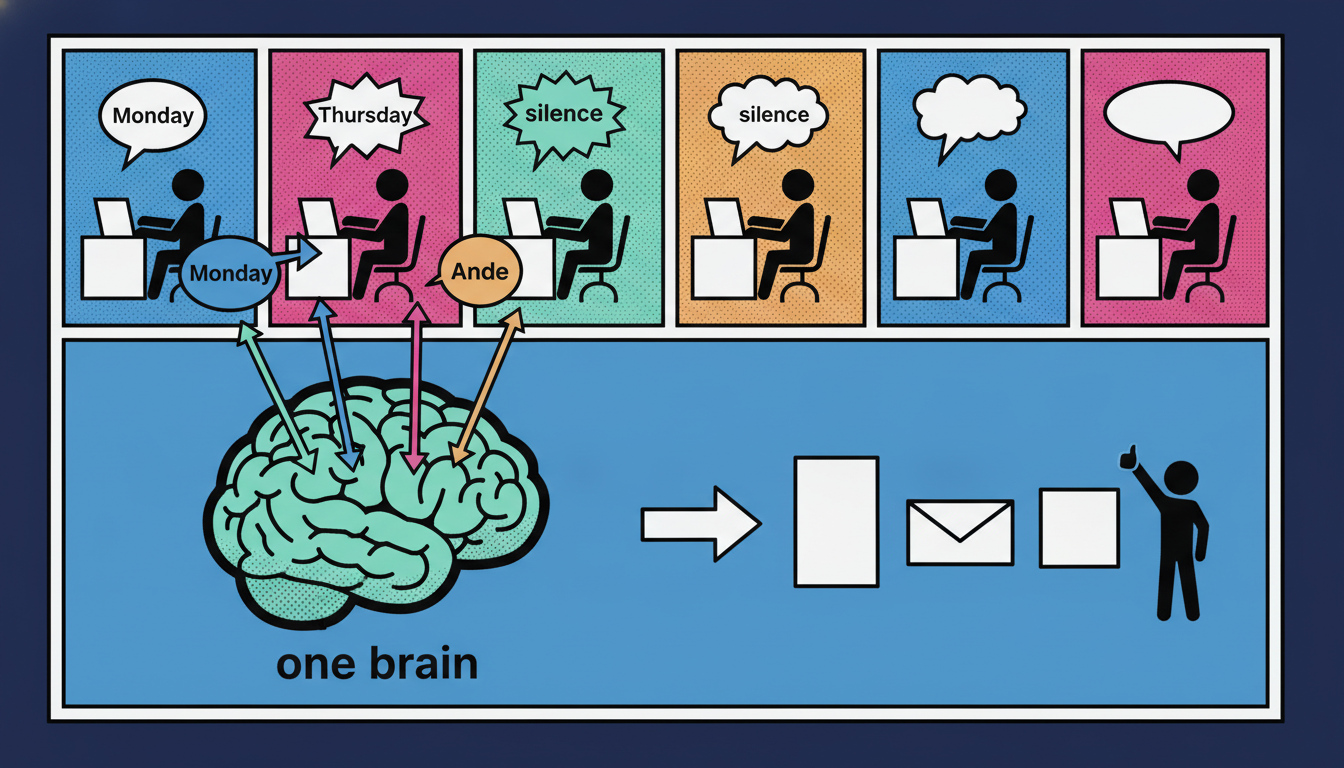
Here is a week of marketing I have watched at more companies than I can count, including my own.
Monday, someone posts on LinkedIn. It is decent. It sounds like the founder, because the founder wrote it between two meetings.
Thursday, the newsletter goes out. A different person wrote it, so it is in a different voice, and it goes to a list nobody has cleaned in a year. A good share of those addresses belong to people who have moved on from the companies they signed up from.
The week after that, nothing. The person who had an hour did not have an hour.
Nobody calls that a strategy out loud, but plenty of companies run on it. I call it random acts of content. Each piece is made from scratch, from memory, by whoever had the time, and nothing about it is written down: not the audience, not the voice, not the point. Read a month of it back to back and it sounds like six companies wrote it. In a way they did.
The reason it reads like six companies
Nobody can say what any of it was for, because nobody wrote down who it was for.
It is tempting to blame the people. The founder is too busy. The marketer is new. The agency never got the brand. All of that may be true, and none of it is the cause.
The cause is simpler and more uncomfortable. Nobody can say what any of that content was for, because nobody wrote down who it was for.
When the audience lives only in the founder's head, everyone else who touches the content has to guess at it. They guess at the reader, they guess at the tone, they guess at the one thing the piece should leave behind. Six guessers produce six voices. That is not a talent problem. That is a missing document.
And the document is missing because the thing it should describe was never pinned down in the first place: not the channel, not the calendar, but the job the customer is trying to get done.
Start with the job, not the channel
Clayton Christensen, the Harvard professor behind the theory of disruptive innovation, gave us the cleanest way to think about this. He called it Jobs to Be Done. People do not buy a product. They hire it to make progress on something in their life or their business. Nobody wants a drill for its own sake; they want the shelf up before the weekend ends.
Apply that to marketing and the order of operations flips. You do not start with "we need a LinkedIn post this week." You start with the job: what is the reader trying to get done, and what progress does this piece help them make on it? The channel is just where you meet them. The voice is just how you sound when you get there.
Most founders nod at this. Most marketing teams have the slide. And most companies still ship random acts of content, because a framework on a slide does not change what happens on a Tuesday afternoon when someone needs to write a post.
The half the framework leaves out
The operational half nobody talks about is that the job, the voice and the audience have to live somewhere other than the founder's head, in the system, where every campaign starts from the same brain.
The job, the voice and the audience have to live somewhere other than the founder's head. That is the operational half of Jobs to Be Done, and it is the half nobody talks about.
Not in a brand deck that was last opened the week it was made. Not in a shared document called "voice guide final v3." They have to live in the system, in the same place the work gets done, so that every campaign starts from the same place instead of from a blank page and a vague memory of what we said last time.
On Day 5 of this 30-day season I argued that frameworks beat prompts. A prompt is a one-off instruction; a framework is a repeatable way of thinking that you can hand to a person or a machine and get the same shape of result every time. Jobs to Be Done is a framework. Day 14 is where it stops being something I believe and becomes something written into the system, so the machine can draft from it and the people can hold it to account.
I call that written-down thing the brand brain. It is one record, in the company's own operating system, that holds four things: the brand itself, the voice it speaks in, the audience it speaks to, and the job that audience is hiring the company to do. Everything downstream reads from it. Nothing downstream gets to make it up.
Walking through the marketing brain at Edge8
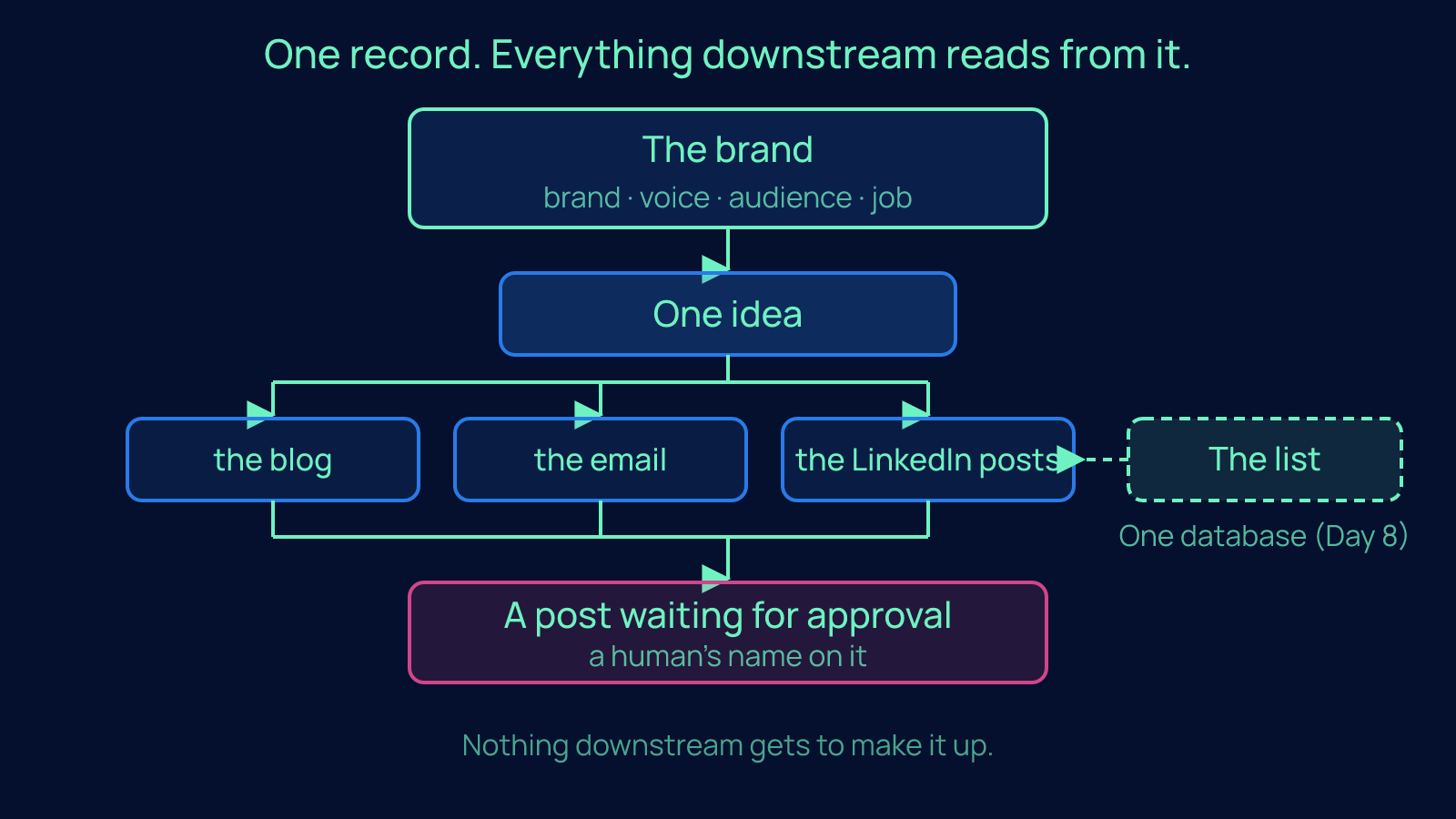
This is how we run our own marketing at Edge8, not a slide about how someone else should.
The brand. At the top sits one record for the brand. It carries the positioning in plain words, the voice with its rules (the ones I actually enforce, like no em dashes and no jargon without a definition), the audience described as real people with real pressures, and the job those people are hiring us for. This is the brain. It gets edited rarely and on purpose.
One idea at the top of a campaign. Below the brand sits a campaign, and a campaign starts with exactly one idea. Not a content calendar. Not a list of channels. One argument we want a specific reader to walk away holding. Today's idea is the one you are reading: random acts of content come from nobody writing down who the content is for.
The channel pieces drafted beneath it. From that one idea, the AI drafts the pieces for every channel: the blog, the email, the LinkedIn posts, the rest. It does not draft them from scratch. It drafts them from the brain, in the brand's voice, aimed at the audience the brain describes, each one shaped for the channel it will live on. The email reads like an email. The LinkedIn post reads like a LinkedIn post. They all sound like the same company, because they all came from the same record.
The list. This is the part that fixes the Thursday newsletter. The audience is not a guess and not an export someone made last year. It comes from the same database as the deals and the meetings. The people who get the email are the same people the sales team talked to last quarter, with the same tags, the same stages and the same history. One database, which we built on Day 8, now feeds the marketing as well as the pipeline.
A post waiting for approval. Every piece lands in a queue with a human's name on it. Nothing ships until that human reads it and says yes. If the draft misses, the marketer fixes it or kills it. If it misses because the brain was wrong, the marketer fixes the brain so the next draft does not.
What the AI does and what the marketer decides
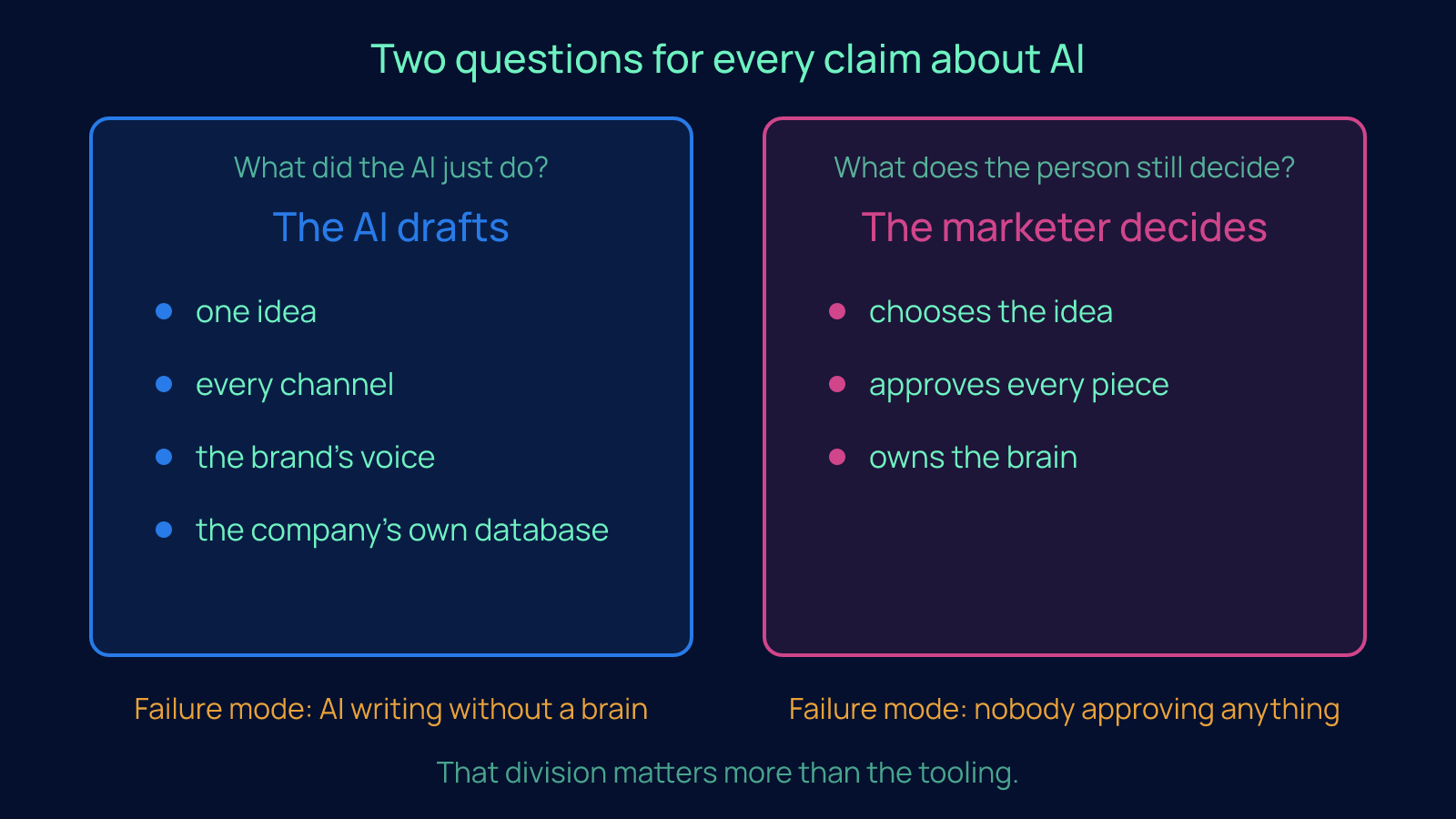
I hold every claim about AI to two questions. What did the AI just do? And what does the person still decide? Here is the honest answer for Day 14.
The AI drafts. It takes one idea and drafts it out for every channel, in the brand's voice, aimed at a list drawn from the company's own database. That is a lot of typing, and it is typing that used to be done from scratch by whoever had an hour.
The marketer decides. The marketer chooses the idea. The marketer approves every piece before anything ships. The marketer owns the brain, so when the voice drifts, the fix is a deliberate edit to one record, not a quiet argument across six documents.
That division matters more than the tooling. The failure mode I see most is not AI writing badly. It is AI writing without a brain to draft from, which just gives you random acts of content faster. The second failure mode is nobody approving anything, which gives you a company that has handed its voice to a machine. Neither is what we built.
One idea becomes a week of content
One idea used to become one post; now it becomes a week of content, and the marketer spends the saved hours on the next idea.
One idea used to become one post. Now it becomes a week of content.
The founder's Monday post, the Thursday email, the follow-up on LinkedIn, the short version for the sales team to forward: all of it from the same idea, in the same voice, to the right list, approved by a person. The marketer is not writing six things from scratch anymore. The marketer is choosing the next idea and spending the saved hours making it sharper.
That is the point. Not more content for its own sake. The content a good marketer would have written anyway, every week, in one voice, without depending on who happened to have an hour.
The revenue office is now closed
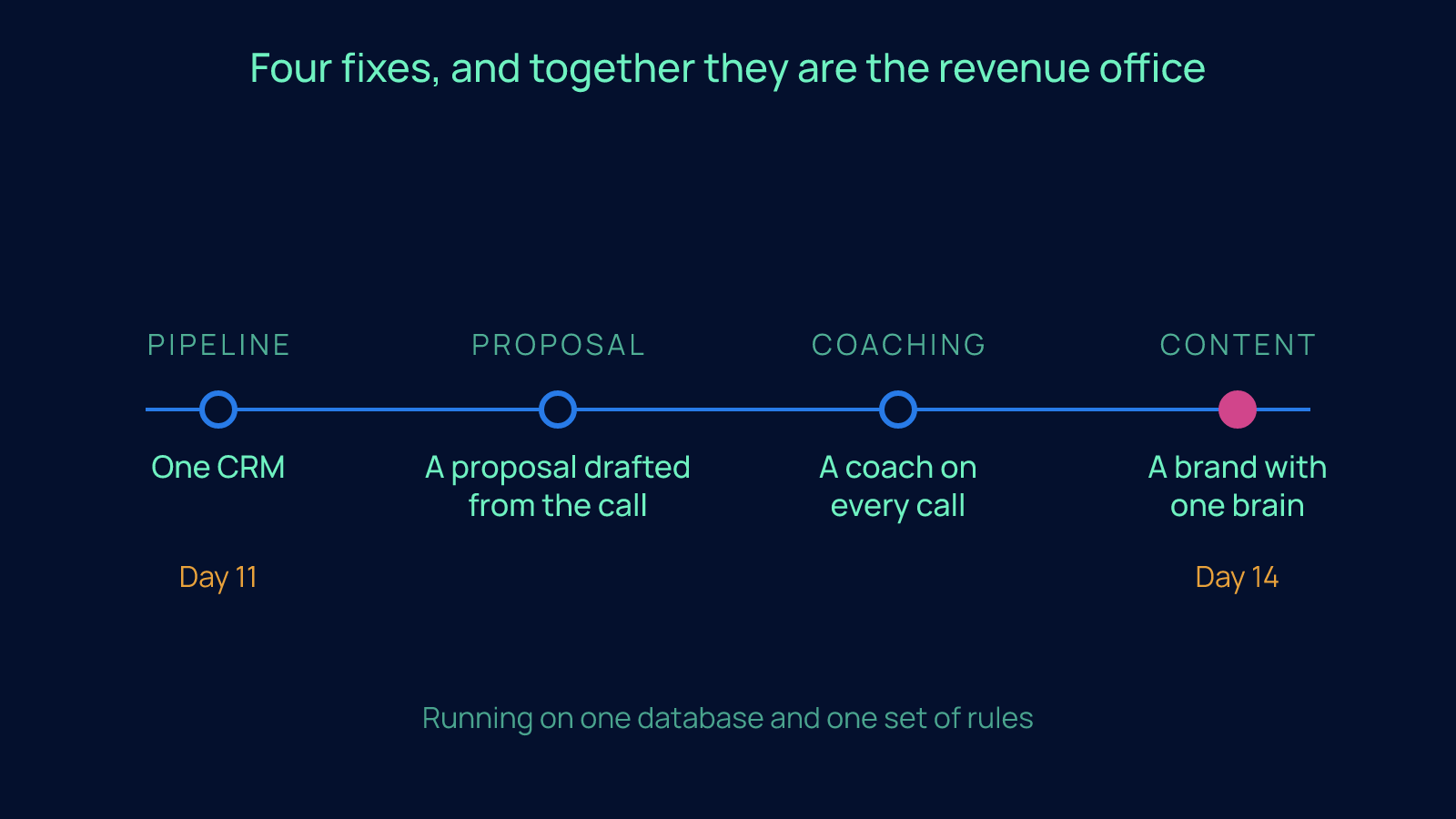
Day 14 finishes what Day 11 started. Four fixes, and together they are the revenue office.
One CRM, so every deal, contact and meeting lives in one place and the pipeline is something you can look at rather than something you have to ask about. (A CRM is the record of your customers and the deals in flight. Most companies have one. Few have only one.)
A proposal drafted from the call, so the document the client receives is built from what was actually said, not reconstructed from memory two days later.
A coach on every call, so the feedback a rep gets is the same feedback whether or not a manager happened to be listening.
A brand with one brain, so the content that feeds the top of that pipeline sounds like one company and reaches the people already in the database.
Pipeline, proposal, coaching, content. Each one is a designed workflow with a person deciding and a machine doing the parts that never needed a person. Together they are the half of the company that brings in revenue, running on one database and one set of rules.
What to do this week
If your content reads like six companies wrote it, do not start by buying a tool and do not start by bringing in a writer. Start by writing down three things in one place: who the reader is, what job they are hiring you for, and how you sound when you talk to them. If you cannot write those down, no tool and no writer will fix the drift, because they will be guessing the same way everyone else has been.
Once it is written down, put it where the work happens, so every draft starts from it and a person signs off on every piece.
Then watch the Day 14 film, where I walk through the marketing brain inside Edge8 on screen, from the brand record to the post waiting for approval.
Day 15 walks into the talent office. The revenue side of the company is closed. Next we fix how you find and grow the people who run it.
Until then, if you want to see the marketing brain running on your own idea and your own database, reply and we will set up a demo.
FAQ
How do I make my company's content sound like one brand across blog, email and LinkedIn when every piece is written from scratch by whoever had an hour that week?
Write down three things in one place before you touch a tool: who the reader is, what job they are hiring you for, and how you sound when you talk to them. Keep that as one record where the work happens, holding four things (the brand, its voice, its audience and the job), and have every draft start from it instead of from a blank page. That is why a month of content currently reads like six companies wrote it: six people guessing at the audience produce six voices. Once the record exists, one idea becomes a week of content in one voice, with a person approving every piece before it ships.
Why does my company's content sound like different people wrote it?
It is not a talent problem, it is a missing document. When the audience lives only in the founder's head, everyone else who touches the content has to guess at the reader, the tone and the point, and six guessers produce six voices. Read a month of that back to back and it sounds like six companies wrote it, because in a way they did. Fix the document, not the people.
What is Jobs to Be Done and how do I apply it to my marketing?
Jobs to Be Done is Clayton Christensen's framework: people do not buy a product, they hire it to make progress on something, like wanting the shelf up before the weekend rather than wanting a drill. Applied to marketing, you start with the job the reader is trying to get done, not with the LinkedIn post you need this week. The half most teams skip is operational: the job, the voice and the audience have to live in one record in your system, holding four things, so every campaign starts from the same place instead of from a slide last opened the week it was made.
What should AI draft for my marketing and what should a human still decide?
The AI drafts: it takes one idea and writes it out for every channel, the blog, the email, the LinkedIn posts, in the brand's voice, aimed at a list drawn from your own database. The marketer chooses the idea, approves every piece before anything ships, and owns the record the drafts come from, so when the voice drifts the fix is one deliberate edit to one record rather than an argument across six documents. AI drafting without that record just produces inconsistent content faster, and nobody approving anything hands your voice to a machine.
How do I turn one idea into a week of content and stop emailing a list nobody has cleaned?
Put one idea at the top of a campaign and draft every channel piece from it: one idea used to become one post, and now it becomes a week of content, the Monday post, the Thursday email, the LinkedIn follow-up and a short version for sales to forward. For the list, stop sending to an export nobody has cleaned in a year and pull the audience from the same database that holds your deals and meetings, with the same tags, stages and history. The marketer is no longer writing six things from scratch and spends the saved hours making the next idea sharper.