The call went well. You could hear it in the questions. The buyer stopped asking whether the thing works and started asking how it would work for them, which is the question people only ask once they are already picturing it. You hung up and said what every founder says at that moment: I will get a proposal over to you.
Then the week happened.
The buyer cools while the write-up waits
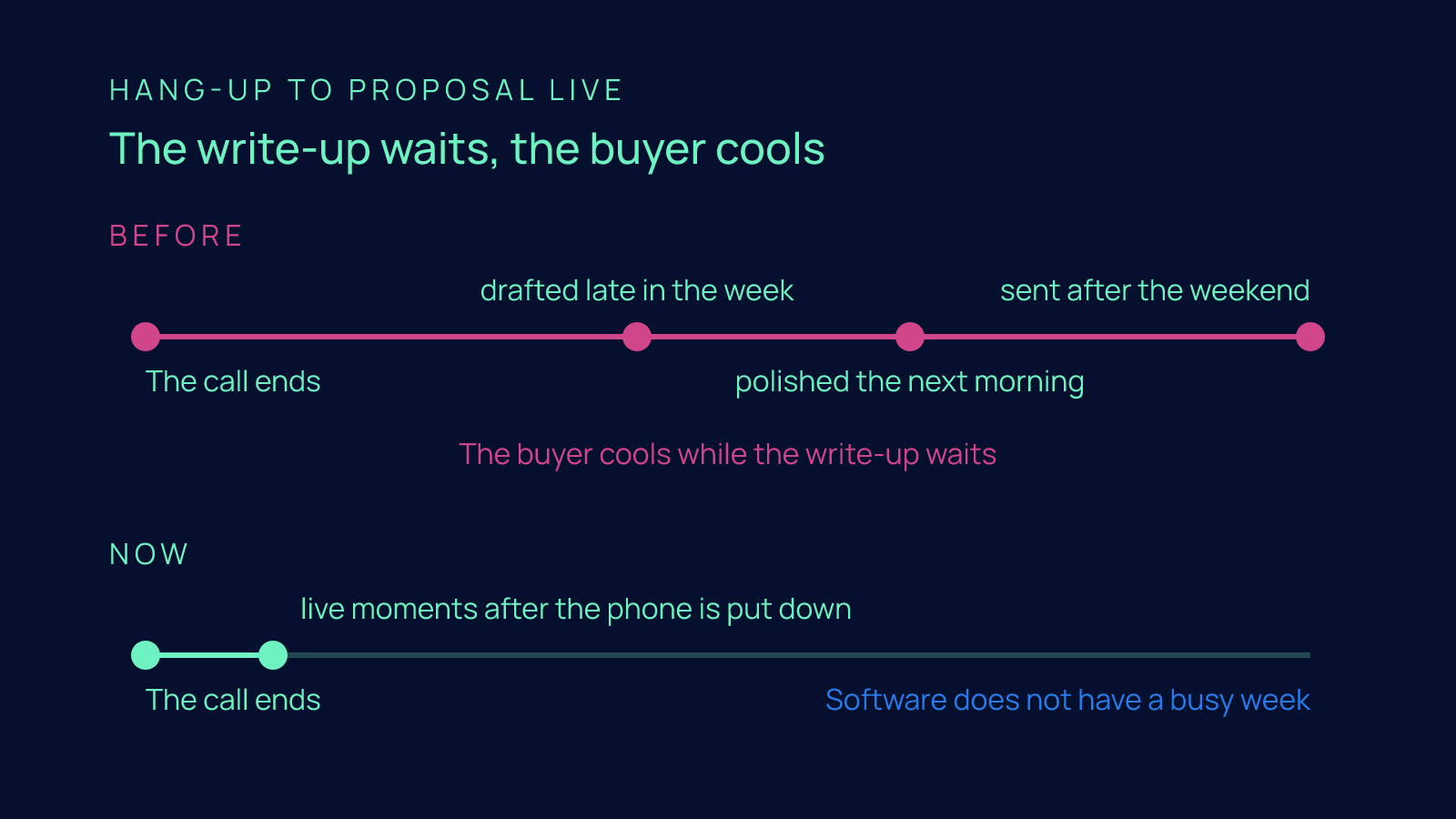
The proposal is not hard. It is the same shape as the last one, with a different name, a different scope and a different number at the bottom. It is a short job for someone who knows the deal.
But the person who knows the deal is you, or your best salesperson, and that person has a day of other calls, a client on fire, a problem only they can fix. So the proposal goes on the list. It sits behind other work. It gets drafted late in the week, polished the next morning, and sent after the weekend.
By then the buyer has had a weekend. They have talked to their partner. They have taken another vendor call. They have reread their budget. They have done what warm buyers always do when they are left alone: they have started talking themselves out of it. The document lands on someone who has already cooled, and it reads like a bill instead of a plan.
Nobody decided this
Nobody in your company chose to send proposals late. There is no policy that says the write-up waits. No one is lazy. The delay is simply what happens when the steps after the call have no design, so they fall to whoever has a free hour, and nobody has a free hour.
That is the pattern I keep seeing in companies that use AI every day and still run on memory. The AI is there. The people are good. The gap is that no one wrote down what happens after the call, who does it, and when. So it happens whenever.
Edge8 lived this one
Speed is not a nice-to-have in sales; speed is the sale.
Our sales calls were fine. The relationship was fine. The price was fine. What was not fine was the gap between the end of the call and the proposal landing with the buyer. The proposal waited behind other work, and the wait was pure admin: pulling notes together, updating the client record, moving the deal on the board, opening the last proposal, swapping details, formatting, checking, sending.
None of that was selling. All of it was friction. And every day the proposal sat in the queue was another day the buyer had to reconsider.
I came out of that period with one line I now say to every founder who will listen: speed is not a nice-to-have in sales. Speed is the sale.
When a buyer is warm, the fastest thing you can do is show them that working with you feels like the call felt. A proposal that arrives while the conversation is still in their head is proof. A proposal that arrives after they have moved on is a chore they have to re-enter. That is not a theory about buyers. It is what happens to you when a vendor takes a week.
What Roberge got right
Design the steps, measure them, then hand the right ones to software, because repeatable beats brilliant and repeatable scales.
Mark Roberge built HubSpot's sales machine, and his book, The Sales Acceleration Formula, makes an argument every founder should take seriously: sales stops being an art the moment it becomes a process. Measurable, repeatable and engineered. That is how he built the sales engine at HubSpot, and the lesson transfers to a company of any size.
The instinct in most founder-led companies runs the other way. We treat sales as a talent. The best person on the team closes because they are brilliant, and the proposal goes out fast when that brilliant person has a quiet afternoon. Roberge's point is that brilliance does not scale and does not repeat. A process does. Design the steps, measure them, then hand the right ones to software, because repeatable beats brilliant, and repeatable is the only thing that scales.
So we engineered our worst gap.
The design: who does what
Before anything was built, we wrote the workflow down the way Day 9 of this season describes: which steps are a person's, which steps are the AI's, and where the handoff is.
The human owns the call, the relationship and the price. Nothing about that moved. The person who sat on the call still decides what we are proposing, who it is for and what it costs. That is judgment, and judgment stays with people.
After the call, the human does one act: the transcript goes into the system.
Everything after that is the AI's job.
The run, step by step
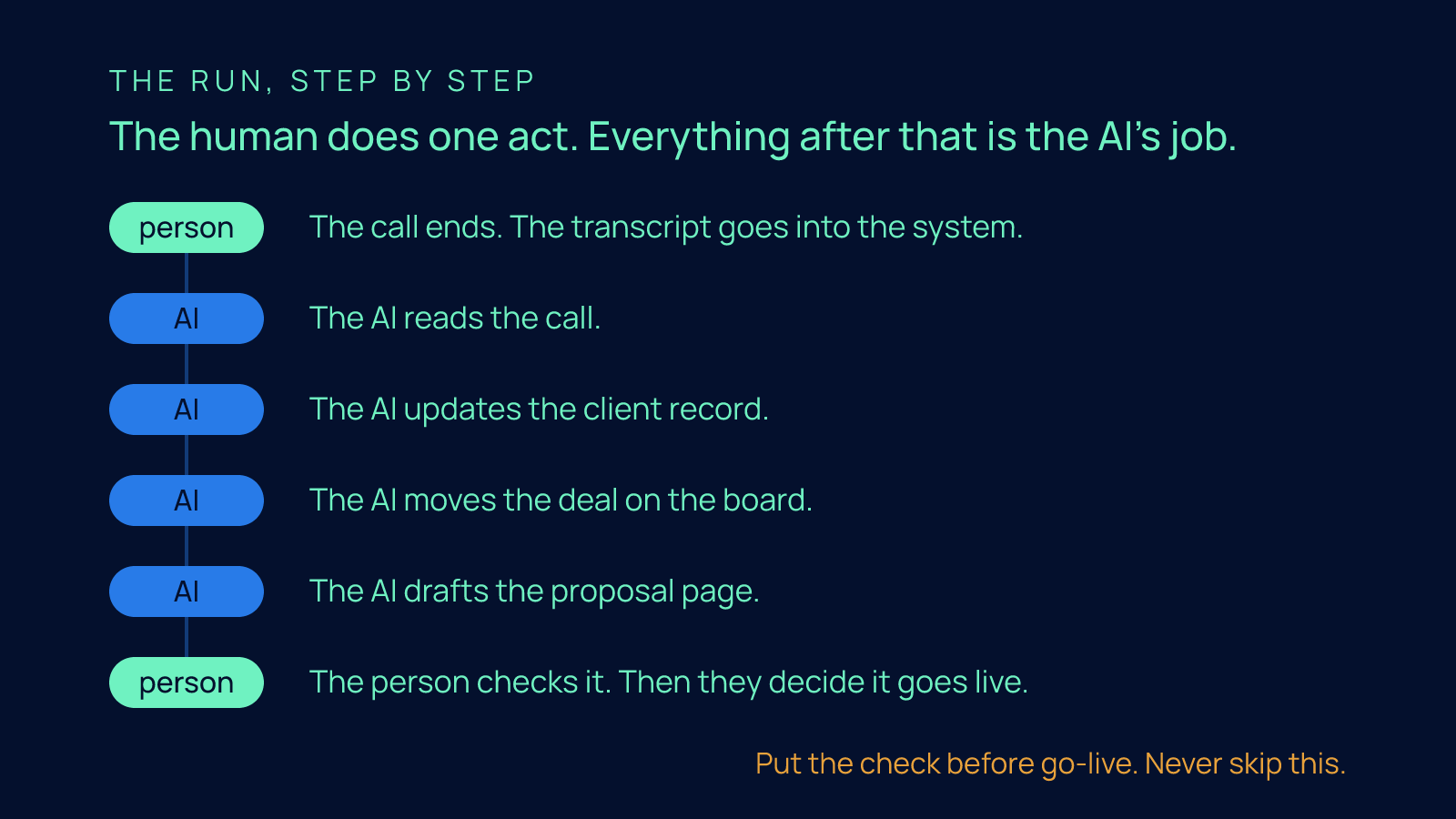
Here is what happens now, every time, in the order it happens.
The call ends. The person drops the transcript into our system. That is the whole handoff. No form, no notes to tidy, no reminder to set.
The AI reads the call. It pulls out who the buyer is, what they asked for, what was agreed and what was left open.
The AI updates the client record. The contact, the context and the substance of the conversation go onto the record in our one database, the same one Day 8 of this season built, so the next person who opens that client sees what was actually said.
The AI moves the deal on the board. The pipeline stage changes to reflect where the conversation actually got to, so the board is true without anyone remembering to update it.
The AI drafts the proposal page. Not a document attached to an email. A page on Edge8's own domain, in Edge8's own format, generated from Edge8's own system, with the scope and terms that came out of the call already in place, ready to review.
The person checks it. They read the draft, correct anything the call did not make clear, confirm the price. Then they decide it goes live.
That is it. The proposal is live moments after the phone is put down. The buyer gets a link while the call is still the most recent thing in their head.
What the AI did, and what the person still decides
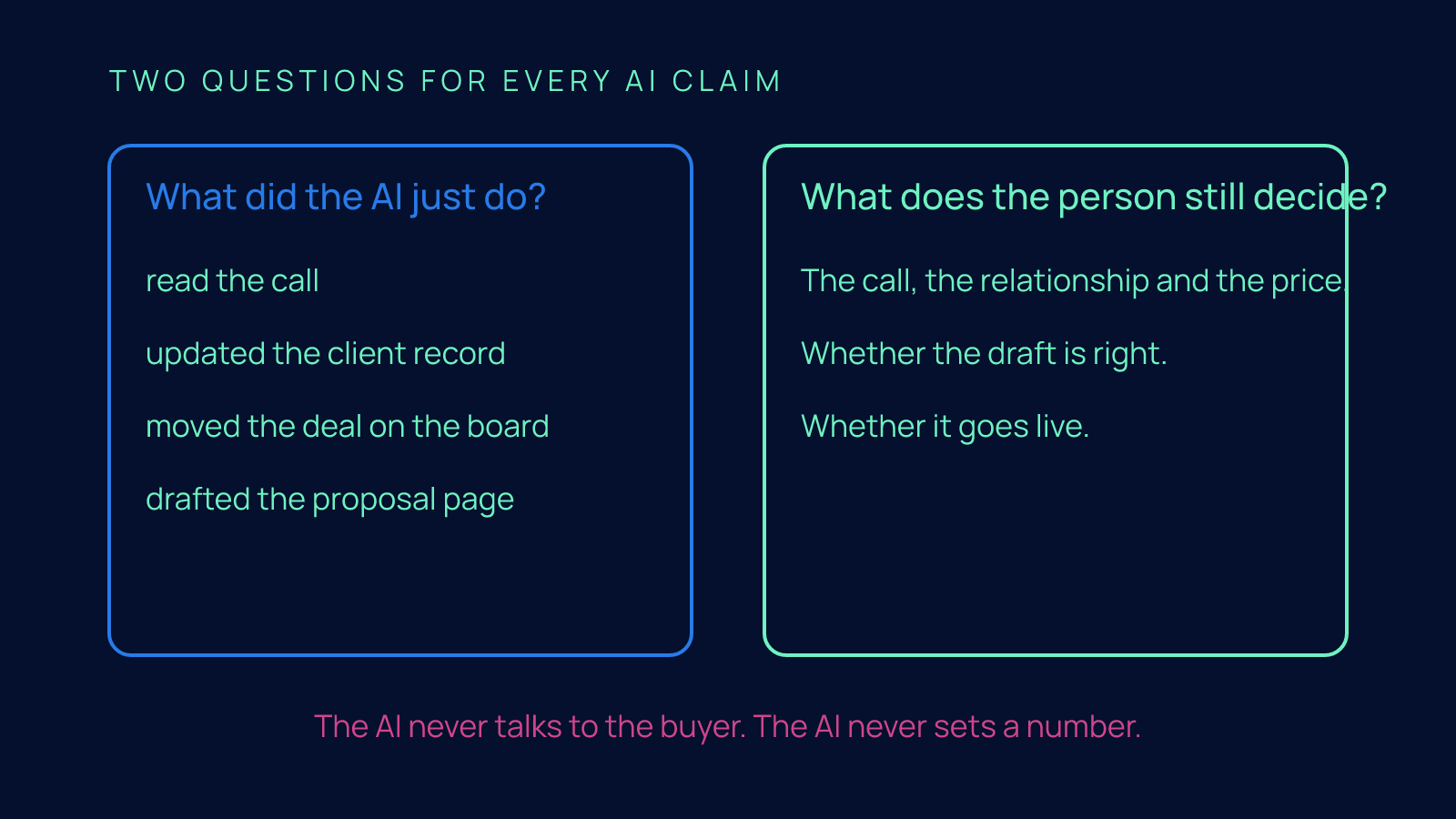
I hold every AI claim to the same two questions, so here they are for this one.
What did the AI just do? It read the call, updated the client record, moved the deal on the board and drafted the proposal page.
What does the person still decide? The call, the relationship and the price. Whether the draft is right. Whether it goes live.
The AI never talks to the buyer. The AI never sets a number. The AI does the admin that used to sit in a queue, and the person does the part that was always theirs.
Software does not have a busy week
Same AI everyone has, different company, because the workflow was designed.
The first run was fast. Every run since has been fast, busy weeks included.
That is the part that matters. A brilliant salesperson can get a proposal out fast on a good day. Software gets it out fast on every day, because software does not have a busy week. It does not have a client on fire. It does not forget which deal it promised to write up. The speed is not a result of effort. It is a result of design.
And here is the detail founders tend to miss: nothing in this workflow needed a prompt. Nobody on our team types instructions into a chat window after a call. The Day 9 playbook runs the whole thing. The steps are written down, the AI reads them, the person does their one act, and the rest happens. If you have been following this season, this is the designed workflow Day 4 previewed, now running in full on a live pipeline.
It is tempting to assume we have something you do not. We do not. The AI we use is the same AI everyone has. Our people are not faster typists. What is different is that the workflow was designed. Somebody wrote down what happens after a sales call, decided which steps belong to a person and which belong to software, and built the handoff so it runs without anyone remembering.
That is the whole edge. Same tools, different company, because the steps have an owner.
How to send a proposal right after a sales call
If you want the short version for your own company, here it is.
Decide what the person owns. For us: the call, the relationship, the price. Write it down.
Decide the one act that starts the machine. For us: the transcript goes into the system. Make it one act, not three.
Write the AI's steps in order. Read the call. Update the record. Move the deal. Draft the proposal in your format, on your domain, from your system.
Put the check before go-live. The person reads the draft and decides. Never skip this.
Measure the gap. The time from hang-up to proposal live. If it is not minutes, something in the design is still relying on memory.
That is how a proposal reaches the buyer while the call is still the most recent thing in their head, and it is how Roberge's argument becomes real in a company nowhere near HubSpot's size.
Watch Day 12, then reply
Day 11 of the 30-day 8 Edges season put every interaction on one CRM so no deal dies of silence. Day 12 takes the next step in the same pipeline: the proposal that waits. The film shows the whole run on our own pipeline, from the transcript going in to the page going live. Day 13 puts a coach on every call.
Watch the Day 12 film. Then reply and tell me where your proposals wait and who they wait on. If you want to see the workflow run on your own pipeline rather than ours, say so and I will set up a demo.
FAQ
How do I send a proposal right after a sales call, within ten minutes of hanging up, instead of letting it wait behind other work while the buyer cools off?
Write the steps after the call down before you build anything, the way Day 9 of the 30-day 8 Edges season describes: which steps belong to a person, which belong to the AI, and where the handoff is. The person owns the call, the relationship and the price, then does one act: the transcript goes into the system. From there the AI reads the call, updates the client record in the one database, moves the deal on the board and drafts a proposal page in your format on your domain, and the person checks it and decides it goes live, moments after the phone is put down. Then measure the gap from hang-up to proposal live; if it is not minutes, something in the design still relies on memory.
Why do warm buyers go cold before my proposal arrives?
Because the proposal is a short job that waits behind other work: it is the same shape as the last one, with a different name, a different scope and a different number at the bottom, but the only person who knows the deal has a day of other calls. By the time it is sent after the weekend the buyer has talked to their partner, taken another vendor call and started talking themselves out of it, so the document reads like a bill instead of a plan. Nobody decided this; it happens when no one wrote down what happens after the call, who does it and when, so the fix is a workflow where the person does one act and the rest runs without memory.
Can AI draft a sales proposal from a call transcript, and what do I still have to decide myself?
Yes, as long as you hold it to the same two questions every time: what did the AI just do, and what does the person still decide. In the workflow Dave Hajdu runs, the AI reads the call, updates the client record, moves the deal on the board and drafts the proposal page with the scope and terms from the call already in place. The person still owns the call, the relationship and the price, reads the draft, corrects anything the call left unclear, and decides whether it goes live. The AI never talks to the buyer and never sets a number.
How do I make my sales process repeatable instead of depending on my best closer having a free afternoon?
Mark Roberge's argument in The Sales Acceleration Formula is that sales stops being an art the moment it becomes a process: measurable, repeatable and engineered, which is how he built HubSpot's sales machine. In a founder-led company the proposal goes out fast only when the brilliant person has a quiet afternoon, and brilliance does not repeat or scale. Design the steps, measure them, hand the right ones to software, and reduce the human trigger to one act, not three, so the proposal goes out fast on every day because software does not have a busy week.
How do I know whether my follow-up after sales calls is actually designed or just running on memory?
Measure the gap from hang-up to proposal live; if it is not minutes, a step is still waiting on someone's free hour. Check whether the person's part is one act (the transcript goes into the system) or three, and whether the client record, the pipeline stage and the proposal draft all happen without anyone typing a prompt or setting a reminder. In the run from Day 12 of the 30-day 8 Edges season, the conversation lands in one database, the same one Day 8 built, so the next person who opens that client sees what was actually said. Same AI everyone has, different company, because the steps have an owner.