
Ask a salesperson how they got good and they will tell you about a deal they lost.
That is not false modesty. It is how the job actually teaches. A deal dies, and if there is a quiet hour that week, someone asks what happened. The rep replays it from memory, the manager adds a note, a lesson gets written down somewhere. Then everyone moves on to the next quarter.
Now think about everything that happened in between.
The discovery call where the rep took the first answer and moved on. The objection the prospect raised in passing, almost as an aside, that nobody circled back to. The demo that ran long on features the buyer had not asked about. None of those calls lost a deal that day. So nobody looked at them. They evaporated.
Reps run dozens of calls a month. The lessons are sitting in those calls, and almost none of them get reviewed. That is why salespeople improve slowly and more or less at random: the only calls that ever get coached are the ones that already failed.
Nobody watches the game film
Pick any other field where performance is measured and you will find people watching film. Athletes do it. Pilots debrief. Surgeons review cases. Running dozens of live performances a month and never studying a single one would be strange anywhere else.
In sales, the film exists. Calls are recorded and transcribed. It sits in a folder. Nobody watches it, because watching it is nobody's job.
Two people pay for that.
The first is your best rep. They are good, and they cannot tell you why. Ask them and you get "I listen" or "I ask better questions," which is true and useless. Their skill lives in countless small moves they make without thinking, and since nobody has studied the film, nobody can name those moves, including them.
The second is your newest rep. They would love to learn from the best rep. The only way to do that is to sit in on calls, and they cannot sit in on enough of them to see the pattern. So they learn the way everyone learns: by losing, slowly.
The gap between the two stays open. Not because anyone is lazy. Because the information that would close it is scattered across more hours of recordings than any human will ever sit through.
Two frameworks already solved this on paper
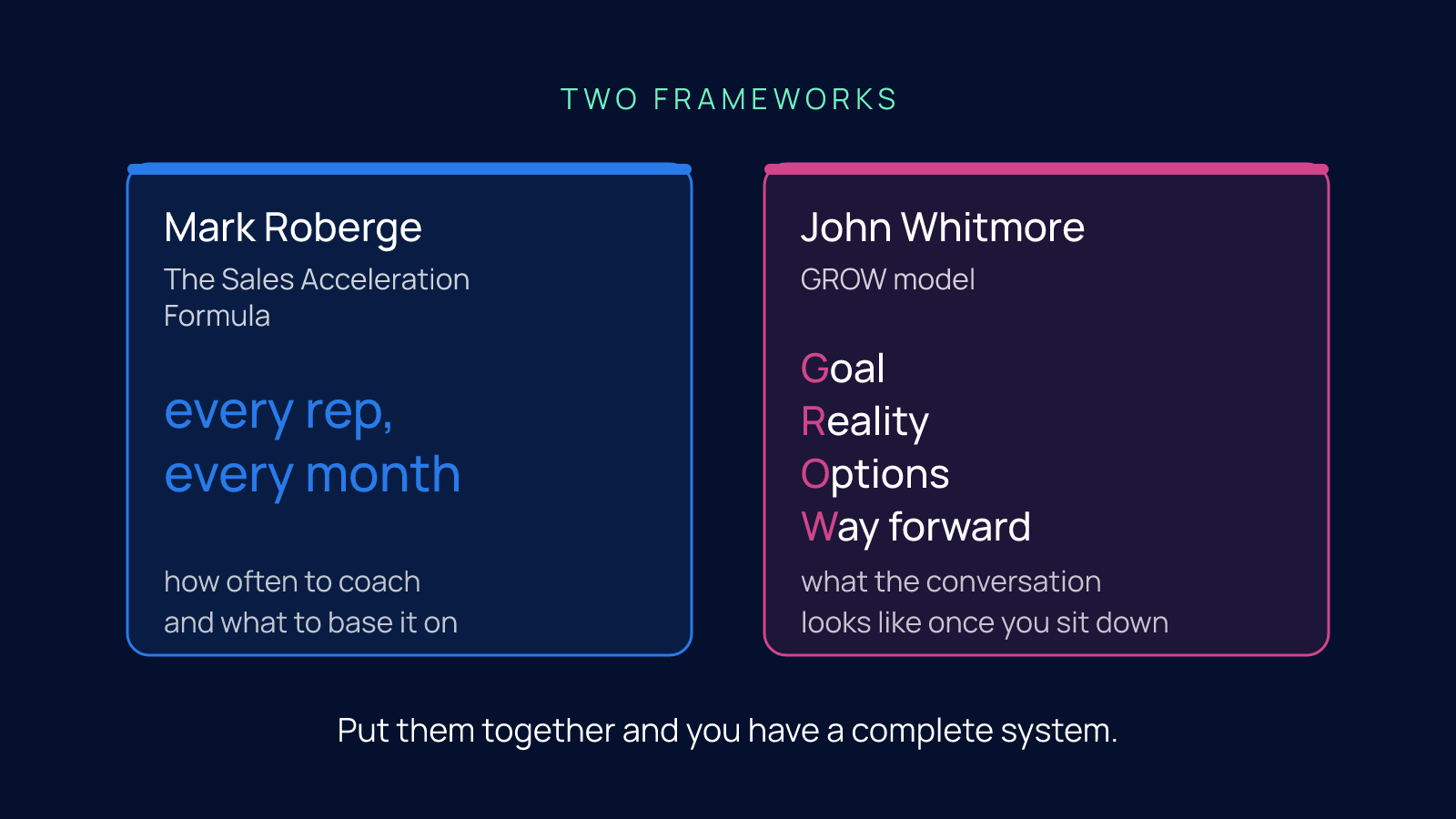
Mark Roberge's formula treats coaching as a metrics-driven habit done on every rep every month, not a pep talk, and John Whitmore's GROW gives the conversation its structure: goal, reality, options, way forward.
This is not an unsolved problem. Two people worked it out years ago.
Mark Roberge, the man who scaled HubSpot's sales from nothing, wrote the first one down in The Sales Acceleration Formula. His position is simple: coaching is not a pep talk, and it is not something that happens only when a deal is big enough to hurt. It is a metrics-driven habit done on every rep, every month. You look at the rep's numbers, you find the one skill that would move those numbers most, you work on that skill, and next month you do it again. Every rep. No exceptions.
John Whitmore wrote the second one. His GROW model gives the coaching conversation its structure: Goal, Reality, Options, Way forward. Start with where the rep is trying to get to. Look honestly at what is actually happening. Lay out what could change. End on one concrete thing to try next. It is a coach's structure, not a judge's. It asks questions before it hands down verdicts.
Put them together and you have a complete system. Roberge tells you how often to coach and what to base it on. Whitmore tells you what the conversation looks like once you sit down.
Most sales leaders I talk to have read at least one of these. Almost none of them run it.
Why your managers skip it
Managers do not do this today because reviewing one call properly takes time nobody has.
It is not that they disagree with Roberge or Whitmore. It is that reviewing one call properly takes time nobody has.
Properly means listening to the whole thing. Noting where discovery went shallow. Catching the objection that slipped past. Thinking about what the rep should have tried instead. Writing it up in a way the rep will actually read before the next call. That is real work, and it is work for one call.
Multiply it by dozens of calls per rep, and by every rep on the floor, and a manager who did it properly would do nothing else.
So managers triage. The lost deal gets reviewed. The big deal gets reviewed. The rep who is visibly struggling gets some attention. Everything else goes uncoached, and the two frameworks that would fix it stay in a book on the shelf.
That is the real reason sales coaching is random in most companies. Not a lack of frameworks. A lack of hours to apply them.
Install the framework instead of teaching it
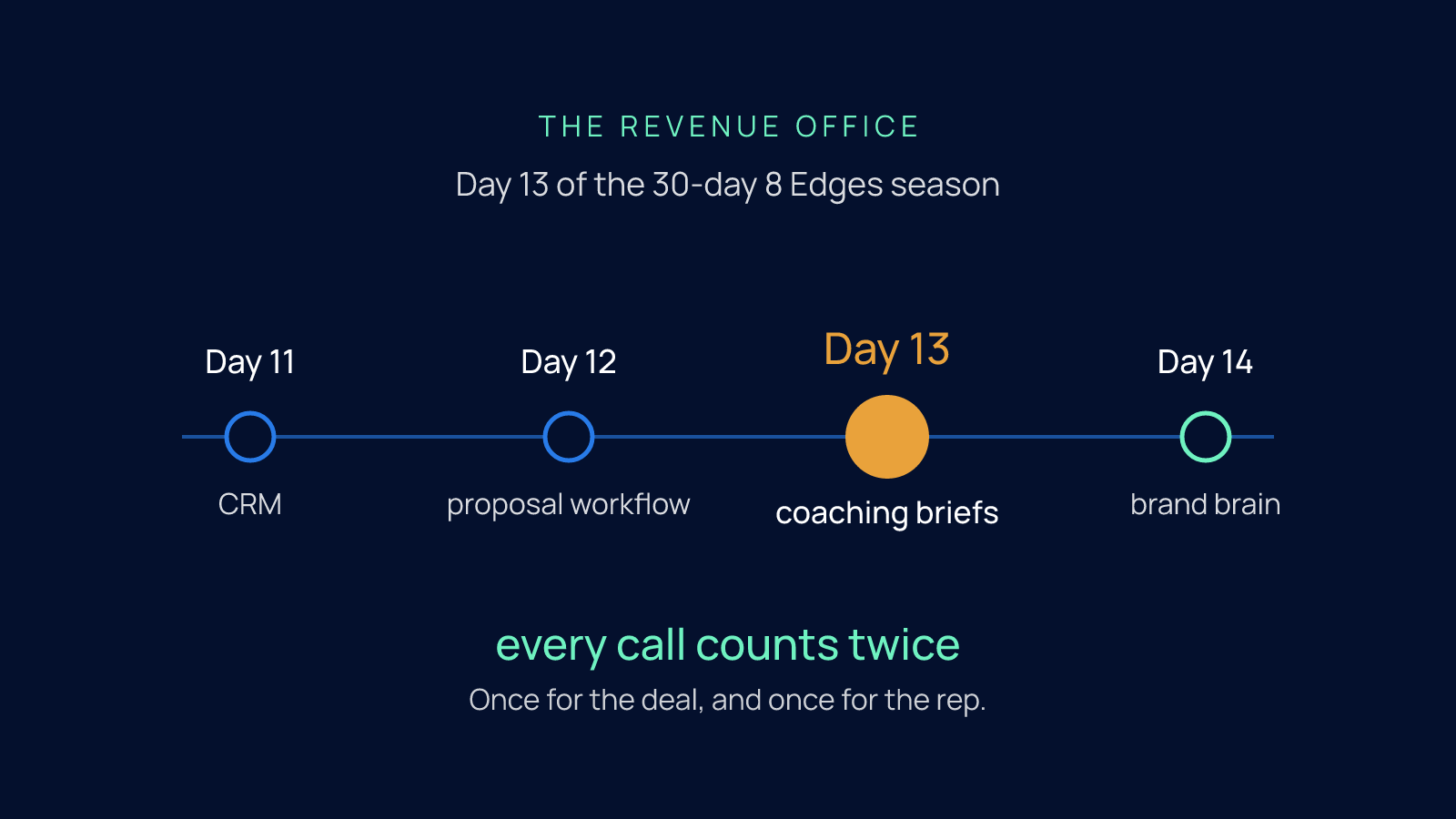
This is Day 13 of the 30-day 8 Edges season, the third episode in the revenue office. On Day 11 we put every customer interaction on one CRM, the single record of every conversation with a customer. On Day 12 we took a call transcript and turned it into a live proposal in one designed workflow. Day 13 uses that same transcript a second time, for a second purpose: coaching the rep who ran it.
We did not ask our managers to memorize Roberge's formula or Whitmore's GROW. We installed them.
Every call transcript comes into sales intelligence, the part of Edge8's own Company OS that reads our sales conversations. The AI reads the transcript and does the game film. It writes a coaching brief: where discovery went shallow, which objection slipped past, and what to try next. The brief is laid out GROW-style, goal, reality, options, way forward, and it is written in a coach's tone rather than a judge's. It points at the moment in the call, says what happened, and suggests one thing to try. It does not grade the rep.
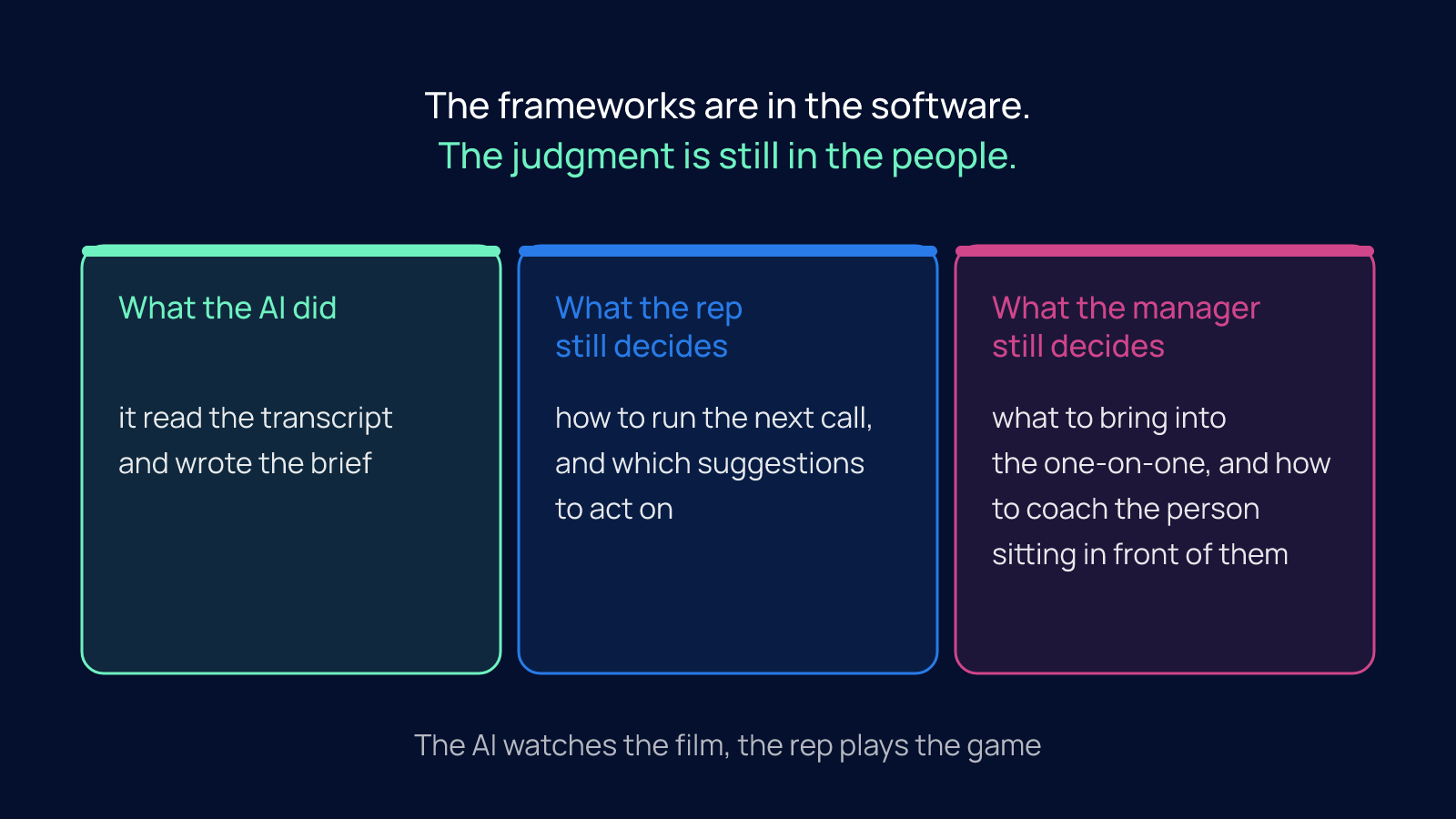
I ask the same two questions of every AI claim, including my own: what did the AI just do, and what does the person still decide?
What the AI did: it read the transcript and wrote the brief.
What the rep still decides: how to run the next call, and which suggestions to act on.
What the manager still decides: what to bring into the one-on-one, and how to coach the person sitting in front of them.
The frameworks are in the software. The judgment is still in the people.
The AI watches the film, the rep plays the game
It is like having Roberge in the room on every call with infinite patience.
The AI watches the film. That is the part no human had time for. It reads every call, not just the lost ones, and every rep, not just the struggling ones. It never gets tired of the same objection slipping past again and again. It never skips a call because the deal was small.
The rep plays the game. The brief lands before the next call, and the rep reads it quickly, the way you glance at notes before walking into a room. One thing to try. Then they run the call, make the choices, and handle whatever the prospect throws at them. The AI is not on the call and is not making the pitch.
The manager holds the one-on-one. Before it, they read the briefs. They walk in already knowing where this rep's discovery tends to go shallow and which objection keeps getting through. The conversation starts from the film instead of from memory, and it goes somewhere.
Nobody schedules anything. There is no new meeting, no review session, no call-listening hour. The briefs are simply there.
It is like having Roberge in the room on every call, with infinite patience.
Every call counts twice
Before this, a call counted once. It was a step toward a deal, and when the deal closed or died, the call was spent.
Now every call counts twice. Once for the deal, and once for the rep.
The best rep's skill starts to become visible, because the briefs name the moves they make: the question that opened discovery up, the way they handled the objection the newest rep let slide. What was invisible instinct becomes something the rest of the team can read.
The newest rep gets a brief after their first call. Not after their first lost deal. On day one, they know where discovery went shallow and what to try tomorrow. The gap between them and the best rep starts closing immediately, instead of some day, if ever.
And the manager finally gets to run Roberge's formula and Whitmore's GROW the way the books describe them: on every rep, every month, with a structure. Not because they found the hours. Because the hours stopped being the bottleneck.
Watch Day 13, then come back for Day 14
The Day 13 film shows the brief itself: a real transcript going in, the coaching brief coming out, and the rep reading it before the next call. Watch it, and listen to the tone. A judge tells you what you did wrong. A coach tells you what to try next.
Day 14 closes the revenue office. Everything the CRM, the proposal workflow and the coaching briefs now know gets pulled into one brand brain, so the whole revenue office speaks with one voice.
If your reps only improve when a deal dies, reply to this and tell me how many calls a month go unreviewed on your floor. I will show you the coaching briefs running live in our own Company OS, and we can talk about what it would take to install them in yours.
FAQ
How do I coach my sales reps on every call instead of only the lost deals, when reviewing one call properly takes time I do not have?
Stop asking managers to do the reviewing and install the coaching framework in software instead. Reps run dozens of calls a month, and reviewing one call properly (listening to the whole thing, noting where discovery went shallow, catching the objection that slipped past, writing it up) is real work for a single call, so managers triage and only the lost and big deals get reviewed. When every call transcript is read by AI that writes a short coaching brief, the two frameworks that already solved this on paper, Mark Roberge's monthly metrics-driven habit from The Sales Acceleration Formula and John Whitmore's GROW model, finally run on every rep because the hours stop being the bottleneck.
What is the GROW model and how do I use it to coach a sales rep after a call?
GROW is John Whitmore's structure for a coaching conversation: Goal, Reality, Options, Way forward. You start with where the rep is trying to get to, look honestly at what actually happened on the call, lay out what could change, and end on one concrete thing to try next. It is a coach's structure rather than a judge's, so the brief points at the moment in the call, says what happened, and suggests one thing to try instead of grading the rep.
How often should sales managers coach their reps, and what should they base it on?
Mark Roberge, who scaled HubSpot's sales from nothing, lays it out in The Sales Acceleration Formula: coaching is a metrics-driven habit done on every rep, every month, with no exceptions. You look at the rep's numbers, find the one skill that would move those numbers most, work on that skill, and next month you do it again. Most sales leaders have read this, yet almost none run it, because applying it to dozens of calls per rep is more hours than any manager has.
What should AI do in sales coaching and what should the manager still decide?
Ask the same two questions of any AI claim: what did the AI just do, and what does the person still decide? In a coaching brief setup the AI reads every call transcript and writes the brief, naming where discovery went shallow, which objection slipped past, and one thing to try next. The rep still decides how to run the next call and which suggestions to act on, and the manager still decides what to bring into the one-on-one and how to coach the person in front of them.
How do I help my newest sales rep learn from my best rep faster?
Two people pay when nobody reviews calls: the best rep cannot explain the small moves that make them good, and the newest rep cannot sit in on enough of the dozens of calls a month to see the pattern, so they learn by losing, slowly. When every transcript produces a coaching brief, the best rep's moves get named in writing, the question that opened discovery up and the way they handled an objection, and the rest of the team can read them. The newest rep gets a brief after their first call rather than their first lost deal, so on day one they know where discovery went shallow and what to try tomorrow.