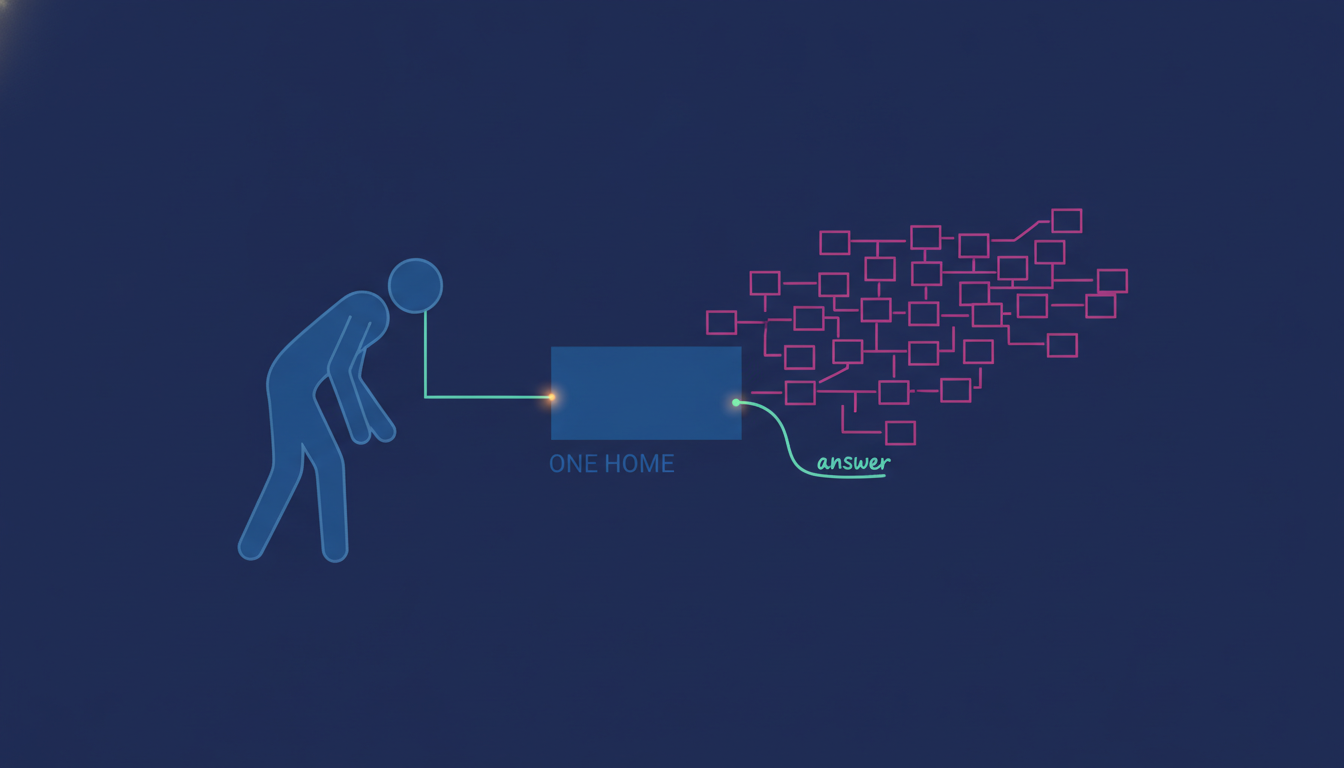
You need one number before the leadership meeting. Which clients have open deals but no meeting in the last thirty days.
That is the whole question. It is not a hard one. Any rep could answer it for their own book from memory.
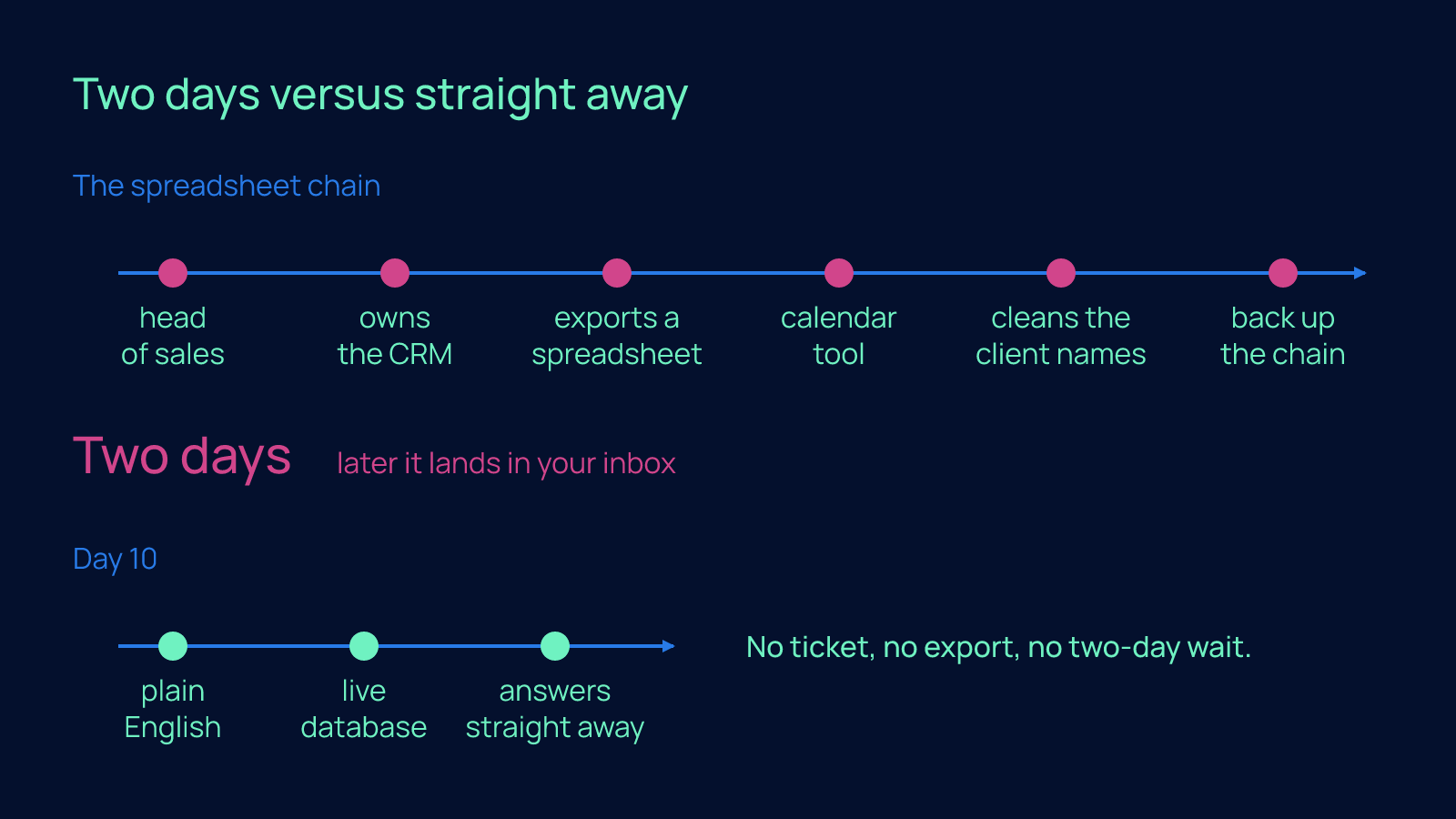
So you ask your head of sales. She asks the person who owns the CRM, the system that holds the sales pipeline. He exports a spreadsheet, lines it up against the calendar tool, cleans the client names that are spelled differently in each system, and sends it back up the chain. Two days later it lands in your inbox.
By then the company has moved. Deals closed. A client booked a call yesterday. The report is already wrong on the day it arrives, everyone in the room knows it, and everyone pretends it is fine.
Most leaders accept this as the price of running a company. That acceptance rests on a handful of myths, and Day 10 of the 8 Edges season takes them apart one at a time. This post is the written version. The film is the proof.
Myth one: the problem is that reports are slow
The real cost is not slow answers but unasked questions, every one not worth two days, so most leaders run on feel because asking is too expensive.
Slow reports are annoying. They are not the real cost.
The real cost is the questions you never ask. Every question in your company has a price tag on it, and right now the price is roughly two days of somebody's time plus the political cost of interrupting them. Most questions are not worth that. So you do not ask them. You round off. You go with your gut. You run the business on feel because asking is too expensive.
Think about how many times in the last week you wanted to know something about your own company and decided it was not worth the hassle. Which customers went quiet. Which proposals have sat untouched. Which projects are burning hours against a fixed fee. You did not ask. Not because the answer did not matter, but because the asking cost more than the answer was worth.
That is not a reporting problem. That is a decision problem. A leader who cannot afford to ask questions makes worse decisions, and nobody can see it happening, because an unasked question leaves no trace.
Myth two: a better analyst or a better dashboard fixes it
This is the standard fix, and it is a trap.
A dashboard answers the questions you had when you built the dashboard. The moment you ask something new, you are back to the spreadsheet chain. The dashboard is a photograph of last quarter's curiosity.
An analyst is better, because an analyst can handle new questions. But an analyst is a translation layer. You speak business, the data speaks tables, and the analyst sits in the middle turning one into the other. Every question still routes through a person, and a person has a queue.
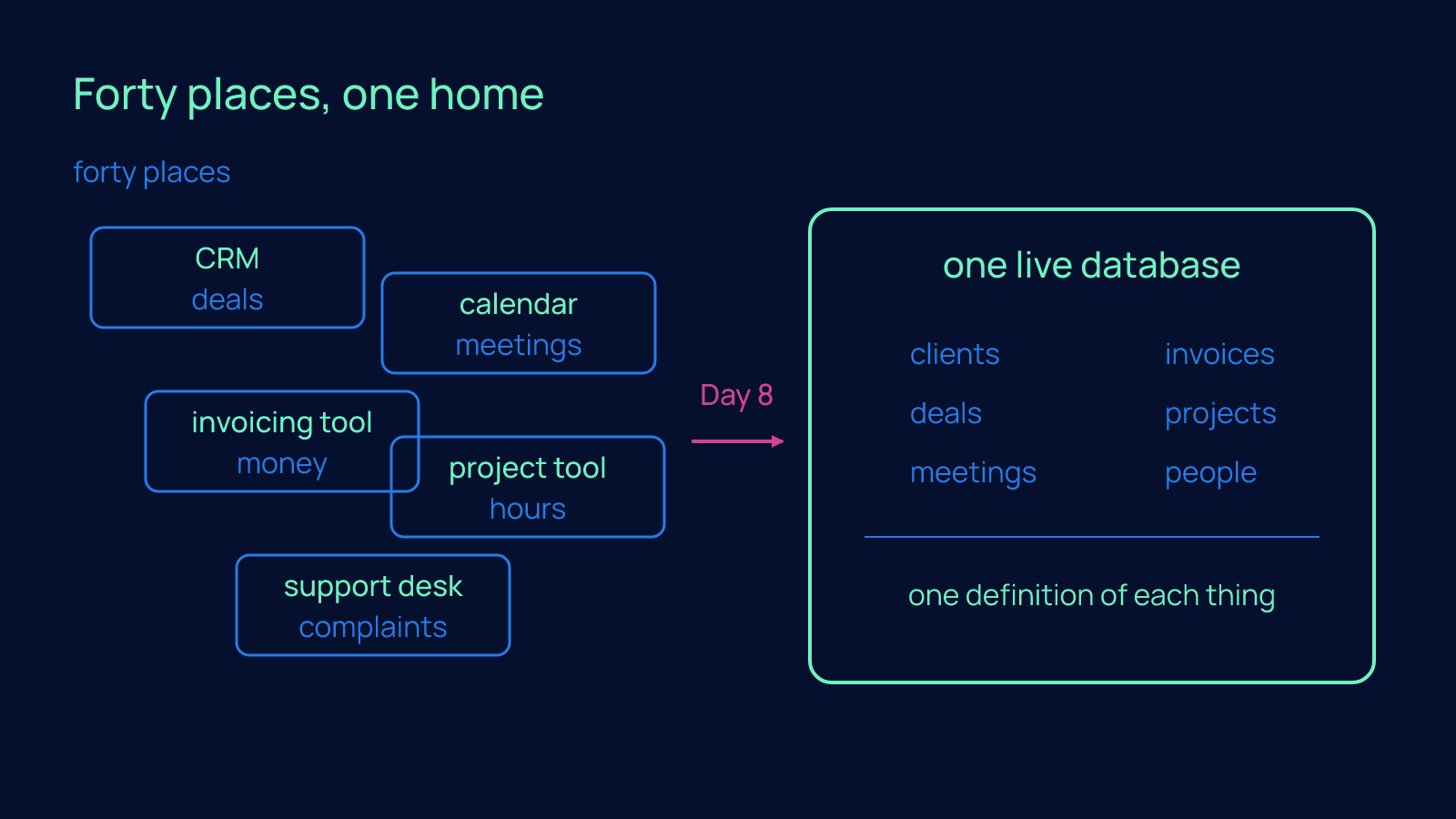
Neither fixes it because neither touches the thing that makes the report expensive. The data lives in forty places. The CRM has the deals. The calendar has the meetings. The invoicing tool has the money. The project tool has the hours. The support desk has the complaints. None of them agree on what a client is called. So answering any question that touches more than one of them means gathering, gathering means people, and people means time.
You cannot fix that with a prettier front end or a faster person in the middle. You fix it by removing the gathering.
Myth three: your data is ready for AI because it is in the cloud
Stanford found that very few companies had data ready for AI, and ready means one thing: the answer has one place to live.
Stanford looked at this and found that very few companies had data that was actually ready for AI. Days 3 and 8 of this season both leaned on that finding. Day 10 is where it bites.
Most founders hear "ready for AI" and think it means clean, or backed up, or in a modern tool. It means none of those things. Ready means one thing: the answer has one place to live.
If the answer to "which clients have open deals but no meeting in the last thirty days" is scattered across a CRM, a calendar and a spreadsheet someone keeps on their desktop, then no amount of AI will fetch it for you. The AI would have to do the same gathering your ops person does, and it would make the same mistakes about which "Acme" is which.
That is what Day 8 bought. Day 8 put every fact in one home: clients, deals, meetings, invoices, projects, people, all in one live database with one definition of each thing. Day 9 wrote down who does what, so the records stay true because someone owns each of them. Neither day was exciting on its own. They were foundation. Day 10 is what the foundation was for.
Myth four: asking your data a question is a demo trick
You have seen the slick demo. Someone types a question into a chat box, a chart appears, the room claps, and later you find out the data was a sample set built for the stage.
In 8 Edges, the assistant sits on Edge8's live database. Our actual company. Every table, every record, the real clients and the real deals.
On Day 10 I ask it the exact question that opened this post: which clients have open deals but no meeting in the last thirty days. It answers straight away. No ticket, no export, no two-day wait. The question goes in plain English, straight to the live database, with no analyst and no translation layer in between.
Then comes the part that matters more than the first answer. The follow-up. I want the open deals broken out by stage. That is not a new request routed to a new person. It is the next sentence. The assistant already knows what we were talking about, so the follow-up costs nothing.
And this is not a dashboard someone built for the film. It is the live company, open to anyone on the team who asks. The salesperson can ask about her own pipeline. The project lead can ask which jobs are over budget. The finance person can ask who has not paid. Same database, same plain English, same instant answer.
That is the difference between a demo and a company. A demo answers the question the presenter rehearsed. A company answers the question you just thought of.
Myth five: once the AI can answer, it is making the decisions
The person still decides what to ask and what to do about the answer; the AI does the fetching and the person does the judging.
This is the fear that stops founders from doing any of this, so let me be exact about who does what.
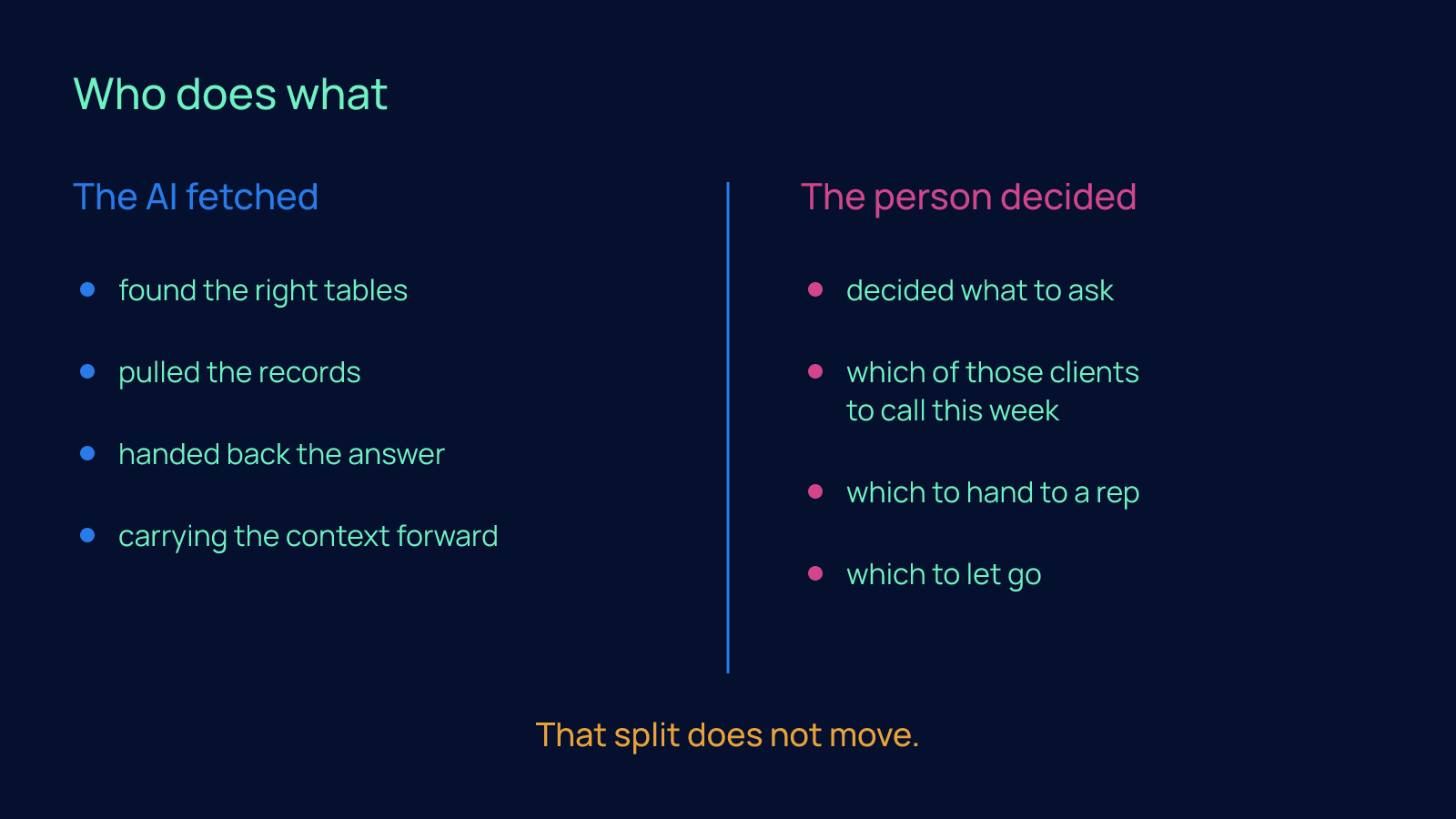
The AI fetched. It took a plain English question, found the right tables, pulled the records, and handed back the answer. On the follow-up it did the same thing again, carrying the context forward.
The person decided. I decided what to ask. I decided that "no meeting in thirty days" was the right signal to worry about. And once the list came back, I decided what to do about it: which of those clients to call this week, which to hand to a rep, which to let go.
That split does not move. The AI does the fetching. The person does the judging. If anyone sells you a system where the AI also decides what to do about the answer, walk away, because they have either not built it or not thought about it.
What changes when answers are free
When a question costs two days, you ask a handful a quarter and run on feel the rest of the time.
When a question costs nothing, you ask the follow-up. Then the follow-up to that. You ask the small questions that were never worth a ticket. You notice the client who went quiet before they leave instead of after. You stop arguing about whose spreadsheet is right because there is only one set of facts and anyone can check it.
And something else happens that I did not expect when we built this. People ask better questions. Not more questions, better ones. When the price of a bad question drops to zero, you stop rationing and start exploring, and exploring is where the useful questions live.
The leader still has to be curious. The leader still has to know what matters. The AI does not supply judgment. It just stops charging you for using it.
The next step
Day 8 put every fact in one home. Day 9 wrote down who owns what. Day 10 is the payoff: once both exist, every question in the company becomes cheap, and the answer Day 8 promised finally arrives. Day 11 walks into the Office of Revenue, where this stops being a question in a chat window and becomes the way a sales team runs its week.
Watch the Day 10 film and see the question asked and answered on Edge8's live database, follow-up included. Then write down the one question about your own company you have not asked in the last month because it was not worth two days.
Reply with that question. We will talk about what it would take for your data to have one home and who would need to own it. Not a dashboard. A company that answers.
FAQ
How do I ask my own data a question and get the answer straight away instead of waiting two days for a report that is already wrong when it lands?
Stop routing the question through people and route it through one database instead. Right now a simple question like which clients have open deals but no meeting in the last thirty days costs roughly two days of someone's time, because the facts sit in forty different tools and a person has to gather and reconcile them. Once every fact lives in one live database with one definition of each client, deal and meeting, you type the question in plain English, the AI fetches the records directly, and the follow-up is just the next sentence. On Day 10 of the 8 Edges season that exact question is put to Edge8's own live company database and answered immediately, with no ticket, no export and no analyst in between.
Why won't a better dashboard or a sharper analyst fix my slow company reporting?
Because neither touches the thing that makes the report expensive: the data lives in forty places, so any question that spans more than one tool means gathering, gathering means people, and people means a queue. A dashboard only answers the questions you had when you built it, and the moment you ask something new you are back to the spreadsheet chain and the two-day wait. An analyst can handle new questions but is a translation layer between your business language and the tables, so every question still waits on a person. The fix is removing the gathering by giving every fact one home, not a prettier front end or a faster person in the middle.
What does it actually mean for business data to be ready for AI, and is being in the cloud enough?
Being in the cloud, backed up or in a modern tool is not what ready means. Stanford looked at this and found that very few companies had data that was actually ready for AI, and the practical definition is simple: the answer to any question has one place to live. If the answer to which clients have open deals but no meeting in the last thirty days is split across a CRM, a calendar and a spreadsheet on someone's desktop, the AI would have to do the same gathering your ops person does and make the same mistakes about which Acme is which. Ready means one live database with one definition of each thing, plus a named owner for each record so it stays true.
If an AI can answer questions about my company instantly, is it making the decisions for me?
No, and the split should be explicit every time. The AI fetched: it took a plain English question, found the right tables, pulled the records and handed back the list, then did the same on the follow-up for open deals broken out by stage. The person decided: what to ask, that no meeting in thirty days was the right signal to worry about, and once the list came back, which clients to call this week, which to hand to a rep and which to let go. If anyone sells you a system where the AI also decides what to do about the answer, walk away, because they have either not built it or not thought about it.
What changes in how I run my business once asking a question about it costs nothing?
When a question costs two days you ask a handful a quarter and run on feel the rest of the time, and the unasked questions leave no trace in your decisions. When a question costs nothing you ask the follow-up, then the follow-up to that, and the small questions that were never worth a ticket: which customers went quiet, which proposals sat untouched, which fixed-fee projects are burning hours. You notice the client who went quiet before they leave instead of after, and you stop arguing about whose spreadsheet is right because there is only one set of facts anyone can check. People also ask better questions, not just more, because when the price of a bad question drops to zero you stop rationing and start exploring.