There is a sentence nobody says out loud at the leadership offsite. Everyone in the room knows it. Nobody puts it on a slide.
Operations will never make you money.
It is a cost center. It always was. And it will happily eat unlimited amounts of your best people's time. Leave requests. The laptop nobody can find. The vendor contract nobody remembers signing. None of it grows the company, and all of it has to happen.
I have built companies most of my working life, TINYpulse among them, and I have never once heard an operations function ask for less. The requests only go one direction. More headcount, more tools, more process, more meetings about the process. Each ask sounds reasonable on its own. Together they are the quietest way a company gets heavy.
The usual answer is the trap
Most companies respond to ops pain the same way. Something slips. A laptop goes missing for a month. Two people on the same small team get their leave approved for the same week. A contract auto-renews that nobody wanted. And the fix is always to add. Put a coordinator on it. Buy a system. Write a policy. Start a weekly meeting.
The pain goes away for a while, because now there is a person whose job is to chase. But you have not removed the chasing. You have made it someone's job. Work that creates no value now has a salary attached and a seat at the table, and it will defend itself the way every department defends itself.
That is the trap. A messy ops function pushes you to grow ops. A bigger ops function creates more surface area for more admin, more approvals, more forms, which pushes you to grow it again. I have watched founders build operations teams that were genuinely impressive. Well run, well documented, fully resourced. Not one of those companies was better for it, because the goal was never to make operations impressive.
The goal is small, not impressive
The goal was never to make operations impressive; the goal is to make it small.
Say it plainly: the best operations function is the smallest one that still works.
Not the leanest-sounding. Not the one with the best org chart. The smallest. Every person and every hour in operations is a person and an hour not spent on the thing customers pay you for. That is not a criticism of the people doing the work. It is a description of the work. Admin is overhead by definition, and the honest response to overhead is to shrink it, not to professionalize it.
Once you accept that, the question changes. It stops being "how do we run operations better" and becomes "how much of this can we make disappear." Hold that question. Everything that follows is an answer to it.
Toyota named this problem decades ago
Lean thinking is one move repeated forever: find the waste, remove it, keep the value.
You do not have to invent the thinking. The Toyota Production System named it long before any of us had an inbox.
Waste, in that system, is any activity that consumes resources but creates no value for the customer. It is not a moral judgment. Nobody is lazy. It is a category: work that costs something and produces nothing the customer would pay for. And it comes in recognizable forms. Waiting. Handoffs. Rework. Chasing information that should already be in front of you.
Here is the part that should sting. The customer never pays for any of it. You do. Every minute of waiting and every re-entered form comes straight out of your margin or your team's evenings.
Lean thinking, which grew out of Toyota's approach, is one move repeated forever: find the waste, remove it, keep the value. That is the whole discipline. Not a transformation program. Not a certification. One move, done this week and done again next week, until the only work left is the work that matters.
Your factory floor is the inbox
Most founders skip past Lean because it sounds like a factory thing. It is not. You do not need a production line. You need an honest look at where your people's hours actually go.
Take that look in a modern company and you will not find the waste on a shop floor. You will find it in the admin. The chasing. The reminding. The re-typing of things the company already knows.
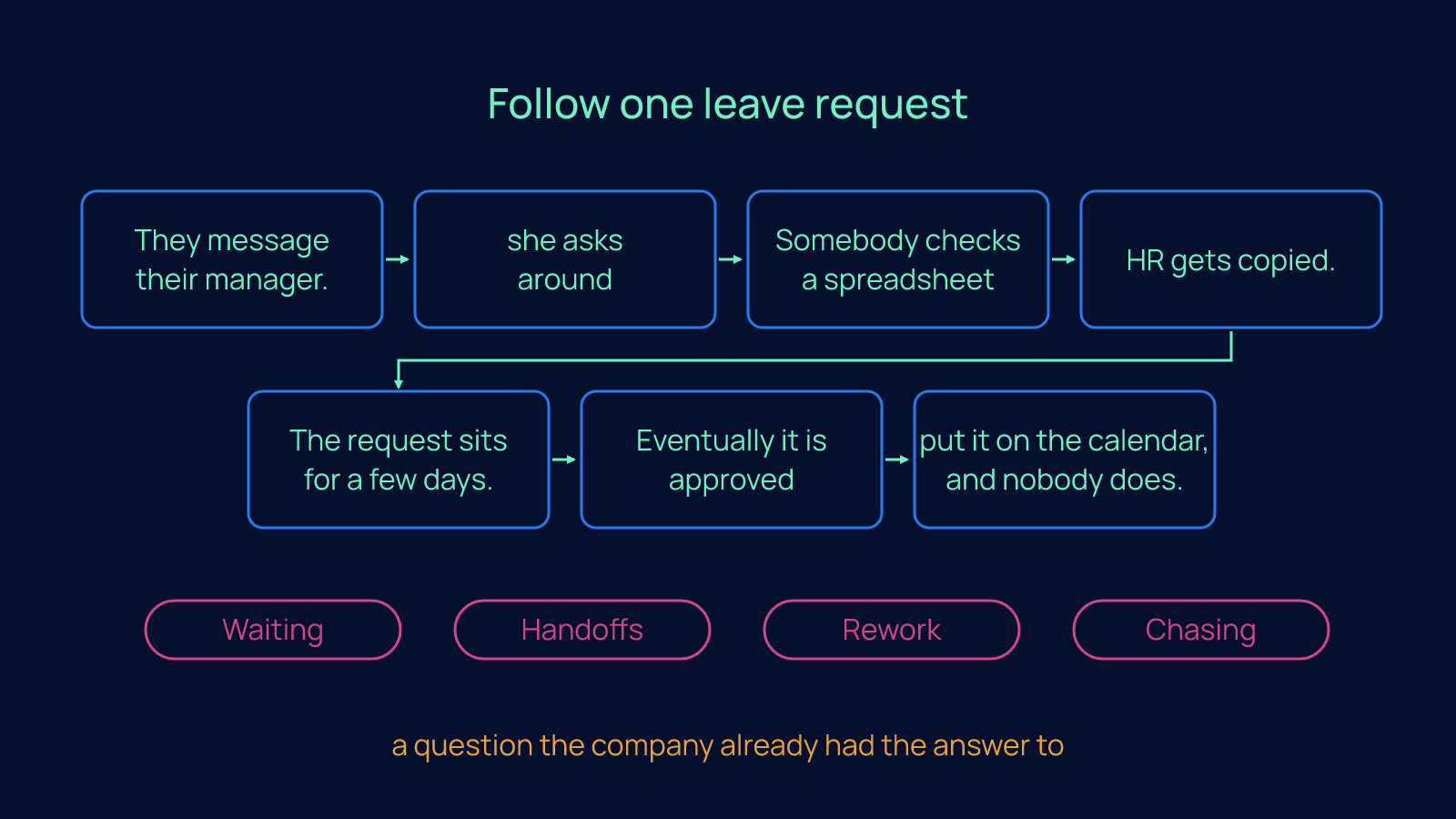
Follow one leave request. Someone wants a week off in the spring. They message their manager. The manager cannot remember who else is off that week, so she asks around. Somebody checks a spreadsheet that was last updated in the winter. HR gets copied. The request sits for a few days. Eventually it is approved, and then someone has to remember to put it on the calendar, and nobody does. That is waiting, handoffs, rework and chasing, all of it, for a question the company already had the answer to.
Now do the same for the laptop that was handed to a contractor who left, or the software subscription that renewed because the contract lived in an email thread. Same pattern every time. The information existed. It just lived in someone's head or someone's inbox, so a person had to go and get it.
What small looks like: the operations wing of 8 Edges
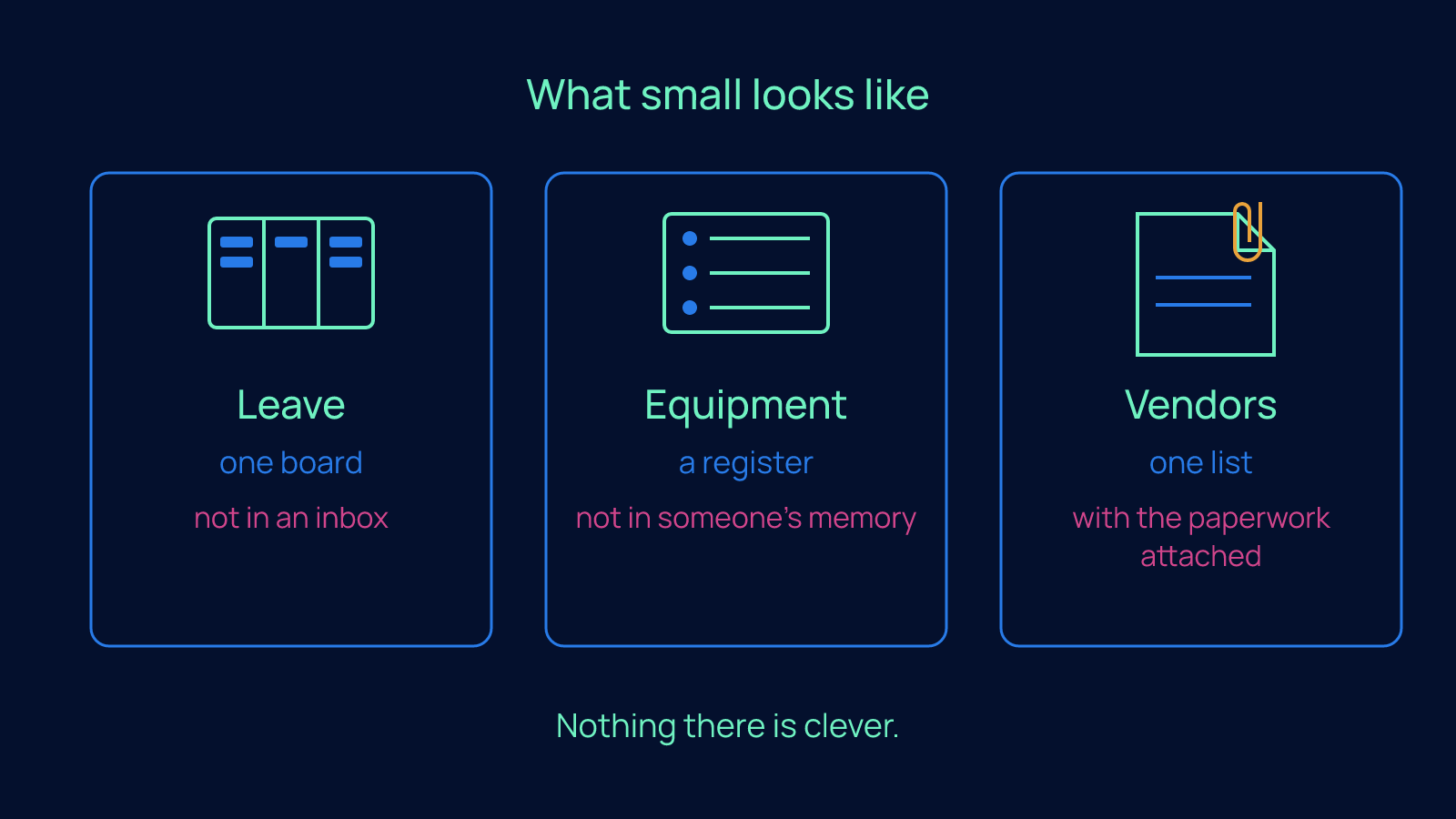
The operations wing of 8 Edges is what small looks like in practice. These screens are live in Edge8's own Company OS. We run on them. I am going to describe them plainly, and I am going to resist making them sound clever, because the point is that they are not.
Leave lives on one board, not in an inbox. Every request, every approval, every day off for every person, in one place the whole company can see. The manager does not ask around. The spreadsheet does not exist. The question of who is off next week is answered by looking.
Equipment lives in a register, not in someone's memory. Every laptop, every phone, every monitor, with who has it and since when. When someone joins, the register knows what they were given. When someone leaves, the register knows what has to come back. Nobody has to remember.
Vendors live in one list with the paperwork attached. Every supplier, every contract, every renewal date, with the signed document sitting right there. Nobody remembers signing it because nobody has to. The list remembers.
Nothing there is clever. I want to be honest about that, because the market is full of people selling you clever. Each screen exists for one reason: to make a whole category of chasing disappear. Not to make it faster. To make it gone.
What the AI does and what you still decide
The AI does the tracking, the filing and the record keeping; the people decide the exceptions and the judgment calls, and only those.
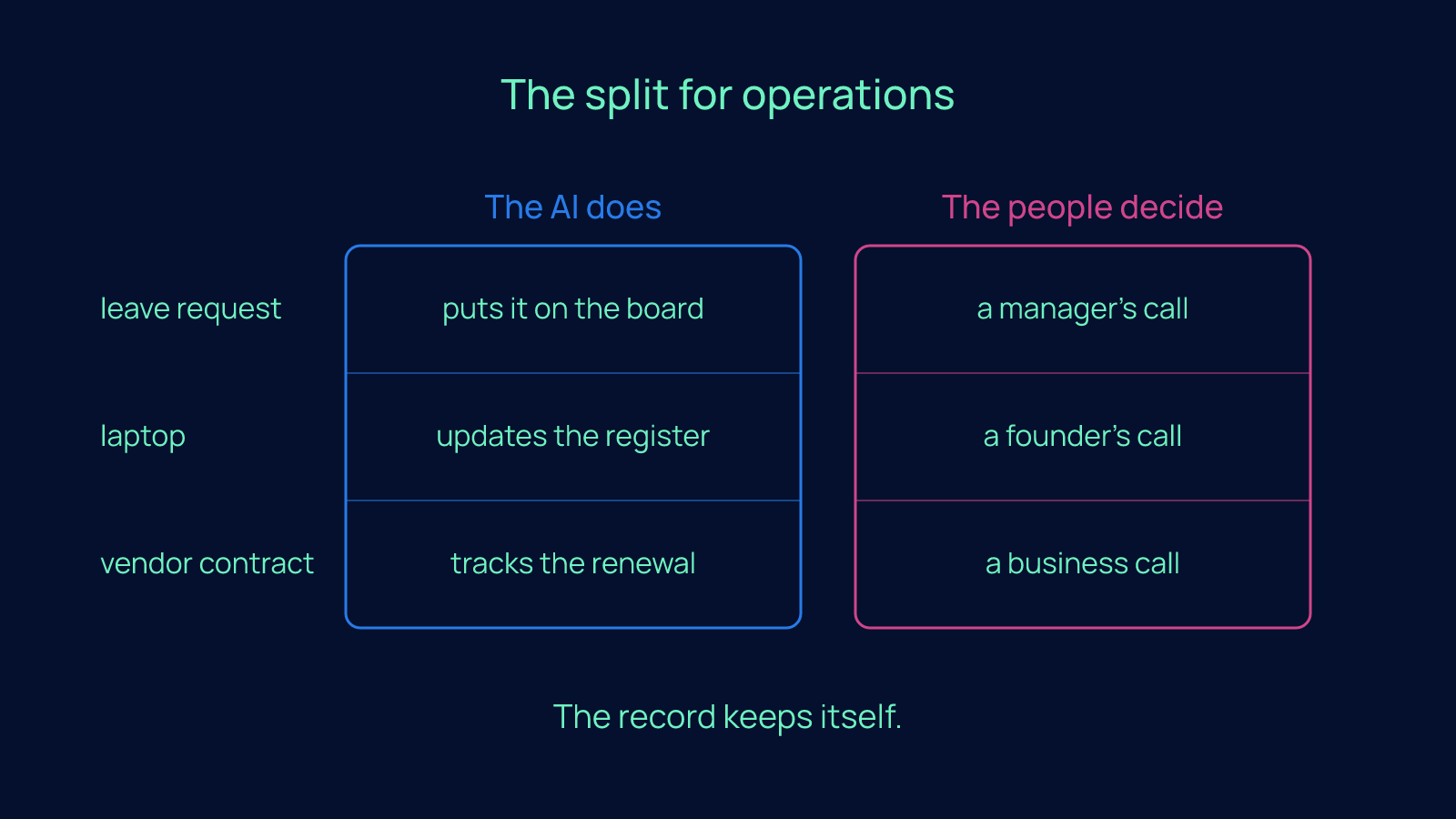
Every claim about AI in this season answers the same two questions. What did the AI just do, and what does the person still decide. Here is the split for operations.
The AI does the tracking, the filing and the record keeping. When a leave request comes in, the AI puts it on the board and flags that someone else on the same team is already out that week. When a laptop is assigned, the AI updates the register. When a vendor contract is uploaded, the AI files it against the vendor and tracks the renewal.
The people decide the exceptions and the judgment calls, and only those. Whether two people off the same week is a problem for this particular team is a manager's call. Whether a departing employee keeps the laptop as a parting gift is a founder's call. Whether to renew the vendor is a business call. Those are the decisions a human should be making, and in a company that runs small, those are the only ones a human is asked to make.
That split matters more than any feature. The failure mode of most AI in operations is that it adds a layer: now a person checks the AI, and the chasing comes back with a new name. The design I am describing removes the layer. The record keeps itself, and a person shows up only when something needs deciding.
Where the hours go
Every hour operations does not consume is money back. That is the cost center argument turned the right way around. You cannot make ops profitable, but you can make it cheap, and the cheapest ops function is the one that barely needs anyone.
More importantly, it is an hour your best people spend on revenue or on building something new. The manager who is not asking around about leave is coaching her team. The founder who is not hunting for a contract is in front of a customer. The engineer who is not filling in an equipment form is shipping. That is what streamlined operations means. Not an operations team that looks good. An operations function so small you forget it is there, and a company where the people you brought in for their judgment spend their days using it.
Watch Day 20, then come back for Day 21
Day 20 of the 30-day 8 Edges season opens the Operations block of Act 2, the last office before Act 3. Days 15 to 19 built the Talent office. Day 20 states the thesis you just read, run ops lean because it is a cost center, and names the four episodes that follow: the busywork board, the books, the bottleneck, and where the saved hours go. Day 21 takes the first of them, the busywork board.
Here is your next step. Watch the Day 20 film today. Then, if you want to see the leave board, the equipment register and the vendor list running inside Edge8's own Company OS, reply to this post and I will walk you through them. Day 21 is tomorrow, and it starts with the busywork board.
FAQ
How do I keep operations small as my company grows instead of hiring more people to chase leave requests, missing laptops and vendor contracts?
Accept that operations is a cost center and set the goal accordingly: the best operations function is the smallest one that still works, not the most impressive. The trap is that something slips, like two people on the same small team getting leave approved for the same week, and the fix is always to add a coordinator, a system or a weekly meeting, which turns chasing into a salaried job. Instead, make whole categories of chasing disappear: leave lives on one board, equipment in a register, and vendors in one list with the paperwork attached, so the information the company already has is answered by looking rather than by a person going to get it. The AI keeps the records and a person shows up only when something needs deciding.
What counts as waste in my business if I am not running a factory?
The Toyota Production System defined waste as any activity that consumes resources but creates no value for the customer, and it shows up as waiting, handoffs, rework and chasing information that should already be in front of you. In a modern company that waste is not on a shop floor, it is in the admin: follow one leave request through a manager asking around, a stale spreadsheet, HR being copied and days of sitting, and you find every form of it for a question the company already had the answer to. Lean thinking, which grew out of Toyota's approach, is one move repeated forever: find the waste, remove it, keep the value. The customer never pays for any of it; you do.
Why does adding a coordinator or a new system every time something slips in operations make the company heavier?
Because operations requests only go one direction: more headcount, more tools, more process, more meetings about the process, and each ask sounds reasonable on its own. When you put a person on the chasing you have not removed it, you have given it a salary and a seat at the table, and a bigger ops function creates more surface area for more approvals and forms, which pushes you to grow it again. Dave Hajdu has watched founders build well run, fully resourced operations teams, and not one of those companies was better for it, because the goal was never to make operations impressive.
What should AI handle in operations and what should my managers still decide?
Every claim about AI should answer the same two questions: what did the AI just do, and what does the person still decide. In operations the AI does the tracking, the filing and the record keeping: it puts a leave request on the board and flags that someone else on the team is already out that week, updates the equipment register when a laptop is assigned, and files a vendor contract and tracks its renewal. People decide only the exceptions and judgment calls, so whether two people off the same week is a problem for this particular team is a manager's call, and whether to renew the vendor is a business call. The failure mode to avoid is adding a layer where a person checks the AI, because then the chasing comes back with a new name.
What happens to the hours my team gets back when admin stops eating them?
Every hour operations does not consume is money back: you cannot make ops profitable, but you can make it cheap, and the cheapest ops function is the one that barely needs anyone. More importantly, those hours go to revenue or to building something new, so the manager not asking around about leave is coaching her team and the founder not hunting for a contract is in front of a customer. This is Day 20 of the 30-day 8 Edges season, which opens the Operations block after Days 15 to 19 built the Talent office, and it names the four episodes that follow: the busywork board, the books, the bottleneck, and where the saved hours go.