Walk into most companies on a Tuesday morning and here is what you will find. Sales says the pipeline is the fire. Engineering says the release is the fire. Finance says the month-end close is the fire. Support says the ticket queue is the fire. Every team is holding a hose, every team is right about its own patch of smoke, and the founder is walking the line trying to give each one a little more water.
I have run companies exactly like that. It feels like leadership. It is the most expensive habit a founder can have.
Here is the truth underneath the wall of urgent. At any moment, one constraint sets the pace for your whole company. One team, one step, one approval that everything else is quietly waiting on. Improve anything else and you have improved nothing. You have polished a machine that is still waiting on its slowest part.
The skill is not working harder on everything. The skill is knowing which one thing is the thing. This is Day 23 of the 30-day 8 Edges season, and it is about finding that one thing: first the framework, then how the numbers get watched inside Edge8's own Company OS so my best people do not have to watch them.
A company is a chain
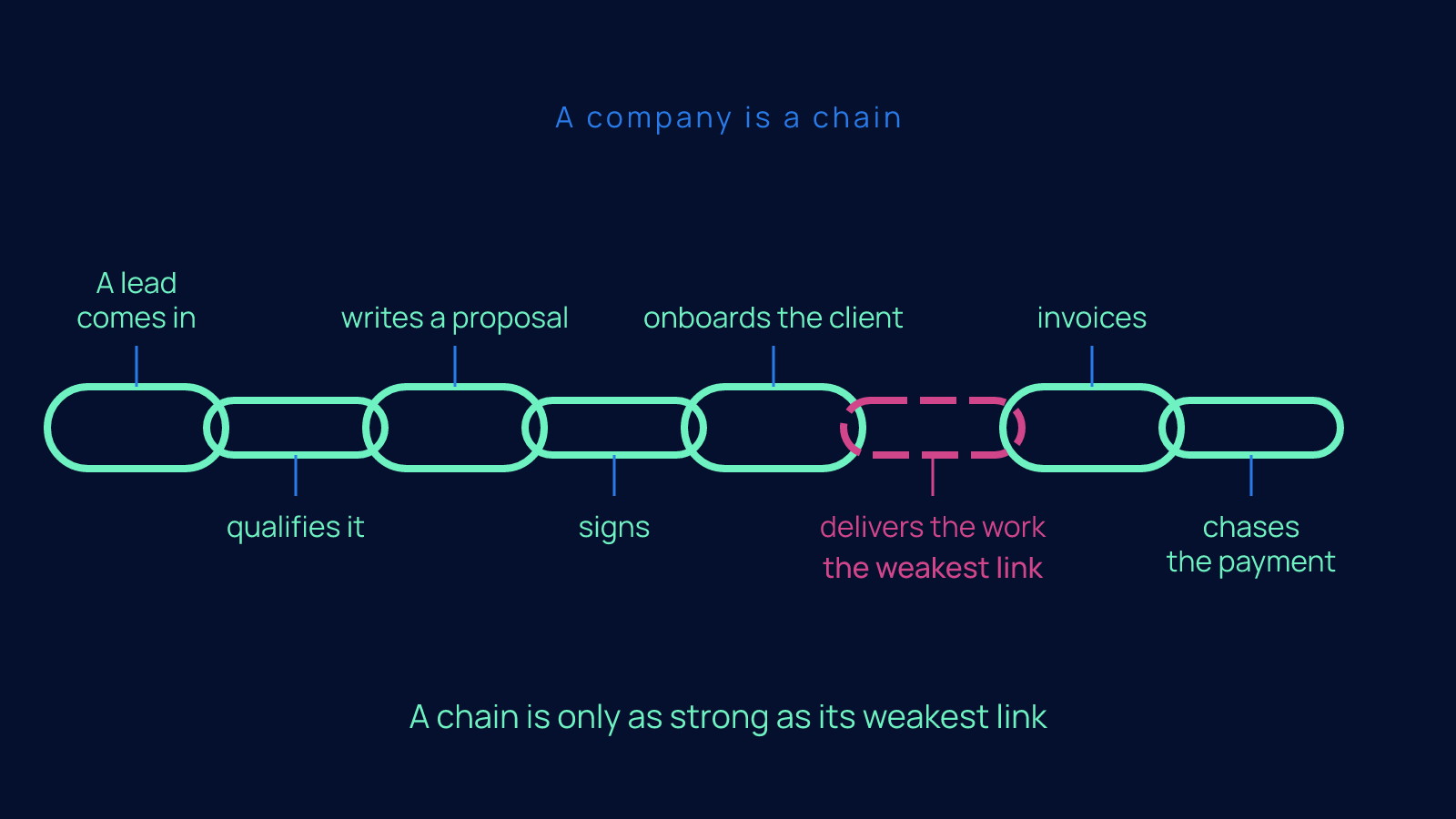
a chain is only as strong as its weakest link, and a company is a chain.
Eliyahu Goldratt spent his career on this problem and gave it a name: the Theory of Constraints. He did not teach it in a textbook. He taught it in a business novel, The Goal, which is still the best management book I know for a founder who learns by watching someone else struggle.
The idea fits in one sentence. A chain is only as strong as its weakest link, and a company is a chain.
Think about how money actually moves through your business. A lead comes in. Someone qualifies it. Someone writes a proposal. Someone signs. Someone onboards the client. Someone delivers the work. Someone invoices. Someone chases the payment. Each of those is a link, and the work has to pass through every one of them in order. If one link stops, nothing downstream moves, no matter how fast the other links are.
Now the uncomfortable part. If you strengthen a link that was not the weakest, the chain holds exactly the same weight it held before. You spent money, you spent attention, you spent political capital, and the output of the company did not change by a single unit.
In my experience most effort in most companies goes to links that were already strong enough. It goes where the loudest people are, or where the founder is most comfortable, or where the last customer complained. It almost never goes to the quiet step everyone is waiting on, because waiting is silent.
The five steps, in plain words
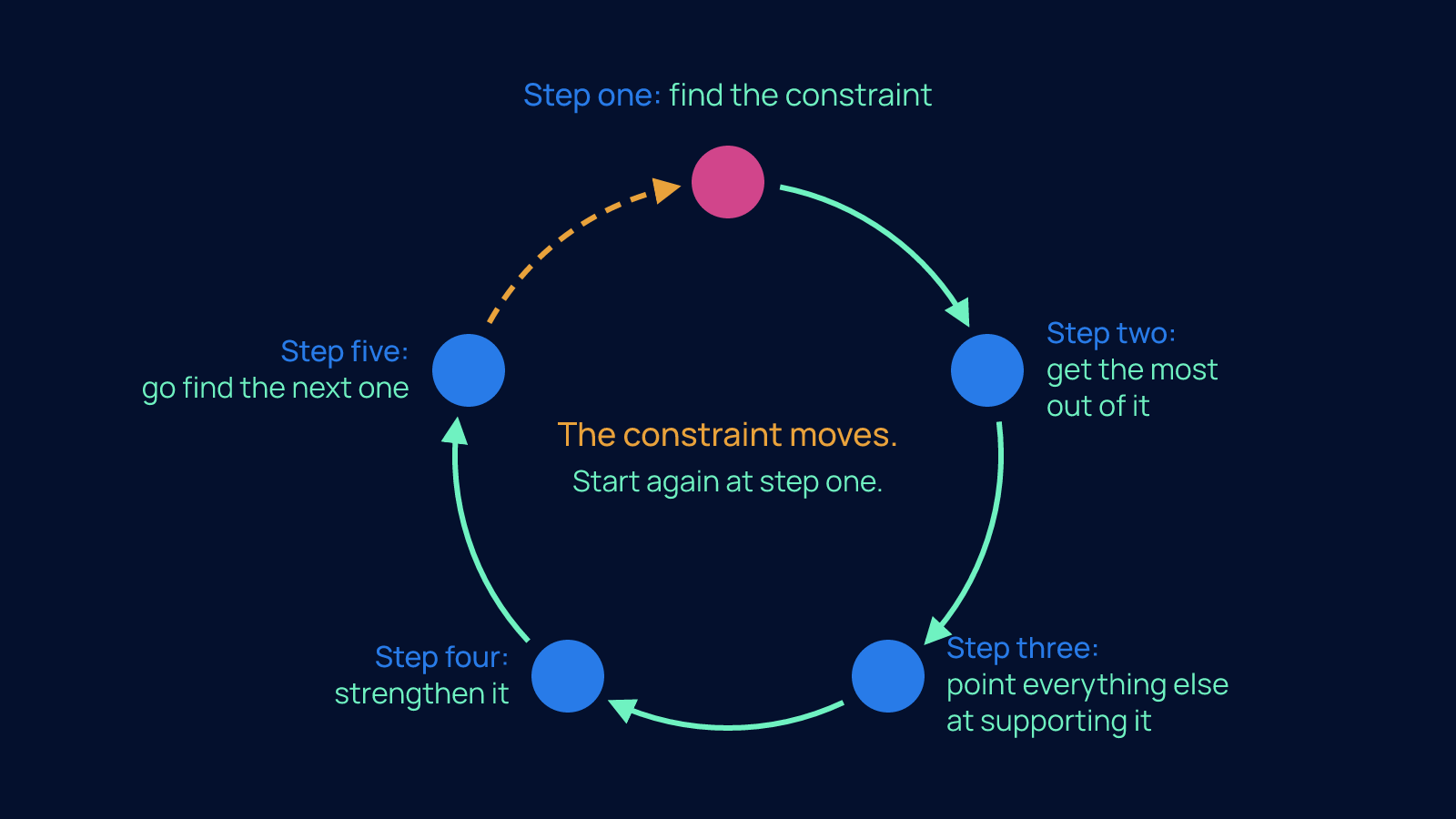
Goldratt's method is simple to say and hard to do, which is the right shape for a framework. Here it is without the jargon.
Step one: find the constraint. Ask where the work piles up. Ask who everyone is waiting on. The constraint is the step with a queue in front of it and idle time behind it.
Step two: get the most out of it. Before you spend a dollar, squeeze what you already have. Do not let the constraint sit idle. Do not feed it work that will get thrown away. Do not let your most limited resource spend its afternoon in meetings about something else. Protect its hours like they are the company's hours, because they are.
Step three: point everything else at supporting it. This is the step founders skip. Every other team slows down to the pace of the constraint, stops producing work the constraint cannot consume yet, and starts delivering its output in exactly the shape the constraint needs. Goldratt called this subordination. In plain words: the rest of the company works for the bottleneck, not the other way around.
Step four: strengthen it. Now you invest. Put more people on it, automate it, buy the tool, redesign the process. You do this last, not first, because by now you know the money is going to the one place where it changes the output of the whole system.
Step five: go find the next one. The moment you clear a constraint, another step becomes the slowest. The constraint moves. The danger is inertia: keeping all the rules you built around the old bottleneck long after it stopped being one. Start again at step one.
An hour at the bottleneck is an hour for the whole company
Goldratt's sharpest point was about time: an hour lost at the bottleneck is an hour lost for the whole company, and an hour saved anywhere else is an illusion.
Goldratt's sharpest point was about time, and it is the one that reframes the urgent list.
An hour lost at the bottleneck is an hour lost for the whole company. Not for that team. For everyone. The whole chain moves at the pace of its slowest link, so when that link stops for an hour, the company's output for that hour is gone and it is not coming back.
An hour saved anywhere else is an illusion. That team finishes earlier, and then it waits. The work still arrives at the constraint at the same rate the constraint can handle it. Nothing reached the customer sooner. Nothing reached the bank sooner.
Sit with that, because it is brutal. It means most of what your team calls urgent does not matter at all, and one thing matters completely. The fire in sales might be real and still be polish. The release might be late and still be polish. The only question that counts for each item on the list is this one: is it at the constraint? If it is, drop everything. If it is not, it can wait, and the waiting costs you nothing.
That is a hard thing to say to a team that is working hard. It is also the only honest thing to say.
You do not find the constraint by feel
You do not find the constraint by feel; you find it in the numbers.
Here is where most founders go wrong, and I include my younger self.
Feel points you to the loudest problem. The loudest problem is almost never the slowest step. The slowest step is quiet, because a queue of waiting work does not shout. It just sits there. The person at the bottleneck is usually the most heads-down person in the building, and the last one to put their hand up.
So founders guess. They pick the constraint based on who complained in the last leadership meeting, or on which part of the business they understand best, or on what they happen to be worried about that week. Then they spend a quarter strengthening a link that was never the weakest, and wonder why the numbers did not move.
You find the constraint in the numbers. Which metric keeps missing its target. Where the time between steps keeps stretching. Where the queue is growing while the team downstream has room to spare. Those signals point at the same place, and that place is your constraint.
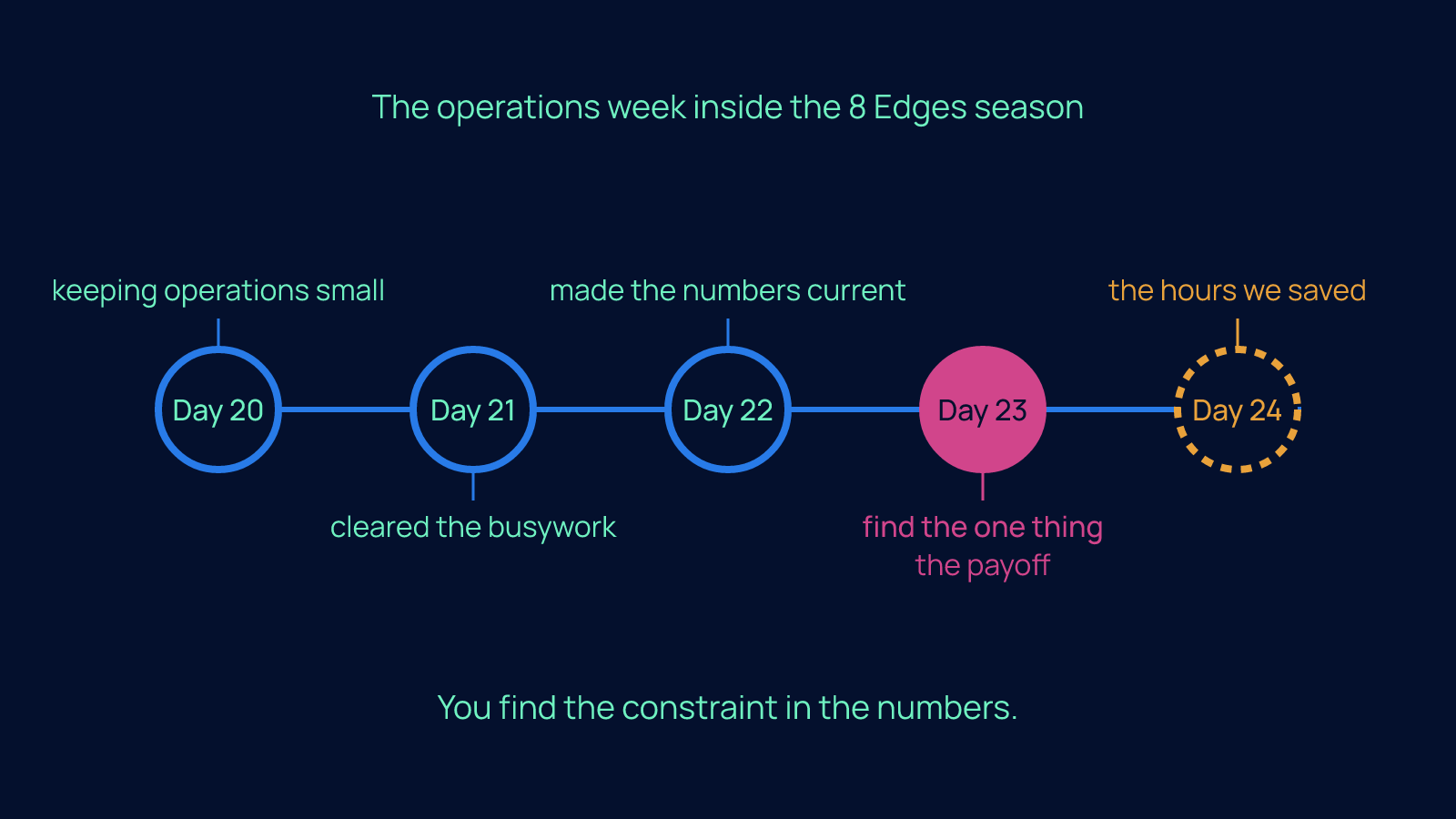
This is why the operations week inside the 8 Edges season runs in the order it does. Day 20 made the case for keeping operations small. Day 21 cleared the busywork so the team had hours back. Day 22 made the numbers current, so they describe the company as it is today and not as it was at the last board meeting. Day 23 is the payoff: you use those current numbers to find the one thing.
What the metrics page shows
Inside 8 Edges, the Company OS we built and run Edge8 on, there is a metrics page. It puts every office and every metric on one screen. Each metric has an owner, a target and a trend. You can see at a glance which ones are holding and which ones have been drifting.
Then there is the rule. We set a threshold for how long a metric is allowed to keep missing before it becomes someone's problem. When a metric crosses that line, the system files an issue on its own. It assigns the issue to the metric's owner and it lands in that person's queue like any other piece of work. Nobody has to notice the miss. Nobody has to remember to check. Nobody has to be the person who brings bad news to the Monday meeting.
That last part matters more than it sounds. In most companies a metric can miss for weeks before a human admits it out loud, because admitting it is awkward and because everyone is busy with their own fire. Here the machine admits it the moment the line is crossed, in writing, with an owner attached. The awkwardness is gone and so is the delay.
This week it filed one for a metric that had kept missing. Not a crisis, not a fire anyone was shouting about. A quiet miss, repeated, in a step that other work depends on. Exactly the kind of thing feel would never have found.
Asking the database in plain English
An issue tells you something is wrong. It does not tell you why, or whether this miss is the constraint or just a symptom of one further upstream. For that you have to dig, and digging used to mean a spreadsheet export, a pivot table and most of an afternoon.
Now I ask the database from the dashboard, in plain English. Which metrics missed this month. Where is the work piling up. Where is the longest wait between one step finishing and the next step starting. I type the question the way I would ask a colleague, and the answer comes back straight away, pulled from the live numbers the system has been watching all along.
That is the dig. It happens the moment the question occurs to me, not after I have asked someone to schedule the analysis. And when the answer comes back, the constraint is usually not where the loudest team said it was.
What the AI did, and what the people decide
Every claim about AI should answer two questions: what did the machine just do, and what does the person still decide. Here is the honest answer for this episode.
The AI watched every number on the metrics page, all day, every day. When one kept missing past our setting, it filed an issue and assigned it. When I asked where the work was piling up, it answered from the live data.
That is all it did. It raised its hand.
It did not decide which constraint to attack. It did not decide whether the fix is more hands, an automation, a process change or simply telling other teams to slow down and feed the bottleneck properly. It did not decide what to stop doing. Those are judgment calls about people, money and priorities, and they belong to the humans who run the company. We make them in the room, with the issue open and the answer on the screen.
That split is the whole point of running operations lean. The machine finds the problem. The best people's hours go to fixing it, to revenue and to building. Not to staring at dashboards. Not to noticing. Noticing is the machine's job now.
One constraint cleared, then the next
Streamlined operations is not a tidy process document or a smaller org chart. It is a rhythm. Find the constraint. Get the most out of it. Point the company at it. Strengthen it. Then go find the next one, because there is always a next one, and that is not failure, that is the method working.
Done this way, the urgent list stops being a wall. It becomes one item that matters and a queue of things that can wait without costing you anything. Your team stops holding hoses and starts moving water to the one place it changes the outcome.
That is Day 23 of the 8 Edges season. Watch the Day 23 film to see the metrics page, the issue the system filed on its own, and the plain-English question to the database, all live inside our own Company OS.
Tomorrow, Day 24 asks the last operations question of the week and closes Act 2: the hours we saved across this week, where did they actually go?
If you are looking at your own wall of urgent and want to see what it looks like when the machine watches the numbers and your people make the calls, reply with the word "demo" and I will walk you through 8 Edges on your own company's chain.
FAQ
How do I find the one bottleneck that is slowing my whole company down when everything feels urgent and every team says their fire comes first?
Stop guessing by feel and look at the numbers, because at any moment one constraint sets the pace for your whole company: one team, one step or one approval everything else is quietly waiting on. Eliyahu Goldratt's Theory of Constraints, taught in his novel The Goal, gives you five steps: find the constraint, get the most out of it, point everything else at supporting it, strengthen it, then go find the next one. The constraint is the step with a queue in front of it and idle time behind it, and it shows up as the metric that keeps missing its target, the stretching wait between steps and the growing pile of work while the team downstream has room to spare. Effort anywhere else is polish on a machine still waiting on its slowest part.
What are the five steps of the Theory of Constraints in plain English?
Goldratt's method has five steps. Step one, find the constraint: ask where the work piles up and who everyone is waiting on. Step two, get the most out of it: do not let it sit idle, do not feed it work that will be thrown away, and protect its hours like they are the company's hours. Step three, point everything else at supporting it, which Goldratt called subordination and which means the rest of the company works for the bottleneck. Step four, strengthen it with more hands, automation or a process change, and you do this last because only now do you know the money changes the output of the whole system. Step five, go find the next one, because the moment you clear a constraint another step becomes the slowest.
Why does saving time in one department not speed up my whole business?
Because a company is a chain and the chain only moves at the pace of its slowest link. Goldratt's sharpest point was about time: an hour lost at the bottleneck is an hour lost for the whole company, not for one team, and it is not coming back. An hour saved anywhere else is an illusion, because that team finishes earlier and then waits, the work still reaches the constraint at the rate the constraint can handle, and nothing reaches the customer or the bank any sooner. If you strengthen a link that was not the weakest, the chain holds exactly the weight it held before and the output of the company does not change by a single unit.
How do I decide which urgent problem actually matters when every team is fighting its own fire?
There is one question that counts for each item on the list: is it at the constraint? If it is, drop everything, because an hour lost there is an hour lost for the whole company. If it is not, it can wait and the waiting costs you nothing, even when the sales pipeline is real and the release is late. One constraint sets the pace at any moment, so most of what your team calls urgent does not matter at all and one thing matters completely, and that is a hard but honest thing to say to a team that is working hard.
Can software find the bottleneck in my company for me, or do I still have to decide what to do about it?
Software can do the noticing and the digging, and it should, but the people still decide. Inside Edge8's own Company OS, 8 Edges, a metrics page puts every office and every metric on one screen with an owner, a target and a trend, and when a metric keeps missing past a set threshold the system files an issue on its own and assigns it to the owner, so nobody has to remember to check or bring bad news to the Monday meeting. This week it filed one for a quiet, repeated miss in a step other work depends on, exactly the kind of thing feel would never have found, and a plain-English question to the database shows where work is piling up straight away. What the machine does not decide is which constraint to attack, whether the fix is more hands, an automation or a process change, and what to stop doing; those calls about people, money and priorities belong to the humans who run the company.