You have listened to weeks of claims. You are entitled to say it back: prove it.
Fair. So this episode drops the frameworks. No theory, no diagrams, no borrowed stories from other companies. Just Edge8's own screens, Edge8's own data, and what changed inside the company once the data had one home and every workflow had a design.
The rule for the film is simple. Numbers, not adjectives. If it cannot be shown on screen, it does not get said.
The rule for this post is the mirror of that rule. The film holds every figure, on the live screens where the figures live. This post holds the words. A number typed into a blog by the person who benefits from it is just another claim. A number on a live screen, with the row behind it and the date on it, is a receipt. Watch Day 29 for the receipts. Read this for what they mean, and for how to run the same test inside your own company.
Where the season started
The season opened on the Stanford Digital Economy Lab finding that in most of the enterprise AI deployments that worked, the hardest part was the data and the workflow redesign, not the AI, and that very few companies had data ready for AI at all.
The 8 Edges season opened on a finding from the Stanford Digital Economy Lab. In most of the enterprise AI deployments that actually worked, the hardest part was not the AI. It was the data and the workflow redesign. And very few of the companies studied had data that was ready for AI at all.
I said at the start that Edge8 was not in the ready group, and I meant it. Our data lived in more than one place, which is the same as living nowhere. Ask a plain question about our own pipeline and the honest answer was "let me pull that together." That was not an AI problem. That was a data problem wearing an AI costume. Same people. Same AI tools everyone else can rent. A company that could not answer its own questions without a meeting.
I am walking you through Edge8 rather than a client for one reason: I can show you everything. A client case study always has the interesting screens blurred out. Mine do not. Every result in the film is ours, and the people who produced it are the same people who were here when the data was scattered.
I will walk the receipts in the order the film shows them. For each one, I will answer the only two questions that matter about any AI claim: what did the AI just do, and what does the person still decide.
The database that holds the people, the companies and the deals
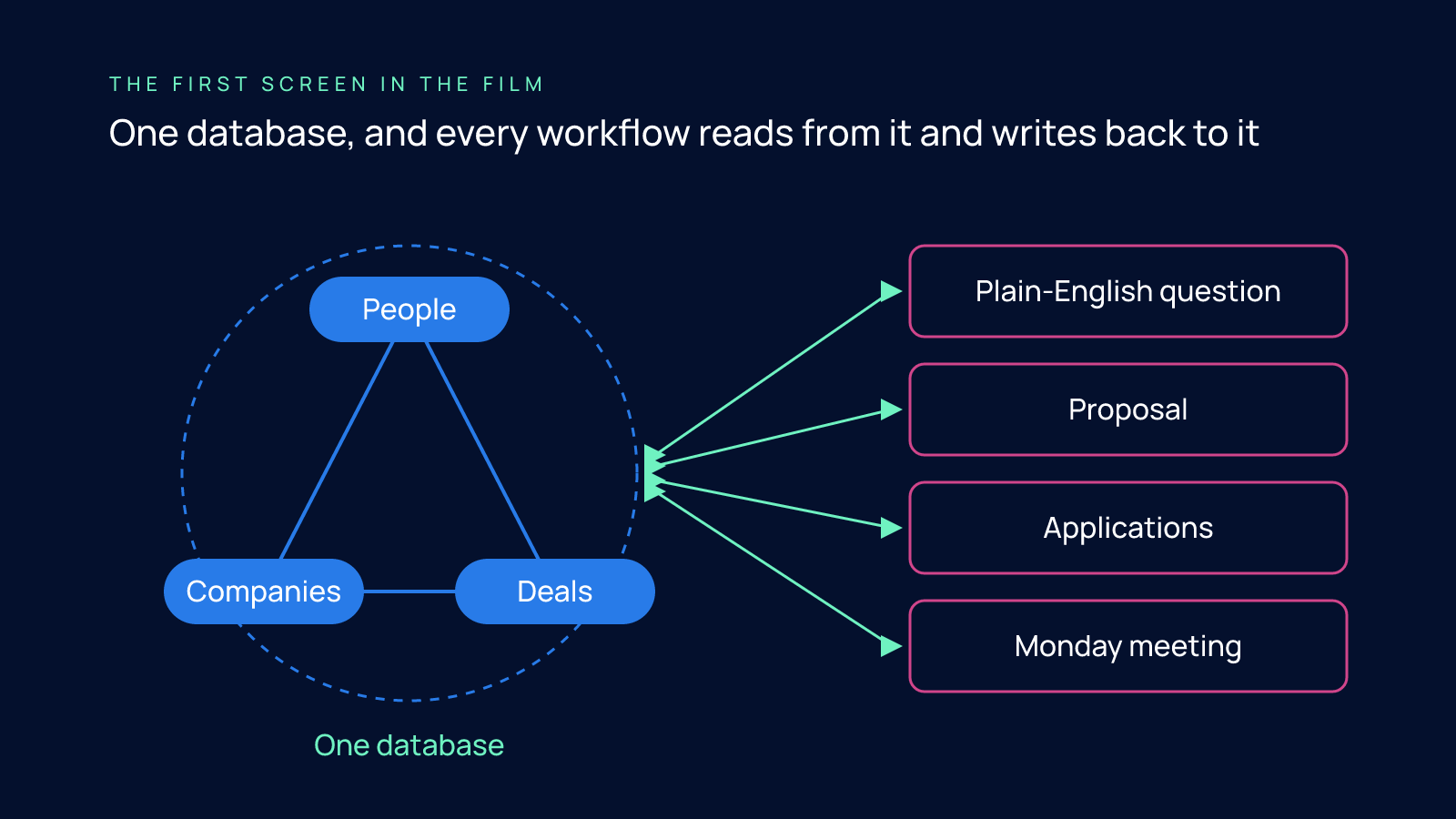
The first screen in the film is boring, and it is the most important one. It is one database. The people we know, the companies they work at, the deals we have open or closed, all in one place, all current, and all pointing at each other. A person belongs to a company. A deal belongs to a company and to a person who owns it on our side. Change a title in one place and it is changed everywhere, because there is only one place.
Then I type a plain-English question into it. Not a query. Not a filter built by someone who knows the schema (the structure of how the tables are laid out and connected). A sentence, the way you would ask a colleague across the desk. And the answer comes back from the live data, not from a report someone exported last week.
What did the AI do? It read my sentence, worked out which tables and fields it needed, pulled the answer from the database, and showed me the rows behind it so I could check its work.
What do I still decide? Everything that happens next. The AI did not decide which deals to chase or which companies to call. It answered the question. I decided what the answer meant and what to do about it.
That is the whole foundation. Every other receipt in the film stands on this one, because every other workflow reads from this database and writes back to it. If your data is in several places, nothing below is available to you, no matter which model you pay for.
The proposal that was live before the call had cooled
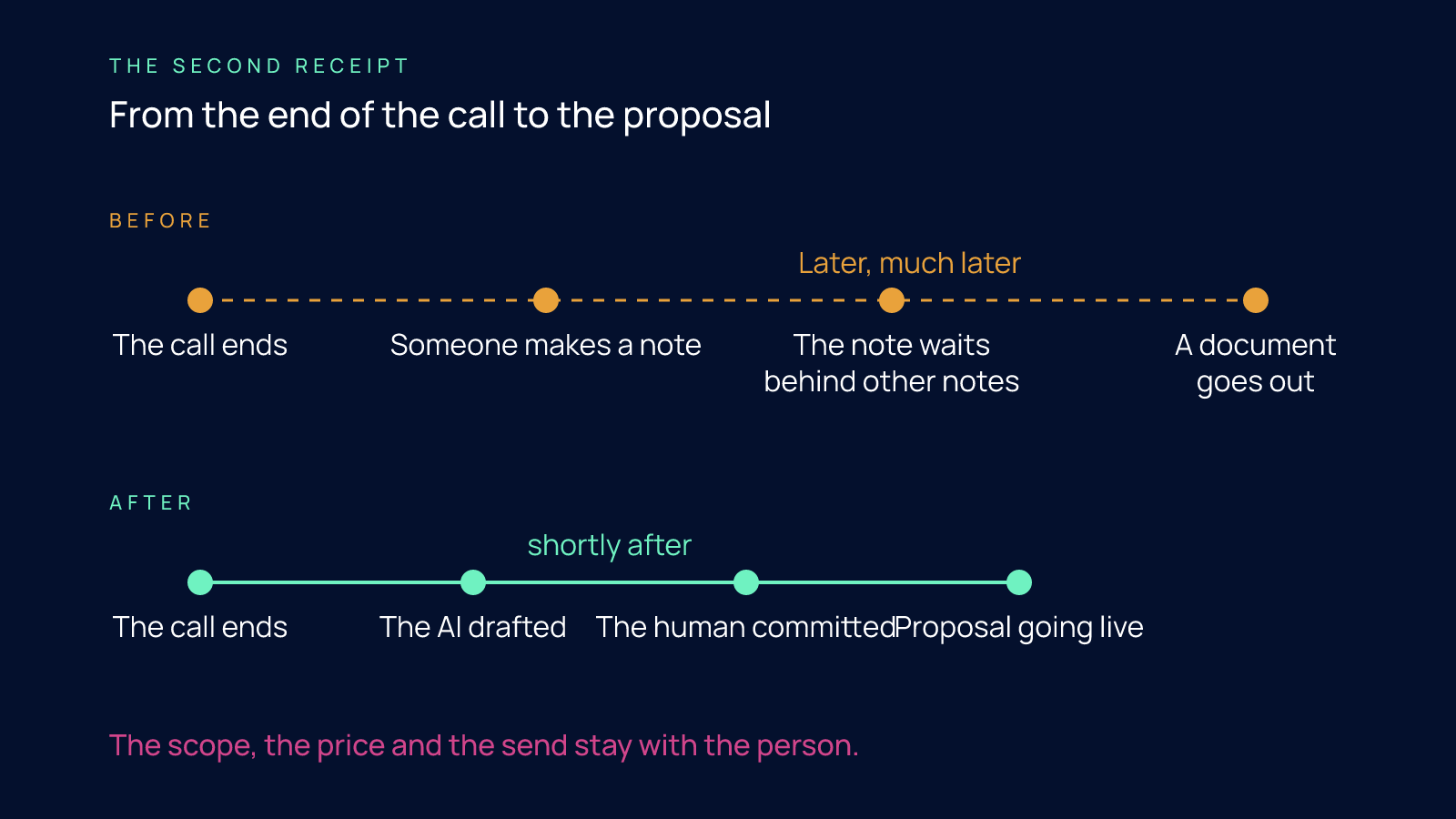
The second receipt is a deal we won. The film shows the sales call ending and the proposal going live shortly after, while the conversation was still fresh in the client's mind.
Here is what used to happen, at Edge8 and at most firms I sit across from. The call ends. Someone makes a note to write the proposal. The note waits behind other notes. Later, much later, a document goes out that rehashes the call from memory, and the client reads it with half the energy they had when they hung up.
What did the AI do? It took what was said on the call and what the database already knew about that company and the people in it, and it assembled the proposal in our format, with our terms, in the right shape for that kind of engagement.
What did the person decide? The scope, the price and the send. A human read it, corrected what needed correcting, and chose to put it in front of the client. The AI drafted. The human committed. The deal was won because a real proposal reached a real person while they still cared, and because the person who sent it did not have to start from a blank page.
The speed is not the point. The point is that speed became the default rather than a heroic effort by whoever happened to have a free evening.
Every application, read in full, scored the same way
Edge8's pipeline is applications, and a lot of them. Here is the dirty secret of every application process I have ever seen, including ours before this: nobody reads every application in full. Early applications get careful attention. Late ones get a skim. The ones that arrive on a bad afternoon get a glance. The scoring drifts with the reader's mood, their coffee, and how many they have already read.
The film shows the screen where that stopped. Every application that comes in is read in full and scored against the same rubric (the written list of what we are looking for and how much each thing counts). The same criteria, applied the same way, to the first application and the last.
What did the AI do? It read each application completely, scored it against the rubric we wrote, and wrote down why, so that a human can see the reasoning and disagree with it.
What does the person decide? Who moves forward, who gets the offer, and whether the rubric itself is right. The AI does not choose anyone. It makes sure nobody is quietly overlooked because they applied on the wrong day. That is fairness as a workflow design, not as a value painted on a wall.
The time that came back, and the Monday meeting that got shorter
The last receipt is the one founders ask about first, and it is the one I trust least when someone else claims it. Time saved. Everyone claims it. Almost nobody can show where it went.
So the film shows it. The hours that came back to the team, by workflow, and the Monday sync before and after. The meeting got shorter because nobody has to read numbers to each other anymore. The numbers are on the screen, pulled from the one database, current as of that morning. The meeting is spent on the decisions the numbers raise, which is what a meeting is for.
And the line underneath that matters more than any of the figures: same size team as at the start. We did not grow our way to this. We did not cut our way to it either. The same people are doing the work, with the chasing and the retyping removed from their week.
What did the AI do? It took over the collecting, the formatting and the reporting that used to fill the hour.
What do the people decide? What to do about the numbers. The decisions in that room are still made by the people in that room. They just get to the decision faster, with the same facts in front of everyone.
Same people, same AI, different company
Same people, same AI everyone else has, a different company, because the data has one home and every workflow has a design.
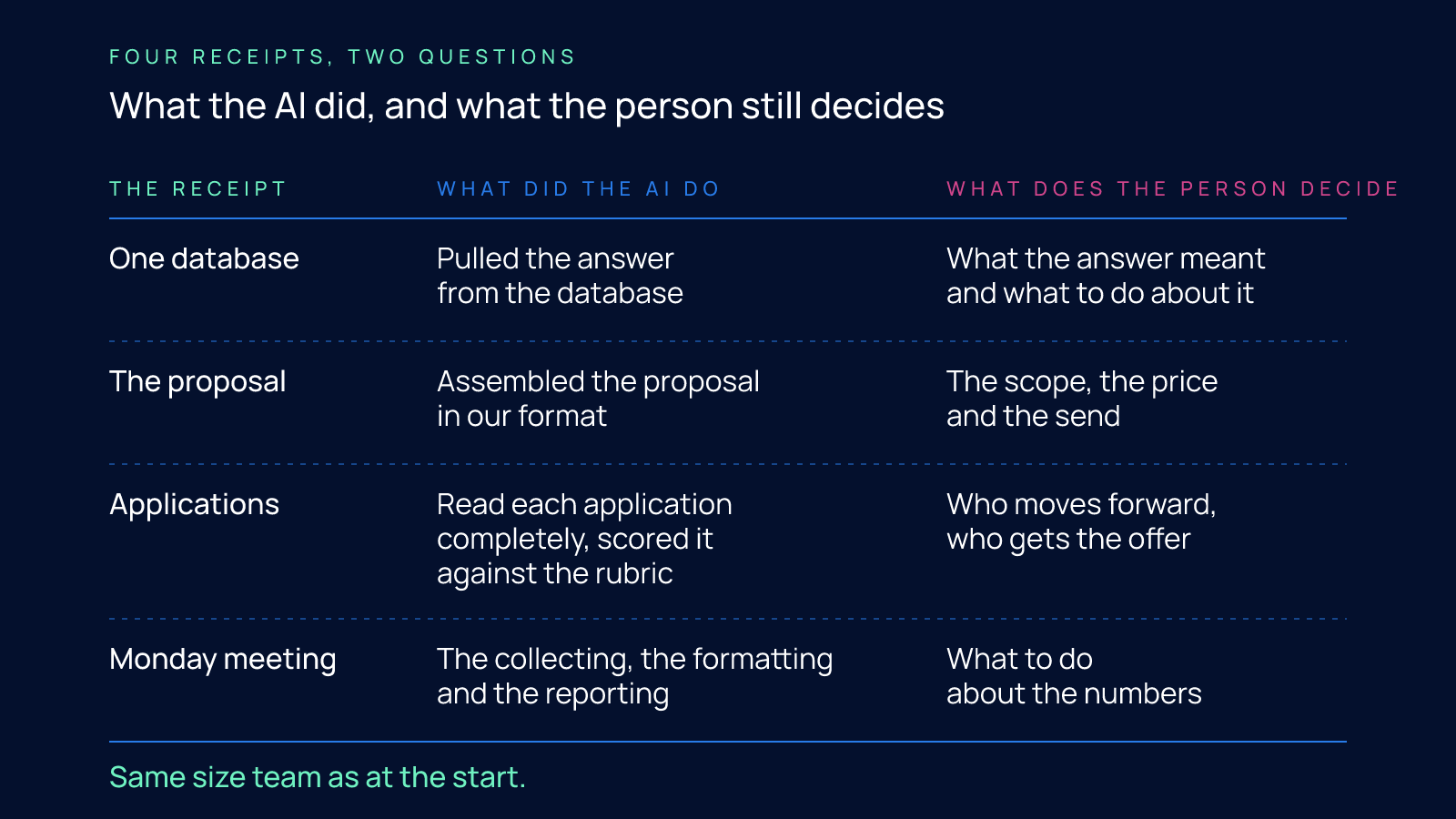
Put the receipts side by side and the pattern is hard to miss. Nothing about Edge8's people changed. Nothing about the AI changed; we use the same models anyone can rent. What changed is that the data has one home and every workflow has a design.
A workflow with a design means this: someone wrote down where the work starts, what the AI does with it, where the human looks at it, and where the result lands. No step lives in someone's head. No handoff lives in an inbox. That is the unglamorous part, and it is the part that decides whether the AI is useful or decorative.
That is exactly what the Stanford finding predicted, and it is the opposite of what most companies do. Most companies buy the AI first and hope it will sort out the data. It will not. It will produce confident answers from stale, contradictory data, and you will stop trusting it inside a quarter. Then the story becomes "AI did not work for us," when the truth is that the company was never ready for it, and nobody did the work of making it ready.
I take the position plainly: the AI is the easy part. The database and the workflow design are the hard part, and they are the whole difference between a company that uses AI and a company that runs on it.
How you would know it worked in your company
You asked for proof from me. Here is how to demand it from yourself. A short set of tests, no adjectives allowed.
- Ask a plain question about your own business and time how long it takes to get an answer you would bet on. If the answer is "let me pull that together," your data does not have one home yet.
- Look at your last won deal and find the gap between the end of the call and the moment the proposal reached the client. Then ask who filled that gap and what else they dropped to do it.
- Pull up your last round of applications and ask whether the first and the last were read with the same care and scored against the same criteria. If you cannot say yes without flinching, the process is not fair, it is just familiar.
- Sit in your Monday meeting and notice how much of it is people reporting versus people deciding. If the reporting could have been a screen, the hour is being spent on the wrong thing.
None of those tests needs a consultant. All of them need honesty. And every one of them has a screen in the Day 29 film that shows what the answer looks like once it is fixed.
Watch the receipts, then the finale
This is what it looks like from the inside once you are: one database holding the people, the companies and the deals, all current; a proposal live minutes after a sales call ends; every application read in full and scored the same way; time returned to the team and a shorter Monday meeting, with the same size team as at the start.
Day 29 is the proof. One database, and a plain question answered from it. A won deal and the proposal that went live fast. Every application read in full and scored the same way. The time that came back and the shorter Monday meeting, with the same size team as at the start.
Day 30 is the question you have been holding since the season began: how do you get this? That is the finale, and it is the only episode that answers it directly.
Here is your next step. Watch Day 29 and check the screens against what I have written here. Then reply to this post and tell me which of the four tests above your company fails. We will walk you through the same workflow on our own screens, live, and talk through what it would take to build it inside your company.
Prove it was the right thing to say. Now go and look.
Dave
FAQ
What actually changes in my company once I put all my data in one database and give every workflow a design, and how would I know it worked?
Once the people, the companies and the deals live in one database, all current and pointing at each other, a plain-English question gets answered from live data instead of from a report someone exported last week, and every other workflow reads from and writes back to that one place. In Edge8's case the proposal went live while the sales call was still fresh, every application was read in full and scored against the same rubric, and the Monday meeting got shorter because the numbers were already on screen, all with the same size team as at the start. You know it worked by running four tests: time how long a plain question takes to answer, measure the gap between a call ending and the proposal landing, check whether the first and last application got the same care, and count how much of your Monday meeting is reporting versus deciding.
How do I tell whether an AI result in my business is real or just a good demo?
Ask the only two questions that matter about any AI claim: what did the AI just do, and what does the person still decide. If the answer cannot be shown on a live screen with the row behind it and the date on it, it is a claim, not a receipt. Edge8 applied that rule to its own Day 29 film, where every figure appears on screen and the post itself states no number at all.
Why does AI keep giving me confident answers about my own business that turn out to be wrong?
Because the data lives in more than one place, which is the same as living nowhere, and the AI produces confident answers from stale, contradictory records. Most companies buy the AI first and hope it sorts out the data, then stop trusting it inside a quarter and conclude AI did not work for them. The fix is one database with one home for every record, so a title changed in one place is changed everywhere.
Will I need a bigger team to run my company on AI, or can the people I have do it?
The same people can do it, if the chasing and the retyping are removed from their week. Edge8 produced every result in its Day 29 film with the same size team as at the start, the same people who were there when the data was scattered, using the same models anyone can rent. What changed was that the data got one home and every workflow got a design, meaning someone wrote down where the work starts, what the AI does, where the human looks and where the result lands.
What should I check before I decide AI does not work for my company?
Check whether your data was ever ready for it, because the Stanford Digital Economy Lab finding that opened the season showed the hardest part of the enterprise AI deployments that worked was the data and the workflow redesign, not the AI, and very few companies had data that was ready at all. Run one simple test first: ask a plain question about your own business and time how long it takes to get an answer you would bet on. If the answer is let me pull that together, your data does not have one home yet and no model you pay for will fix that.