
Picture your Monday meeting as it actually runs, not as the calendar describes it.
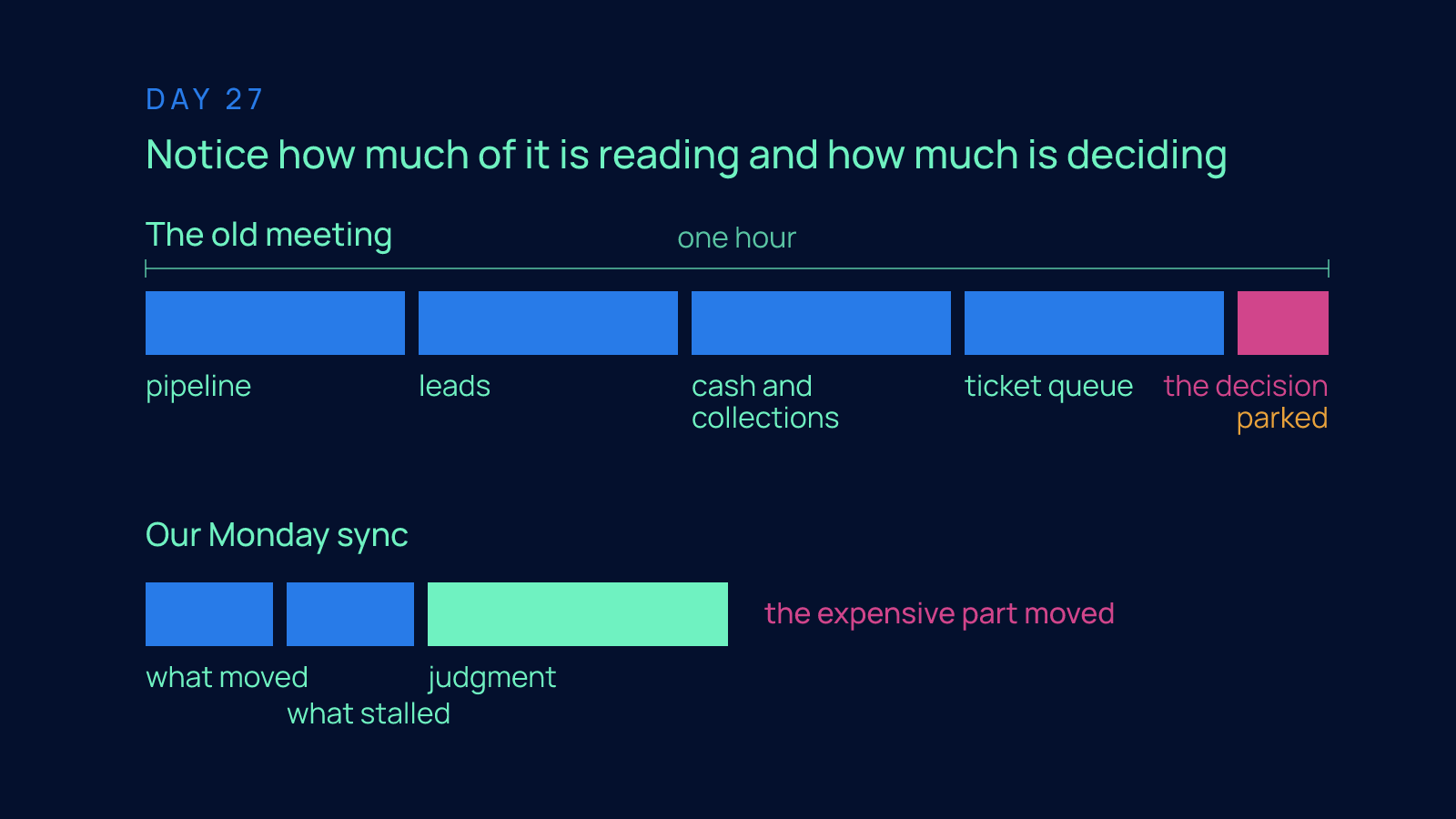
The one hour starts. Sales reads the pipeline out loud. Marketing reads the leads. Finance reads cash and collections. Ops reads the ticket queue. Everyone nods along, because it would be rude not to. Somewhere in the back half, the one item that needs a real decision finally comes up: the pricing change, the vendor contract, the customer who is about to walk. There is no time left to argue it properly, so it gets parked. Next Monday the same thing happens. The decision waits a week, then another.
If that is your meeting, you have probably already diagnosed it, and I would bet the diagnosis is wrong. Most founders I sit across from blame themselves or their team. Not disciplined enough. Too loose on the agenda. Too polite to cut people off. The fix they reach for is a timer, a stricter chair, or a rule that status goes in a doc nobody reads. None of those fixes work, and the reason they do not work is the whole point of this post.
This is Day 27 of the 30-day 8 Edges season, the third episode of Act 3. Day 26 set the goals. Day 27 is the rhythm that keeps them pointed where they were set, and it closes the loop on FAST goals, the framework the season introduced on Day 2. I am going to take the common diagnosis apart one myth at a time, then show you how we fixed the meeting inside Edge8's own Company OS, the operating system we run the company on.
Myth: the meeting runs long because the team lacks discipline
That is not a discipline problem. Gathering the status costs so much that nothing is left for judgment.
Reading numbers aloud is not a bad habit. It is the delivery mechanism. In most companies the Monday meeting is the only place the week's numbers get into the same room at the same time, so the meeting has to carry them. Somebody pulled the pipeline on Friday afternoon. Somebody else exported the ledger. Somebody screenshotted the dashboard. The meeting is where all of that gets unloaded, line by line, so the people who did not pull it can hear it.
That is not indiscipline. That is a cost being paid in the room, out loud, with everyone watching.
The Day 27 script draws the old meeting as one that spends most of its length reading numbers to each other, and that picture lands because it is what most of us have lived. Gathering the status costs so much that nothing is left for judgment. The decision slips not because people are weak but because the hour was spent before the decision arrived.
You cannot discipline your way out of a cost. You can only move it. A timer makes the reading faster and the decision no more likely. A stricter chair makes the reading tense and the decision no more likely. A status doc moves the reading to Sunday night, where nobody does it, and Monday fills back up with the same reading. The only thing that frees the hour is taking the gathering out of it entirely.
Myth: a goal reviewed every quarter is a goal that is being managed
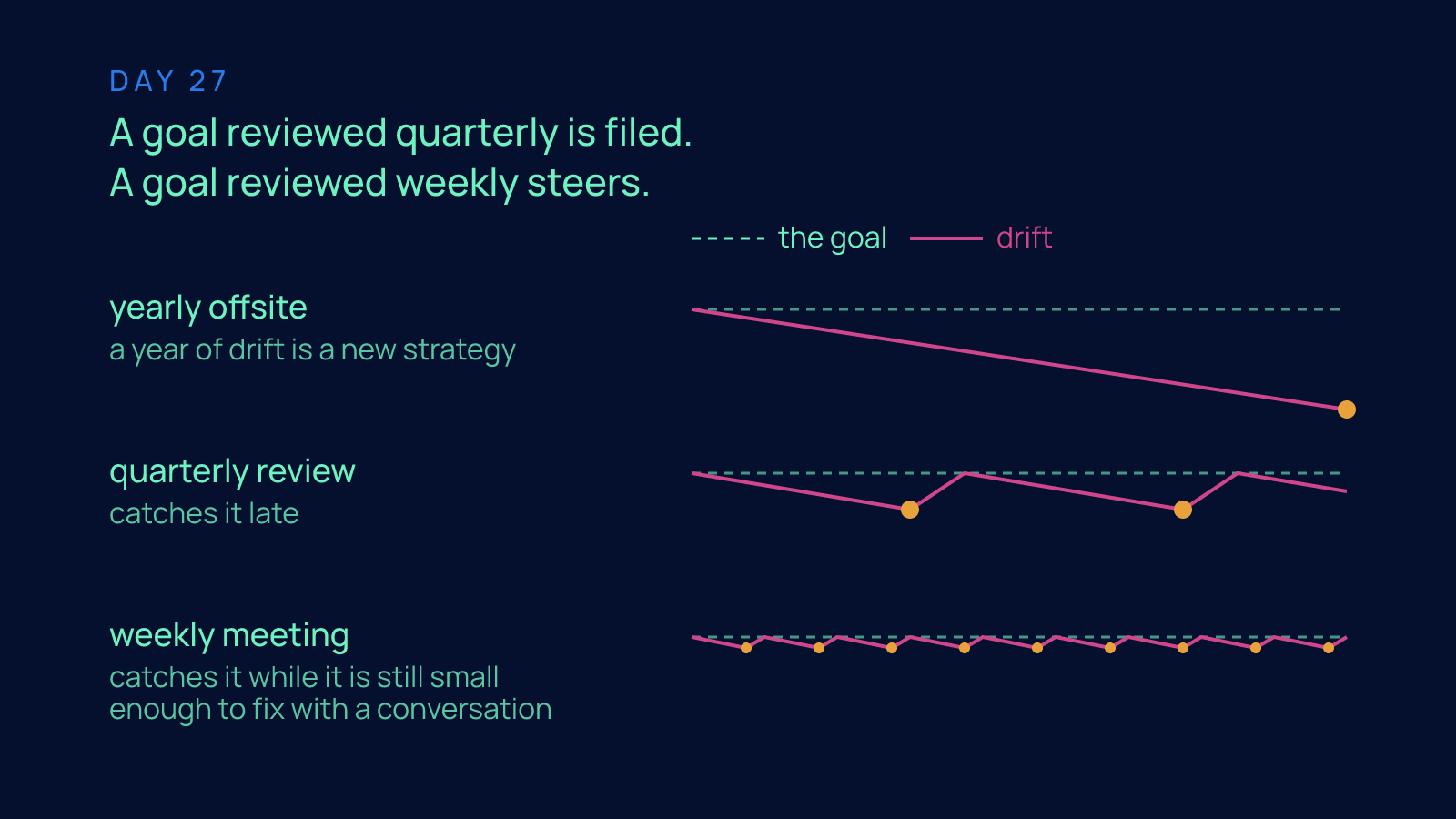
A goal reviewed quarterly is filed; a goal reviewed weekly steers.
On Day 2 I introduced FAST goals, the framework from Sull and Sull at MIT Sloan. FAST stands for frequently discussed, ambitious, specific, transparent. Of those four words, the one that matters most for this episode is frequently.
A goal reviewed quarterly is filed. A goal reviewed weekly steers.
That is the whole distinction. A quarterly review tells you what happened. By the time you look, the quarter is over and the number is a verdict, not a signal. A weekly review tells you what is happening, while there is still most of a quarter left to do something about it. Same goal, same number, completely different relationship to it. One is a report card. The other is a steering wheel.
Most companies set goals in an offsite, write them down with real care, and then review them when the next offsite comes around. Nobody decided to do that. It is what happens when reviewing is expensive, because expensive things get done rarely. Which brings me to the myth that actually stops people.
Myth: weekly review means more work, so it will not last
This one is honest, and I am not going to pretend otherwise. Frequency has a price. If you review goals weekly, someone has to pull the numbers every week. Not a dashboard somebody set up once, but the actual current numbers from the actual systems, assembled into something the team can read in a few minutes. That is a real job, it is boring, and it lands on whoever is most conscientious until they burn out on it.
That used to be the blocker. It is why so many teams try a weekly cadence, hold it for a month, and slide back to quarterly without ever admitting they stopped. The frequency was right. The cost was unpaid.
So the honest answer is not "try harder." The honest answer is: pay the cost somewhere other than your people's week.
Myth: if AI prepares the meeting, AI is making the decisions
The AI reads the status; the people decide what to do about it.
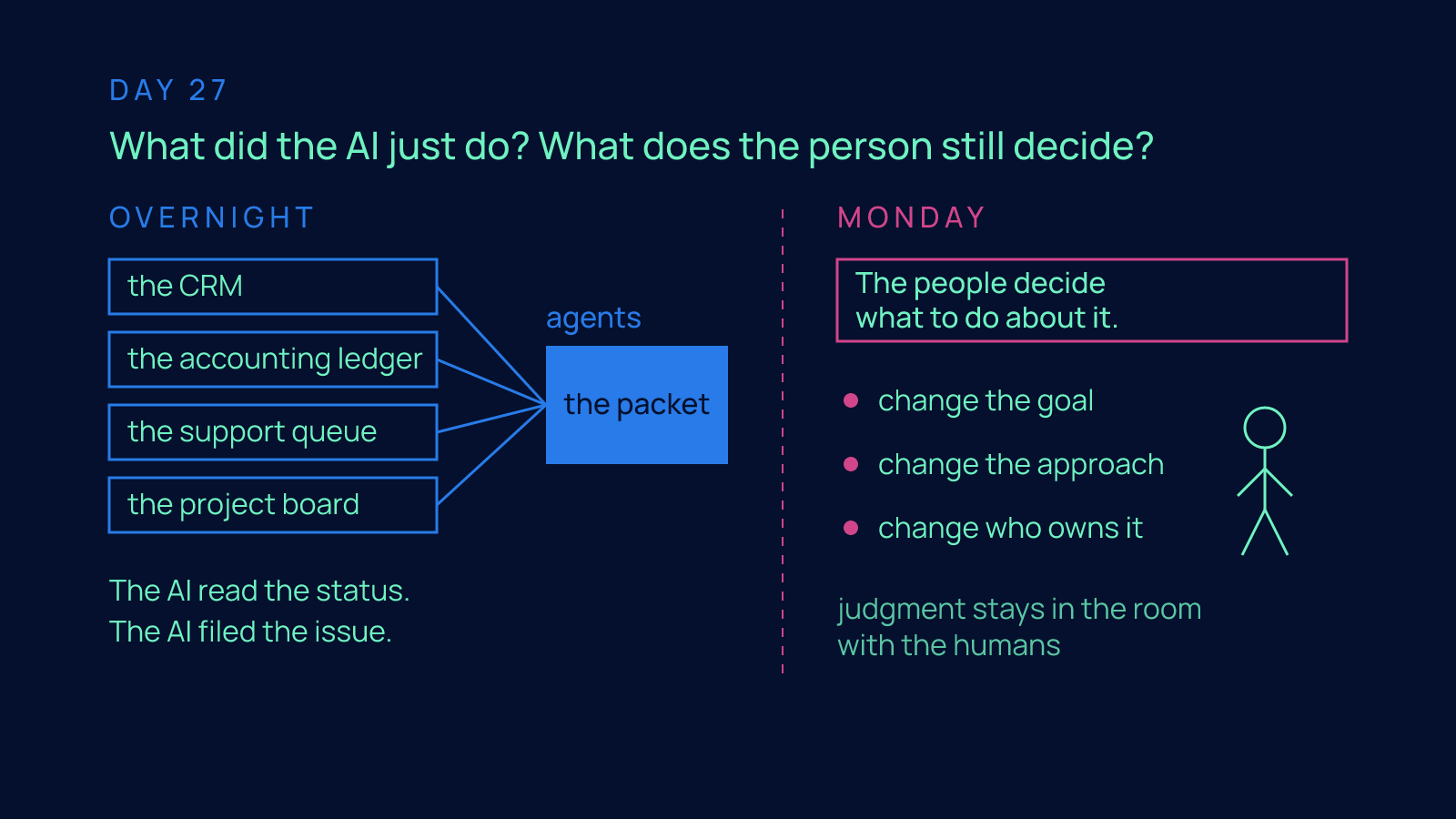
This is the one I care most about, because every claim about AI in this season answers the same pair of questions. What did the AI just do? What does the person still decide? If a vendor cannot answer both, walk away.
Here is what happens in 8 Edges, in plain words.
Overnight, before Monday, agents pull the week's numbers from the source systems. An agent, in this sense, is a small piece of software that does one defined job on its own, on a schedule, without someone clicking a button. The source systems are the places the numbers actually live: the CRM (the system that tracks customers and deals), the accounting ledger, the support queue, the project board. The agents do not ask people for updates. They read the systems directly.
By the time the team walks in, the packet is already on the table. It shows what moved and what stalled, goal by goal, against what we set on Day 26. Nobody reads it aloud, because everyone can already read.
When a metric keeps missing, week after week, the system files an issue on its own and puts it on the agenda. Not a nudge, not a red cell in a spreadsheet. An actual issue, with the metric attached, waiting for a human to pick it up. That is the AI reading the status and noticing a pattern that a busy team would rationalize away for another month.
Now the line that matters. The AI read the status. The AI filed the issue. The people decide what to do about it. Whether the stalled metric means the goal was wrong, the tactic was wrong, or the owner needs help, that is judgment, and judgment stays in the room with the humans. The packet gives them the facts. It does not give them the answer.
That is the whole division of labor. The AI arrives at the data-gathering point so the humans can arrive at the decision point.
What Monday looks like at Edge8 now
I will tell you our own practice, as our practice, not as research.
Our Monday sync runs far shorter than it used to. The packet is open before anyone speaks. We skim what moved and nod. We stop on what stalled. The agenda is the issues the system filed over the week plus whatever a person wants to raise. Almost all of the time is judgment: do we change the goal, change the approach, or change who owns it. The reading that used to fill the hour simply does not happen in the room anymore, because it happened overnight.
The meeting did not get shorter because we got stricter. It got shorter because the expensive part moved.
Why a short weekly habit beats a long yearly offsite
Here are the stakes. Most companies run on a handful of outcomes that are supposed to add up to one strategy. In 8 Edges we call them the four outcomes, and Day 26 was about setting them so they point the same direction. The danger is not that they are set wrong. The danger is that they drift, one week at a time, until the team is working hard on things that no longer add up.
Drift is weekly. So the correction has to be weekly. A yearly offsite cannot catch it, because a year of drift is a new strategy. A quarterly review catches it late. A weekly meeting that actually reaches the decision point catches it while it is still small enough to fix with a conversation.
That is why frequently is the word that matters most in FAST. Not because meetings are good, but because steering is continuous, and a goal you only look at quarterly is a goal you are not steering.
What to do this week
In order.
Watch the Day 27 film. It shows the packet landing, the issue being filed and the meeting that follows, in a few minutes.
Then look at your own Monday. Notice how much of it is reading and how much is deciding. Do not fix it yet. Just see it.
Then reply to this post and tell me what your Monday meeting looks like. If you want to see what your own packet would contain, pulled overnight from your own systems, I will walk you through it in a demo. Day 28 is up next: what happens when a number misses, and who decides what to do about it.
FAQ
How do I turn my Monday meeting from one that reports into one that decides, when most of the hour goes to people reading numbers to each other and the one real decision slips another week?
Stop treating it as a discipline problem and treat it as a cost problem: in a typical one hour meeting, the first half is spent reading pipeline, leads, cash and tickets aloud, so the one real decision arrives in the back half with no time left and gets parked for another week. A timer or a stricter chair makes the reading faster or tenser but does not make the decision more likely. The only thing that frees the hour is taking the gathering out of it entirely, which is why Edge8 has agents pull the week's numbers from the source systems overnight so the packet is already on the table and the meeting starts at the decision point.
How often should I review my company goals, quarterly or weekly?
Weekly. The FAST goals framework from Sull and Sull at MIT Sloan has four words, frequently discussed, ambitious, specific and transparent, and the one that matters most is frequently. A goal reviewed quarterly is filed, because by the time you look the quarter is over and the number is a verdict; a goal reviewed weekly steers, because there is still most of a quarter left to do something about it. Drift happens one week at a time, so the correction has to be weekly too.
Why does my weekly leadership meeting always run out of time before we reach the real decision?
Because the meeting is the only place the week's numbers get into the same room at the same time, so it has to carry them, and that carrying eats the hour. Someone pulled the pipeline on Friday, someone exported the ledger, someone screenshotted a dashboard, and the one hour meeting becomes the place all of it gets unloaded line by line. The decision does not slip because people are weak; it slips because the hour was spent before the decision arrived. You cannot discipline your way out of a cost, you can only move it.
If AI prepares my Monday meeting, is the AI making the decisions?
No, and every claim about AI should answer the same two questions: what did the AI just do, and what does the person still decide. At Edge8 the agents read the source systems overnight, assemble a packet showing what moved and what stalled goal by goal, and when a metric keeps missing week after week they file an issue and put it on the agenda. The people then decide whether the stalled metric means the goal was wrong, the tactic was wrong, or the owner needs help. The AI arrives at the data gathering point so the humans can arrive at the decision point, and that is how all four outcomes stay pointed at one strategy.
Why do weekly goal reviews never last at my company even though everyone agrees they are a good idea?
Because frequency has a price that nobody budgeted for: someone has to pull the actual current numbers from the actual systems every single week, and that boring job lands on the most conscientious person until they burn out. That is why so many teams try a weekly cadence, hold it for a month, and slide back to quarterly without admitting they stopped. The frequency was right and the cost was unpaid. The fix is not to try harder but to pay the cost somewhere other than your people's week, which at Edge8 means agents pulling the numbers overnight before the Monday sync.