You know the room.
The dashboard is on the screen. One number is red. Nobody speaks for a beat too long, and in that beat every person at the table does the same thing: they start writing their defense. The head of sales is lining up the deals that slipped for reasons nobody could have controlled. The ops lead is remembering the week the vendor went dark. The person who owns the red number is deciding how much of the truth to lead with, and in what order.
Nobody is thinking about the problem. Everyone is thinking about the trial.
I have sat in that room as the founder asking the question, and I have sat in it as the person with the red number. Both seats are miserable, and both produce the same thing: a careful story instead of a clear answer.
The review is where most companies get this wrong, and they get it wrong because of five beliefs that sound like discipline. I will take them one at a time, then show what replaces them.
For anyone following along: this is Day 28 of our 30-day 8 Edges season, the fourth episode of Act 3. Day 27 showed the Monday sync, the weekly meeting where the numbers get checked, catching a missed metric and filing it as an issue. Day 28 is what the company does with that issue. It brings back two ideas from Act 2, Amy Edmondson's work on psychological safety from Day 19 and the GROW coaching model from Days 13 and 18, and it is the last episode before the season shows its own numbers on Day 29.
Myth one: blame makes people careful
Teams that feel safe reporting mistakes learn faster, because the mistakes surface while they are still cheap.
The theory behind the hard review goes like this. If a miss hurts, people will work harder not to miss. Make the room uncomfortable and you buy attention.
Blame does make people careful. It makes them careful about what they tell you.
The person with the red number learns, fast, that the safest move is to shape the story before it reaches you. Round the bad news down. Lead with the external cause. Mention the deal that is "basically closed." None of this is lying, exactly. It is editing. And the edit always runs in the same direction, away from you.
So in a blame culture the truth arrives last, if at all. You hear about the pipeline problem after the quarter, about the customers quietly leaving after the renewal date, about the agent that has been sending the wrong follow-up after a customer complains. By the time the truth reaches the founder, it is expensive.
Amy Edmondson at Harvard studied this for decades. Her finding is simple to state and hard to live: teams that feel safe reporting mistakes learn faster, because the mistakes surface while they are still cheap. She calls the condition psychological safety, which in plain words means people believe they can say "I got this wrong" without it costing them their standing. It is not softness. It is the only reliable way to get bad news to travel at the speed of good news.
I ran TINYpulse for years, a company whose entire business was getting honest feedback out of employees who did not feel safe saying it to their manager's face. The lesson from that whole chapter fits on one line: people tell you the truth in proportion to how safe it is to tell you. Blame moves that dial in the wrong direction every single time.
Myth two: a miss is a verdict
A miss is not a verdict; a miss is data.
When the number is red, the room treats it like a sentence has been passed. Someone failed. The question is who.
A miss is not a verdict. A miss is data.
That reframe sounds small. It is not. A verdict ends a conversation; data starts one. A verdict asks "who," and the honest answer to "who" is always a defense. Data asks "what happened," and the honest answer to "what happened" is the thing you actually need.
When you treat the miss as data, the person who owns the number stops being the defendant and becomes the person with the most useful information about the miss. That is the seat you want them in. They were closest to it. They know which assumption broke. The only question is whether the room makes it safe to say so.
Myth three: the review is about the person
This is the belief that does the most damage, because it is the one that feels most like accountability.
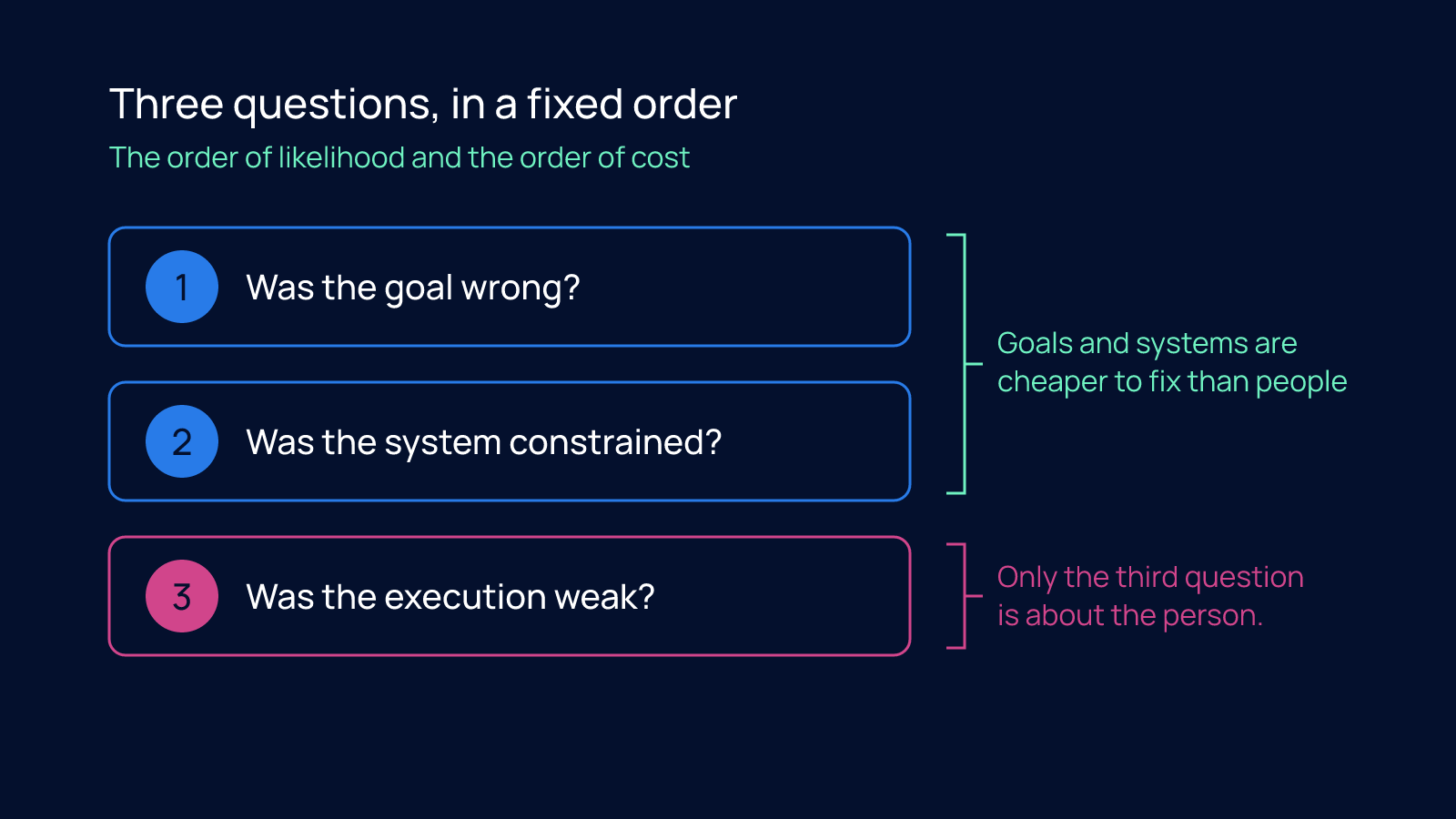
In Edge8's own practice, every review of a missed number runs through three questions, and they run in a fixed order:
-
Was the goal wrong? Did we set a target that was never realistic, or that pointed at the wrong thing? Goals get set in a planning session months earlier by people with less information than the room has today. Plenty of misses are the goal being wrong, and if you skip this question you will coach someone to hit a number that should never have existed.
-
Was the system constrained? Did the person have what they needed? Was the handoff from the previous team late? Was the tool broken? Was the agent upstream feeding them bad leads? A great salesperson with an empty pipeline misses. That is not a sales problem. It is a pipeline problem wearing a sales number.
-
Was the execution weak? Only now, after the first two questions have been honestly answered, do you ask whether the person did the work well.
Only the third question is about the person. The order matters because it is the order of likelihood and the order of cost. Goals and systems are cheaper to fix than people, and in my experience they are more often the cause. Asking about the person first is how you end up with a team that is very good at explaining and very bad at reporting.
Notice what the order does to the room. If the first thing the founder asks is "was the goal wrong," the person with the red number exhales. They are not on trial yet. They can tell you what they actually saw.
Myth four: when it is the person, the conversation looks back
Sometimes the honest answer to the third question is yes. The goal was fair, the system was fine, and the execution was weak. That is a real conversation and it needs to happen.
It just does not need to happen as an autopsy.
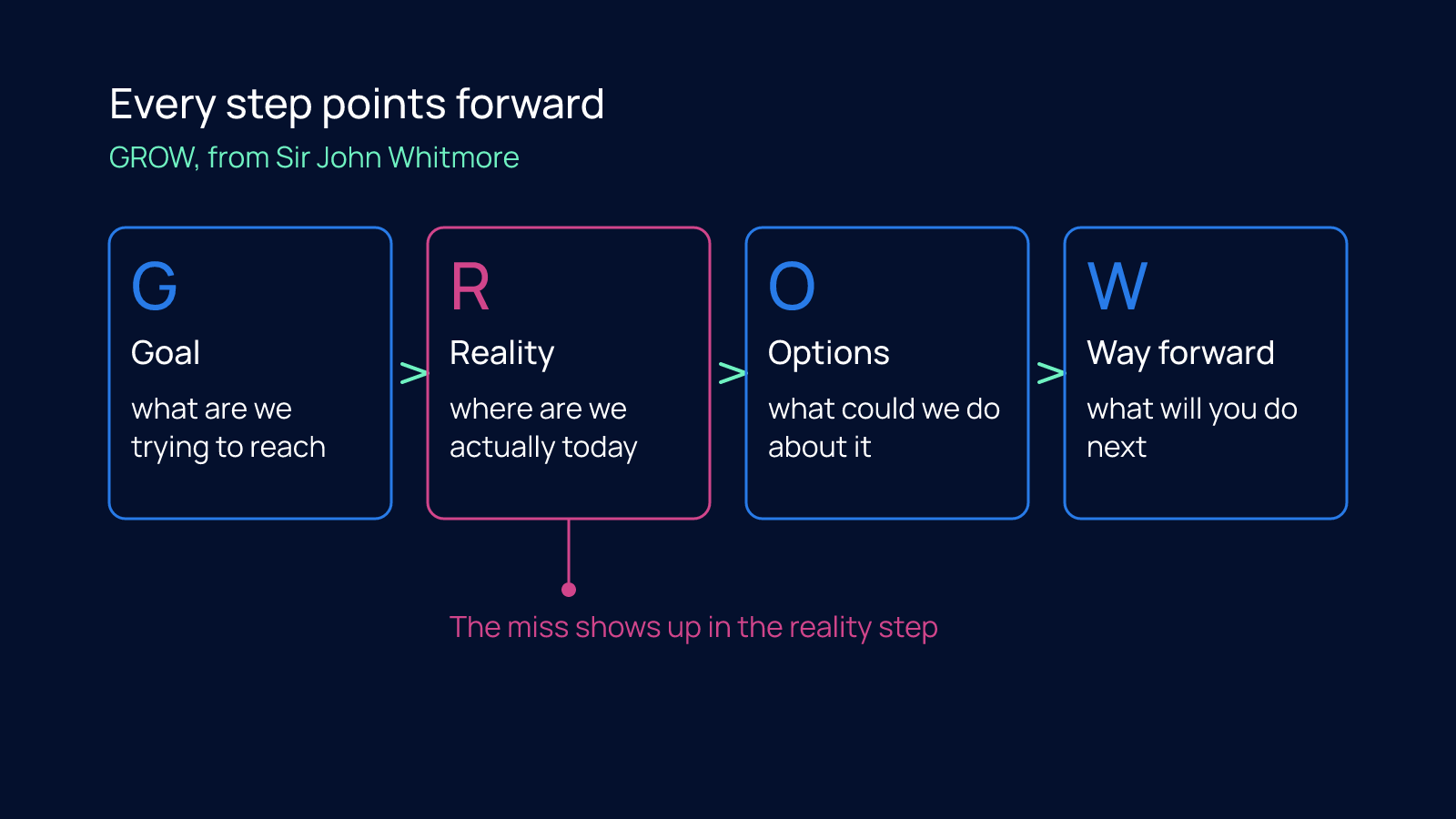
The shape that conversation takes in our company is GROW, from Sir John Whitmore. Goal, reality, options, way forward. In plain words: what are we trying to reach, where are we actually today, what could we do about it, and what will you do next. Every step points forward. The miss shows up in the reality step, as a fact about today, not as a charge sheet about last month.
Run on GROW, the conversation about weak execution becomes a coaching conversation. The manager and the person leave with a next action instead of a grudge. That is the whole difference between a company that learns from misses and a company that collects them.
Myth five: every miss has a human behind it
This is the belief the old review process was built on, and it is the one that quietly stopped being true.
Here is Edge8's view of a company run this way: many of the misses are no longer human. If you have agents doing real work, and by agent I mean a piece of AI software that runs a job on its own, chasing invoices, qualifying leads, drafting the first follow-up, then some of your red numbers belong to an agent. The follow-up number missed because the agent's instructions told it to wait too long. The qualified-lead number missed because the agent was scoring on the wrong signal.
The old review process has no seat for that. You cannot put an agent on trial. You cannot ask it to feel bad. The only thing you can do with an agent that missed is the thing you should have been doing with people all along: treat the miss as data, ask the three questions, and fix the cause.
Was the goal wrong? Maybe the agent was given a target no set of instructions could hit. Was the system constrained? Maybe its inputs were stale. Was the execution weak? Then the fix is rewriting its instructions. Same questions, same order, different owner.
What the loop looks like in our own Company OS
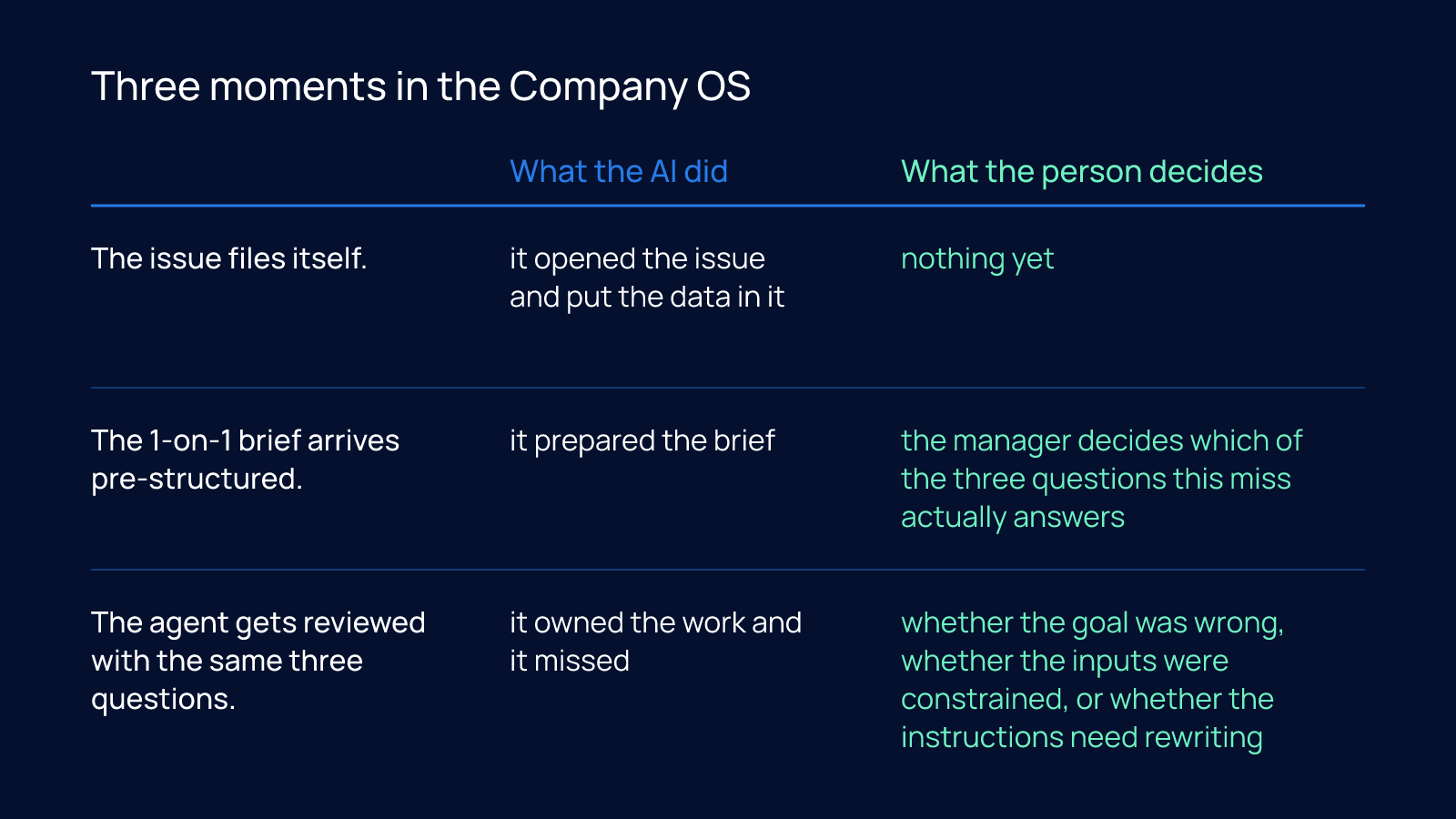
We run Edge8 on what we call a Company OS, the single system where our goals, issues, meetings and agents live, and the Day 28 film shows this loop running live in it. Three moments matter. For each one I will be precise about what the AI did and what the person still decides, because that is the pair of questions I want you to ask of every AI claim you hear.
The issue files itself. When a metric misses in the Monday sync, the miss is already filed as an issue with the numbers attached. What the AI did: it opened the issue and put the data in it. What the person decides: nothing yet, and that is the point. Nobody has to confess. Nobody has to decide how to frame it. The data walked in first, so the room starts with the facts instead of with someone's defense of the facts.
The 1-on-1 brief arrives pre-structured. If the miss belongs to a person, their manager's next 1-on-1 brief shows up with GROW already laid out and the miss already in the reality section, in context, next to what was agreed last time. What the AI did: it prepared the brief. What the person decides: the manager decides which of the three questions this miss actually answers, and the manager runs the conversation. The brief makes the meeting coaching rather than ambush. It does not make the meeting.
The agent gets reviewed with the same three questions. When the issue's owner is an agent, the review runs exactly the same way. The miss is data. The questions run in order. What the AI did: it owned the work and it missed. What the person decides: whether the goal was wrong, whether the inputs were constrained, or whether the instructions need rewriting. Sometimes the fix is coaching a person. Sometimes it is rewriting an agent's instructions. Sometimes it is moving the work from one to the other, because the agent should never have had it, or because the person should not.
None of those decisions belong to the software. All of them belong to a person looking at the data the software put in front of them.
Reviews as tuning, not trials
When misses are data, reviews stop being trials and become tuning, and people, agents and goals are corrected back toward the same strategy every cycle.
Put the five myths side by side and you can see what they have in common. Every one of them turns the review into a trial. Trials need a defendant, a verdict and a sentence, and the people in the room arrange themselves accordingly. The truth is the first casualty.
When misses are data, reviews stop being trials and become tuning. Every cycle, the goals get corrected, the systems get unblocked, the people get coached and the agents get rewritten, and all of them get pulled back toward the same strategy. Nobody is on trial. Something is being adjusted. The room stays loud, because the room has nothing to hide.
That is Day 28. Day 29 is where the season stops describing the loop and shows its own numbers: what we set out to hit, what we hit, and what we missed. Those are the receipts, and after this post you will know exactly how to read them.
Next step: watch the Day 28 film and look at the quiet room from the other side of the table. Then reply to this post with the last number that went quiet in one of your reviews. If you want to see the issue, the brief and the agent review running on your own numbers, say so in the reply and we will set up a demo.
FAQ
How do I review a missed number without blame so my team tells me the truth early instead of rehearsing excuses around the table?
Treat the miss as data instead of a verdict, and run every review of a missed number through three questions in a fixed order: was the goal wrong, was the system constrained, was the execution weak. Only the third question is about the person, so the owner of the red number is not on trial until the cheaper causes have been ruled out. Amy Edmondson at Harvard studied this for decades and found that teams that feel safe reporting mistakes learn faster, because the mistakes surface while they are still cheap.
Why does my team hide bad news until it is too late to fix?
Blame does make people careful, but only about what they tell you: they round the bad news down, lead with the external cause and mention the deal that is basically closed, so the truth arrives last and arrives expensive. Most companies get the review wrong because of five beliefs that sound like discipline, and the first is that making the room uncomfortable buys attention. Edmondson's research, built over decades at Harvard, shows the opposite: people report mistakes in proportion to how safe it is to report them.
What questions should I ask when someone on my team misses their target?
Ask three questions, always in the same order. First, was the goal wrong, because targets get set months earlier by people with less information than the room has today. Second, was the system constrained, meaning a late handoff, a broken tool or bad leads upstream. Third, and only after the first two have been honestly answered, was the execution weak; goals and systems are cheaper to fix than people and are more often the cause.
How do I turn a conversation about weak execution into coaching instead of an autopsy?
When the honest answer to the third question is yes, run the conversation on GROW from Sir John Whitmore: goal, reality, options, way forward. The miss shows up in the reality step as a fact about today, not as a charge sheet about last month, so every step points forward and the manager and the person leave with a next action instead of a grudge. In a company run on one system, the manager's next one-on-one brief can arrive with GROW already laid out and the miss already in the reality section, next to what was agreed last time.
How do I review an AI agent that missed its number?
Exactly the same way you review a person: the miss is data, and the same three questions run in the same order. Was the goal wrong, meaning the agent was given a target no instructions could hit; was the system constrained, meaning its inputs were stale; or was the execution weak, in which case the fix is rewriting its instructions. In a company where agents do real work, many of the misses are no longer human, and the person still decides whether to coach someone, rewrite the agent or move the work from one to the other.