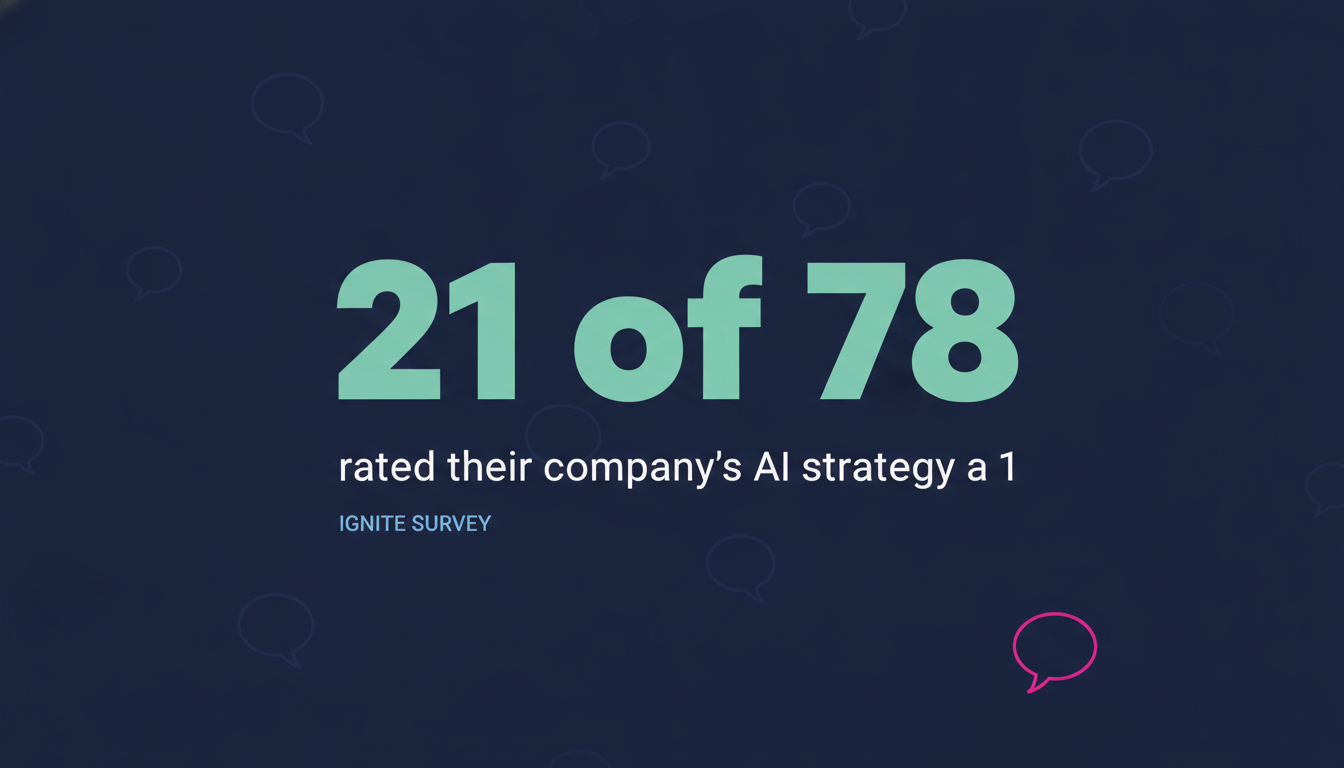
Twenty-one of them gave it a 1.
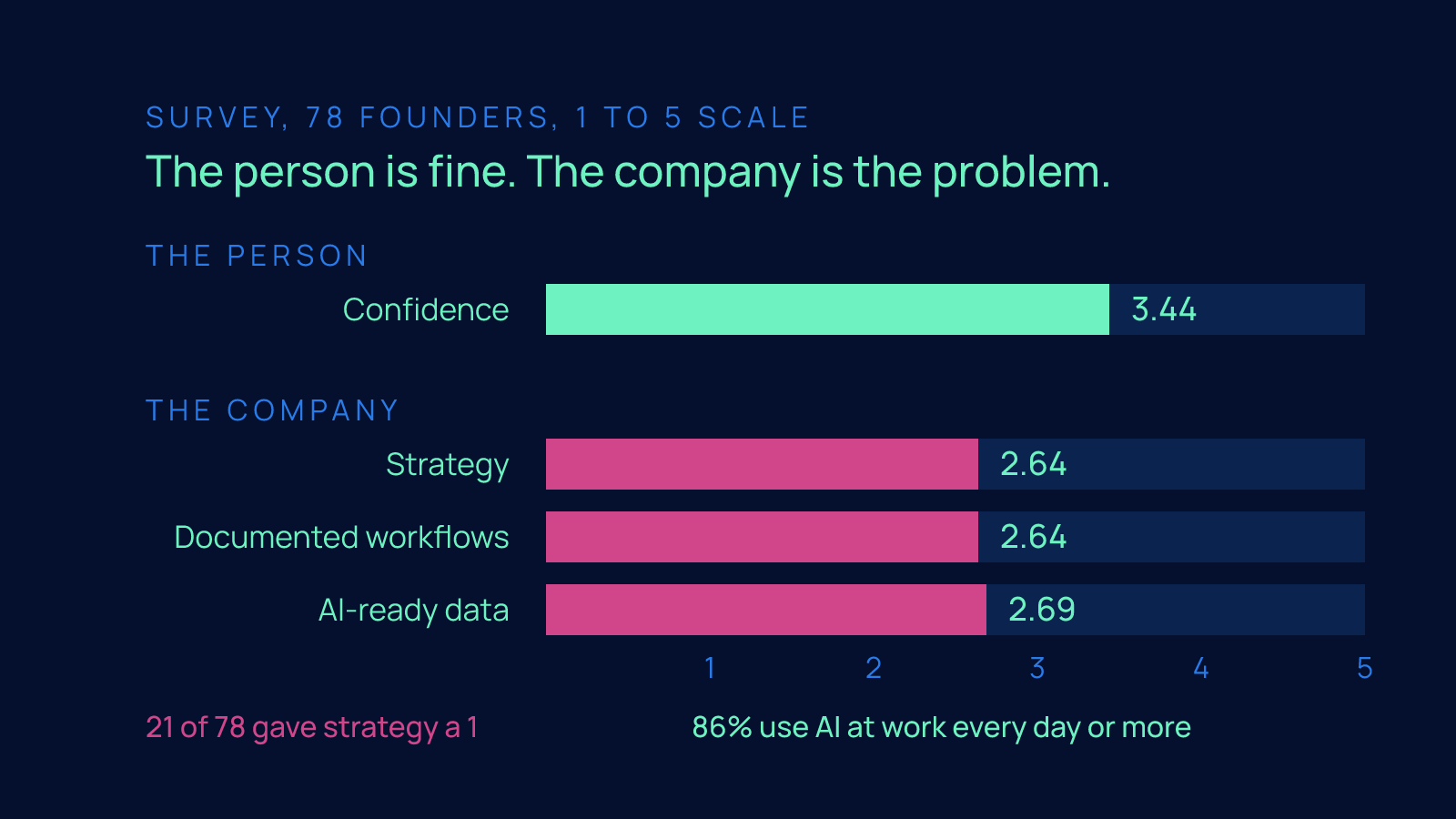
At EO South Pacific Ignite in Sydney on 18 October, 78 founders and operators filled in our survey before the workshop started. One question asked them to rate their company's AI strategy from 1 to 5. 21 of them wrote down a 1. The average across the room was 2.64.
Same room, same survey, one question earlier: 86% of them use AI at work every day or more.
Read those two numbers together and you have the whole problem. These are not people who are behind on AI. They are in Claude and ChatGPT before their first coffee, and they are reasonably confident in it: they rated their own confidence 3.44 out of 5. The moment you ask about the company instead of the person, the number falls off a cliff. Strategy 2.64. Documented workflows 2.64. AI-ready data 2.69.
The person is fine. The company is the problem. The rest of this post is the evidence and the fix.
Who was actually in the room
This matters, because it was not an AI crowd. People came to Ignite for a conference, not for an AI workshop, and it was the most diverse room we have taught under Infinite Leverage, the retreat we run the workshop under.
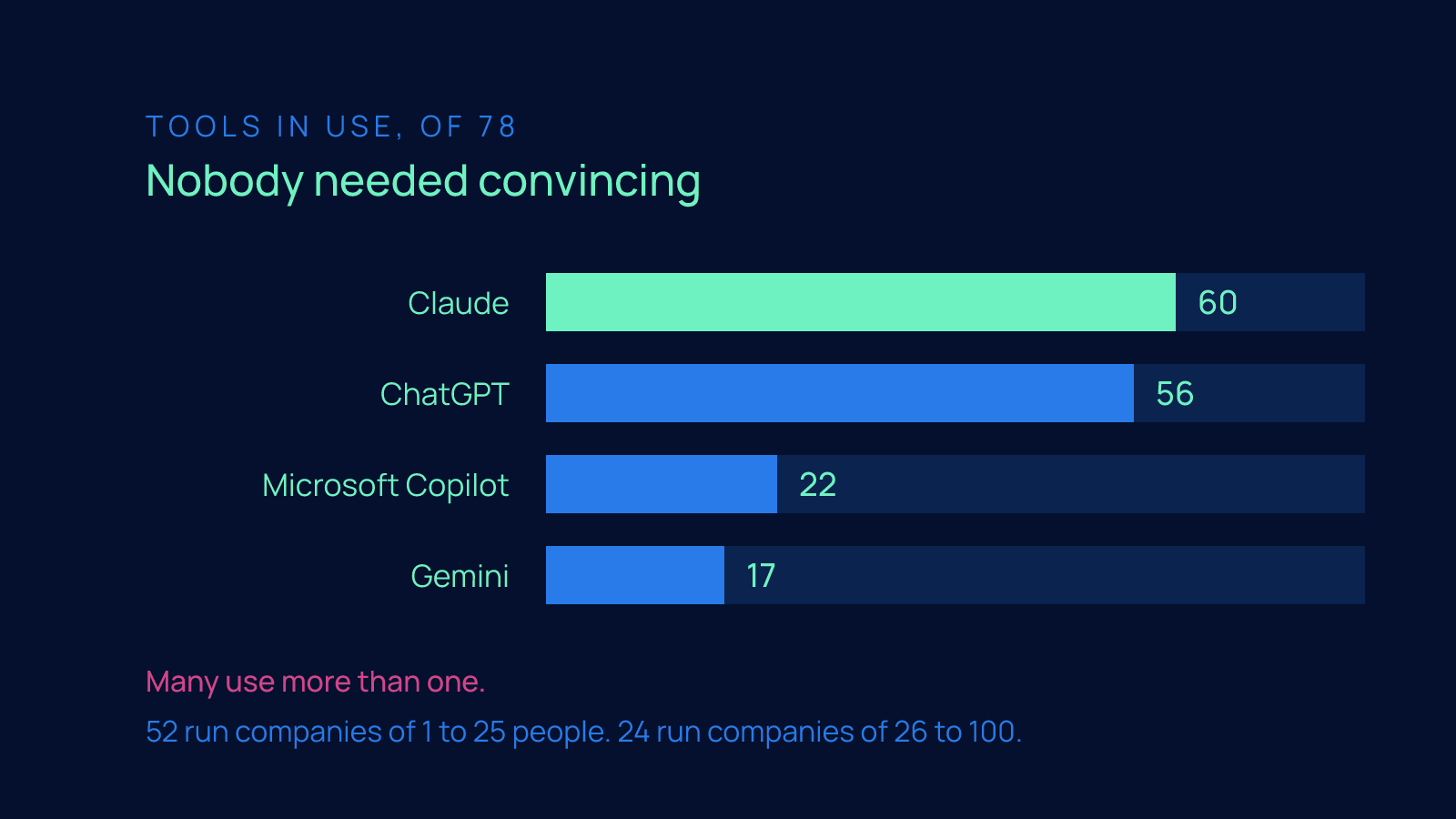
Of the 78, 52 run companies of 1 to 25 people and 24 run companies of 26 to 100. Construction and trades was the largest group, then property, professional services, marketing agencies, healthcare and retail. Businesses with crews, sites, clients, patients and inventory. Real operations, not software companies.
The tools tell the same story. 60 use Claude, 56 use ChatGPT, 22 use Microsoft Copilot, 17 use Gemini, and many use more than one. Nobody needed convincing that AI is useful. They had already decided that for themselves, one person at a time.
That phrase, one person at a time, is the cause of everything that follows.
This is the normal state, not a failure
everyone built their own tools on their own copies of the data, so nothing compounds and the data is never organised enough for AI to work.
A 1 on strategy next to daily use is not a failure. It is the normal state of a small company in 2026, and it has a specific cause. Here is the sequence, and I would bet it is yours.
Someone on the team tries a chatbot. It works. They use it for emails, then quotes, then meeting summaries. They build a custom GPT or a Claude project, paste in some company documents to make it smarter, and now it is part of how they work. Across the office, a second person does the same thing with a different tool and different documents. Then a third. Six months later, everybody is using AI and the company itself has nothing: no shared way of working, no documented process, no data that any system could run on.
Everyone built their own tools on their own copies of the data. Nothing compounds. The work one person did to make their assistant useful is invisible to the next person. The company gets eleven personal productivity gains and zero company capability.
That is why the strategy score is a 1. Not because the founder never thought about AI. Because there was never anything central to have a strategy about.
The two things that click in every room
I have taught this to enough rooms to know the exact moments where the room goes quiet. There are two, and they happened again at Ignite.
1. AI does not work because the data is not organized
When a founder tells me "we tried AI for X and it was not good enough", the problem is almost never the model. The problem is what the model was given. Your customer list lives in a spreadsheet that three people have their own version of. Your job history is in email threads. Your pricing is in someone's head and partly in a PDF from two years ago.
An AI system can only work on what is in front of it. If the data is scattered, duplicated and half out of date, the output will be scattered, duplicated and half out of date, just faster. The 2.69 the room gave its own AI-ready data is the honest number. The AI was never going to outperform the data.
That is the first click: you do not have an AI problem, you have a data organization problem, and once the data is organized the AI mostly just works.
2. Personal GPTs built on copied data are a security risk
The second moment is less comfortable. When your people build their own assistants, they make them useful the same way everyone does: they copy company data in. Client details, contracts, financials, staff information. Now that data sits inside a personal account, under a personal login, in a tool the company does not administer and cannot see.
When that person leaves, the copy goes with them. When their account is compromised, the company's data is compromised. When a client asks what you do with their information, you genuinely do not know, because it is in eleven places you did not set up.
Nobody in the room had done this out of carelessness. They did it because it was the only way to make the tool useful. That is exactly the point: the behavior is rational, and the company structure made it the only option.
What founders actually want
The survey also asked people to write down their biggest pain point with AI. The answers grouped into a few clear themes, and the order of those themes tells you what to build first.
The largest theme was workflow automation. Not "help me understand AI" but "take this repeating piece of work off my desk". Quoting, follow-ups, reporting, onboarding, the same ten emails every week. Founders in trades and property businesses are not asking for a strategy document. They are asking for the hours back.
The second theme was "where do I start". This is the founder who has read enough to know they should be doing something structured and has no idea what the first step is, because every vendor's first step is "buy our thing".
The third theme was getting the team to use it the same way. This is the one that confirms the thesis. The founder already uses AI. Some of the team already uses AI. The pain is that everyone uses it differently, on different data, with different results, and there is no way to make it consistent.
Put those three together and you get a precise description of what is missing: a shared system, a plan for building it, and one set of data the whole team works from.
What the internet outage taught us
When the workshop's internet died, what survived was the lesson: a person with a chatbot is not a company with an AI system.
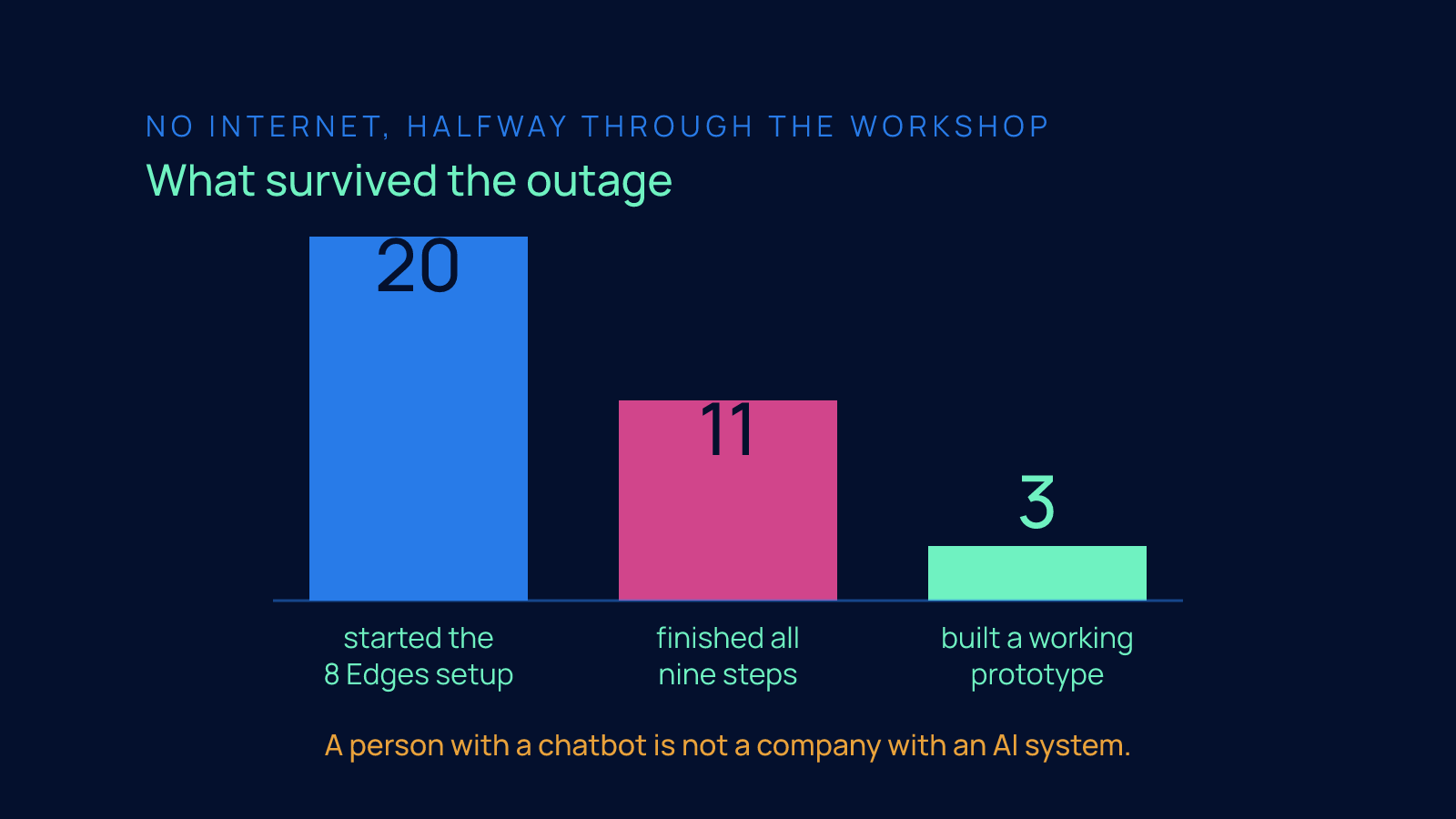
Halfway through the workshop, the venue's internet died.
For a hands-on AI session, that should have been the end of it. Instead it became the clearest demonstration of the day. 20 people had started the 8 Edges setup. 11 finished all nine steps. 3 built a working prototype, in a room with no connection, by working through the plan on paper and with whatever they had cached.
What survived the outage was not the chatbot. It was the structure: the steps, the plan, the decisions about what the business needs and what data goes where. A person with a chatbot and no internet has nothing. A person with a plan and a system design can keep building.
That is the line I keep coming back to. A person with a chatbot is not a company with an AI system. The chatbot is the least important part. The system is the part that lasts.
Manage for opportunity, not only for risk
One of the finance speakers at Ignite made a point I am going to paraphrase until we have the recording in hand: manage for opportunity, not only for risk.
Most AI advice aimed at small companies is risk advice. Do not paste client data into tools. Do not let staff build unsanctioned bots. Write a policy. All true, and all backwards if that is where you stop, because a policy that says "do not" with no system that says "do this instead" just pushes the behavior underground.
The opportunity side is the whole reason the room showed up. The same central data that closes the security hole is the data that makes workflow automation possible. Organize it once and you get both: the risk goes down and the capability goes up. You are not choosing between safety and leverage. You are choosing whether to build the thing that gives you both.
What an AI system actually is
Strip away the vendor language and an AI system for a small company is three things in one place.
Central data. One set of records for customers, jobs, people, pricing and documents that the company owns and administers. Not copies. The source.
Central workflows. The repeating work of the company written down as steps, so that a person or an AI can run them the same way every time. This is the documented-workflows score the room gave a 2.64. It is the part most founders skip because it feels like paperwork. It is the part that makes everything else work.
Integrations. The connections that let the data and the workflows talk to the tools you already use, so the automation runs where the work happens instead of in a separate window someone has to remember to open.
When those three live together, the thing compounds. One person's improvement to a workflow is everyone's improvement. New data makes every automation smarter. A new team member inherits the system instead of starting from a blank chat window.
When they live apart, in personal accounts and personal copies, you get exactly the survey: high personal use, low company capability.
What Edge8 does with founders who are done experimenting
The AI drafts, plans and builds; the founder decides what the business needs and owns what ships.
This is the work. Edge8 builds the system with the founder, from a plan, so the team works off one set of data.
The division of labor is specific, because every claim about AI should answer two questions: what did the AI just do, and what does the person still decide.
The AI drafts the plan from what you tell it about the business. The founder decides which parts of the business the plan is actually about.
The AI maps the workflows from your descriptions and your existing documents. The founder decides which workflow gets automated first and what "done right" looks like for it.
The AI builds the automations and the integrations. The founder tests them against real work, decides what ships, and owns it once it does.
At no point does the founder hand the company to a tool or to us. The founder decides what the business needs. We make sure the system gets built, in one place, on data the company owns, and we leave the founder running it.
A handful of people from the Ignite room installed 8 Edges or asked to work with us in the days after the workshop. That is the pattern every time: the people who move are not the ones who learned the most about AI. They are the ones who recognized their own 1 on the strategy question and decided it was a building problem, not a learning problem.
The next step
If your people use AI every day and your company would score a 1 or a 2 on strategy, workflows or data, you are in the normal state and you do not need another tool. You need the system.
If you were in the room and the outage beat you, the online make-up session on 30 October is where we finish the setup together.
Everyone else: reply to this post with three things. How many people are in the company, which AI tools your team already uses, and the one piece of repeating work you would automate first. I will tell you where to start and whether 8 Edges on your own, or building the system with Edge8, is the right fit. That is the conversation. Let's have it.
FAQ
How do I turn my team's daily AI use into a real company AI strategy when everyone has their own chatbot and their own copy of the data?
Start by accepting that the gap is normal: at EO South Pacific Ignite in Sydney, 86% of the 78 founders surveyed use AI at work every day or more, yet they rated their company's AI strategy 2.64 out of 5 and 21 of them gave it a 1. The cause is that each person built their own tools on their own copy of the data, so nothing compounds and the company gets eleven personal productivity gains and zero company capability. The fix is to put central data, central workflows and integrations in one place the company owns, so one person's improvement becomes everyone's. You do not need another tool, you need the system.
Why does AI give bad results when I point it at my own company's data?
Because the problem is almost never the model, it is what the model was given. The Ignite room rated its own AI-ready data 2.69 out of 5, and that is the honest number: the customer list lives in a spreadsheet three people have their own version of, job history sits in email threads, and pricing is partly in a PDF from two years ago. An AI system can only work on what is in front of it, so scattered and duplicated data produces scattered and duplicated output, just faster. Organize the data once and the AI mostly just works.
Is it a security risk when my staff paste company data into their own custom GPTs or Claude projects?
Yes, and it is the second thing that makes every room go quiet. Of the 78 founders surveyed at Ignite, 60 use Claude, 56 use ChatGPT, 22 use Microsoft Copilot and 17 use Gemini, and the way people make those tools useful is by copying in client details, contracts, financials and staff information. That data now sits in personal accounts the company does not administer and cannot see, so when a person leaves the copy goes with them, and when a client asks what you do with their information it is in eleven places you did not set up. Nobody does this out of carelessness; it is the rational move when the company has no shared system, which is why a policy that only says 'do not' pushes the behavior underground.
What does an AI system for a small business actually consist of, beyond a chatbot?
Three things in one place: central data (one set of records for customers, jobs, people, pricing and documents the company owns), central workflows (the repeating work written down as steps so a person or an AI runs it the same way every time), and integrations that connect both to the tools you already use. Documented workflows is the part most founders skip, and the Ignite room scored itself 2.64 out of 5 on it. When the venue's internet died halfway through the workshop, 20 people had started the setup, 11 finished all nine steps and 3 built a working prototype with no connection, because what survived was the plan and the structure, not the chatbot.
What do small business owners actually want AI to do first?
Take repeating work off their desk. Among the 78 founders and operators at Ignite, 52 run companies of 1 to 25 people and 24 run companies of 26 to 100, mostly in construction and trades, property, professional services, marketing agencies, healthcare and retail. Their largest pain-point theme was workflow automation: quoting, follow-ups, reporting, onboarding and the same ten emails every week. The second theme was where to start, and the third was getting the whole team to use AI the same way, which together describe exactly what is missing: a shared system, a plan for building it, and one set of data everyone works from.