You want your people building with AI. Sales wants a tool that drafts follow-ups from the pipeline. Finance wants one that flags invoices before they go stale. Ops wants a checklist that fills itself in from last week's numbers. Every one of those is a good idea, and every one of them scares you a little.
The picture in your head is specific: ten teams, ten tools, ten copies of the same customer. One tool says the deal closed. Another says it is still open. A third has the old email address. Nobody knows which one is true, and the person who finds out the hard way is you, in front of a customer or a board.
So you do one of two things. You say no, and your fastest people build in the shadows anyway, in spreadsheets and chat windows you never see. Or you say yes, and you spend next year paying someone to clean it up.
There is a third option. I run Edge8 on it. This post walks through it in five steps, so you can set it up for your company this week.
The fear is right, as long as every tool keeps its own data
Founders keep getting told that their fear of chaos is old-fashioned. It is not. The fear is correct.
When every tool keeps its own data, every tool becomes its own version of the truth. The sales tool has a customer record. The support tool has a customer record. The finance tool has a customer record. The day someone changes a phone number in one of them, the other two are wrong, and nobody gets a notification about that. The errors do not announce themselves. They just sit there until a decision lands on top of one.
That is what "ten copies of the same customer" actually costs. Not the storage. The arguments. The Monday meeting where two people hold up two different numbers and the hour goes to figuring out which one to believe. The AI tool that confidently answers a question from the stale copy.
So the fear is not the problem. The diagnosis is. Founders look at the chaos and conclude they have too many tools. They do not. They have too many places where the data lives.
The fix is not fewer tools. It is one database and one gate
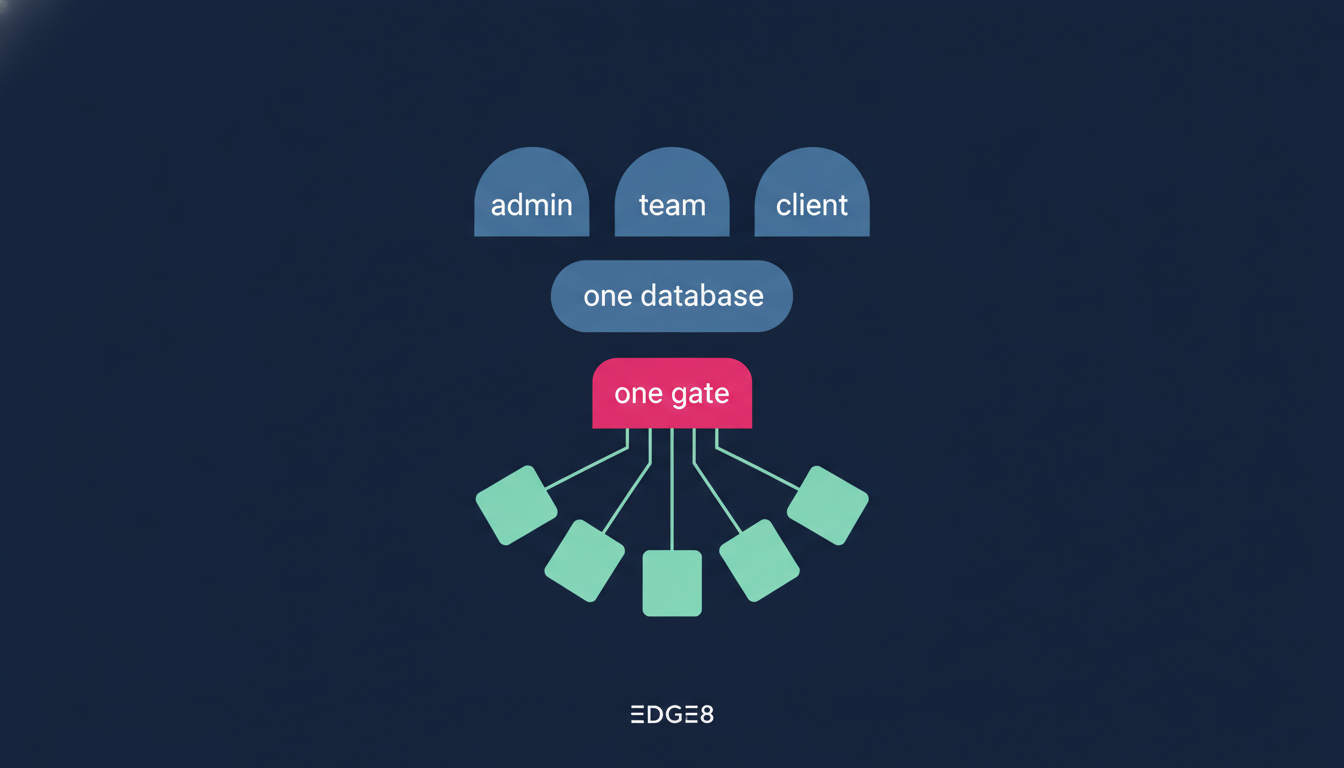
That fear is right when every tool keeps its own data. It goes away when everyone builds on one database, through one gate.
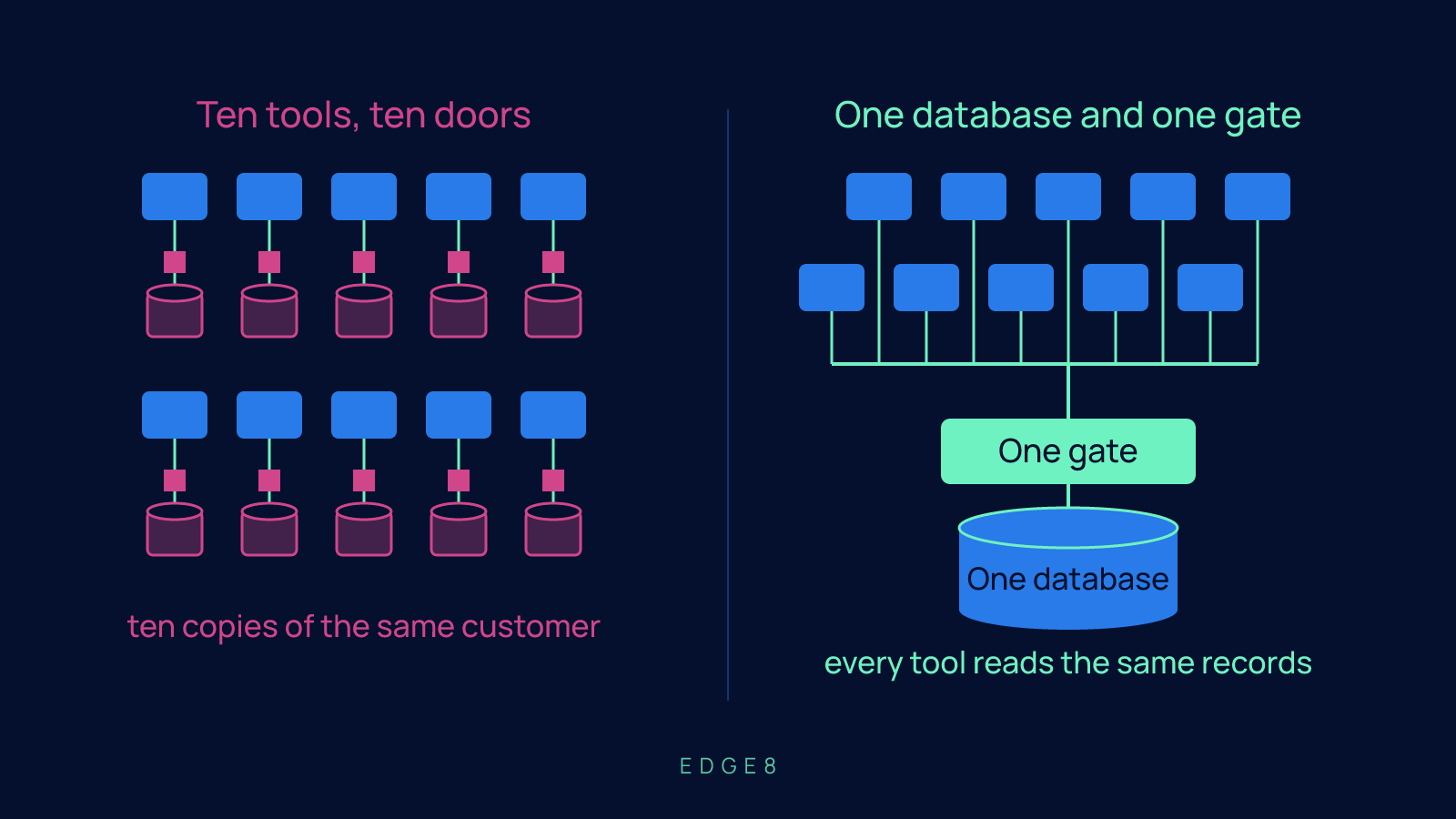
Here is the shift. Stop trying to control how many tools your teams build. Control where the data lives and how anything gets to it.
Two terms, defined in plain language, because I am going to use them for the rest of this post:
- One database. A single store where every company record lives: people, deals, goals, money. Not one per department. One, full stop.
- One gate. A single controlled entrance that every AI tool has to pass through to read or change that database. Not a separate door per app.
If those two things are true, the number of tools stops mattering. A team can build a tool on Tuesday and another on Thursday, and both are reading and writing the same records as everyone else. There is no second copy to drift.
That is the whole idea. The rest of this post is how it works in practice on Eight Edges, the open system I run Edge8 on, and how you can fork it for free.
Step 1: Put the whole company in one database
On Eight Edges, the whole company lives in one database: people, deals, goals and money.
That sentence is simple and it is the hardest step, because it means you stop treating your CRM, your task tool, your goals spreadsheet and your books as four separate worlds that occasionally sync. They are four views of the same company, so they sit in the same place.
What changes for you as a founder is that there is finally one answer to "what does this customer look like right now." Not the sales answer and the finance answer. One answer, and every team and every tool reads it.
If you have already done this, the next four steps are fast. If you have not, this is where you start, and everything else waits.
Step 2: Give everyone one of three doors, and show them only what they should see
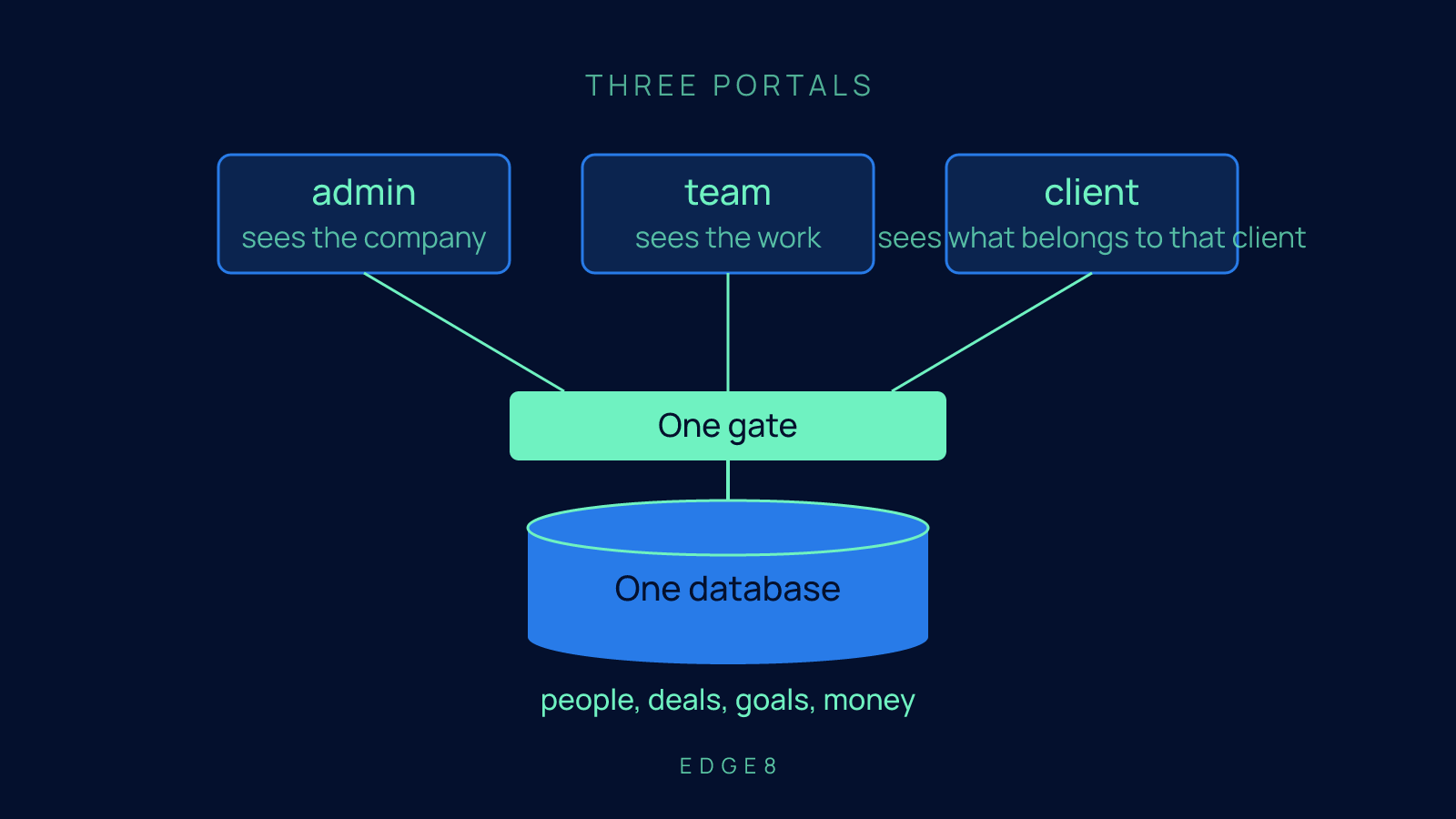
One database does not mean everyone sees everything. That is the second fear founders raise, right after chaos: "If it is all in one place, does my newest person see payroll?"
No. On Eight Edges, everyone signs in through one of three portals: admin, team, or client. Each portal shows a person exactly what they should see and nothing more. The admin portal sees the company. The team portal sees the work. The client portal sees what belongs to that client.
The point is that access is decided at the door, once, instead of being re-decided inside every tool a team builds. When a team ships a new tool, it inherits the door. Nobody has to remember to lock it.
Step 3: Let a team describe the tool it needs in plain English
A team describes the tool it needs in plain English, and Claude Code builds it on the same database, so the new tool reads the same records everyone else uses.
This is the part founders find hard to believe until they watch it happen.
A team describes the tool it needs in plain English. "We need a view that shows every deal that has not had a touch in ten days, with the last note and the owner." Then Claude Code builds it. Claude Code is an AI coding tool from Anthropic: you give it an instruction in ordinary language and it writes and runs the code.
The part that matters for you is not that AI wrote the code. It is where it wrote it. Claude Code builds the tool on the same database everyone else uses, so the new tool reads the same records as every other tool in the company. It does not create its own list of deals. It does not export a copy. It points at the one source and shows it a new way.
That is how you get speed without sprawl. The sales team gets its tool this week. Finance gets its tool next week. Neither one adds a copy of anything.
Step 4: Route every AI request through one gate
Now the security question, because it is the right one to ask.
On Eight Edges, AI reaches the data through one gate in front of that one database, not a separate door per app. I wrote about why in Many Doors or One Gate, and the short version is this: every tool that opens its own connection to your data is a door you have to watch. Ten tools, ten doors. The eleventh is the one nobody remembers to check.
One gate means there is one place where access is enforced, one place to look when you want to know what touched the data, and one place to shut if something goes wrong. The tools multiply. The doors do not.
Step 5: Have a person who can read the change review it before it goes live
The last step is the one that keeps the whole thing honest.
Before a new tool or a change to an existing one goes live, a person who can read the change reviews it. Not a committee. Not a six-week approval chain. One person who understands what the code does, looking at it before it runs against the company's records.
This is where I will take a position some people will not like: the plain-English step does not remove the need for someone technical. It changes what that person does. Instead of building every tool by hand, they read what the AI built and decide whether it is safe. That is a smaller job, and it is a different job, and your company still needs someone who can do it. If you do not have that person today, that is the gap to close first, not the tooling.
What you get as the founder
The point for a founder: every team builds faster, and you still have one version of the truth.
Put the five steps together and the fear you started with has nowhere to live.
- Every team builds faster, because the path from "we need a tool" to "we have a tool" is a plain-English description and a review.
- You still have one version of the truth, because every tool reads the same records through the same gate.
- Access is set once at the door, so new tools do not quietly widen who sees what.
- A human checks every change before it touches the company.
You are no longer choosing between letting people build and keeping the data clean. You get both, and the second one does not depend on anyone being careful.
Proof: this is how Edge8 runs
I am not describing a diagram. Edge8 runs its own company this way, on Eight Edges, with one database, three portals, one gate and a review before anything goes live. Our people, deals, goals and money sit in that one database today.
I am not going to dress that up with a results table. Anything I told you here would be self-reported, and you should treat it that way. The honest proof is that we fork our own system and build our own tools on it, and we are willing to hand you the same code.
How to start this week
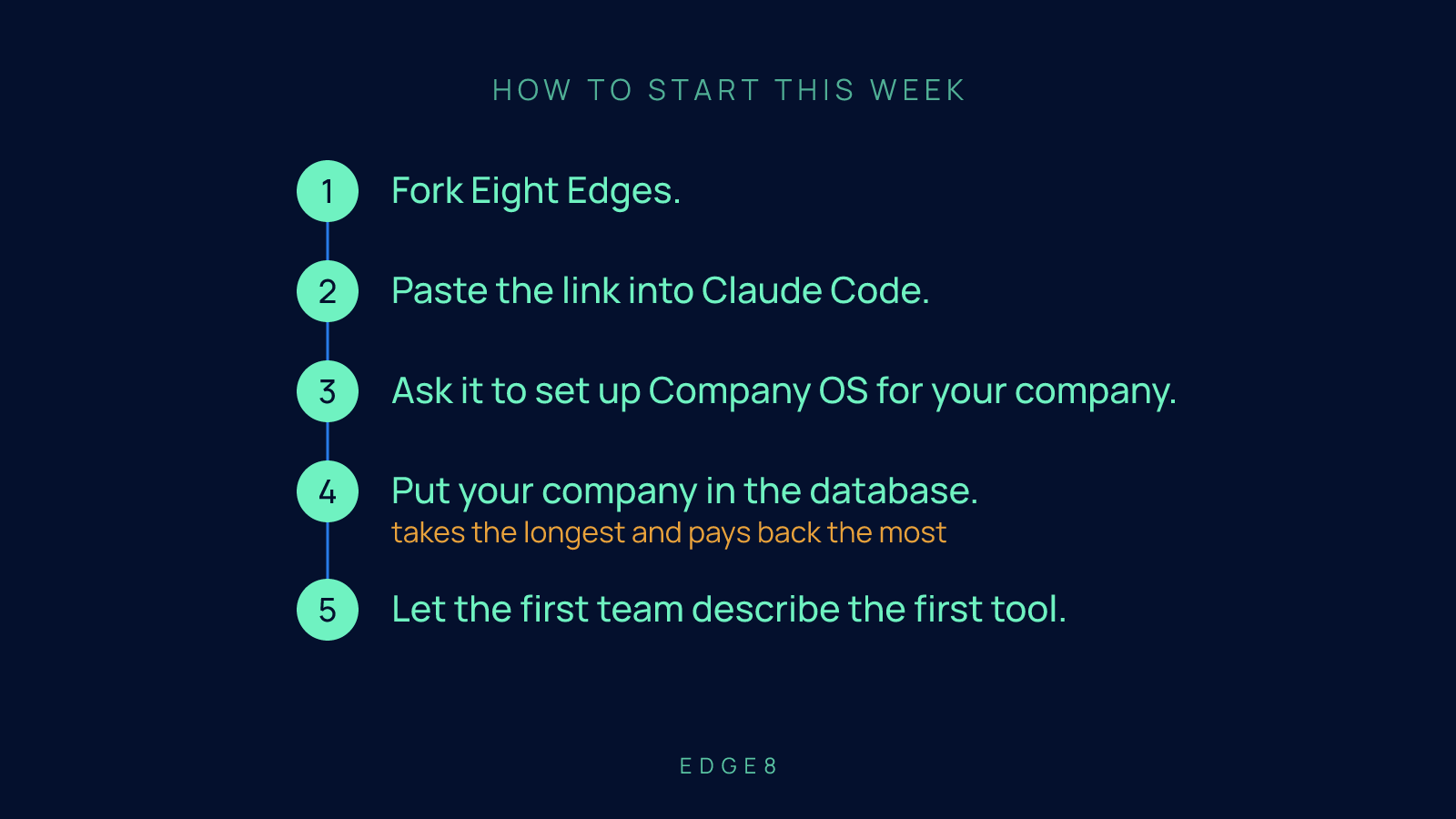
The system is free and open on GitHub. Here is the whole process.
- Fork Eight Edges. A fork is a copy of a codebase that you own and can change without affecting the original. Go to the Eight Edges fork on GitHub and fork it for your company.
- Paste the link into Claude Code. Open Claude Code and give it the link to your fork.
- Ask it to set up Company OS for your company. In plain English. That is the instruction.
- Put your company in the database. People, deals, goals, money. This is the step that takes the longest and pays back the most.
- Let the first team describe the first tool. Pick the team with the loudest need. Have them write what they want in a paragraph. Let Claude Code build it, have your reviewer read it, then ship it.
You will know it worked when the second team asks for a tool and nobody in the room flinches.
The next step
Fork Eight Edges free for your company from GitHub, paste the link into Claude Code, and ask it to set up Company OS.
And if the part you are missing is the person in Step 5, the one who can read the change before it goes live, reply and tell me about the roles you actually need.
FAQ
How do I let every team build its own AI tools without ending up with ten copies of the same customer and nobody knowing which one is true?
Stop trying to limit how many tools your teams build and instead control where the data lives and how anything reaches it. The setup is five steps: put the whole company (people, deals, goals and money) in one database, give everyone one of three portals, let teams describe tools in plain English, route every AI request through one gate, and have a person who can read the change review it before it goes live. Once every tool reads and writes the same records through the same gate, there is no second copy to drift, so the number of tools stops mattering. You can set it up for your company this week.
If I put my whole company in one database, does my newest hire see payroll?
No. One database does not mean everyone sees everything. Everyone signs in through one of three portals, admin, team or client, and each shows a person exactly what they should see and nothing more: the admin portal sees the company, the team portal sees the work, the client portal sees what belongs to that client. Access is decided once at the door, so when a team ships a new tool it inherits that door and nobody has to remember to lock it.
Can my sales team build its own AI tool without a developer writing the code from scratch?
Yes. The team describes the tool in plain English, for example a view showing every deal that has not had a touch in ten days with the last note and the owner, and Claude Code, an AI coding tool from Anthropic, writes and runs the code. The part that matters is where it builds: on the same one database everyone else uses, so the new tool points at the one source instead of creating its own list of deals or exporting a copy. Sales gets its tool this week, finance gets its tool next week, and neither adds a copy of anything.
Do I still need a technical person if AI writes the code for my team's tools?
Yes, and that is the step that keeps the whole thing honest. Of the five steps, the last is that a person who can read the change reviews it before it goes live: not a committee and not a six-week approval chain, one person who understands what the code does. The plain-English step does not remove the need for someone technical, it changes the job from building every tool by hand to reading what the AI built and deciding whether it is safe. If you do not have that person today, that is the gap to close first, not the tooling.
What is the fastest way to start letting my teams build AI tools on shared company data this week?
Fork the free open system from GitHub, paste the link into Claude Code, and ask it in plain English to set up a company operating system for your business. Then put your company in the one database, people, deals, goals and money, which is the step that takes the longest and pays back the most, and let the team with the loudest need describe the first tool in a paragraph. The whole process is five steps, and you will know it worked when the second team asks for a tool and nobody in the room flinches.