top of page

Open-Weight AI Models Transform Enterprise Data Security and Computing Independence

  • Writer: David Hajdu
    David Hajdu
  • Aug 6
  • 5 min read

Updated: Aug 22

90% of enterprise AI implementations send sensitive data to external servers, creating compliance risks and ongoing costs. OpenAI's new open-weight models (gpt-oss-120b and gpt-oss-20b) eliminate these risks by running entirely on local infrastructure. Companies can now achieve enterprise-grade AI capabilities without data transmission or recurring API fees.

The implications extend far beyond technical specifications. For the first time since the cloud computing revolution began, enterprises have a viable path to AI independence that doesn't compromise on capability or increase operational complexity.


The Strategic Imperative Behind Local AI Processing

Enterprise leaders face an impossible choice between AI capabilities and data security. This false dichotomy has prevented countless organizations from fully embracing AI transformation. Cloud-based AI services require sending sensitive information to external servers, creating compliance nightmares and exposing organizations to data breaches.

Open-weight models dissolve this barrier entirely. Healthcare organizations can analyze patient records for treatment optimization. Financial institutions process confidential documents without regulatory concerns. Legal firms review sensitive cases while maintaining attorney-client privilege. The smaller 20b model runs on consumer hardware while matching o3-mini's coding and reasoning performance.

Strategic AI planning often proves more valuable than first-mover advantage when implementing these advanced capabilities. Organizations that establish local AI capabilities now position themselves advantageously for future developments in the space.


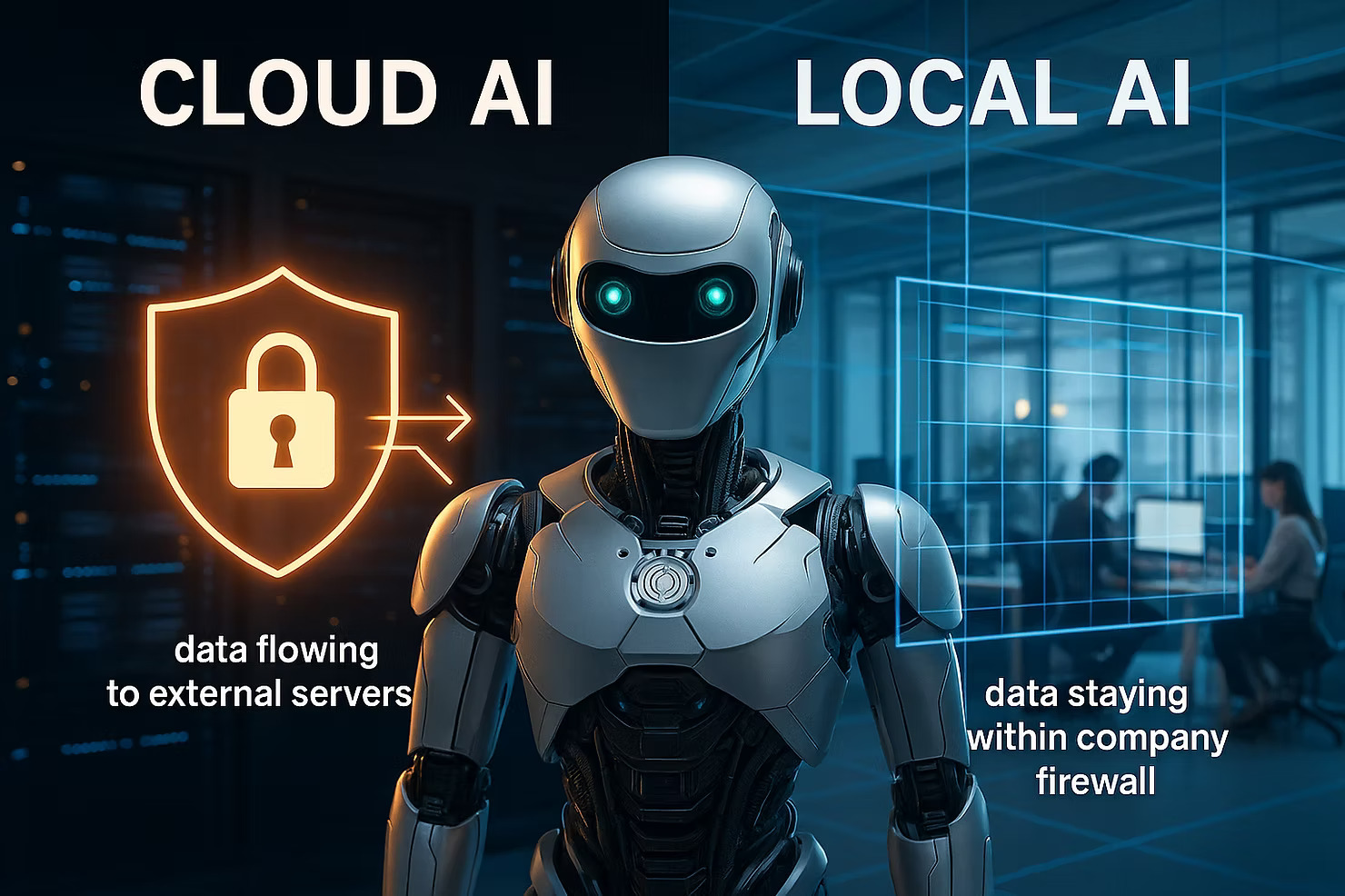
Comparison showing data flowing to external cloud servers versus secure local AI processing within company infrastructure

Cloud AI (data flowing to external servers) vs. Local AI (data staying within company firewall)


Economic Impact and Cost Structure Transformation

Organizations typically spend $50,000+ annually on cloud AI services with usage-based pricing. Open-weight models require only one-time hardware investment and setup costs. Companies processing large data volumes can reduce AI costs to near-zero operational expenses after initial implementation.

The economic advantages extend beyond immediate cost savings. Unlike cloud services that scale costs with usage, local AI processing creates predictable operational expenses. A mid-size enterprise currently spending $50,000 annually on cloud AI services could reduce these costs to electricity expenses after initial setup.

Cost comparison for high-volume processing:

  • Cloud AI services: $2,000-5,000 monthly recurring

  • Open-weight models: $0 after setup (electricity only)

  • Annual savings: $24,000-60,000 per organization


Transformative Applications Across Industries

Healthcare analytics represents the most immediate application for privacy-focused AI processing. Patient record analysis, treatment pattern identification, and care delivery optimization can occur entirely within hospital security perimeters. Zero external data transmission eliminates HIPAA compliance complications while enabling advanced analytics.

Venture capital firms gain unprecedented advantages in deal flow analysis. Confidential financial data and proprietary business information remain within secure environments. Manufacturing companies optimize production processes using operational data that never leaves their facilities. Executive communication and video processing capabilities remain fully functional regardless of internet connectivity.

The hospitality industry benefits significantly from AI-powered personalization that respects privacy by design. Hotels can leverage guest data for tailored experiences without exposing personally identifiable information to third-party servers.


Implementation Strategy for Enterprise Success

Technical deployment requires 2-4 weeks for most organizations with dedicated IT support. Model installation, system integration, and staff training represent the primary implementation phases. Organizations without strong technical teams benefit from external consulting support during initial deployment.

Hardware requirements scale with organizational needs:

  • Small teams (1-10 users): MacBook Pro M2/M3 with 16GB RAM

  • Medium businesses (10-50 users): Dedicated server with 32GB RAM

  • Enterprise (50+ users): Multiple servers with 64GB+ RAM each

Security frameworks must evolve to accommodate local AI processing. IT teams need training on model deployment, monitoring, and maintenance procedures. Change management becomes crucial as employees adapt to AI-powered workflows that operate independently of cloud services.


Performance Benchmarks and Capability Assessment

The 120b model approaches GPT-4 performance levels for most business applications. Document analysis, code generation, and data processing show particularly strong results compared to cloud alternatives. Performance varies by use case, with coding and analysis tasks demonstrating the strongest alignment with business needs.

Enterprise applications where open-weight models excel include:

  • Document analysis and summarization with complete privacy

  • Code generation and debugging without external exposure

  • Data analysis and reporting using sensitive information

  • Customer service automation with proprietary knowledge

  • Content creation and editing for internal communications

  • AI-powered executive communications and video processing

Local deployment enables organizations to fine-tune models using proprietary data without external exposure.Custom model training uses internal data to improve accuracy for specific business contexts while maintaining complete control over intellectual property.


Security Architecture and Risk Mitigation

Local AI processing eliminates the primary attack vector for AI-related data breaches. All processing occurs within existing security perimeters, reducing compliance audit complexity significantly. IT teams maintain complete control over data access, processing, and storage without external dependencies.

Security advantages include:

  • Elimination of external API keys and authentication tokens

  • Zero data-in-transit vulnerabilities for AI processing

  • Simplified compliance reporting and regulatory auditing

  • Complete organizational control over model updates and modifications

Air-gapped AI processing creates unique value propositions for government contractors and regulated industries.Organizations can offer AI features that work seamlessly in high-security environments where internet access is restricted or prohibited.


Operational Excellence and Business Continuity

Remote work scenarios benefit significantly from offline AI capabilities. Sales teams maintain AI support during client visits. Consultants access analytical tools in client facilities. Traveling executives preserve productivity without cloud dependency. Field operations maintain full AI capabilities regardless of internet connectivity quality.

Business continuity planning improves dramatically with local AI processing. Internet outages, cloud service disruptions, and connectivity issues no longer impact AI-powered business processes. Organizations can maintain operational efficiency during infrastructure challenges that affect cloud-dependent competitors.


Future-Proofing Enterprise AI Strategy

Market trends strongly support AI independence initiatives. Increasing data privacy regulations globally create compliance advantages for organizations with local processing capabilities. Growing cybersecurity threats to cloud services make local AI processing a risk mitigation strategy beyond just a cost optimization.

Strategic advantages compound over time. Organizations that establish local AI capabilities can develop proprietary models and customizations that create lasting competitive advantages. Companies can be tech-forward by developing internal AI expertise that builds institutional knowledge and reduces vendor dependency.

As regulatory requirements tighten and data privacy concerns intensify, companies with proven local AI implementations will maintain competitive advantages over cloud-dependent alternatives. The strategic value extends beyond immediate operational benefits to include reduced vendor lock-in risks and greater control over AI development roadmaps.

Ready to implement secure, private AI solutions that reduce costs while enhancing data control? Open-weight models offer unprecedented opportunities for businesses to achieve AI independence without sacrificing performance or operational efficiency.

Schedule a consultation about private AI implementation to discover how your organization can benefit from these revolutionary developments while reducing operational costs by up to 90%.


Frequently Asked Questions About Open-Weight AI Models

What are open-weight AI models?

Open-weight models are AI systems whose trained parameters are publicly available for download and use. Unlike cloud-based AI services, open-weight models run entirely on local hardware without internet connectivity requirements.

How do open-weight models differ from cloud-based AI services?

Cloud-based AI requires sending data to external servers for processing, while open-weight models run locally on your infrastructure. This provides better privacy, offline functionality, and eliminates usage fees, though may require more powerful local hardware.

What hardware investments are required for enterprise deployment?

Small teams need MacBook Pro-level hardware with 16GB+ RAM, while enterprises require dedicated servers with 32-64GB RAM. No specialized AI hardware is necessary for most business applications.

Can open-weight models match enterprise-grade cloud AI performance?

The 120b model approaches GPT-4 performance for most business applications. Document analysis, coding, and data processing show particularly strong results, though the largest cloud models may still offer advantages for highly complex tasks.

Which industries benefit most from private AI processing?

Healthcare, finance, legal, and government sectors see immediate benefits due to strict data privacy requirements. Any organization handling sensitive customer data or proprietary information gains significant competitive advantages.

How long does enterprise implementation typically require?

Most organizations complete implementation within 2-4 weeks with dedicated IT support. Timeline depends on integration complexity, hardware procurement, and staff training requirements.

What are the main limitations of open-weight models?

Open-weight models require more technical expertise for setup, need powerful local hardware, and don't receive automatic updates like cloud services. However, these limitations are often outweighed by security and cost benefits for enterprise applications.

How do ongoing costs compare to cloud AI services?

After initial setup, open-weight models have minimal ongoing costs (primarily electricity). Organizations typically save 80-90% compared to cloud AI services that charge per API call or usage volume.


Comments


bottom of page